June 2, 2026
The Hidden Cost of Standing Still in an Industry That Cannot Afford To
Every major technological shift in heavy industry begins the same way: a handful of early adopters demonstrate measurable gains, the economics become impossible to ignore, and the rest of the sector races to close the gap. The progression from steam-powered drilling to electrified underground haulage followed this pattern. So did the shift from manual survey techniques to GPS-guided precision positioning. Mining autonomous operations are now following the same arc, and the industry finds itself at an inflection point where the cost of inaction is rising faster than the cost of adoption.
The forces converging on modern mining operators are not temporary. They are structural, compounding, and, in many cases, accelerating. Understanding why autonomy has shifted from a competitive advantage to an operational necessity requires examining the underlying pressures reshaping the entire extractive industry.
When big ASX news breaks, our subscribers know first
Why the Mining Industry Can No Longer Delay the Automation Conversation
The business case for mining autonomous operations does not rest on a single factor. It emerges from the intersection of several simultaneous pressures that are fundamentally altering the economics of ore extraction. Furthermore, automation transformed mining in ways that make reverting to purely manual processes economically untenable for competitive operators.
Declining ore grades represent perhaps the most structurally significant driver. As surface-level, high-grade deposits are progressively exhausted, miners must pursue deeper, more geologically complex resources. Deeper operations increase exposure to heat, unstable ground conditions, poor ventilation, and elevated seismic risk, all of which create environments where human presence introduces both safety liability and productivity constraints. Autonomous systems, by contrast, can operate continuously in environments that would require human operators to rotate out every few hours.
Remote and hazardous operating environments compound these cost pressures. Fly-in, fly-out workforce models in remote regions carry substantial logistical overhead, from accommodation and transport to fatigue management and emergency response infrastructure. Replacing or supplementing human operators with autonomous systems in these contexts does not merely improve productivity — it restructures the cost base entirely.
Beyond the physical environment, regulatory frameworks governing worker safety and environmental compliance are tightening across major mining jurisdictions. The combination of stricter exposure limits, mandatory proximity detection requirements, and increasing scrutiny of dust, noise, and vibration hazards is making the human-operated mine progressively harder to run within regulatory parameters. Autonomous systems inherently remove workers from the most hazardous exposure points.
Finally, global demand for critical minerals used in battery technology, grid infrastructure, and semiconductor manufacturing is placing upward pressure on throughput requirements. Meeting this demand within existing operational footprints requires higher utilisation rates and more consistent production cycles than human-operated fleets can reliably deliver.
Where the Industry Actually Stands: Penetration Rates and What They Reveal
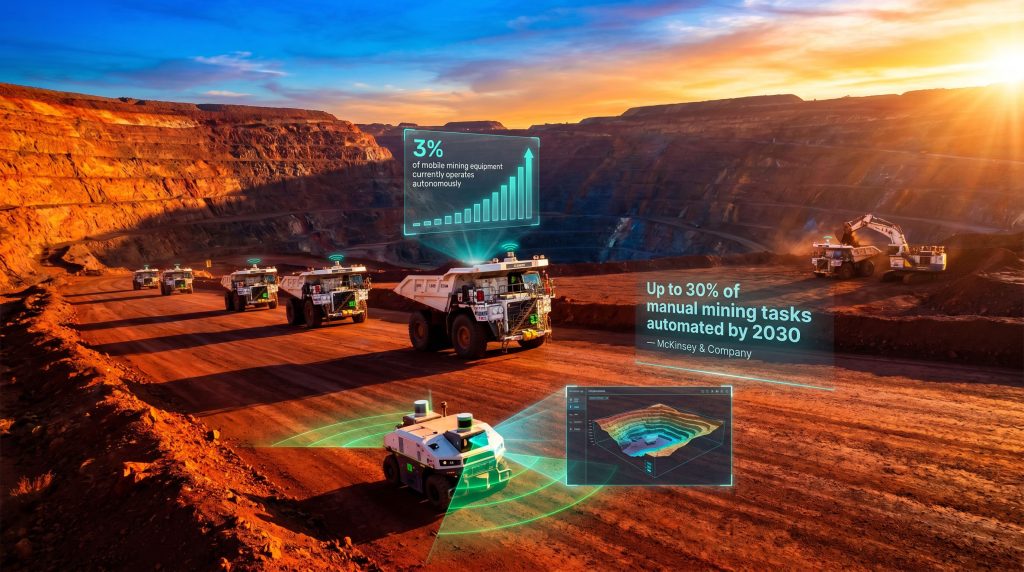
Despite the compelling business case, the current state of autonomous deployment in mining is far more modest than industry rhetoric might suggest. As of recent industry assessments, approximately 3% of mobile mining equipment operates autonomously — a figure that simultaneously reflects the proven commercial viability of the technology and the enormous deployment gap that still exists across the broader industry.
This low penetration rate is not primarily a technology problem. Autonomous haul trucks, drills, and inspection systems have been commercially validated at scale. Caterpillar's autonomous haulage fleet had accumulated over 4 billion tonnes of material moved and more than 145 million kilometres of operation by 2021. Rio Tinto's autonomous truck program transported in excess of 200 million metric tonnes of iron ore across its Pilbara operations over a six-year deployment period, making it the first major miner to fully automate ore haulage at that scale.
The gap between these demonstrated achievements and 3% overall penetration reflects implementation complexity, capital requirements, workforce transition challenges, and the fragmented nature of current deployments, which predominantly automate individual equipment categories rather than integrated mine systems.
Industry analysis from McKinsey projects that up to 30% of manual mining tasks will be fully automated by 2030. The distance between today's 3% equipment autonomy rate and that 2030 projection represents one of the most consequential technology deployment opportunities currently active in the global resources sector.
The Autonomy Spectrum: A Framework for Understanding Deployment Maturity
Not all autonomous mining systems are equivalent, and conflating early-stage assisted automation with full operational independence creates significant misunderstanding of where the industry actually sits and what is required to advance further. According to ABB's five-level framework, the journey to a fully autonomous mine is a staged progression that demands deliberate planning at each phase.
A practical framework for evaluating mining autonomous operations uses five progressive levels:
| Autonomy Level | Classification | Key Characteristics |
|---|---|---|
| Level 1-2 | Assisted/Partial | Human-operated with sensor guidance and collision alerts |
| Level 3 | Conditional Autonomy | System-led in defined scenarios with human oversight maintained |
| Level 4 | High Autonomy | Independent operation with self-learning capability and issue resolution |
| Level 5 | Full Autonomy | Complete independence across all conditions, zero human intervention |
The commercial sweet spot for current deployments sits at Levels 3 and 4. Level 5 full-site autonomy, where every aspect of extraction, haulage, and processing operates without human input, remains an aspirational benchmark rather than an industry-standard reality.
Underground block and panel cave mining operations have advanced furthest toward Level 4 in the sub-surface context. The repetitive, high-volume nature of drawpoint loading in these methods is particularly well-suited to autonomous programming, where consistent extraction cycles allow machine learning systems to progressively optimise loader behaviour over time.
The Technology Stack Powering Mining Autonomous Operations
Autonomous Haul Trucks: The Highest-Maturity Commercial Application
Haul truck automation represents the most commercially mature segment of mining autonomous operations. Documented outcomes from large-scale deployments consistently show operating cost reductions of up to 15% per vehicle alongside productivity improvements of up to 30% compared to conventionally operated fleets. Rio Tinto's autonomous truck program generated an estimated 700 additional production hours per vehicle annually relative to human-operated equivalents — a figure that reflects both the elimination of shift changeovers and the removal of fatigue-related performance degradation.
Modern fleet management platforms can coordinate up to 100 autonomous vehicles simultaneously, optimising routing, load assignments, and traffic management across complex pit geometries in real time. The enabling technology stack includes:
- GPS precision positioning for centimetre-level location accuracy across open pit environments
- LiDAR obstacle detection providing continuous 360-degree environmental awareness
- Real-time telemetry systems transmitting machine health, position, and payload data to centralised control
- Machine-to-machine communication enabling coordinated fleet behaviour without human dispatch intervention
Autonomous Drilling and Precision Loading
Automated drilling systems improve the accuracy of borehole placement beyond what human operators can reliably achieve under fatigue or adverse conditions. The role of AI in drilling and blasting is particularly significant here, as intelligent systems directly improve explosives efficiency, reduce ore fragmentation variability, and enhance the quality of geological data collected during the drilling process.
In underground loading, Sandvik Mining's AutoLoad 2.0 technology, introduced in June 2023, demonstrates a qualitatively different approach to loader automation. Rather than following fixed, pre-programmed routes, each machine is taught the unique physical characteristics of its assigned drawpoint, including muckpile geometry and floor profile. This adaptive approach allows a single remote operator to simultaneously supervise five to six loaders, fundamentally altering the relationship between labour input and production output. The reduction in ore dilution from precision loading also improves mill feed quality, with downstream benefits across the entire processing chain.
Autonomous Mobile Robots in Underground Inspection
Autonomous Mobile Robots, or AMRs, occupy a distinct and increasingly important niche within mining autonomous operations. Unlike Autonomous Guided Vehicles, which require fixed infrastructure such as magnetic strips or embedded cables to navigate, AMRs use onboard sensor arrays and mapping algorithms to build dynamic environmental models as they move through unfamiliar or changing spaces.
The integration of LiDAR technology is central to AMR capability in mining environments. These sensors generate 360-degree real-time point cloud maps, allowing robots to identify obstacles, assess structural conditions, and navigate safely through passages that are inaccessible or unsafe for human entry. LiDAR systems suitable for underground mining applications offer relatively low power consumption and can be configured through web-based platforms optimised for high-stress environments, including operation in the presence of airborne particulates, variable humidity, and temperature extremes.
One of the less widely discussed applications for AMRs is the re-assessment of abandoned or legacy mines. Many mines decommissioned in previous decades were closed before geological surveys identified mineral types now critical to modern technology supply chains, including lithium, cobalt, and rare earth elements. AMRs can traverse flooded tunnels and structurally compromised passages to conduct initial mineral assessment, mapping geological formations and identifying target zones at a fraction of the cost and risk associated with conventional human re-entry. While an inspection robot cannot substitute for a full mine reopening, it can establish whether the economics of rehabilitation merit further investment.
AI, Machine Learning, and the Intelligence Layer
The practical capability of any autonomous mining system is bounded by the intelligence layer processing its sensor inputs and translating them into operational decisions. Artificial intelligence and machine learning applications in data-driven mining operations serve several distinct functions:
- Predictive maintenance: Pattern recognition algorithms identify equipment degradation signatures before failures occur, shifting maintenance from reactive intervention to scheduled, anticipatory servicing
- Operational optimisation: AI systems continuously adjust routing, load factors, and cycle times to maximise throughput within physical and regulatory constraints
- Situational awareness: Real-time data integration from distributed sensor networks provides operators with a continuously updated operational picture across the entire mine site
- Scenario simulation: Digital twin environments allow engineers to model the consequences of operational changes before implementing them physically, reducing trial-and-error costs
Hitachi Construction Machinery has been among the manufacturers advancing digital twin applications, using virtual testing environments to validate autonomous system configurations before physical commissioning. The broader adoption of predictive and prescriptive analytics is projected to deliver up to 20% productivity improvement across operations where IoT connectivity and AI processing are fully integrated.
Connected Mine Architecture and IoT Infrastructure
Autonomous systems do not operate in isolation. Their effectiveness depends on a communication and data infrastructure that connects equipment, personnel, and operational systems across the entire mine site. Wireless sensor networks form the backbone of the connected mine, enabling real-time data collection from every point in the production cycle.
The benefits of this connectivity extend beyond autonomous vehicle coordination. Connected infrastructure supports early warning systems for equipment failure, environmental monitoring, personnel tracking, and integration between mine planning, scheduling, and execution systems. However, the expansion of connectivity introduces two significant operational risks:
- High infrastructure installation costs, particularly in underground or remote surface operations where communications infrastructure must be engineered to survive harsh physical environments
- Cybersecurity exposure, where the interconnection of physical equipment with digital control systems creates attack surfaces that, if compromised, could result in loss of control over physical processes at scale
The cybersecurity dimension of connected mine architecture is frequently underestimated in deployment planning. A breach in an autonomous system does not merely result in data loss — it can mean the loss of directional control over heavy equipment operating at industrial scale.
Quantified Performance Outcomes: What the Data Shows
The business case for mining autonomous operations is supported by a growing body of documented commercial outcomes. The table below consolidates key performance metrics from operational deployments:
| Performance Metric | Documented Outcome |
|---|---|
| Operating cost reduction per haul truck | Up to 15% |
| Haul truck productivity improvement | Up to 30% |
| Additional production hours per vehicle annually | ~700 hours (Rio Tinto data) |
| Simultaneous fleet management capacity | Up to 100 vehicles |
| Manual task automation by 2030 | Up to 30% (McKinsey projection) |
| AI and IoT combined productivity uplift | Up to 20% projected |
| GHG emissions reduction (Goldcorp underground mine, Canada) | 70% achieved |
The safety performance data is equally compelling. Proximity detection and collision avoidance systems built into autonomous equipment eliminate a primary category of fatal mining incidents involving interactions between mobile equipment and personnel. Sandvik Mining's Flexible Safety Zones technology represents a notable advancement in this area — rather than requiring all autonomous equipment to stop when manually operated machinery enters a defined zone, the system allows autonomous operations to continue at reduced speed with dynamic boundary adjustments, removing the binary stop-start constraint that previously limited productivity during mixed-fleet operations.
The next major ASX story will hit our subscribers first
The Environmental Dimension: Autonomy as an ESG Enabler
The environmental performance record of autonomous mining operations is increasingly relevant as institutional investors and regulators scrutinise the ESG credentials of the mining sector. The 70% reduction in greenhouse gas emissions achieved at Goldcorp's fully automated underground mine in Canada is the most frequently cited benchmark, but the sustainability benefits of autonomy extend beyond emissions reduction.
Precision autonomous operations reduce ore dilution, meaning less waste rock is extracted and processed alongside target ore. This reduces energy consumption, water usage, and tailings generation at the processing stage. Optimised haul routing by autonomous fleet management systems reduces fuel consumption per tonne moved, and the consistent, programmatic nature of autonomous operation eliminates the inefficiencies introduced by driver behaviour variability.
Autonomous systems are increasingly positioned not merely as productivity and safety tools, but as structural components of ESG compliance frameworks. For mining companies facing pressure from sustainability-focused institutional capital, the automation roadmap and the ESG reporting framework are converging.
The Leading Technology Providers Shaping Autonomous Mining in 2026
The autonomous mining technology market in 2026 is served by a group of established industrial manufacturers alongside emerging specialist developers. Key players include:
- Sandvik Mining: Comprehensive underground autonomous systems including AutoLoad 2.0 drawpoint loading and Flexible Safety Zones for mixed-fleet operations
- Caterpillar: Industry-leading surface autonomous haulage with the largest documented operational track record globally
- Hitachi Construction Machinery: Autonomous large-scale hydraulic excavators with digital twin integration and remote operation capability
- Volvo Autonomous Solutions: The Autona and Earth ecosystem combining LiDAR, radar, camera arrays, and proprietary virtual driver software
- ABB: ABB Ability Operation Management System integrating AI and digital twin technology for mine-wide optimisation
- Mach: Modular autonomous solutions spanning haul trucks, drilling rigs, surface miners, and material handling systems
The fragmentation of this vendor landscape creates integration complexity for operators attempting to build mine-wide autonomous systems from components sourced across multiple manufacturers. Interoperability between competing platforms remains one of the most practically significant unresolved challenges in the sector.
Four Prerequisites That Determine Whether Autonomous Deployment Succeeds or Fails
The technical capability of autonomous mining systems is no longer the primary constraint on adoption. The more consequential determinants of success are organisational and operational. Industry experience has identified four foundational prerequisites:
1. Value clarity and business case alignment
The productivity, safety, cost, and ESG value drivers for autonomy differ substantially by mine type, commodity, operational scale, and ownership structure. Deployments that proceed without explicit identification of primary value drivers frequently result in misaligned capital allocation and failed rollouts. Stakeholder expectations must be calibrated before capital commitment. AI-powered mining efficiency tools can assist operators in modelling these value drivers with greater precision before committing capital.
2. IT architecture and interoperability readiness
Communications infrastructure must support seamless data exchange between heterogeneous equipment types and vendor platforms. Supply chain and operational management systems must be assessed for convergence compatibility with autonomous control layers. Critically, cybersecurity frameworks must be established before connectivity is expanded. A breach in an autonomous mining system can result in the loss of physical control over equipment and operational processes.
3. Data governance and quality assurance
AI-driven decision-making is only as reliable as the data feeding it. Organisations must develop the capability to collect, validate, and manage high-volume data streams from distributed sensor networks. Without robust data preparation infrastructure, autonomous systems are functionally constrained regardless of the hardware deployed. Poor data quality in predictive maintenance in mining systems can produce false negatives that lead to exactly the unplanned failures they were designed to prevent.
4. Workforce transition and change management
The shift to autonomous operations transforms operational roles rather than eliminating them wholesale. Equipment operators transition to remote supervision, fleet management, and data analysis functions. Transparent communication about these transitions is essential to reducing workforce resistance and maintaining morale during implementation phases. Engagement with local authorities and community stakeholders is equally important for preserving the social licence to operate in regions where mining employment is economically significant.
Barriers That Still Constrain Full Autonomous Mine Deployment
Several structural barriers continue to slow the transition from selective autonomous applications to fully integrated autonomous mine systems:
System integration across operational domains: Current deployments predominantly automate individual equipment categories. Achieving true mine-wide autonomy requires coordinated, real-time decision-making across drilling, blasting, loading, haulage, and processing simultaneously — a multi-vendor integration challenge that has not been resolved at commercial scale.
Regulatory and certification fragmentation: No universally adopted safety certification standard exists for autonomous mining systems across jurisdictions. Regulatory frameworks in key mining regions are still evolving to accommodate Level 4 and Level 5 operations, and certification timelines can substantially extend deployment schedules.
Capital and ROI asymmetry: The initial deployment cost of autonomous systems, encompassing hardware, software, connectivity infrastructure, integration engineering, and validation, is substantial. Smaller operators face capital barriers that are disproportionate relative to achievable productivity gains, creating a risk that autonomy becomes a capability exclusively accessible to the largest Tier 1 producers.
Strategic Scenarios for Autonomous Mining Through 2030
Three plausible trajectories characterise the outlook for mining autonomous operations over the next four years:
Scenario 1: Accelerated Adoption. Continued cost reduction in sensor technology, AI processing, and connectivity hardware drives deployment beyond surface haulage into integrated underground operations. Regulatory frameworks mature in parallel with deployment rates, and the current 3% autonomous penetration rate climbs toward 15-20% by 2030.
Scenario 2: Selective Deepening. Large-scale miners accelerate full-site autonomy at Tier 1 operations while mid-tier and junior producers adopt modular, incremental automation. The performance gap between large and small operators widens, potentially driving industry consolidation as autonomous productivity advantages compound over time.
Scenario 3: Regulatory Constraint. Fragmented international certification standards slow deployment timelines for Level 4 and above systems. Autonomous adoption concentrates in jurisdictions with mature regulatory frameworks, including Australia, Canada, and Chile, while other regions lag by several years. In Australia specifically, the safe mobile autonomous mining code of practice published by WorkSafe WA provides one of the more developed regulatory reference points currently available to operators navigating this environment.
Regardless of which scenario unfolds, the directional trajectory toward autonomous mining operations is structurally irreversible. The technology has been commercially validated, the economics are demonstrably favourable at scale, and the operational pressures driving adoption are intensifying rather than easing. The strategic question for mining operators is not whether to pursue autonomous operations, but at what pace and across which operational domains to prioritise investment.
Furthermore, research published in Nature's communications engineering journal highlights that advances in AI perception and machine learning are continuing to close the remaining performance gaps between autonomous and human-operated systems, reinforcing the long-term trajectory toward full autonomy across the sector.
Disclaimer: Statistical projections and scenario forecasts referenced in this article, including McKinsey automation estimates and projected penetration rates, represent analytical assessments subject to revision based on evolving technology, regulatory, and market conditions. This article is intended for informational purposes only and does not constitute financial or investment advice. Readers should conduct independent due diligence before making capital allocation decisions related to autonomous mining technology.
For additional industry perspectives on autonomous mining technology and smart mining system development, visit Metals & Mining Review.
Want to Know Which ASX Mining Companies Are Driving the Next Wave of Autonomous Operations?
Discovery Alert's proprietary Discovery IQ model scans ASX announcements in real time, instantly identifying significant mineral discoveries across the commodities powering autonomous mining's expansion — from critical minerals to base metals — and delivering actionable insights directly to subscribers. Explore historic discoveries and the returns they generated, then begin your 14-day free trial to position yourself ahead of the market.