Global economic patterns reveal a fundamental shift in how different industrial sectors respond to macroeconomic pressures. While traditional industries struggle with structural constraints and declining productivity, resource extraction continues demonstrating resilience through commodity cycles and operational adaptations. This divergence reflects deeper systemic changes in how economies generate value, distribute income, and maintain competitiveness in an interconnected world.
Understanding these sectoral dynamics requires examining not just quarterly performance metrics, but the underlying mechanisms that enable certain industries to thrive while others stagnate. The interplay between global commodity markets, domestic infrastructure capabilities, and regulatory frameworks creates distinct pathways for economic growth that vary dramatically across different sectors of the economy.
What Economic Indicators Reveal About Mining's Sustained Performance?
Quarterly Growth Metrics That Define Sectoral Leadership
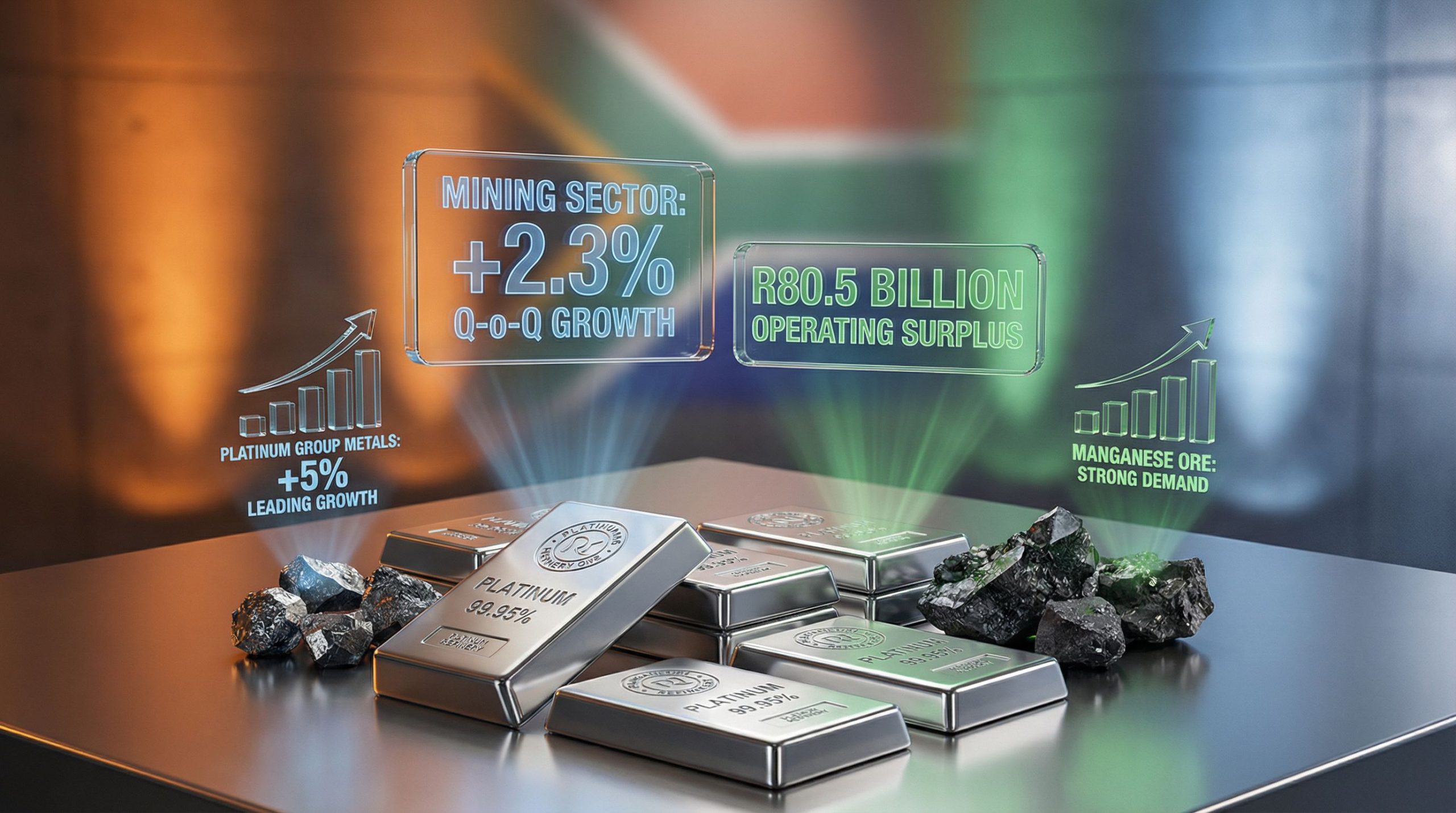
South Africa's mining sector has emerged as the standout performer in recent economic data, with mining outperformed other sectors becoming a defining characteristic of the country's economic landscape. The sector achieved 2.3% quarter-over-quarter expansion in Q3 2025, marking its second consecutive quarter of leadership among all major economic sectors.
This performance stands in stark contrast to other key sectors. Furthermore, the historic gold surge has significantly contributed to mining's exceptional performance:
- Finance sector: +0.3% growth contributing 0.1 percentage point to GDP
- Trade sector: +1.0% growth contributing 0.1 percentage point to GDP
- Manufacturing, agriculture, transport, government, and personal services: Each contributed ≤0.1 percentage point individually
The broader economic context reveals concerning trends. South Africa has now experienced 12 consecutive quarters with GDP growth below 1%, while the overall Q3 2025 real GDP growth reached only 0.5% quarter-over-quarter.
Between 2014 and 2024, annual average real GDP growth averaged 0.8% compared to population growth of 1.3%, creating a sustained decline in per capita income that affects living standards across the economy. However, mining innovation trends continue to drive sector resilience.
Critical Commodity Performance Driving Growth
The mining sector's robust performance stems from specific commodity strengths that demonstrate the sector's exposure to global market dynamics. Platinum group metals (PGMs), manganese ore, and coal served as the primary drivers of Q3 2025's mining expansion, reflecting both price appreciation and operational efficiency improvements.
Mineral exports generated an R18 billion increase between January and September 2025 compared to the same period in 2024. This surge was primarily driven by higher gold and PGM prices, demonstrating how global commodity price movements translate directly into domestic economic performance through the mining sector's export-oriented operations.
The revenue contribution analysis reveals mining's strategic importance despite its relatively modest share of total economic output. While mining contributed 0.1 percentage point to overall GDP growth, this represents a disproportionate impact given the sector's size, calculated as approximately 20% of total growth contribution from just 4-5% of economic output.
In addition, comprehensive gold market analysis indicates sustained bullish trends that further support mining sector performance.
How Does Mining Compare Against Other Economic Sectors?
Sectoral Performance Rankings and GDP Contributions
Q3 2025 Sectoral Growth Analysis
| Sector | Q-o-Q Growth | GDP Contribution (pp) | Ranking |
|---|---|---|---|
| Mining | +2.3% | +0.1 | 1st |
| Trade | +1.0% | +0.1 | 2nd |
| Finance | +0.3% | +0.1 | 3rd |
| Construction | +0.1% | ≤0.1 | Minimal Growth |
| Utilities | -2.5% | -0.1 | Last |
The data reveals a clear hierarchy of sectoral performance, with mining maintaining its position as the economy's growth leader. This ranking system demonstrates how different sectors contribute to overall economic momentum, with mining's 2.3% growth rate significantly outpacing all competitors in both absolute and relative terms.
The utilities sector, particularly electricity, contracted by 2.5% in Q3 2025, subtracting 0.1 percentage point from GDP growth. This represents a structural constraint on economic activity, as electricity supply challenges create operational difficulties for all other sectors, particularly manufacturing and mining operations that require consistent power supply.
Infrastructure and Construction Sector Challenges
Construction sector performance reveals deeper structural problems within South Africa's economic foundation. With growth of only 0.1%, construction represents the weakest among positive-contributing sectors, signaling inadequate investment in productive capacity and infrastructure development.
The construction sector's capital stock has been declining at an annualized rate of 1.1% since 2016, indicating that depreciation and disinvestment have consistently outpaced infrastructure replacement and new development. This deterioration rate, while concerning, provides perspective when compared to conflict-affected economies:
- Iraq (2003-2010): 2-4% annual capital stock reduction
- Ukraine (2022-2023): 3-5% annual capital stock reduction
- Syria (2011-2016): 6-8% annual capital stock reduction
The infrastructure decline creates cascading effects throughout the economy. Adequate and efficient infrastructure reduces business costs and catalyzes economic growth, making the construction sector's weakness a constraint on broader economic competitiveness and productivity improvements.
What Macro-Economic Forces Enable Mining's Outperformance?
Global Commodity Price Dynamics and Export Performance
Mining's sustained outperformance reflects its unique position as a bridge between domestic economic conditions and global commodity markets. The sector's R18 billion export increase demonstrates how international price appreciation translates directly into domestic economic gains, operating independently of local economic constraints.
External trade dynamics show the complexity of mining's contribution to economic performance. While mineral exports surged, the broader trade balance subtracted 0.4 percentage points from Q3 2025 GDP growth, as imports increased by 2.2% compared to exports growth of 0.7%. This indicates that domestic demand for imported goods and services exceeded the economy's ability to generate export revenues from non-mining sectors.
Currency effects on mineral export competitiveness create additional layers of complexity in mining's performance metrics. The sector benefits from rand weakness against major currencies, which enhances the domestic value of commodity sales priced in US dollars and other hard currencies, though specific exchange rate impacts were not quantified in available data. Furthermore, tariff impact insights reveal how global trade policies affect commodity pricing and mining profitability.
Gross Operating Surplus Trends Across Industries
The income distribution patterns within South Africa's economy reveal significant disparities between profit growth and wage increases, with mining showing the most extreme divergence. Economy-wide, gross operating surplus (a proxy for profits) increased by 6.9% year-over-year to R883.7 billion in Q3 2025, while employee compensation grew by 3.2% to R869 billion.
Mining sector income distribution shows an even more pronounced pattern. Additionally, US-China trade impact on global commodity demand continues to influence mining sector performance:
Mining gross operating surplus surged 21.3% year-over-year to R80.5 billion in Q3 2025, while employee compensation grew by only 2.1% to R47.5 billion, creating a 1,920 basis point gap between profit growth and wage increases.
This dramatic divergence suggests several possible explanations:
- Operational efficiency improvements without proportional labor cost increases
- Commodity price appreciation flowing primarily to capital rather than labor
- Capacity utilization gains achieved through existing workforce optimization
- Mix shifts toward higher-margin commodities and operations
The profit margin expansion demonstrates mining's ability to convert favorable external conditions into enhanced returns, though the benefits appear concentrated among capital owners rather than distributed broadly through wage increases.
Why Has South Africa's Global Economic Position Declined?
Historical Economic Share Analysis (1994-2024)
South Africa's diminished global economic standing represents one of the most significant structural changes in the country's post-apartheid economic trajectory. Between 1994 and 2008, the country maintained 0.8% of global GDP, but this share has contracted to 0.5% by 2024, representing a 37.5% relative decline in global economic relevance.
The opportunity cost calculations reveal the magnitude of this economic underperformance:
Potential versus Actual Economic Output (2024)
| Metric | Potential (0.8% global share) | Actual 2024 | Opportunity Cost |
|---|---|---|---|
| GDP (Nominal) | R18.3 trillion | R7.4 trillion | R10.9 trillion |
| Tax Revenue | R4.6 trillion | R1.8 trillion | R2.8 trillion |
These figures assume that maintaining the 1994-2008 global economic share would have generated proportionally higher tax revenues and economic output. The R2.8 trillion tax revenue shortfall represents foregone government capacity to invest in infrastructure, education, healthcare, and other productivity-enhancing public services.
Post-Global Financial Crisis Economic Trajectory
The 2008-2009 Global Financial Crisis marked a turning point in South Africa's economic trajectory, initiating a 16-17 year period of relative decline that continues through 2025. The sustained nature of this underperformance, evidenced by 12 consecutive quarters below 1% GDP growth, suggests structural rather than cyclical challenges.
Investment flow patterns and capital formation trends indicate reduced confidence in South Africa's long-term growth prospects. The combination of infrastructure deterioration, regulatory uncertainty, and competitive disadvantages in key sectors has created a self-reinforcing cycle of reduced investment and slower growth.
Industrial competitiveness metrics show South Africa falling behind emerging market peers in key areas including energy costs, regulatory efficiency, and infrastructure quality. Policy responses to these challenges have proven inadequate to reverse the declining trajectory or restore the country's historical share of global economic output. However, insights from McKinsey's mining value creation research suggest potential pathways for improvement.
What Structural Reforms Could Amplify Mining's Economic Impact?
Energy Cost Competitiveness and Industrial Viability
Energy pricing represents the most critical structural constraint facing South Africa's industrial sectors, with electricity costs increasing by 900% for large consumers since 2008. This dramatic cost escalation has fundamentally altered the competitiveness of energy-intensive industries, particularly affecting mining operations and downstream processing activities.
The ferrochrome sector exemplifies these challenges, with smelters facing potential closure despite South Africa's abundance of chromium ore resources. The disconnect between raw material availability and processing viability demonstrates how energy costs can negate natural resource advantages and force value-added activities offshore.
Ferrochrome smelter closure risks create supply chain implications extending beyond the immediate sector. Domestic industries both supplying the smelters and relying on their products face serious disruption, with negative consequences for employment and industrial capacity. The ramifications affect the entire metals processing ecosystem and reduce the economy's ability to capture value from mineral resources.
Comparative energy costs with mining competitor nations reveal South Africa's disadvantaged position. Countries with abundant energy resources or efficient energy systems can process similar mineral resources at significantly lower costs, attracting investment and industrial activity that might otherwise locate in South Africa.
Investment Climate and Regulatory Framework Analysis
The development of investor-friendly policies emerges as a critical requirement for capitalizing on mining's catalytic potential. Current regulatory frameworks often create uncertainty and compliance burdens that discourage capital investment, particularly in long-term projects requiring substantial upfront commitments.
Microeconomic reform priorities include labor market flexibility and competition policy improvements. These structural changes could enhance productivity growth across sectors while reducing costs and improving operational efficiency. However, progress on these reforms has been characterized as lacking sufficient urgency and comprehensiveness.
Institutional reform assessment reveals mixed results in strengthening the governance and regulatory structures necessary for sustained economic growth. While economic theory emphasizes the importance of strong institutions in driving development, South Africa's institutional improvements have not yet generated the investment climate necessary to reverse declining competitiveness.
Mining sector catalytic potential depends on creating policy environments that encourage both direct investment in mineral extraction and downstream processing activities. This requires coordinated approaches addressing energy costs, regulatory certainty, infrastructure development, and skills formation. Indeed, PWC's Australian mining report demonstrates how effective policy frameworks can support mining sector growth.
How Do Mining Profits Compare to Employment Benefits?
Income Distribution Patterns in Resource Sectors
The distribution of mining sector income reveals significant disparities between capital returns and labor compensation, reflecting broader patterns in resource-intensive industries. With mining's gross operating surplus increasing 21.3% to R80.5 billion while employee compensation grew only 2.1% to R47.5 billion, the sector demonstrates how commodity price benefits concentrate among capital owners.
Economic analysis shows mining profit margins expanding dramatically while wage growth lags both sector performance and economy-wide compensation trends, indicating that commodity price gains primarily benefit shareholders and investors rather than workers.
This income distribution pattern raises questions about the sustainability and inclusivity of mining-led economic growth. While the sector generates substantial economic output and foreign exchange earnings, the benefits appear concentrated rather than broadly distributed through the labor market.
The 2.1% mining wage growth compares unfavorably to the 3.2% economy-wide compensation increase, suggesting that mining employees have not shared proportionally in the sector's improved performance. This creates potential social and political tensions around resource extraction activities and their contribution to broader economic development.
Employment Multiplier Effects and Economic Spillovers
Beyond direct employment within mining operations, the sector generates significant indirect job creation through supply chain relationships and regional economic development. Mining operations require specialized services, equipment suppliers, transportation networks, and supporting infrastructure that create employment opportunities extending beyond the immediate extraction activities.
Supply chain employment dependencies demonstrate mining's broader economic impact. Local procurement of goods and services, maintenance and repair activities, professional services, and logistics support generate employment multipliers that amplify the sector's contribution to job creation and economic activity.
Regional economic development patterns around mining hubs show concentrated benefits in specific geographical areas. Mining towns and regions often experience higher income levels, better infrastructure, and more diverse economic activities compared to areas without mineral resources, though this can also create regional inequalities and economic vulnerabilities.
Skills development and human capital formation within mining create transferable capabilities that benefit other sectors. Technical expertise, project management skills, engineering capabilities, and operational experience developed in mining operations contribute to broader economic capacity and productivity improvements.
What Does Mining's Performance Signal for Future Economic Policy?
Sectoral Rebalancing Strategies for Sustainable Growth
Mining's consistent outperformance while other sectors struggle suggests the need for economic policy frameworks that leverage resource sector strengths while addressing structural weaknesses elsewhere. The challenge involves using mining outperformed other sectors as an economic anchor during transition periods while building capacity in other productive sectors.
Diversification requirements must balance the imperative to maximise returns from natural resource advantages with the need to develop alternative sources of economic growth. This involves using mining revenues and foreign exchange earnings to fund investments in education, infrastructure, technology, and industrial capacity that can support broader economic development.
Technology adoption patterns show significant variations between traditional mining operations and emerging sectors. Mining companies often invest heavily in productivity-enhancing technologies, automation systems, and operational optimisation, while other sectors may lag in technological upgrading due to capital constraints or regulatory barriers.
Export-led growth model sustainability depends on maintaining competitiveness in global commodity markets while developing additional sources of export earnings. This requires continuous investment in mining efficiency and productivity while building capabilities in manufacturing, services, and other tradeable sectors.
Long-term Competitiveness Framework Development
Infrastructure investment priorities for mining support must address both sector-specific needs and broader economic requirements. Transportation networks, energy systems, water resources, and telecommunications infrastructure serve mining operations while providing benefits for other economic activities and communities.
Regulatory certainty requirements for sustained investment involve creating predictable policy environments that encourage long-term capital commitments. Mining projects typically require decades-long time horizons, making regulatory stability essential for investment decisions and project development.
Environmental compliance and sustainable mining practices increasingly influence investment decisions and operational parameters. Balancing resource extraction with environmental protection requires regulatory frameworks that ensure responsible mining while maintaining sector competitiveness and investment attractiveness.
Integration with global value chains and supply security concerns affect mining's strategic importance. As countries and companies prioritise supply chain resilience and resource security, South Africa's mineral resources become increasingly valuable strategic assets requiring careful management and development.
Frequently Asked Questions About Mining's Economic Leadership
Why Has Mining Outperformed for Two Consecutive Quarters?
Mining outperformed other sectors due to the convergence of favourable external and internal factors. Commodity price cycles, particularly for gold and platinum group metals, have created revenue opportunities that mining companies have successfully captured through operational efficiency improvements and cost management strategies.
Global demand patterns for South African minerals remain robust, driven by industrial applications, energy transition requirements, and strategic stockpiling by major economies. This demand provides a foundation for sustained mining sector performance even as domestic economic conditions remain challenging.
Currency advantages for export-oriented operations enhance mining profitability when the rand weakens against major trading currencies. This creates natural hedging benefits for mining companies while generating additional domestic value from commodity sales priced in foreign currencies.
Investment in technology and productivity enhancements has enabled mining operations to increase output and reduce costs, improving competitiveness and profitability. These operational improvements position the sector to capitalise on favourable market conditions while maintaining efficiency during more challenging periods.
What Risks Could Undermine Mining's Continued Performance?
Infrastructure constraints and logistics challenges pose significant risks to mining sector sustainability. Transportation bottlenecks, port capacity limitations, and railway system inefficiencies can reduce mining companies' ability to deliver products to international markets efficiently and cost-effectively.
Energy supply reliability and cost pressures represent existential threats to energy-intensive mining operations. The 900% increase in electricity costs since 2008 has already forced some operations to consider closure or relocation, while supply interruptions disrupt production schedules and increase operational costs.
Regulatory uncertainty and policy changes can dramatically affect mining investment decisions and operational parameters. Changes in taxation, environmental regulations, labour laws, or mineral rights policies create risks that may discourage investment or force operational modifications that reduce competitiveness.
Global economic slowdown and demand reduction could undermine commodity prices and reduce export revenues. Mining outperformed other sectors largely due to its dependence on international markets, which makes the sector vulnerable to global economic cycles and trade disruptions that affect commodity demand and pricing.
How Sustainable Is Mining-Led Economic Growth?
Resource depletion considerations and reserve management require long-term planning to ensure continued mining sector contributions to economic growth. Finite mineral resources necessitate ongoing exploration, technology development, and resource optimisation to maintain production levels and economic benefits.
Environmental sustainability requirements increasingly influence mining operations and development decisions. Balancing resource extraction with environmental protection requires investment in cleaner technologies, rehabilitation activities, and sustainable practices that may affect short-term profitability but ensure long-term viability.
Economic diversification timeline and transition planning become critical as mineral resources are depleted or become uneconomical to extract. Using mining revenues to develop alternative economic sectors and build human capital creates foundations for post-mining economic sustainability.
Technology disruption impacts on traditional mining models may require significant adaptation and investment. Automation, artificial intelligence, renewable energy integration, and new extraction technologies could transform mining operations while affecting employment patterns and skill requirements.
Disclaimer: This analysis is based on available economic data and industry reports. Economic forecasts and projections involve inherent uncertainty, and actual results may differ from expectations. Investment and policy decisions should consider multiple sources of information and professional advice. The views expressed regarding future economic performance, sectoral trends, and policy implications represent analytical assessments rather than guaranteed outcomes.
Looking to Capitalise on Australia's Mining Discoveries?
Discovery Alert's proprietary Discovery IQ model delivers real-time alerts on significant ASX mineral discoveries, instantly empowering subscribers to identify actionable opportunities ahead of the broader market. Begin your 30-day free trial today and secure your market-leading advantage by visiting Discovery Alert's discoveries page.