Why Are Mining Giants Forming Strategic Alliances in Today's Market?
The contemporary mining landscape has undergone a fundamental transformation where collaborative development models now dominate strategic planning across major corporations. This shift stems from multiple converging pressures that have rendered traditional solo development approaches increasingly unviable from both financial and operational perspectives, driving the mining industry evolution toward more strategic partnerships.
Capital intensity in modern mining operations has reached unprecedented levels, with average development costs for major greenfield copper projects now exceeding $3 billion globally. This represents a 35-40% increase over the past decade, driven primarily by declining ore grades that now average 0.8% compared to 1.5% twenty years ago.
Furthermore, deeper mining operations require 40-60% higher operational costs per ton of ore processed, fundamentally altering project economics. These challenges underscore the importance of collaborative approaches in today's mining environment.
The Economics Behind Mining Partnerships
Table: Capital Efficiency Comparison
| Development Model | Typical CAPEX Range | Risk Distribution | Timeline to Production |
|---|---|---|---|
| Solo Development | $2.5B – $4.0B | Single Entity | 7-10 years |
| Joint Venture | $1.6B – $2.0B | Shared 50/50 | 5-7 years |
| Infrastructure Sharing | $1.2B – $1.8B | Proportional | 4-6 years |
Over 25 major mining partnerships and joint ventures have been announced globally in the 2023-2025 period. Consequently, joint venture partnerships now account for approximately 35-40% of new major development projects. This trend reflects industry recognition that risk distribution across multiple balance sheets has become investor-critical for project funding approval.
Strategic partnerships enable companies to leverage existing infrastructure while sharing geological expertise and distributing financial exposure. The Vale and Glencore joint venture in Canada exemplifies this approach, targeting combined capital efficiency through shared development costs estimated between $1.6-2.0 billion rather than separate investments that could reach $3-4 billion individually.
Recent successful partnerships demonstrate the model's effectiveness. For instance, the Teck-Anglo American merger announced in 2024, valued at approximately $14.9 billion USD, consolidated base metals exposure while optimising capital allocation. Southern Copper Corporation's multi-decade partnership with Grupo Mexico has successfully operated major Peruvian and Mexican copper assets for over 30 years, proving partnership durability.
What Makes the Sudbury Basin a Strategic Copper Hub?
The Sudbury Basin represents a unique convergence of geological advantages and established infrastructure that positions it as North America's premier location for collaborative mining development. This 130-year-old mining district offers what industry experts term a "greenfield-lite" development opportunity.
Geological Advantages and Infrastructure Legacy
Historical mining operations in the Sudbury Basin have produced over 9 million metric tons of nickel, establishing comprehensive understanding of local geology and mineralisation patterns. Current mining operations extend up to 2,000+ meters below surface, supported by 15+ operational shafts with established ventilation, power, and transportation systems.
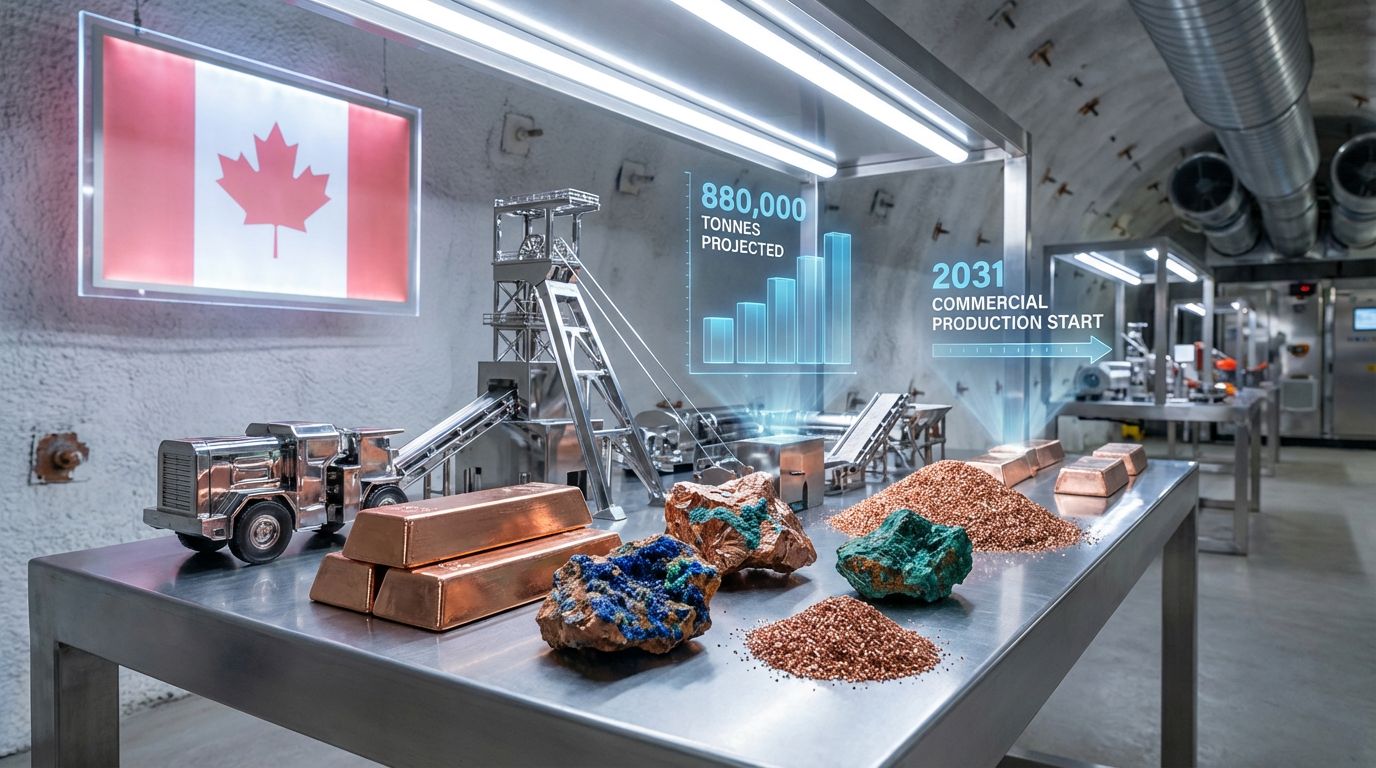
The Vale and Glencore joint venture in Canada leverages this infrastructure foundation, with projected production of 880,000 metric tons of copper over 21 years. This translates to approximately 41,900 metric tons annually, representing a significant addition to North American copper supply.
Key Strategic Assets:
- Existing shaft infrastructure reducing initial capital requirements by 30-45%
- Established transportation networks eliminating logistics development costs
- Skilled workforce with multi-generational mining expertise
- Proven geological continuity across property boundaries
- Regulatory relationships developed over 130+ years of continuous operations
Multi-Metal Revenue Diversification
Polymetallic ore bodies in the Sudbury Basin enable cross-commodity optimisation that reduces per-unit processing costs by approximately 25-35% compared to single-commodity mining operations. Recovery rates for nickel historically exceed 95% in Sudbury operations, while cobalt recovery from nickel-rich ores achieves 70-80% through selective processing.
Additionally, this diversified approach supports gold and copper exploration strategies that maximise resource extraction from existing infrastructure.
Revenue Stream Diversification:
- Primary copper production generating core revenue streams
- Secondary nickel extraction for stainless steel and battery applications
- Cobalt recovery estimated at 8,000-12,000 tonnes annually
- Platinum Group Metals providing 15,000-20,000 ounces annually
- Gold production contributing 40,000-60,000 ounces annually
This multi-metal approach provides natural hedging against commodity price volatility while maximising resource extraction efficiency from shared processing facilities.
How Do Joint Ventures Address Modern Mining Challenges?
Contemporary mining projects face unprecedented complexity requiring sophisticated risk management approaches that exceed individual company capabilities. Joint venture structures provide systematic solutions to capital, technical, and operational challenges that have rendered traditional development models obsolete.
Capital Allocation Optimisation
Joint venture partnerships achieve capital savings of approximately 30-45% compared to solo development, with the Vale and Glencore joint venture in Canada exemplifying this efficiency. The partnership targets CAPEX between $1.6-2.0 billion versus potential solo development costs of $2.5-4.0 billion.
Risk Mitigation Strategies:
- Shared geological and technical risk exposure across partnership entities
- Distributed regulatory and permitting responsibilities
- Combined financial resources for unexpected cost overruns
- Pooled expertise in specialised mining technologies
- Risk-adjusted cost of capital reduction estimated at 2-3% improvement
Operational Synergy Creation
Strategic partnerships in established mining districts enable companies to maximise existing assets while minimising redundant capital expenditure, creating operational efficiencies that standalone developments cannot achieve.
Timeline acceleration represents a critical advantage, with joint ventures reducing development periods from 7-10 years to 5-7 years. The Vale-Glencore partnership targets first half 2027 for final investment decision, with projected commercial production by 2031.
Technical Integration Benefits:
- Underground Infrastructure Consolidation through deepening existing Glencore Nickel Rim South Mine shaft
- Processing Plant Optimisation enabling larger-scale facilities with 15-20% per-unit cost reductions
- Shared Services including unified environmental monitoring and safety protocols
- Logistics Optimisation through coordinated mining schedules
However, these trends also reflect broader mining consolidation trends observed across the industry. Successful historical models validate this approach. The Antamina four-party joint venture in Peru, involving Glencore, BHP, Mitsubishi, and Teck, has operated successfully since 1995, producing approximately 600,000 MT copper annually.
What Are the Market Implications of This Partnership Model?
The global copper market faces structural supply-demand imbalances that position strategic partnerships as essential responses to emerging shortages. Current market fundamentals indicate growing recognition among institutional investors and industry participants that collaborative development models offer superior risk-adjusted returns.
Copper Supply Chain Positioning
Global copper production currently reaches approximately 20.7 million metric tons annually, while projected 2030 demand estimates range between 24-26 million metric tons. This creates a potential supply deficit of 2-6 million metric tons annually if no new production capacity develops.
Table: Global Copper Demand Drivers (2025-2035)
| Sector | Current Demand (Mt) | Projected Growth | Strategic Importance |
|---|---|---|---|
| Power Grid | 8.2 | +45% | Critical Infrastructure |
| EVs & Batteries | 2.1 | +180% | Energy Transition |
| Data Centers | 0.8 | +220% | Digital Economy |
| Renewable Energy | 1.9 | +95% | Climate Goals |
The Vale and Glencore joint venture in Canada addresses this supply challenge by contributing approximately 41,900 MT annually, representing 1.6-1.8% of projected supply deficit scenarios in the 2030-2035 timeframe. These projections align with global copper supply forecasts that highlight the critical role of new partnerships.
Energy Transition Copper Requirements
Electrification initiatives create unprecedented copper demand across multiple sectors simultaneously. Wind turbine installation requires approximately 5-7 tons of copper per megawatt capacity, while electric vehicles require 50-120 kg of copper per vehicle compared to 20 kg in internal combustion vehicles.
AI Infrastructure Impact:
- Data centre power consumption growing at 10-15% annually
- AI-specific data centre power requirements 3-5x higher than traditional facilities
- Copper demand for AI infrastructure projected to increase 220% by 2035
- Current spot copper price: $5.304 per pound as market recognises supply constraints
How Does This Impact Investment Strategy and Market Dynamics?
Investment strategies increasingly favour mining companies demonstrating collaborative capabilities and multi-commodity exposure rather than single-metal speculation. The partnership model provides portfolio diversification benefits that align with institutional investor preferences for de-risked mining exposure.
Portfolio Diversification Benefits
Modern mining investments require demonstration of:
- Multi-commodity exposure reducing single-metal price volatility risks
- Infrastructure leverage improving capital efficiency ratios
- Established jurisdiction presence minimising regulatory uncertainties
- Partnership capabilities indicating sophisticated management competence
The Vale and Glencore joint venture in Canada exemplifies these criteria through established Sudbury Basin operations, multi-metal revenue streams, and proven partnership execution capabilities. Moreover, these partnerships reflect opportunities similar to copper investment in Canada that demonstrate regional expertise and market understanding.
Timeline and Decision Framework
Development Milestones:
- 2026: Comprehensive engineering and permitting phase initiation
- H1 2027: Final investment decision targeting
- 2028-2030: Construction and commissioning period
- 2031: Commercial production commencement (projected)
Critical Success Factors:
- Regulatory approval efficiency in Canadian jurisdictions
- Community engagement and indigenous consultation outcomes
- Copper price sustainability above $4.00/lb operational threshold
- Infrastructure integration complexity management
Disclaimer: Mining partnerships involve significant risks including commodity price volatility, regulatory changes, technical challenges, and operational uncertainties. Projected timelines and production estimates represent current management guidance subject to material changes.
What Does This Signal About Future Mining Industry Evolution?
The emergence of strategic partnerships as preferred development models reflects fundamental industry transformation toward optimised resource extraction methodologies. This evolution extends beyond cost-sharing arrangements to encompass comprehensive operational integration and strategic positioning.
Strategic Implications for Sector Development
Contemporary mining partnerships demonstrate industry transition toward:
- Collaborative resource development replacing competitive isolation strategies
- Infrastructure maximisation over greenfield development preferences
- Multi-decade planning horizons supporting sustainable extraction practices
- Integrated supply chain positioning rather than commodity price speculation
Regional Development Impact
Economic Multiplier Effects:
- Direct employment creation in established mining communities
- Indirect service sector stimulation across Northern Ontario regions
- Tax revenue generation for municipal and provincial governments
- Indigenous community economic participation opportunities
- Infrastructure investment supporting regional development initiatives
The Sudbury Basin partnership demonstrates how established mining regions maintain relevance through innovative collaboration models, extending operational lifespans while supporting critical mineral security objectives for North American supply chains.
Industry consolidation trends suggest partnerships will become standard practice rather than exceptional arrangements. Environmental, Social, and Governance (ESG) requirements increasingly drive partnership selection criteria, with investors preferring companies demonstrating collaborative stakeholder engagement capabilities.
Furthermore, Vale Base Metals and Glencore Canada have established a framework that other mining companies are likely to emulate across different jurisdictions.
Disclaimer: Future industry evolution projections involve significant uncertainties including technological developments, regulatory changes, market conditions, and macroeconomic factors that may materially impact mining partnership success rates and industry structure.
Partnership Models Reshaping Mining Investment Landscape
Strategic alliances between major mining corporations represent fundamental evolution toward optimised resource extraction methodologies that address contemporary challenges including capital intensity, regulatory complexity, and market volatility. The Vale and Glencore joint venture in Canada demonstrates how established mining districts can leverage infrastructure advantages while positioning for long-term commodity demand growth.
This collaborative approach enables risk distribution across multiple balance sheets, accelerated development timelines, and operational synergies that standalone developments cannot achieve. Success metrics will likely influence future development strategies across the global mining sector, particularly in established jurisdictions where infrastructure leverage provides competitive advantages over greenfield alternatives.
The partnership model's effectiveness in addressing supply-demand imbalances positions it as an essential component of future mining industry structure, supporting critical mineral security while optimising capital allocation efficiency for investor returns.
Disclaimer: Mining investments and partnerships involve substantial risks including commodity price volatility, regulatory uncertainties, operational challenges, and market conditions. Past performance does not guarantee future results, and investors should conduct thorough due diligence before making investment decisions.
Considering Strategic Mining Partnership Opportunities?
Discovery Alert's proprietary Discovery IQ model delivers real-time alerts on significant ASX mineral discoveries, instantly empowering investors to identify actionable opportunities ahead of the broader market. Begin your 30-day free trial today and gain a market-leading advantage as major mining partnerships reshape the global investment landscape.