
May 21, 2026
The Execution Gap That Has Long Defined African Mining Partnerships
Every major resource cycle in history has been shaped not just by what lies beneath the ground, but by the institutional architecture built above it. Infrastructure, governance frameworks, capital structures, and community relationships ultimately determine whether mineral wealth translates into lasting industrial development or remains locked in a cycle of extraction and export. Nowhere is this dynamic more consequential today than across the African continent, where the collision of extraordinary mineral endowment, maturing continental frameworks, and intensifying global demand for critical minerals is forcing a fundamental question: why do so many Mining Indaba partnerships in practice fail to move beyond the signing ceremony?
The honest answer is structural. Memoranda of understanding between governments, mining companies, development finance institutions, and infrastructure developers accumulate at an impressive pace, yet the pathway from signed agreement to operational delivery is littered with obstacles that no single framework has yet resolved systematically. Furthermore, understanding those obstacles in technical and institutional detail is the prerequisite for appreciating why African mining finance trends have become the defining conversation heading into 2027.
Three Systemic Failure Points That Repeat Across the Continent
When African mining partnerships break down, the failure can almost always be traced to one or more of three recurring structural weaknesses rather than a lack of goodwill or strategic intent.
-
Capital misalignment between public development objectives and the return timelines required by commercial investors creates a persistent risk gap at the project financing stage. Development finance institutions price risk differently from private equity or commercial banks, and without a deliberate blended finance architecture bridging those positions, capital simply does not flow.
-
Regulatory divergence across sovereign jurisdictions undermines cross-border projects before they reach feasibility. When mining codes, fiscal regimes, environmental standards, and community consultation requirements differ substantially between neighbouring countries, the transaction costs of compliance multiply and investor confidence erodes.
-
Community exclusion from design phase converts what should be durable social licence into a recurring source of project risk. When local communities are consulted after key commercial and operational parameters are fixed, the result is predictable: disputes over benefit-sharing, local procurement, and land use that surface at the most capital-intensive moments in project development.
The table below illustrates how these failure points manifest across different partnership categories in the African mining context.
| Partnership Failure Category | Primary Driver | Frequency in African Mining Context |
|---|---|---|
| MOU-to-execution breakdown | Capital misalignment | High |
| Infrastructure corridor delays | Competing national priorities | High |
| Community benefit agreement disputes | Exclusion from design phase | Medium-High |
| Cross-border regulatory friction | Inconsistent policy frameworks | High |
| Development finance disbursement delays | Risk perception gaps | Medium |
The pattern that emerges from this data is significant. The most frequent failure modes are not primarily technical or geological. They are institutional and financial, which means they are also, in principle, solvable through better partnership architecture.
Redefining Partnership as Operational Infrastructure, Not Diplomacy
The conceptual shift at the centre of Mining Indaba's 2027 theme is deceptively simple but practically profound. Partnerships are no longer peripheral diplomatic gestures that surround the real work of mining. They are the operating infrastructure through which capital, policy, production capacity, and community relationships must align simultaneously if projects are to reach construction, let alone sustained operation.
This reframing has direct implications for how partnerships are designed, governed, and measured. A transactional arrangement asks what each party receives from the deal. A transformational operating model, however, asks how the collective architecture of the partnership creates conditions that no individual actor could generate alone.
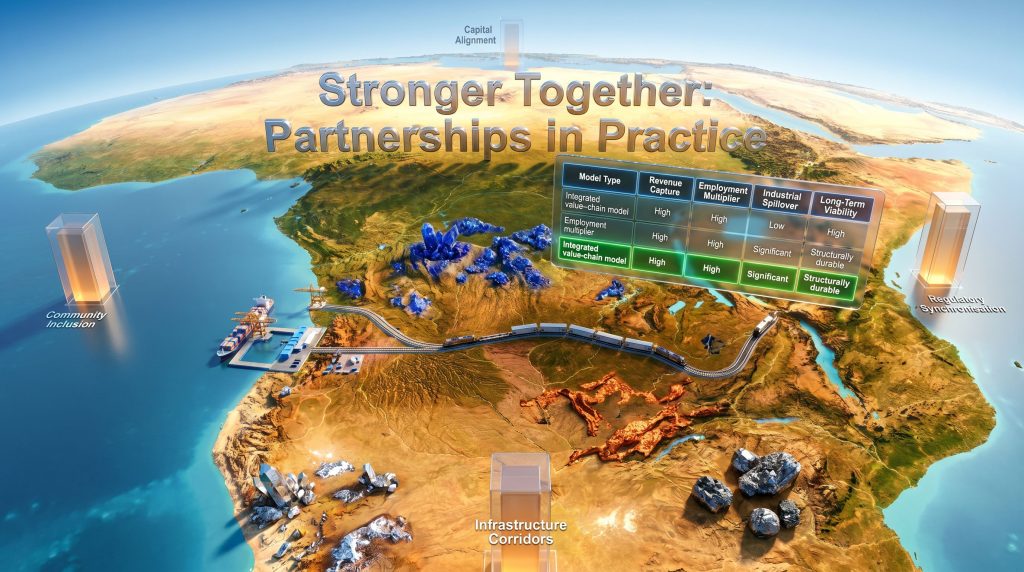
The Four Pillars of Functional Mining Partnerships
1. Capital Alignment Between Public and Private Actors
Blended finance has moved from an experimental instrument to the de facto standard for greenfield critical minerals projects across Africa's frontier and emerging markets. The basic mechanism involves layering concessional capital from multilateral development banks, including the International Finance Corporation, the African Development Bank, and bilateral development agencies, beneath commercial debt and equity in a risk waterfall structure that absorbs first losses and thereby reduces the return hurdle for private investors.
What distinguishes effective blended finance structures from ineffective ones is the degree to which risk allocation is negotiated explicitly at the partnership design stage rather than renegotiated under pressure during project execution. In addition, co-investment structures where mining private equity participants take equity positions rather than simply providing concessional loans have shown particular effectiveness in aligning long-term incentives across partner classes.
2. Policy and Regulatory Synchronisation Across Borders
The African Continental Free Trade Area provides a legal and institutional architecture with genuine potential to reduce the regulatory friction that has historically fragmented cross-border mineral value chains. By establishing common rules of origin, dispute resolution mechanisms, and trade facilitation standards, AfCFTA creates a foundation on which sector-specific harmonisation of mining codes and environmental standards can be built.
The challenge is that AfCFTA's potential remains largely unrealised at the project level. Translating a continental trade framework into bilateral regulatory alignment for a specific copper or lithium project requires institutional capacity that many African governments are still developing, alongside political commitment to subordinate short-term fiscal interests to longer-term value chain integration.
3. Infrastructure Corridors as Partnership Multipliers
Logistics infrastructure is widely recognised as the single largest constraint on African mining competitiveness, yet it is also the category of partnership where the multiplier effect extends furthest beyond the mine gate. The Lobito Corridor, connecting the mineral-producing heartlands of the Democratic Republic of Congo and Zambia to Atlantic export infrastructure through Angola, has emerged as the most cited contemporary model for what infrastructure-anchored partnership can deliver.
Nicolas Gregoir, COO of Lobito Atlantic Railway, has described the corridor's function as a strategic backbone for African mining, enabling connectivity improvements that reduce logistics costs while simultaneously creating economic pathways for surrounding communities, agricultural producers, and emerging manufacturing activities along the route.
Infrastructure partnerships that extend economic benefit beyond the mine gate, into surrounding communities, regional agriculture, and manufacturing ecosystems, represent the most durable form of mining-linked development. Shared corridors reduce per-unit logistics costs while simultaneously creating the conditions for broader industrialisation.
The economic logic is compelling. Per-unit transport costs on poorly maintained road networks in sub-Saharan Africa can represent 15 to 30 percent of total project operating costs for bulk minerals, according to estimates from the World Bank's transport research. Rail corridors developed under shared ownership models reduce that burden substantially while distributing the fixed infrastructure cost across multiple users and commodity types.
4. Community Inclusion as a Structural Requirement
The paradigm shift from stakeholder consultation to community co-design represents one of the most significant changes in mining partnership practice over the past decade. The World Bank's environmental and social framework, updated in 2018, elevated community benefit-sharing, local hiring thresholds, women's participation, and energy access from aspirational targets to baseline requirements for projects receiving multilateral financing.
What this means in practice is that community exclusion from partnership design is now recognised not just as an ethical failure but as a primary project risk factor with direct implications for financing, permitting, and operational continuity. Modern partnership agreements in the most sophisticated African mining jurisdictions are embedding local procurement floors, skills transfer commitments, and independent benefit-sharing oversight mechanisms as contractual terms rather than voluntary commitments.
Africa's Critical Minerals Position and the New Strategic Logic
Africa holds proven reserves of copper, cobalt, lithium, graphite, manganese, and rare earth elements that are increasingly central to global industrial policy. The Democratic Republic of Congo alone accounts for approximately 70 percent of global cobalt production. Southern Africa holds a substantial share of the world's platinum group metals. The Lithium Triangle of Zimbabwe, DRC, and the broader Great Rift Valley system represents one of the most geologically prospective lithium regions outside South America.
The acceleration of global critical minerals demand for energy transition applications has elevated Africa's strategic importance in supply chain conversations across the European Union, the United States, and Asia-Pacific industrial policy frameworks. This has attracted new categories of partners, including sovereign wealth funds, national strategic reserves agencies, and technology manufacturers pursuing long-term supply security rather than short-term commodity exposure.
From Extraction to Industrial Value Chain: The Partnership Imperative
The comparison below illustrates why African governments and their development partners are increasingly unwilling to accept extraction-only export models as the ceiling of ambition.
| Model Type | Revenue Capture | Employment Multiplier | Industrial Spillover | Long-Term Viability |
|---|---|---|---|---|
| Extraction-only export | Low | Low | Minimal | Vulnerable to price cycles |
| Partial processing partnership | Medium | Medium | Moderate | Improved resilience |
| Integrated value-chain model | High | High | Significant | Structurally durable |
The integrated value-chain model requires partnerships between governments, development finance institutions, and industrial operators that are structurally more complex but economically far more durable. Joint ventures designed to build local refining and processing capacity require technology transfer provisions, workforce development commitments, and fiscal arrangements that share downstream revenues rather than concentrating them at the export gate.
Continental Frameworks: Why Ambition Has Outpaced Implementation
The African Union has developed a series of sophisticated frameworks for mining sector development over the past two decades. The African Mining Vision, adopted in 2009, articulated a comprehensive model for leveraging mineral wealth to support broad-based industrial development. Africa's Green Minerals Strategy aligns that vision with decarbonisation timelines and rare earth supply chains requirements. Agenda 2063 provides the long-horizon industrialisation framework within which mining partnerships are intended to operate.
The distance between policy aspiration and operational delivery in African mining is not primarily a vision problem. It is a coordination and resourcing problem. Frameworks exist. What has been missing is the institutional architecture to operationalise them at the project level.
The coordination failure has multiple dimensions. Political cycles in many African jurisdictions are shorter than the development timelines for major mining projects, creating persistent instability in the regulatory and fiscal terms that underpin long-duration capital commitments. Institutional capacity gaps at the national level mean that well-intentioned multilateral agreements frequently cannot be translated into the bilateral project-level documentation that investors and lenders require before committing capital.
A further constraint that receives insufficient attention is data infrastructure. Investment decision-making across the continent is hampered by incomplete geological databases, inconsistent resource reporting standards, and limited access to independent technical assessments. Building continent-wide mineral data platforms is not a glamorous policy priority, but it is, however, a prerequisite for the scale of private investment that Africa's mining potential warrants.
Mining Indaba 2027: What Execution-Oriented Partnership Looks Like in Practice
Mining Indaba functions as more than a networking event. It operates as a deal-activation environment where the simultaneous presence of ministerial delegations, major mining operators, junior and exploration companies, development finance institutions, downstream buyers, and technology providers creates conditions for partnership formation that are genuinely difficult to replicate through bilateral channels.
The 2027 edition, scheduled for 8 to 11 February 2027 at the Cape Town International Convention Centre, is structured around outcome-oriented sessions rather than conventional panel discussions. Platforms including the Dealmakers Den, which in 2026 produced standout outcomes for companies including Red Sea Resources in precious metals and Midnight Sun Mining in critical minerals, are designed to convert project pitches into actionable investment conversations through structured evaluation and direct engagement with capital providers.
Country Showcases provide sovereign investment positioning platforms that allow governments to present regulatory environments, project pipelines, and fiscal terms directly to qualified investors. The Explorers Showcase and Junior Mining Showcase create structured pathways for early-stage capital formation that would otherwise require months of bilateral outreach to replicate. For further detail on session formats and thematic programming, the full conference agenda is available through the official Mining Indaba platform.
Five Conditions for Moving from Agreement to Action
The structural prerequisites for execution-ready Mining Indaba partnerships in practice are well understood, even if consistently underdelivered. Based on the accumulated evidence from projects that have successfully navigated the MOU-to-execution transition, five conditions consistently distinguish durable partnerships from those that stagnate.
-
Shared risk architecture — Partnership agreements must define explicitly how financial, operational, and regulatory risks are distributed across all parties before capital is committed, not negotiated retrospectively under project pressure.
-
Pre-agreed governance structures — Decision-making frameworks, dispute resolution mechanisms, and performance benchmarks must be established at the outset of the partnership, not assembled as problems arise.
-
Community integration from day one — Local communities must be incorporated as structural partners in project design, with benefit-sharing parameters, local procurement floors, and oversight mechanisms agreed before any capital is deployed.
-
Regulatory pre-clearance pathways — Governments that create streamlined approval processes for partnerships meeting defined development criteria reduce timeline risk and signal institutional commitment that attracts patient capital.
-
Long-duration capital commitment — Mining partnerships require patient capital aligned to project development cycles that typically span 10 to 20 years from discovery to sustained production, not short-term return expectations inappropriate to the asset class.
The institutional infrastructure required to support these conditions at scale across the continent is still being built. Harmonised environmental and social governance standards across African jurisdictions, regional dispute resolution mechanisms for cross-border partnerships, and strengthened government negotiating capacity all represent structural investments that precede rather than accompany project-level execution. Industry conference insights from comparable global forums consistently reinforce this conclusion. That construction work is the genuine substance of what Mining Indaba partnerships in practice means heading into 2027 and beyond.
Readers seeking to deepen their understanding of African mining investment frameworks and partnership models can access related content, conference agenda materials, post-event reports, and Mining Indaba TV interviews through the official Mining Indaba content hub at miningindaba.com.
Want to Identify the Next Major ASX Mineral Discovery Before the Market Moves?
Discovery Alert's proprietary Discovery IQ model delivers real-time alerts the moment significant mineral discoveries are announced on the ASX, transforming complex geological data into clear, actionable investment insights across more than 30 commodities. Explore why historic mineral discoveries have generated extraordinary returns for early investors, and begin your 14-day free trial today to secure a market-leading edge.