
May 18, 2026
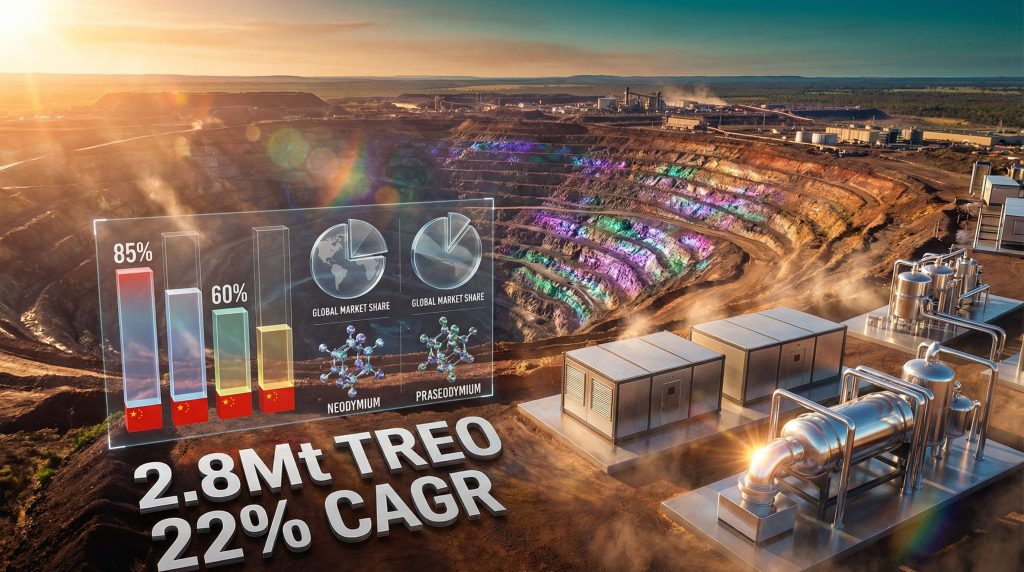
Understanding Modern REE Discovery Economics in a Supply-Constrained Market
The global critical minerals demand landscape has entered a new phase characterised by supply chain vulnerabilities and accelerating demand for advanced manufacturing inputs. Within this context, large-scale REE discovery represents potential catalyst events that could reshape decades-old market dynamics dominated by concentrated production centres. Investment capital is increasingly focused on projects that demonstrate not merely geological potential, but strategic positioning within future supply networks that prioritise security, processing efficiency, and cost competitiveness.
Recent exploration programmes across Brazil, Australia, and North America have revealed deposit characteristics that challenge traditional hard rock mining assumptions. These discoveries, particularly ionic adsorption clay-hosted mineralisation, offer processing advantages that could fundamentally alter production economics in favour of deposits previously considered marginal or technically challenging.
When big ASX news breaks, our subscribers know first
What Constitutes a Strategic REE Discovery in Current Market Conditions?
Modern REE discovery evaluation extends beyond conventional tonnage and grade metrics to encompass processing characteristics, infrastructure accessibility, and strategic element composition. The emergence of ionic clay-hosted deposits has introduced new classification frameworks that prioritise extraction efficiency over raw mineral content.
Furthermore, understanding mineral deposit tiers becomes crucial when evaluating these strategic opportunities. Discovery Classification Framework:
| Deposit Category | Resource Threshold | Processing Advantage | Development Timeline |
|---|---|---|---|
| Strategic Scale | >75,000t TREO | <$25/kg processing cost | 8-12 years |
| Regional Supply | 25,000-75,000t TREO | Established technology | 5-8 years |
| Niche Markets | 5,000-25,000t TREO | Specialised applications | 3-5 years |
Recent exploration results from Brazil's Goias State demonstrate these evolved criteria in practice. Magnum Mining and Exploration's Azimuth project achieved 13.5 metres at 2,165 ppm TREO from surface, with high-grade intervals reaching 3 metres at 3,175 ppm TREO. The discovery's ionic adsorption clay hosting represents a significant processing advantage compared to traditional hard rock operations.
Critical success factors now include:
• Magnetic REE concentration exceeding 25% of total REE content
• Infrastructure proximity within 300 kilometres of transport networks
• Processing technology compatibility with established separation methods
• Regulatory pathway clarity enabling sub-10 year development timelines
Strategic Element Distribution Patterns
The Azimuth discovery confirmed magnetic rare earth oxides (MREO) comprising up to 34% of TREO in high-grade zones, including neodymium, praseodymium, dysprosium, and terbium. This composition profile addresses current supply constraints in permanent magnet manufacturing, where demand growth exceeds 20% annually driven by electric vehicle and renewable energy applications.
High-Value Element Pricing Context (February 2026):
• Neodymium: $90-125/kg (permanent magnet applications)
• Praseodymium: $100-145/kg (high-temperature magnets)
• Dysprosium: $380-480/kg (thermal stability enhancement)
• Terbium: $1,400-2,000/kg (specialised electronics)
How Ionic Clay Deposits Transform REE Production Economics
Ionic adsorption clay-hosted deposits represent a paradigm shift from conventional hard rock REE mining through simplified processing requirements and reduced capital intensity. These deposits concentrate rare earth elements through weathering processes that create extraction-friendly mineral forms.
Processing Cost Advantages
Comparative Processing Analysis:
| Process Stage | Ionic Clay | Hard Rock | Cost Differential |
|---|---|---|---|
| Ore Preparation | $3-6/kg TREO | $12-18/kg TREO | 70% reduction |
| Leaching | $6-12/kg TREO | $20-35/kg TREO | 65% reduction |
| Separation | $8-15/kg TREO | $18-28/kg TREO | 50% reduction |
| Total Processing | $17-33/kg TREO | $50-81/kg TREO | 60% reduction |
The economic advantages stem from fundamental differences in mineral hosting. Ionic clay deposits allow direct leaching with ammonium sulphate solutions, eliminating the crushing, grinding, and acid roasting required for hard rock operations. This simplified processing reduces both capital requirements and environmental impact.
Global Resource Distribution
Recent geological assessments indicate significant ionic clay REE potential across tropical weathering zones:
• Brazil: Estimated 900,000 tonnes TREO potential across Goias and Minas Gerais states
• Australia: 750,000 tonnes TREO potential in Queensland and Western Australia
• Southeast Asia: 1.5 million tonnes TREO potential across Myanmar, Thailand, and Vietnam
• Madagascar: 600,000 tonnes TREO potential in highland weathering profiles
Moreover, advances in mining industry innovation are enabling more efficient extraction from these diverse geological settings.
Strategic Insight: The geographic distribution of ionic clay deposits enables supply diversification away from traditional hard rock operations concentrated in China, Mountain Pass, and Mount Weld.
Premium Element Markets Drive Discovery Valuation
Magnetic rare earth elements command significant price premiums due to their essential role in permanent magnet manufacturing. Consequently, discovery valuations increasingly reflect magnetic REE content over total rare earth content, creating new investment metrics for project assessment.
Demand Growth Projections
Sector-Specific Demand Analysis (2026-2035):
| Application | Annual Growth Rate | Volume Multiplier | Price Sensitivity |
|---|---|---|---|
| Electric Vehicles | 24% | 3.2x current | High volatility |
| Wind Energy | 19% | 2.7x current | Moderate stability |
| Industrial Motors | 13% | 1.9x current | Low volatility |
| Consumer Electronics | 9% | 1.5x current | High cyclical |
The convergence of electrification trends across transportation and energy sectors creates sustained demand pressure for magnetic REE production. However, supply constraints have emerged as the primary limiting factor for permanent magnet manufacturing capacity expansion.
Investment Implications
Discovery valuations now incorporate magnetic REE percentages as primary value drivers:
• >35% MREO content: Premium valuations 50-70% above industry average
• 25-35% MREO content: Standard market valuations with growth potential
• <25% MREO content: Discount valuations requiring cost leadership strategy
Alternative REE Sources Complement Traditional Mining
Unconventional REE sources are gaining commercial viability as processing technologies advance and supply security concerns intensify. These alternative approaches offer potential production timelines significantly shorter than traditional mining development cycles.
Coal Combustion Residue Recovery
Coal-fired power plant ash contains economically recoverable REE concentrations across multiple regions:
United States Coal Ash Potential:
• Total resource estimate: 12 million tonnes REE potential across active and retired plants
• Recovery economics: $55-80/kg TREO using magnetic separation and acid leaching
• Infrastructure advantage: Existing waste management and transport systems
• Development timeline: 2-4 years to commercial-scale operations
Pilot programmes at facilities in Wyoming and North Dakota have demonstrated recovery rates exceeding 65% for magnetic REE elements, with processing costs competitive with ionic clay operations.
Biological Concentration Methods
Phytomining applications use hyperaccumulator plants to concentrate REE from low-grade soils:
• Concentration factors: 150-1,200 times background soil levels
• Suitable sites: Mine tailings, contaminated soils, low-grade deposits
• Processing integration: Compatible with conventional separation circuits
• Commercial timeline: 6-9 years to operational scale
Technology Advantages:
Environmental Compatibility: Phytomining operations provide soil remediation benefits while extracting valuable minerals, creating dual-purpose projects with enhanced social acceptance.
Geopolitical Implications of Supply Chain Diversification
Current REE supply chains exhibit extreme geographic concentration, with processing capacity remaining heavily centralised despite growing production diversification efforts. Importantly, energy transition security concerns drive the strategic significance of new large-scale REE discovery projects outside traditional supply centres.
Existing Market Structure
Global Production Distribution:
• China: 87% processing capacity, 63% primary production
• United States: 8% processing capacity, 16% primary production
• Australia: 3% processing capacity, 12% primary production
• Other regions: 2% processing capacity, 9% primary production
Critical supply vulnerabilities persist across the entire value chain, from mining through final product manufacturing. Furthermore, strategic metals stockpiles in the United States, Japan, and European Union provide limited buffer capacity for extended supply disruptions.
Scenario Analysis: Supply Diversification Outcomes
Distributed Production Model (2035 Projection):
New discoveries combined with processing infrastructure development could reshape supply chains:
• North American hub: 25% of global processing capacity serving regional demand
• Australia-Southeast Asia hub: 20% of global processing capacity for Asia-Pacific markets
• Brazil-Argentina hub: 15% of global processing capacity for South American and European supply
Strategic Assessment: Achieving meaningful supply diversification requires coordinated infrastructure investment exceeding $20 billion across processing, separation, and downstream manufacturing facilities.
The next major ASX story will hit our subscribers first
Investment Framework for REE Discovery Evaluation
Modern REE discovery assessment requires integrated analysis combining geological, technical, financial, and strategic factors. Traditional mining investment metrics prove insufficient for capturing the strategic premiums associated with supply chain positioning.
Due Diligence Requirements
Technical Validation Standards:
• Resource estimation: JORC or NI 43-101 compliant studies with confidence levels
• Metallurgical testing: Recovery rates >75% demonstrated through pilot programmes
• Environmental assessment: Baseline studies and permitting pathway analysis
• Infrastructure analysis: Transport, power, and water access cost modelling
Market Positioning Factors:
• Cost curve analysis: Operating cost positioning relative to existing producers
• Offtake potential: End-user demand validation and pricing mechanism development
• Strategic partnerships: Relationships with established processing companies
• Regulatory clarity: Permitting timeline certainty and government support programmes
Valuation Methodology Framework
Development Stage Valuation Ranges:
| Development Phase | Valuation Multiple | Risk Adjustment | Strategic Premium |
|---|---|---|---|
| Exploration | $8-18/tonne TREO | 70-85% discount | 0-20% |
| Resource Definition | $20-45/tonne TREO | 50-70% discount | 15-35% |
| Feasibility | $45-80/tonne TREO | 30-50% discount | 25-50% |
| Development Ready | $80-140/tonne TREO | 10-30% discount | 40-75% |
Strategic premiums reflect supply chain positioning, processing advantages, and magnetic REE content. Projects demonstrating clear paths to production within established timelines command significant valuation advantages.
What Processing Innovation Enables Economic Viability?
Technological advances in REE processing and separation are expanding the economic viability of previously marginal deposits. Modular processing approaches and environmental compliance innovations reduce both capital requirements and development timelines.
Modular Processing Systems
Scalable Processing Technology:
• Capital cost reduction: 45-55% compared to traditional fixed plants
• Capacity range: 750 tonnes to 6,000 tonnes annual TREO production
• Location flexibility: On-site processing or centralised hub models
• Technology accessibility: Reduced dependence on proprietary separation expertise
Modular systems enable staged development approaches that match production capacity to market demand while minimising upfront capital requirements. These systems have demonstrated successful operation across multiple deposit types.
Environmental Processing Advances
Next-Generation Separation Technologies:
• Closed-loop water systems: 75% reduction in water consumption
• Non-toxic separation: Elimination of hydrofluoric acid processing requirements
• Waste minimisation: 60% reduction in tailings volume through recycling
• Energy efficiency: 40% reduction in processing energy requirements
Comprehensive Processing Cost Analysis:
| Deposit Type | Mining/Collection | Processing | Separation | Total Cost |
|—|—|—|—|
| Ionic Clay | $3-7/kg | $10-18/kg | $6-12/kg | $19-37/kg |
| Hard Rock | $10-18/kg | $28-45/kg | $18-28/kg | $56-91/kg |
| Coal Ash | $2-4/kg | $18-28/kg | $12-22/kg | $32-54/kg |
| Phytomining | $6-12/kg | $22-38/kg | $18-28/kg | $46-78/kg |
These cost differentials demonstrate the competitive advantages of ionic clay deposits and alternative recovery methods compared to traditional hard rock mining operations.
Strategic Positioning for Future REE Supply Cycles
The intersection of supply security concerns, technological innovation, and demand growth creates multiple pathways for REE supply chain transformation. Success in this evolving landscape requires understanding both immediate market dynamics and longer-term strategic positioning.
Critical Success Factors:
• Processing cost competitiveness: Achieving sub-$40/kg total production costs
• Magnetic REE concentration: Maintaining >25% MREO content for premium applications
• Infrastructure integration: Accessing established transport and processing networks
• Regulatory efficiency: Demonstrating clear pathways to commercial production
Large-scale REE discovery in 2026 represents strategic opportunities extending beyond traditional mining investment frameworks. The convergence of ionic clay deposit characteristics, processing innovation, and supply diversification imperatives creates value propositions that encompass both financial returns and strategic positioning.
Investment Insight: The next generation of commercially successful REE projects will be distinguished by their ability to deliver cost-competitive production outside traditional supply chains, with market success measured through supply chain integration rather than resource scale alone.
Future REE supply security depends on developing geographically distributed production networks supported by processing technology that reduces dependency on centralised expertise and infrastructure. Projects demonstrating these characteristics will command significant strategic premiums as supply chain diversification accelerates across critical minerals markets.
In addition, comprehensive CRM facility overview studies reveal how European initiatives are addressing supply security concerns through processing infrastructure development. Furthermore, detailed analysis from Geoscience Australia provides valuable context on Australia's role in global rare earth element supply chains.
Ready to capitalise on the next major REE discovery?
Discovery Alert instantly identifies significant ASX mineral discoveries using its proprietary Discovery IQ model, transforming complex rare earth exploration data into actionable investment insights. Experience why major discoveries historically generate exceptional returns and begin your 14-day free trial today to secure your market-leading advantage.