July 14, 2026
The Hidden Bottleneck Shaping the EV Supply Chain
Most conversations about electric vehicle supply chains focus on lithium, cobalt, or nickel. Graphite rarely commands the same headlines, yet it is the single largest component by weight in a lithium-ion battery cell. Every EV rolling off a production line in Stuttgart, Seoul, or Detroit depends on a continuous supply of highly purified graphite, and right now, the world's ability to source that graphite outside of China is remarkably limited.
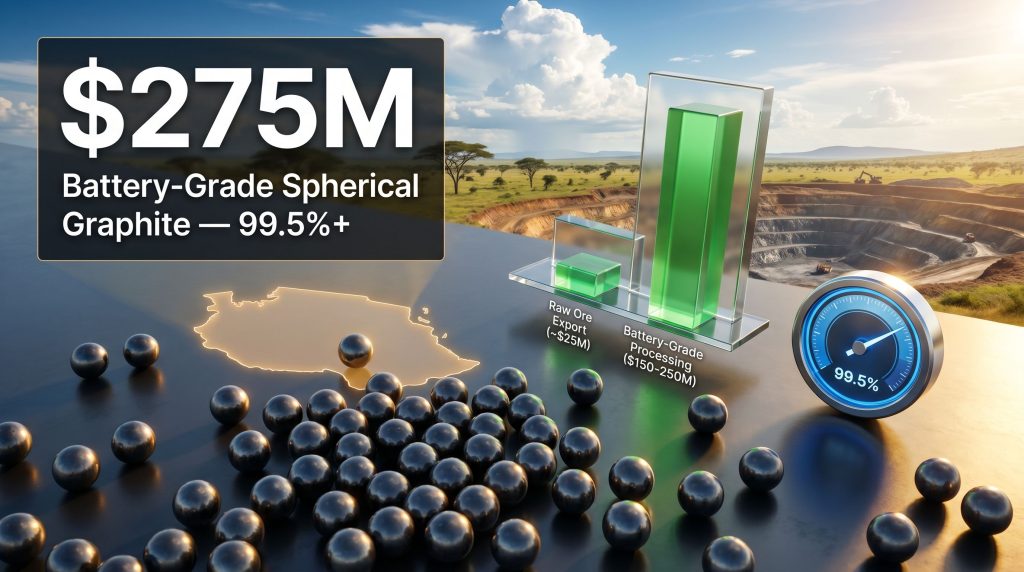
That structural vulnerability is quietly reshaping investment priorities across Africa, and no single announcement has captured this dynamic more sharply than Mohammed Dewji battery-grade graphite investment in Tanzania, worth $275 million. To understand why this commitment matters beyond its headline figure, it helps to start with the material science before moving to the money.
When big ASX news breaks, our subscribers know first
Why Graphite Is the Anode Material the Industry Cannot Replace
Inside a lithium-ion battery, the anode is responsible for storing and releasing lithium ions during charge and discharge cycles. Graphite performs this function with a layered crystalline structure that allows lithium ions to intercalate between carbon planes, a process that is both efficient and reversible over thousands of cycles.
What makes graphite particularly difficult to substitute is that alternative anode chemistries, such as silicon, face durability and volumetric expansion challenges that have so far prevented commercial deployment at automotive scale. Silicon anodes can store roughly ten times more lithium per unit mass than graphite, but they swell dramatically during charging, causing structural degradation over time.
Current EV battery chemistry therefore relies on graphite as the dominant anode material, with silicon used only in small blended proportions to boost energy density incrementally. Each electric vehicle requires between 50 and 100 kilograms of graphite per battery pack depending on cell format and vehicle class. At projected EV production volumes through the end of this decade, the demand trajectory for high-purity graphite is steep and largely inelastic.
Understanding the Purity Divide: Why 99.5% Changes Everything
Not all graphite extracted from the ground is remotely close to what a battery manufacturer can use. The gap between industrial-grade and battery-grade graphite is not a marginal quality difference; it represents an entirely different product requiring distinct processing technologies.
| Graphite Grade | Carbon Purity | Primary End Use | Market Value Relative Index |
|---|---|---|---|
| Industrial / Refractory | 80 to 94% | Lubricants, refractories, electrodes | Lowest |
| High-Carbon Graphite | 94 to 97% | Specialty industrial, precursor feedstock | Moderate |
| Battery-Grade Spherical | 99.5% and above | EV anodes, grid-scale energy storage | Highest |
The journey from raw flake graphite to battery-grade spherical graphite involves two critical processing stages. First, the graphite must be spheronized, a mechanical process that rounds the irregular flake particles into a more uniform spherical shape, which improves packing density and ion diffusion within the anode. Second, the material must be purified to remove impurities, typically through thermal treatment at extremely high temperatures or via chemical acid leaching.
Battery manufacturers in Europe, Japan, and South Korea require independently verified carbon purity of 99.5% or above before a graphite supplier can even enter qualification discussions for Tier 1 automotive programs. Falling short of this threshold, even marginally, disqualifies a supplier entirely.
This purity ceiling explains why most African producers have historically exported raw or semi-processed graphite concentrate rather than finished battery-grade product. The capital intensity and technical complexity of building a spheronisation and purification plant in an emerging market environment have been prohibitive for most operators. Furthermore, the global graphite shortage has made overcoming this barrier all the more urgent. MeTL Group's two-phase approach is specifically designed to navigate it.
China's Processing Monopoly and the Geopolitical Fault Lines It Has Created
China currently accounts for an estimated 60 to 70% of global natural graphite mining output and, more critically, controls over 80% of the world's graphite processing and purification capacity. The spheronisation and thermal purification technologies that convert raw flake graphite into battery-grade material were developed and industrialised almost exclusively within China's manufacturing ecosystem over several decades.
This concentration became a strategic liability for Western governments and EV manufacturers almost overnight. In late 2023, China implemented export controls on graphite-related products, sending an immediate signal to global battery supply chains that sole-source dependence on Chinese processing carried unacceptable geopolitical risk.
The legislative response in Western markets has been significant. Both the European Union's Critical Raw Materials Act and the United States Inflation Reduction Act identify graphite as a priority mineral requiring supply chain diversification. Japan and South Korea, which together host some of the world's largest battery cell manufacturers, have been funding alternative graphite sourcing programmes and encouraging their industrial partners to qualify non-Chinese suppliers.
The convergence of regulatory mandates, geopolitical tension, and accelerating EV demand has created a genuinely rare structural opening for African graphite producers capable of delivering battery-grade material directly into Western and Asian supply chains.
However, one detail that receives insufficient attention in mainstream coverage is the flake size premium. Not all graphite deposits are geologically equal in their suitability for battery-grade production. Large-flake graphite deposits yield a higher proportion of spherical graphite after processing because larger, thicker flakes survive the spheronisation process with fewer fines. Tanzania's graphite belt is characterised by precisely this large-flake morphology, giving its deposits a geological advantage that translates directly into better processing economics and higher product yields compared to fine-flake deposits found in other jurisdictions.
Africa's Graphite Reserve Footprint and Tanzania's Geological Edge
According to African Development Bank data, Africa holds approximately 24% of the world's known natural graphite reserves. The continent's three dominant graphite jurisdictions are Tanzania, Mozambique, and Madagascar, each hosting large-scale flake graphite systems with characteristics relevant to battery-grade processing. In addition, understanding the broader critical minerals demand context helps explain why these reserves are attracting unprecedented global attention.
| Country | Reserve Scale | Processing Infrastructure | Development Status |
|---|---|---|---|
| Tanzania | Large, large-flake dominant | Emerging | Multiple projects at various stages |
| Mozambique | Very Large | Limited domestic processing | Several advanced development projects |
| Madagascar | Significant | Primarily raw export model | Active production |
Tanzania's position within this landscape is particularly compelling for downstream processing investment. Beyond the large-flake geological advantage, the country's mineral policy framework has progressively moved toward requiring greater in-country value addition before export, creating a regulatory environment that structurally supports processing investment over pure extraction.
A lesser-known dynamic in Tanzania's graphite sector is the role of concentrate grade at source. Tanzanian graphite ores typically present with total graphitic carbon grades that allow for efficient beneficiation, meaning the ore can be upgraded to a high-carbon concentrate using conventional flotation methods before advanced purification is applied. This reduces the energy and chemical inputs required at the purification stage, which has direct implications for both operating costs and the environmental profile of the finished product — an increasingly important consideration for European battery manufacturers with sustainability procurement requirements.
MeTL Group's Two-Phase Strategy: Architecture of a Battery-Grade Ambition
Mohammed Dewji's MeTL Group is not a mining company. This distinction matters enormously when evaluating the credibility and strategic logic of the $275 million graphite investment. MeTL is one of East and Central Africa's largest privately held industrial conglomerates, with manufacturing, agriculture, real estate, and infrastructure operations spanning more than a dozen African countries. Forbes has estimated Dewji's net worth at approximately $2.1 billion, reflecting decades of industrial-scale business building across the continent.
The conglomerate structure provides MeTL with competitive advantages that a pure-play mining company cannot replicate: existing logistics networks, regional manufacturing expertise, government relationships built over generations, and an operational culture oriented toward long-term industrial asset building rather than near-term resource monetisation.
The investment plan unfolds across two distinct phases.
Phase 1: Establishing the Processing Foundation
- Commission a graphite processing facility in Tanzania with 50,000 tonnes per year of annual throughput capacity
- Target commissioning within approximately one year from the mid-2026 announcement
- Initial output at approximately 94 to 95% purity, suitable for sale to Chinese graphite refiners and as feedstock for further upgrade
- Generate early revenue and operational learning that de-risks Phase 2 capital deployment
- Estimated initial capital outlay in the range of $25 to $27.5 million
Phase 2: The Battery-Grade Premium Play
- Deploy spheronisation and advanced purification technology to achieve 99.5% battery-grade spherical graphite
- Target direct supply agreements with EV battery manufacturers in Europe, Japan, and South Korea
- Full capital deployment of approximately $250 million
- Capture the substantial price premium that battery-grade material commands over industrial concentrate
The logic embedded in this two-phase architecture is sophisticated: Phase 1 builds cash flow, operational credibility, and processing knowledge within Tanzania before the significantly larger Phase 2 capital commitment is made. It is a staged approach to value chain ascent rather than a single high-risk bet.
Consequently, MeTL's progress in advancing battery-grade graphite production will be closely watched as a benchmark for how African industrial conglomerates can ascend the critical minerals value chain.
The Economics of Processing Locally: Why the Numbers Are Compelling
The case for in-country graphite processing rests on a stark economic arithmetic. Raw graphite concentrate exported at commodity prices captures a fraction of the value that the same material commands once it has been processed to battery-grade specification.
Consider a simplified comparison for the 50,000 tonne per year plant:
| Scenario | Product | Estimated Price per Tonne | Estimated Annual Revenue |
|---|---|---|---|
| Raw export model | Graphite concentrate | ~$500 | ~$25 million |
| Battery-grade processing model | Spherical graphite 99.5%+ | $3,000 to $5,000 | $150 to $250 million |
The value multiplication of 6x to 10x per tonne of processed material illustrates why African governments are increasingly insisting on local value addition as a condition of mineral export licensing. Africa has historically retained less than 1% of the manufacturing value embedded in its own critical mineral reserves, according to data cited by United States trade officials engaged with African mineral sectors. The arithmetic of raw export dependency is simply incompatible with the industrialisation ambitions that governments across the continent are now pursuing.
Dewji articulated precisely this logic at the Africa Unlocked 2026 conference organised by Standard Bank in Cape Town, arguing that renewed global interest in African minerals risks repeating historical extraction patterns unless the continent actively demands greater value retention through downstream processing before export.
The next major ASX story will hit our subscribers first
Key Risks That Investors and Analysts Should Monitor
Despite the compelling strategic rationale, the MeTL graphite investment faces several substantive risks that deserve careful assessment. The evolving battery metals investment landscape adds further complexity to the risk-reward calculation for stakeholders tracking this sector.
Is Technical and Qualification Risk a Major Concern?
Achieving 99.5% purity consistently at commercial scale is technically demanding. The purification process requires precise control of temperature profiles, chemical reagents, and atmospheric conditions. More significantly, battery manufacturer qualification processes typically require 12 to 24 months of sustained supply and testing even after a producer achieves the required purity threshold, meaning the revenue ramp from battery-grade production will lag initial processing milestones.
How Significant Is Financing and Capital Deployment Risk?
A commitment of $250 to $275 million will require structured project financing involving multiple capital sources, potentially including development finance institutions, commercial lenders, and strategic equity partners. Graphite commodity prices are cyclically volatile, and lender confidence in project economics will be sensitive to near-term price movements in the graphite market.
What About Offtake and Market Access Risk?
The competitive landscape for battery-grade graphite is intensifying, with projects in Australia, Canada, and Mozambique also targeting Western EV supply chains. MeTL's existing European partnerships are an encouraging signal, however, formal binding offtake contracts with named battery manufacturers will be the definitive indicator of commercial readiness for Phase 2.
Infrastructure and Energy Cost Risk
Graphite purification, particularly thermal purification at high temperatures, is energy-intensive. Tanzania's power supply reliability and electricity cost structure will materially influence the operating cost profile of a large-scale processing facility. Port and logistics infrastructure capacity will also be relevant to the delivered cost competitiveness of Tanzanian battery-grade graphite in European and Asian markets.
What This Investment Signals for Africa's Critical Minerals Future
The Mohammed Dewji battery-grade graphite investment in Tanzania is significant beyond its capital figure. It represents a model in which an African conglomerate, rather than a foreign mining company, positions itself at the centre of a critical minerals value chain and captures the processing premium that has historically flowed elsewhere.
Several broader implications are worth noting for investors and policymakers tracking Africa's industrial trajectory. Furthermore, these themes connect directly to the wider energy transition minerals conversation unfolding globally, as governments and manufacturers urgently seek supply chain alternatives to Chinese-controlled processing.
- The value chain threshold is shifting. African governments and private sector leaders are increasingly unwilling to accept raw material export models. The MeTL investment is a high-profile expression of this structural shift.
- Geological quality is investable. Tanzania's large-flake graphite geology is a genuine competitive asset, not merely a commodity. Understanding the technical implications of flake size for battery-grade yield is essential for evaluating African graphite projects rigorously.
- Conglomerate capital has structural advantages. MeTL's industrial platform gives it logistical and operational capabilities that greenfield mining developers cannot replicate, reducing execution risk relative to comparable investments by less-established operators.
- Geopolitical alignment creates market pull. The regulatory frameworks in Europe and the United States that incentivise non-Chinese graphite sourcing provide a structural demand tailwind that improves the long-term commercial case for this investment, though formal project-specific support from any government has not been confirmed.
- The proof-of-concept effect matters. A successfully executed battery-grade processing operation in Tanzania could catalyse similar downstream investments across multiple African mineral sectors. Reviewing the graphite industry challenges faced in comparable markets underscores how significant this proof-of-concept could be for the continent's broader critical minerals ambitions.
Disclaimer: This article is intended for informational purposes only and does not constitute financial or investment advice. Projections, revenue estimates, and market scenarios referenced herein are illustrative and subject to significant uncertainty. Readers should conduct independent due diligence before making any investment decisions related to graphite markets, African critical minerals, or companies referenced in this article.
Want to Know When the Next Major Mineral Discovery Hits the ASX?
Discovery Alert's proprietary Discovery IQ model scans ASX announcements in real time, instantly identifying significant mineral discoveries across graphite, battery metals, and more than 30 other commodities — turning complex data into actionable investment insights before the broader market reacts. Explore historic discoveries and the returns they generated, then begin your 14-day free trial at Discovery Alert to position yourself ahead of the next major find.