
June 16, 2026
West African gold consolidation is increasingly about pipeline depth, not just ounces
The Montage Gold acquisition of African Gold highlights a broader shift in mining strategy, where investors increasingly value pipeline depth alongside near-term production. Mining companies can reach a strategic ceiling if they deliver first gold without a second asset, a longer exploration runway, or a credible medium-term growth path.
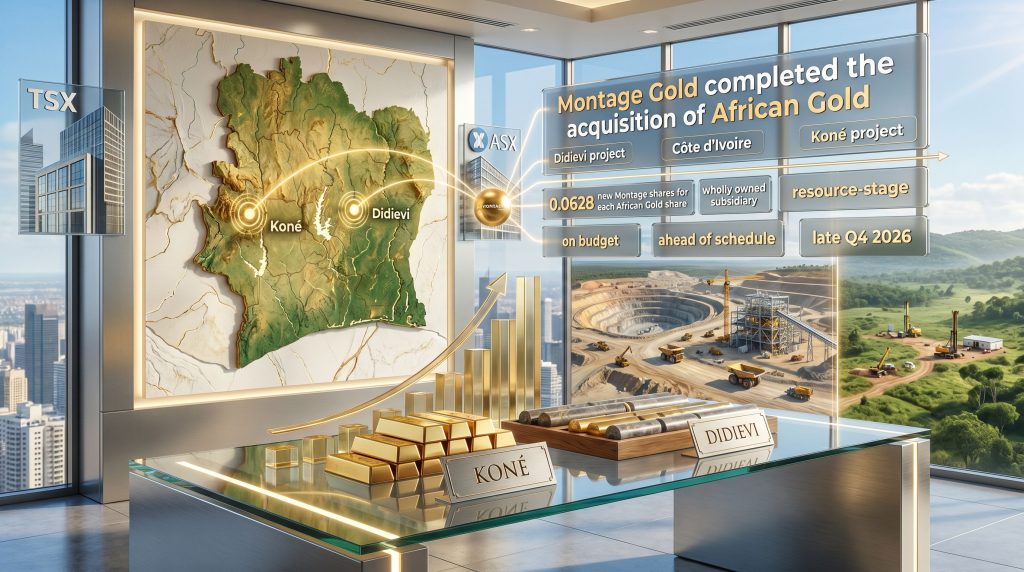
That wider pattern helps explain why the transaction matters beyond the headline deal. On 29 April 2026, TSX-listed Montage Gold completed its acquisition of ASX-listed African Gold, with African Gold becoming a wholly owned subsidiary of Montage.
The deal adds the Didievi project in Côte d’Ivoire to Montage’s portfolio while the company advances its flagship Koné project, which it said remained on budget and ahead of schedule, with first gold pour targeted for late Q4 2026.
In simple terms, Montage Gold completed the acquisition of African Gold through a share exchange, adding the resource-stage Didievi gold project in Côte d’Ivoire. Furthermore, the transaction increases Montage’s exposure to a country where it is already developing Koné towards first gold in late Q4 2026.
This type of mining acquisition is usually less about immediate production uplift and more about building a deeper internal project pipeline around a near-term operating asset.
The hard facts behind the transaction
Confirmed deal details
The core facts disclosed around the transaction are straightforward:
- Acquirer: Montage Gold, listed in Toronto
- Target: African Gold, previously listed in Australia
- Completion date: 29 April 2026
- Structure: African Gold became a wholly owned subsidiary of Montage Gold
- Consideration: Eligible African Gold shareholders received 0.0628 new Montage shares for each African Gold share
- Key acquired asset: Didievi, described as a resource-stage gold project
- Jurisdiction: Côte d’Ivoire
- Montage flagship asset: Koné project
- Koné status at the time of completion: on budget and ahead of schedule
- Koné production target: late Q4 2026 for first gold pour
Why these datapoints matter
Each of these facts shapes how the market is likely to frame the deal:
- Wholly owned subsidiary status means Montage now has full control over African Gold’s assets and corporate direction.
- The fixed share exchange ratio shows this was a scrip-based transaction rather than a cash acquisition.
- The transaction adds a resource-stage project, not a producing mine, which shifts the emphasis towards future optionality rather than immediate earnings.
- Both principal assets sit in Côte d’Ivoire, sharpening both the synergy case and the country concentration risk.
In addition, the company’s own transaction announcement confirms completion and reinforces the strategic framing around regional growth.
When big ASX news breaks, our subscribers know first
How the acquisition reshapes Montage Gold’s portfolio
Before the deal, Montage was primarily seen through the lens of a single major development story centred on Koné. After the acquisition, the company looks more like a multi-asset West African gold platform with one near-term catalyst and one earlier-stage growth option.
Portfolio before and after the deal
| Asset | Country | Stage | Strategic role | Timing relevance | Key risk factor |
|---|---|---|---|---|---|
| Koné | Côte d’Ivoire | Development / construction | Near-term production driver | First gold targeted late Q4 2026 | Construction and ramp-up execution |
| Didievi | Côte d’Ivoire | Resource-stage | Medium-term pipeline depth and exploration optionality | Longer-dated | Resource conversion and development economics |
From single-asset story to broader internal pipeline
That shift matters because the market often discounts developers seen as relying on one critical build. A second project can strengthen the investment case in several ways:
- Future development option if capital becomes available after Koné ramps up
- Resource growth engine if drilling expands the known mineral inventory
- Regional exploration platform in a familiar geological and operating setting
- Strategic buffer if sequencing changes at the flagship asset
This does not automatically make the combined company less risky. However, it does make the balance of risk and reward more layered. In that context, broader trends in mining industry consolidation also help explain why companies are prioritising depth over simple production scale.
What the 0.0628 share exchange ratio means in plain English
The transaction terms state that for every 1 African Gold share, eligible shareholders received 0.0628 new Montage shares.
How a share exchange deal works
| Old holding in African Gold | Exchange ratio | New Montage shares received | Practical meaning |
|---|---|---|---|
| 1,000 shares | 0.0628 | 62.8 Montage shares | Investor shifts from target company shares into acquirer shares |
| 10,000 shares | 0.0628 | 628 Montage shares | Same economic conversion formula applied at scale |
| 100,000 shares | 0.0628 | 6,280 Montage shares | Former African Gold holders become Montage shareholders |
Why miners often use scrip instead of cash
For mining companies, especially those funding construction, a share-based acquisition can be attractive because it can:
- Preserve balance sheet flexibility
- Avoid immediate cash strain
- Align acquired shareholders with future upside and downside
- Reflect relative valuation between buyer and target
A fixed share exchange ratio is also a statement about risk sharing. Former African Gold holders now participate in Montage’s future performance, including Koné execution and any upside from Didievi.
Existing Montage shareholders, however, need to consider dilution. New shares issued to complete the acquisition expand the share base, which can be justified if the acquired asset improves long-term value creation more than it dilutes per-share upside.
Why Côte d’Ivoire remains central to the strategic case
A major reason the deal stands out is its location. Both Koné and Didievi are in Côte d’Ivoire, reinforcing Montage’s focus on one of West Africa’s more active gold development jurisdictions.
Benefits of jurisdictional concentration
Operating within one country can create practical advantages:
- Shared regulatory knowledge and permitting familiarity
- Continuity in stakeholder engagement
- More efficient logistics planning
- In-country technical capability
- Geological learning transfer
For developers, that concentration can reduce duplication and strengthen execution discipline.
The counterpoint: single-country risk
The same concentration also raises exposure to country-level issues, including:
- fiscal changes
- regulatory shifts
- permitting delays
- infrastructure constraints
- sovereign and operating risk
That does not mean concentration is inherently negative. Rather, investors should weigh a possible regional expertise premium against a possible country concentration discount.
How Koné and Didievi may complement each other
The combined portfolio now pairs a development-stage asset with a resource-stage asset, which is often a logical structure for an emerging producer.
Why the pairing matters
- Koné is the execution story. It is the nearer-term source of rerating if construction stays on plan.
- Didievi is the optionality story. It gives investors a reason to look beyond the first pour.
This matters because many companies face a post-build narrative gap. If a mine enters production with no visible follow-on project, the market may focus almost entirely on ramp-up performance and near-term cash flow.
Adding Didievi helps Montage avoid being viewed solely as a one-asset build story. Moreover, the company’s published strategic partnership details suggest this transaction had a longer lead-in than a simple opportunistic takeover.
Questions analysts should now be asking
- What is the updated roadmap for Didievi under Montage ownership?
- Will Didievi be advanced as a standalone asset, a long-dated option, or a regional growth platform?
- How will capital allocation evolve after first gold at Koné?
- Are new drilling, metallurgy, or resource conversion programmes planned?
For instance, investors will likely watch for whether a future definitive feasibility study becomes part of Didievi’s advancement pathway.
Upside drivers and risks after the takeover
A balanced analysis of the transaction needs to separate confirmed facts from forward-looking interpretation.
Bull case, base case, and risk case
| Scenario | Koné outcome | Didievi progress | Funding flexibility | Jurisdiction outlook | Likely market interpretation |
|---|---|---|---|---|---|
| Bull case | Delivered on schedule with strong ramp-up | Steady technical advancement and exploration success | Stronger after production begins | Stable | Montage gains credibility as builder plus pipeline owner |
| Base case | First gold broadly on track | Didievi remains longer-dated | Measured | Stable to mixed | Market focuses mainly on Koné execution |
| Risk case | Construction or ramp-up slippage | Didievi requires more work before clear development path | Tighter | More uncertain | Deal seen as strategically reasonable but poorly timed |
Main upside drivers
- Successful Koné ramp-up
- Maintenance of the current on-budget and ahead-of-schedule profile
- Visible progress at Didievi
- A stronger market view of Montage as an emerging producer with pipeline depth
- Potential future relevance amid rising gold M&A activity
Principal risks
- Execution risk before Koné reaches first gold
- Integration risk following the absorption of African Gold
- Dilution concerns from the share-based structure
- Country concentration risk in Côte d’Ivoire
- Resource-stage uncertainty around Didievi’s economics and timing
Investors should treat any timeline or valuation uplift beyond the disclosed facts as forward-looking and uncertain. Resource-stage assets can change materially as drilling, metallurgy, engineering, and permitting work progress.
The next major ASX story will hit our subscribers first
How investors may interpret the deal
For existing shareholders, the main question is whether added optionality justifies dilution. If Koné remains the primary near-term value driver, shareholders will likely accept dilution only if Didievi improves long-term growth visibility without weakening execution focus.
For former African Gold shareholders, the acquisition changes the risk profile. Instead of holding exposure mainly to a resource-stage project, they now have equity in a company with a nearer-term production catalyst through Koné.
For broader sector investors, the lens may shift towards an emerging producer with a second growth asset. Consequently, sentiment may also be influenced by how the market is pricing gold price and mining equities and whether developers with future options start to look like undervalued mining stocks.
Due diligence points that deserve close attention
High-quality analysis should verify more than the headline deal terms.
Corporate and transaction checks
- Exchange filings confirming final completion terms
- Share issuance mechanics and resulting dilution
- Eligibility terms for African Gold shareholders
- Post-acquisition governance and subsidiary structure
Asset-level checks
- The latest Didievi resource statement
- Drilling and metallurgy updates
- Permitting status and development studies
- Ongoing Koné construction progress disclosures
Country and operating checks
- Côte d’Ivoire mining and fiscal settings
- Infrastructure and power availability
- Community engagement milestones
- Sovereign and security context
A useful rule is simple: distinguish confirmed disclosures from market interpretation. The former is factual, while the latter may prove right or wrong over time.
FAQ: Montage Gold acquisition of African Gold
What did Montage Gold acquire from African Gold?
Montage acquired African Gold in full, making it a wholly owned subsidiary and adding the Didievi project in Côte d’Ivoire to its portfolio.
What is the Didievi project and where is it located?
Didievi is described as a resource-stage gold project located in Côte d’Ivoire.
What does 0.0628 Montage shares per African Gold share mean?
It means each eligible African Gold shareholder received 0.0628 new Montage shares for every African Gold share held at completion.
Is African Gold still an independent listed company after the deal?
No. Based on the disclosed completion terms, African Gold became a wholly owned subsidiary of Montage Gold.
Why is Côte d’Ivoire important for gold miners?
It is an active West African gold jurisdiction where companies may benefit from regional scale, local operating familiarity, and clustered technical capability. However, concentration in one country also increases exposure to jurisdiction-specific risk.
How does this affect the Koné project timeline?
The disclosed transaction terms do not indicate a change to Koné’s timeline. Montage stated Koné remained on budget, ahead of schedule, and targeted late Q4 2026 for first gold pour at the time of completion.
Final takeaways
The Montage Gold acquisition of African Gold expands Montage’s footprint in Côte d’Ivoire, adds the resource-stage Didievi project, and converts African Gold into a wholly owned subsidiary through a 0.0628 share exchange ratio.
Strategically, the Montage Gold acquisition of African Gold appears more significant for pipeline depth than for immediate production growth. The central test now is execution. If Koné reaches first gold in late Q4 2026 and Didievi is advanced with capital discipline, Montage may strengthen its standing as a West African developer moving towards emerging producer status with a broader internal growth runway.
Could The Next Major Gold Discovery Be Identified Earlier?
Discovery Alert’s proprietary Discovery IQ model delivers real-time alerts on significant ASX mineral discoveries, helping investors spot actionable opportunities before the broader market reacts. See how historic discoveries have delivered exceptional returns on the Discovery Alert discoveries page and start a 14-day free trial through the Discovery Alert home page.