Mount Ridley Mines Ltd
Mount Ridley Mines Uncovers High-Grade Scandium Beyond Known Resource, Opening 13km of Untested Ground
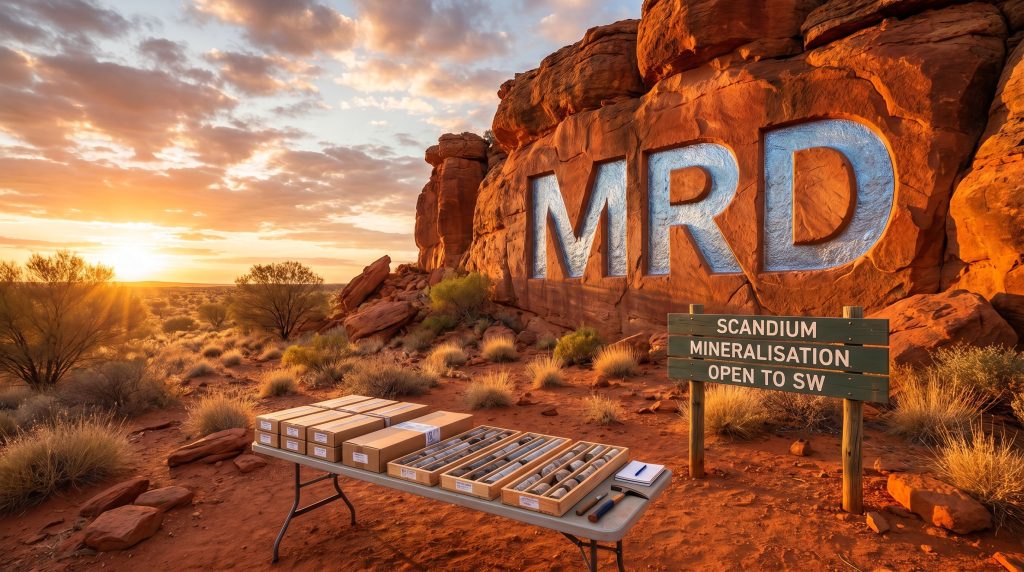
Mount Ridley Mines Ltd (ASX: MRD) has delivered a significant exploration result, confirming that its Grass Patch Complex in Western Australia hosts substantial scandium mineralisation well outside its current defined resource boundary. The Mount Ridley Mines Grass Patch scandium reassay results from Phase 1 of the company's programme have returned grades consistently above the existing resource average, confirmed a brand-new mineralised zone at the southwestern margin, and revealed roughly 13 kilometres of completely untested strike sitting between that zone and the nearest resource block.
For a company already holding one of the larger scandium resources globally, this announcement suggests the full scale of the system may be considerably larger than the numbers currently on the books.
When big ASX news breaks, our subscribers know first
What Did the Reassay Programme Actually Find?
The concept underpinning the programme is straightforward: Mount Ridley's Grass Patch Project was built on a historical drilling database of more than 70,000 metres of aircore and diamond drilling, much of it completed before scandium was recognised as a commercially significant critical mineral. As a result, a large number of pulp samples were never assayed for scandium at the time of collection.
Rather than spending time and capital on new field drilling, Mount Ridley's team went back to these stored pulps and submitted them for modern assay. Phase 1 covered 3,271 samples, targeting areas adjacent to and beyond the current resource boundary where geology was considered favourable for scandium enrichment.
The results confirm the strategy was well placed.
Exceptional Grades at the Southwestern Margin
The standout results from the Mount Ridley Mines Grass Patch scandium reassay results came from a cluster of drillholes at the southwestern extent of the Grass Patch Complex. Every significant intercept in this cluster exceeded the current resource average grades of 91.8 ppm Sc₂O₃ (Block 1) and 86.9 ppm Sc₂O₃ (Block 2).
Table 1: Phase 1 Significant Scandium Intercepts — Southwestern Cluster
| Hole ID | From (m) | To (m) | Interval (m) | Sc (ppm) | Sc₂O₃ (ppm) | vs. Block 1 Avg (91.8 ppm) |
|---|---|---|---|---|---|---|
| MRAC1057 | 7 | 25 | 18 | 73.38 | 114.38 | +25% |
| MRAC1060 | 9 | 18 | 9 | 99.68 | 152.89 | +66% |
| MRAC1062 | 9 | 21 | 12 | 69.76 | 107.0 | +17% |
| MRAC1063 | 9 | 19 | 10 | 83.32 | 127.8 | +39% |
| MRAC1065 | 6 | 19 | 13 | 89.72 | 137.61 | +50% |
| MRAC1066 | 9 | 18 | 9 | 86.70 | 132.98 | +45% |
| MRAC1067 | 18 | 34 | 16 | 54.70 | 83.9 | Below avg |
| MRAC1068 | 15 | 35 | 20 | 75.88 | 116.39 | +27% |
Several of these intercepts are broad and near-surface, which carries practical significance for any future development scenario. The best single result — MRAC1060 returning 9m at 152.89 ppm Sc₂O₃ from 9m depth — sits at 66% above the current Block 1 resource average.
Equally important is the spatial distribution of the results. The highest grades are concentrated at the outermost southwestern end of drilling, which implies that mineralisation does not fade as the system extends away from the known resource. If anything, the data suggests the opposite.
"Phase 1 of our Scandium Reassay Program has confirmed what we suspected: the Grass Patch Complex extends well beyond what we currently have defined. The grades at the southwestern end are above our existing resource average and they sit at the far end of a 13-kilometre corridor that has not yet been touched by the drill bit. We will now work quickly to incorporate these results into the resource model and assess the most appropriate pathway to test the strike extension."
— Allister Caird, Managing Director & CEO, Mount Ridley Mines Ltd
Understanding the Existing Resource Base
To appreciate why the Mount Ridley Mines Grass Patch scandium reassay results matter, it helps to understand the scale of what Mount Ridley already has in the ground at Grass Patch.
Table 2: Mount Ridley Mines — JORC 2012 Inferred Mineral Resource Summary
| Commodity | Tonnage | Average Grade | Contained Metal |
|---|---|---|---|
| Scandium | 367.98 Mt | 57.3 ppm Sc / 87.9 ppm Sc₂O₃ | 18,855 t Sc / 28,920 t Sc₂O₃ |
| Gallium | 838.77 Mt | 29.3 ppm Ga / 39.5 ppm Ga₂O₃ | 24,584 t Ga / 33,045 t Ga₂O₃ |
| Rare Earth Oxides | 122.55 Mt | 889 ppm TREO / 364 ppm HREO | 108,954 t TREO / 44,610 t HREO |
| TREO (Mia Prospect) | 168.00 Mt | 1,201 ppm TREO | — |
All resources are classified as JORC 2012 Inferred. Phase 1 results are expected to be incorporated into the resource model immediately, targeting a potential update and upgrade to the existing estimate.
The remaining ~14,000 historical pulps available for re-assay form the pipeline for subsequent phases of the programme.
A Capital-Efficient Path to Resource Growth
One of the more compelling aspects of the Scandium Reassay Programme is how little it costs relative to what it can potentially deliver. Traditional resource expansion requires new field drilling — mobilising rigs, cutting new holes, managing logistics. Re-assaying stored pulps bypasses all of that.
The drill samples already exist. The geological work has already been done. Mount Ridley is simply applying modern scandium assay methods to material that was collected years ago and never tested for this element.
What This Means in Practice
- No new drilling costs for Phase 1 or Phase 2 sample generation
- Results feed directly into the existing resource model
- Approximately 14,000 additional pulps remain available for re-assay, representing a substantial pipeline of low-cost resource definition work
- The programme can be executed in stages, allowing the company to prioritise the highest-value areas first
Furthermore, the 13km untested strike corridor — sitting between the newly confirmed southwestern zone and the southern boundary of MRE Block 1 — has been flagged as the highest-priority target for Phase 2 coverage.
What Is a Scandium Resource Average Grade and Why Does It Matter?
Mineral Resource grade refers to the average concentration of a target element across the entire defined resource body. For Mount Ridley's Block 1, this average is 91.8 ppm Sc₂O₃ — meaning that across the entire estimated tonnage, every tonne of material contains roughly 91.8 parts per million of scandium oxide, on average.
When exploration results consistently exceed this average — as the Mount Ridley Mines Grass Patch scandium reassay results do — it tells investors two important things:
- The new zones are at least as economically attractive as what is already defined, and potentially more so.
- Incorporating these results into the resource model has the potential to increase not just the total resource tonnage, but also the average resource grade, which typically has a more significant effect on project economics.
The fact that the highest grades appear at the farthest extent of current drilling also suggests the system remains open in that direction — a term miners use to indicate that mineralisation has not been pinned down at its edges, meaning more may lie beyond.
Glossary of Key Terms
| Term | Definition |
|---|---|
| Sc₂O₃ (Scandium Oxide) | The oxidised form of scandium, the standard measurement unit for scandium resources. Converted from elemental Sc using a factor of 1.5883. |
| ppm (Parts Per Million) | A measure of grade concentration. 100 ppm Sc₂O₃ means 100 grams of scandium oxide per tonne of rock. |
| JORC 2012 | The Australasian Code for Reporting of Exploration Results, Mineral Resources and Ore Reserves. The industry standard for resource reporting in Australia. |
| Inferred Resource | The lowest confidence category of JORC resource classification, based on limited data. Subject to upgrade as more information is gathered. |
| Strike Extension | The horizontal continuation of a mineralised zone beyond current drilling limits, indicating untested ground along the same geological trend. |
| AC Drilling (Aircore) | A lightweight drilling method using a blade bit, suited to shallow regolith-hosted mineralisation. Cost-effective for resource definition work. |
| Regolith | Weathered rock and soil material at the surface. Scandium at Grass Patch is hosted within the regolith profile, making it near-surface and accessible. |
| TREO / HREO | Total Rare Earth Oxide / Heavy Rare Earth Oxide — collective measures of rare earth content, with HREO referring to the more commercially valuable heavy rare earths. |
| MRE | Mineral Resource Estimate — a JORC-compliant estimate of the quantity and grade of mineralisation in the ground. |
Scandium Supply: The Context Behind the Results
Scandium is classified as a critical mineral by Australia, the United States, and the European Union. Global annual production is measured in only tens of tonnes of oxide equivalent, with no meaningful supply outside China, Russia, and limited byproduct sources.
In April 2025, China placed scandium under mandatory export licensing alongside six other heavy rare earth elements, materially tightening supply availability to Western buyers. The downstream effect has been tangible: US-bound rare earth exports fell sharply in the months following the controls, with aerospace and semiconductor manufacturers reporting inventory stress and allocation constraints.
Demand for scandium is forecast to grow at a compound annual growth rate of approximately 14.5% through to 2031, driven primarily by:
- Solid oxide fuel cells — where scandium-stabilised zirconia is a key performance material
- Aerospace aluminium-scandium alloys — a small addition of scandium meaningfully strengthens aluminium, reducing weight in aircraft structures
- Additive manufacturing — scandium aluminium alloys are increasingly used in high-performance 3D-printed components
Against this backdrop, the strategic relevance of a large, near-surface scandium resource in Western Australia — a Tier 1 jurisdiction and allied-nation-friendly location — is growing considerably. Mount Ridley's Grass Patch Project is already among the larger scandium resources globally, and Phase 1 suggests the full extent of the system has not yet been captured.
What Comes Next for Mount Ridley Mines?
Mount Ridley has outlined a clear near-term workplan following Phase 1 completion.
Immediate Priorities
- Resource model update — Phase 1 results to be incorporated immediately, targeting an update and potential upgrade of the current JORC 2012 Inferred Mineral Resource
- Phase 2 scoping — The company is designing Phase 2 of the Scandium Reassay Programme, prioritising the 13km untested corridor between the newly confirmed southwestern zone and MRE Block 1, drawing from the remaining ~14,000 unassayed historical pulps
- Further assay results — Remaining results from ALS will be announced to the market as they are received and reviewed
Upcoming Catalysts to Monitor:
| Milestone | Details |
|---|---|
| Resource model update | Incorporating Phase 1 results into the JORC MRE, targeting a potential resource upgrade |
| Phase 2 Reassay Programme | Scoping and execution of re-assay coverage across the 13km untested strike corridor |
| Additional assay releases | Ongoing results from ALS as remaining Phase 1 and future Phase 2 samples are processed |
| Field programme assessment | Timing and scope of potential field drilling into the 13km corridor to be confirmed following resource model update |
The next major ASX story will hit our subscribers first
Why Investors Should Watch Mount Ridley Mines
Phase 1 of the Scandium Reassay Programme has done exactly what it was designed to do: generate material new information at low cost from an existing dataset. The results go further than simply confirming what was suspected — they establish a new high-grade mineralised zone and reveal that the most prospective ground at Grass Patch may extend well beyond what is currently on the map.
Several factors make this development worth tracking closely:
- Scale of the existing resource base — nearly 368 Mt of scandium mineralisation and 839 Mt of gallium already defined, with the reassay programme pointing toward further growth
- Low-cost resource expansion pathway — ~14,000 historical pulps remaining provide a substantial, capital-efficient pipeline of future resource definition work
- Grade quality — Phase 1 intercepts consistently exceed current resource averages, with the best result running at 66% above Block 1 average grade
- System remains open — the 13km untested strike corridor, with grades intensifying toward its outer edge, represents significant exploration upside
- Critical mineral demand fundamentals — scandium demand forecast to grow at ~14.5% CAGR to 2031, with supply tightening from Chinese export controls
- Tier 1 location — 25km from the deep water port of Esperance, Western Australia, with 70,000m of existing historical drilling reducing future exploration risk
Mount Ridley Mines has demonstrated that the Grass Patch Complex is a larger scandium system than its current resource boundary defines. With high-grade Phase 1 results above resource averages, a new mineralised zone confirmed, 13km of untested strike identified, and a capital-efficient re-assay pipeline ready for execution, the company is positioned at an important inflection point. As Phase 2 takes shape and the resource model is updated, there are multiple near-term catalysts for investors to follow closely.
Want to Be First When the Next Major Scandium Discovery Hits the ASX?
Discovery Alert's proprietary Discovery IQ model scans ASX announcements in real time, instantly identifying significant mineral discoveries — including critical minerals like scandium — and delivering actionable alerts directly to subscribers before the broader market reacts. Explore historic examples of exceptional discovery returns and start your 14-day free trial at Discovery Alert to position yourself ahead of the next major mineral discovery.