
May 14, 2026
Inside the Zambian Copperbelt's Next Big Copper Exploration Push
Sediment-hosted copper systems have a remarkable geological quirk that makes them uniquely attractive to large-scale miners: the mineralisation tends to be predictable, laterally continuous, and architecturally consistent across vast strike lengths. Unlike the erratic, structurally controlled ore bodies that define many gold or base metal deposits elsewhere, the stratiform copper deposits of Zambia's Central African Copperbelt follow sedimentary layering with a reliability that exploration geologists prize above almost any other geological setting on earth. It is within this context that the Prospect Resources Mumbezhi copper project drilling program takes on its full significance, not merely as a routine exploration update, but as a technically deliberate campaign targeting a system that has already demonstrated large-tonnage potential and is now being tested for district-scale proportions.
When big ASX news breaks, our subscribers know first
What Makes Mumbezhi's Geological Setting Exceptional
The Central African Copperbelt stretches across Zambia and the Democratic Republic of Congo and represents one of the most productive copper-producing regions in recorded mining history. The copper mineralisation in this belt is hosted within the Katangan Supergroup, a sequence of Neoproterozoic sedimentary rocks that were deposited in a basin environment and subsequently folded and faulted during multiple tectonic events. What this architecture creates is a series of stratabound ore horizons that, where well-preserved, can extend for kilometres along strike and hundreds of metres down dip.
Mumbezhi sits within the northwest Zambian corridor of this mineralised system. Furthermore, understanding Zambia copper growth trends helps contextualise why this region continues to attract serious exploration capital. Prospect Resources (ASX: PSC) holds a 90% ownership stake in the Mumbezhi Mining Licence, a controlling position that preserves full development optionality and maximises leverage to any resource expansions delivered by ongoing drilling.
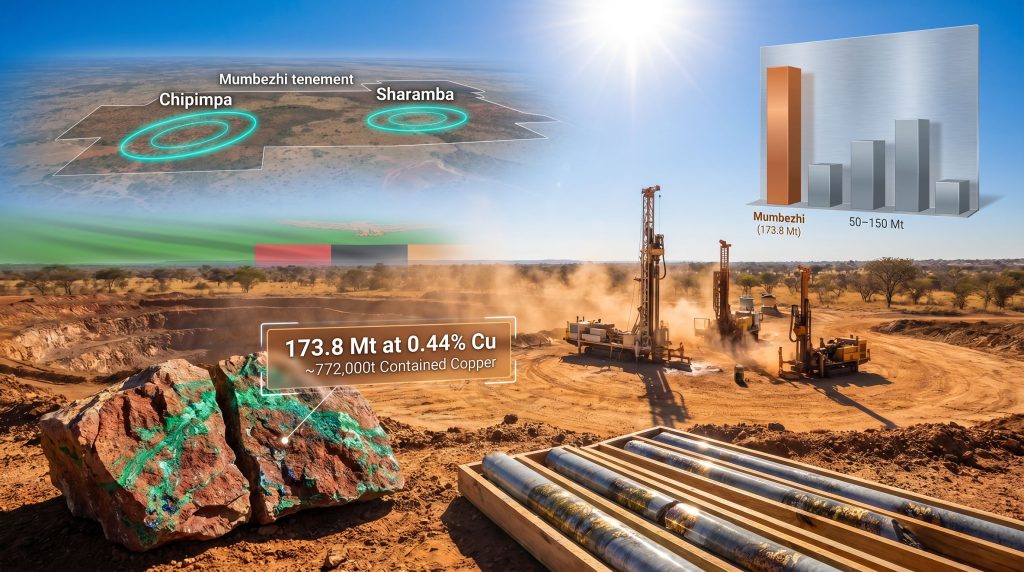
The geological foundation already established at the project's flagship Nyungu Central deposit is substantial. The current mineral resource estimate stands at 173.8 million tonnes (Mt) at 0.44% copper, with a copper equivalent grade of 0.50% CuEq when cobalt and gold credits are factored in. That yields approximately 772,000 tonnes of contained copper, a figure that places Mumbezhi firmly in the upper tier of early-stage Copperbelt exploration projects by contained metal inventory.
A critical but often underappreciated detail is the resource classification split. More than 40% of the resource sits in the Indicated category, meaning it has been defined with a sufficient level of geological confidence to be used in preliminary economic assessments. In junior mining terms, this degree of resource confidence at the current development stage is a meaningful differentiator. Many early-stage projects carry resources that are overwhelmingly Inferred, carrying higher geological uncertainty and requiring more drilling before they can support bankable studies.
The presence of cobalt and gold alongside copper is more than a revenue footnote. In sediment-hosted Copperbelt systems, cobalt in particular occurs as a natural geochemical companion to copper mineralisation, offering genuine by-product revenue potential that can materially shift project economics at feasibility stage.
Breaking Down the Phase 3 Drilling Program
Why Three Drilling Techniques Are Better Than One
The drilling programs underpinning the Prospect Resources Mumbezhi copper project drilling campaign are structured around approximately 410 holes totalling roughly 26,000 metres, combining three distinct drilling methodologies. This is not an arbitrary combination. Each technique serves a specific purpose within a coherent technical strategy.
| Drilling Method | Approximate Hole Count | Primary Application |
|---|---|---|
| Diamond Core (DD) | Up to 60 holes | Resource definition, metallurgical sampling, structural geology |
| Reverse Circulation (RC) | Up to 30 holes | Grade continuity, shallow resource extension |
| Aircore (AC) | Up to 320 holes | Regional reconnaissance, regolith sampling, new target testing |
| Total Program | ~410 holes / ~26,000m | Resource expansion and regional discovery |
Diamond core drilling produces intact cylindrical rock samples that preserve the geological context of mineralisation including orientation, texture, and structural relationships. For metallurgical test work, this sample quality is non-negotiable. Comminution and flotation studies require material that accurately represents the ore as it exists in the ground, and core samples provide exactly that.
Reverse circulation drilling uses a dual-wall drill string that delivers crushed rock chips to surface in a sealed inner tube, minimising contamination. It is faster and cheaper than diamond core but lacks the structural detail. For grade verification along strike and testing shallow extensions, RC represents a strong cost-to-information ratio.
Aircore drilling is the workhorse of regional reconnaissance. Capable of advancing rapidly through shallow regolith and weathered rock, aircore is the go-to tool when the objective is covering ground efficiently across large areas. With 320 aircore holes planned, the program is clearly designed to systematically test the broader tenement package at a pace that diamond drilling alone could never achieve economically.
The Regional Targets: Where Discovery Potential Is Highest
Beyond Nyungu Central, the Phase 3 campaign targets several regional prospects that emerged from the comprehensive geophysical and geochemical survey program completed across the tenement in 2025. The two highest-priority targets are Chipimpa and Sharamba.
Both Chipimpa and Sharamba are defined by electromagnetic (EM) conductor anomalies that exceed 2 kilometres in strike length. Crucially, the scale, geometry, and conductivity characteristics of these targets are described as comparable to the geophysical signature of the Nyungu Central deposit itself. This analogy is significant because it suggests that the same type of mineralised system that produced the 173.8 Mt resource may be present at these locations.
Additional targets including Kamafamba, Chalamba, West Mwombezhi, and Shikezi round out the regional testing program. West Mwombezhi is specifically earmarked for aircore reconnaissance, consistent with its earlier-stage characterisation. Kamafamba and Chalamba represent newer targets identified during the 2025 survey campaign.
How Geophysics Built the Targeting Framework
The Science Behind EM and IP Surveys in Copper Exploration
One of the most technically sophisticated aspects of the Phase 3 program is the concurrent deployment of ground-based induced polarisation (IP) geophysics across priority prospects including Chipimpa, Kamafamba, Shikezi, and Luamvunda.
IP surveys work by injecting electrical current into the ground and measuring the delayed decay of the resulting voltage signal. Sulphide minerals, which are the primary carriers of copper in Copperbelt-style deposits, have a distinctive IP response that distinguishes them from barren rock. When IP data is overlaid with existing EM anomalies and soil geochemistry, the result is a multi-layer targeting picture that dramatically reduces the risk of drilling unproductive holes.
What makes the concurrent IP approach particularly intelligent is its iterative character. As drill results arrive, they can be cross-referenced against the IP response in real time, allowing the exploration team to refine subsequent drill collars with progressively greater precision. This feedback loop between geophysical data collection and active drilling is a hallmark of technically disciplined exploration management.
The four-month planning interval between Phase 2 completion and Phase 3 commencement, however, rather than reflecting hesitation, demonstrates the depth of analytical work invested in target refinement before a single drill metre was committed.
Metallurgical Work: Building the Path to Feasibility
Why Ore Processing Data Matters at This Stage
A portion of the Phase 3 diamond drilling has been specifically designed to supply samples for a comprehensive metallurgical test work program covering copper, cobalt, and gold. This dual-purpose drilling strategy, simultaneously defining the resource and collecting processing data, is a sophisticated approach to compressing the timeline between exploration and feasibility. Understanding modern copper processing methods is consequently becoming an essential part of evaluating project economics at this stage.
The metallurgical programme encompasses three key workstreams:
-
Comminution test work assesses how hard the ore is and how much energy will be required to crush and grind it to a particle size suitable for flotation. Early comminution data directly informs capital cost estimates for processing plant design.
-
Flotation test work examines how effectively copper, cobalt, and gold can be recovered into a saleable concentrate using reagent-assisted bubble flotation. The expected feed ratios for both fresh and transitional material types at Mumbezhi are being used to design representative test programs.
-
Initial variability testing maps how metallurgical behaviour changes across the deposit footprint. Transitional ore zones, which occupy the boundary between oxidised and fresh sulphide rock, often behave differently in processing circuits and can significantly affect overall recoveries if not characterised early.
Copperbelt deposits that carry cobalt alongside copper introduce additional complexity into flotation circuit design. Cobalt recovery typically requires careful reagent selection and circuit configuration, but when successfully optimised, it can add meaningful revenue per tonne processed. Starting this work at Phase 3 rather than waiting for a Pre-Feasibility Study compresses the development timeline considerably.
Capital Position and What the A$45 Million Raise Signals
Reading Investor Confidence Through Placement Participation
The Phase 3 program is underwritten by a recently completed A$45 million equity placement that attracted participation from both existing shareholders and new investors. At a market capitalisation of approximately A$252.3 million at the time of the Phase 3 announcement, the placement represents a capital injection of roughly 18% of the company's market value, a substantial proportional raise that signals meaningful institutional conviction in the project's trajectory.
The capital raised is intended to fund not just Phase 3, but to provide an operational runway estimated at 18 to 24 months, encompassing a broader campaign of approximately 50,000 metres of drilling planned across 2026 and 2027. Phase 3's roughly 26,000 metres therefore represents the first major tranche of a multi-year exploration commitment, with the balance of the broader programme to follow as results are assimilated and targets are refined.
For exploration-stage investors, the absence of near-term funding risk is a critical de-risking factor. Projects that must interrupt drilling to conduct emergency capital raises lose momentum, delay resource updates, and often suffer share price consequences that dilute the value of earlier exploration success.
The next major ASX story will hit our subscribers first
Benchmarking Mumbezhi Against Copperbelt Peers
| Metric | Mumbezhi (Prospect Resources) | Typical Early-Stage Copperbelt Peer |
|---|---|---|
| Resource Size | 173.8 Mt at 0.44% Cu | 50 to 150 Mt at 0.4 to 0.6% Cu |
| Contained Copper | ~772 kt | 200 to 600 kt |
| Indicated Proportion | More than 40% | 20 to 35% |
| Drilling Stage | Phase 3 multi-technique | Phase 1 to 2 |
| By-Products | Cobalt and Gold | Typically copper only |
| Ownership | 90% | Varies, 50 to 85% |
The resource base already established at Nyungu Central compares favourably across every key metric. Broader copper market trends in 2025 further reinforce why projects with this scale of contained metal are attracting renewed investor interest. The by-product profile is a particular differentiator, as most early-stage Copperbelt peers are single-commodity copper plays. Mumbezhi's cobalt and gold credits at Nyungu Central introduce a revenue diversification layer that becomes progressively more valuable as the project advances toward economic study.
What Successful Phase 3 Outcomes Look Like
Three Scenarios for Program Delivery
Base Case: Step-out drilling at Nyungu Central adds modest tonnage to the resource, with one or two regional targets returning positive aircore results that warrant follow-up RC or diamond drilling in a subsequent phase. Resource category conversion from Inferred to Indicated advances.
Bull Case: Chipimpa or Sharamba returns diamond drill intercepts comparable in grade and width to the best intersections at Nyungu Central, triggering work toward a maiden resource estimate for a second deposit within the same mining licence. The Mumbezhi project begins to be characterised as a multi-deposit system.
Stretch Case: Simultaneous positive results across Chipimpa, Sharamba, and Kamafamba, combined with material resource upgrades at Nyungu Central, positions Mumbezhi as a multi-deposit copper district with aggregate resources that could approach or exceed 250 Mt. At this scale, the Prospect Resources Mumbezhi copper project drilling effort enters a different class of development conversation entirely.
Disclaimer: The scenario projections above are speculative in nature and are presented for analytical framing purposes only. They do not constitute financial advice. Actual drilling outcomes may differ materially from any projections. Investors should conduct independent due diligence and consult a licensed financial adviser before making investment decisions.
Frequently Asked Questions
What is the Mumbezhi copper project?
Mumbezhi is a large-scale copper exploration and development project in northwest Zambia's Central African Copperbelt, held 90% by Prospect Resources (ASX: PSC). It hosts a mineral resource of 173.8 Mt at 0.44% copper, with cobalt and gold by-products. In addition, interpreting drill results from the project requires understanding the unique geological characteristics of this sediment-hosted system.
What does the Phase 3 drilling program involve?
Phase 3 comprises approximately 410 holes across around 26,000 metres, using diamond core, reverse circulation, and aircore drilling techniques. It targets resource expansion at Nyungu Central and new discoveries across regional prospects. Further details are available in the official project update released by Prospect Resources.
Why are Chipimpa and Sharamba considered high priority?
Both targets are defined by electromagnetic conductor anomalies exceeding 2 kilometres in strike length, with geophysical characteristics described as geometrically and conductively comparable to the Nyungu Central deposit.
How is Phase 3 funded?
Through a recently completed A$45 million equity placement that attracted participation from both existing and new investors, providing an estimated 18 to 24 months of operational runway.
What metallurgical work is underway?
A portion of the diamond drilling is supplying samples for comminution testing, flotation test work, and variability testing across copper, cobalt, and gold, covering both fresh and transitional ore types.
How large is the broader 2026 to 2027 drilling commitment?
Prospect Resources has indicated a total programme of approximately 50,000 metres across 2026 and 2027, with the current Phase 3 program of around 26,000 metres representing the opening tranche of that larger campaign.
Want to Stay Ahead of the Next Major Copper Discovery on the ASX?
Discovery Alert's proprietary Discovery IQ model delivers real-time alerts the moment significant mineral discoveries are announced on the ASX, transforming complex exploration data across more than 30 commodities into clear, actionable insights for investors at every level — explore historic discovery returns to understand the scale of opportunity, then start your 14-day free trial at Discovery Alert to position yourself ahead of the broader market.