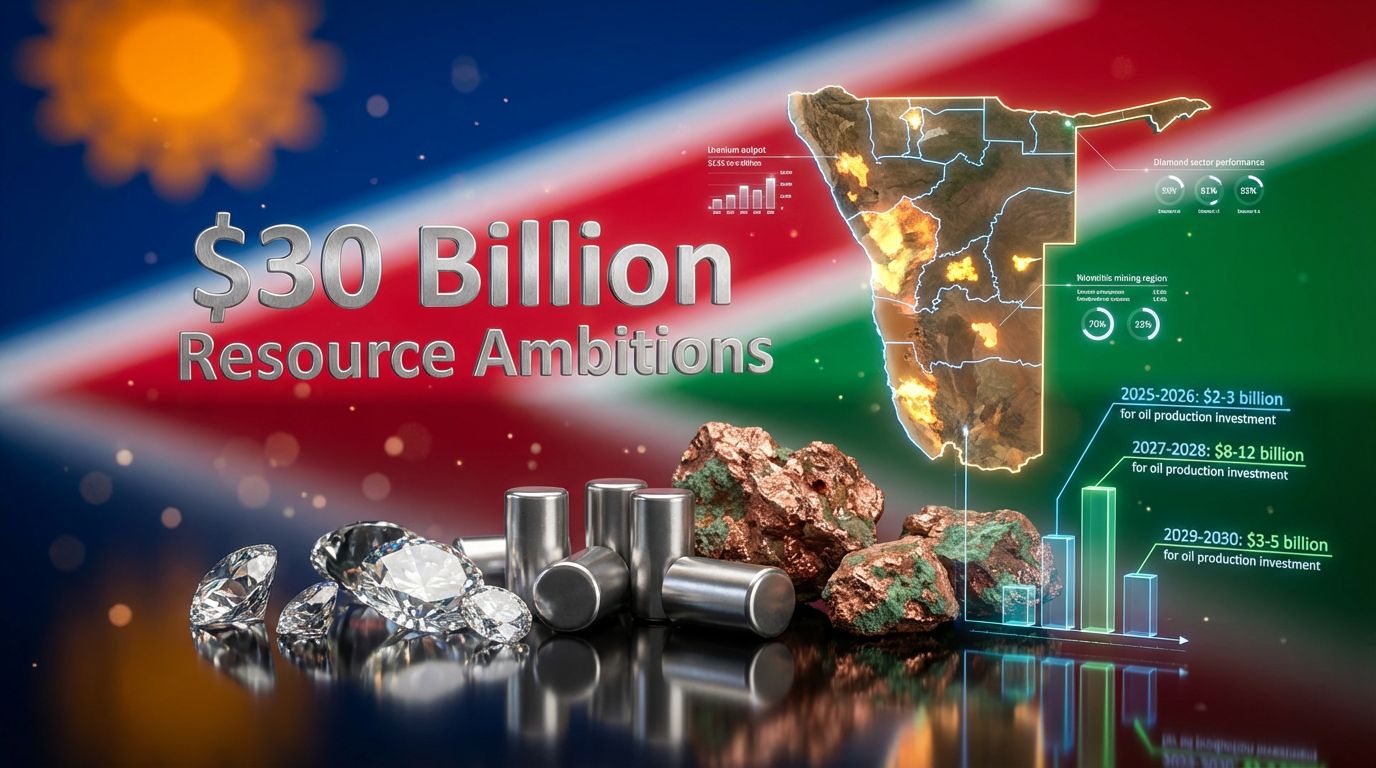
Namibia's new mines and energy minister appointment represents a significant development in the Southern African nation's resource sector transformation. Traditional mining jurisdictions are experiencing leadership transitions that could reshape international investment flows and commodity markets. Understanding these shifts requires examining how ministerial appointments influence policy continuity, regulatory frameworks, and infrastructure development priorities across major resource economies.
How Strategic Leadership Changes Shape Resource Investment Landscapes
Understanding Namibia's Ministerial Transition Context
The Namibia new mines and energy minister appointment recently saw Modestus Amutse selected as the new Minister of Mines, Energy and Industry following President Netumbo Nandi-Ndaitwah's decision to remove Natangwe Ithete from the position in October 2025. This leadership change occurs as the Southern African nation pursues ambitious resource development targets, including first crude oil production by 2030.
The selection of Amutse, who previously served as deputy minister of information and communication technology and as a member of parliament, signals potential emphasis on technological modernisation within the mining sector. His ICT background may prove relevant as mining operations increasingly integrate digital mining innovations, data analytics, and automated systems to improve efficiency and safety protocols.
Namibia's resource sector encompasses significant uranium and diamond production, alongside emerging oil and gas developments from major offshore discoveries. The ministerial appointment comes at a critical juncture as the nation seeks to maximise revenue from existing mineral operations while developing new hydrocarbon resources.
Evaluating Performance Metrics for Resource Leadership
Resource ministers face measurable performance indicators that directly impact investor confidence and sector development. Furthermore, these metrics provide clear benchmarks for evaluating ministerial effectiveness. Key metrics include:
- Production Target Achievement: Meeting established timelines for new resource development
- Regulatory Processing Efficiency: Streamlining permit approval processes and licensing procedures
- Infrastructure Development Coordination: Ensuring adequate transport, power, and port capacity
- Revenue Optimisation: Maximising government revenue while maintaining competitive fiscal regimes
- International Partnership Management: Facilitating foreign direct investment and technology transfer
For Namibia specifically, the 2030 oil production target represents a critical milestone requiring coordination across multiple government departments, international operators, and infrastructure providers. Success depends on regulatory clarity, environmental compliance frameworks, and efficient project approval processes.
Investment Opportunity Assessment in Transitional Resource Jurisdictions
Oil Sector Development Timeline Analysis
Namibia's offshore oil exploration discoveries have attracted international operators including TotalEnergies and Shell, with first production targeted for 2030. The development timeline involves multiple phases requiring substantial capital investment and regulatory oversight.
Resource development phases typically follow this progression:
Exploration Completion Phase (2025-2026):
- Final appraisal drilling campaigns
- Reserve certification and field development planning
- Environmental impact assessments
- Regulatory approval submissions
Infrastructure Development Phase (2026-2028):
- Subsea infrastructure installation
- Processing facility construction
- Pipeline and export terminal development
- Workforce training and local content implementation
Production Ramp-up Phase (2029-2030):
- First oil production achievement
- Production optimisation
- Revenue generation commencement
- Market access and supply chain establishment
The success of this timeline depends significantly on ministerial leadership providing consistent policy direction, efficient regulatory processing, and effective coordination with international partners.
Critical Minerals Strategy Development
Namibia's uranium sector represents a cornerstone of its mineral economy, with operations including the Langer Heinrich Mine operated by Paladin Resources. The company ranks among the world's largest independent uranium producers, highlighting Namibia's significance in global nuclear fuel supply chains.
Current market dynamics favour uranium producers as global nuclear renaissance initiatives drive demand growth. However, uranium market volatility requires careful risk management strategies. Factors supporting uranium market expansion include:
- Nuclear capacity additions: Multiple countries expanding nuclear power programs
- Energy security priorities: Reduced reliance on fossil fuel imports
- Climate change mitigation: Nuclear power as low-carbon energy source
- Supply constraint concerns: Limited new uranium mine development globally
Beyond traditional uranium production, Namibia possesses potential for emerging battery metals development, including lithium, cobalt, and nickel resources. Consequently, successful development requires comprehensive regulatory frameworks specifically designed for these commodity classes.
Diamond Industry Modernisation Requirements
Namibia's diamond sector, encompassing both onshore and offshore operations, faces modernisation pressures to maintain competitiveness in evolving global markets. Key modernisation priorities include:
Technology Integration:
- Advanced sorting and recovery technologies
- Automation in mining technology systems
- Digital mine planning and optimisation
- Real-time production monitoring
Value Addition Strategies:
- Local cutting and polishing facilities
- Jewellery manufacturing capabilities
- Marketing and branding initiatives
- Direct market access development
Sustainability Compliance:
- Environmental impact reduction
- Community development programs
- Responsible sourcing certification
- Traceability system implementation
Regional Resource Governance Benchmarking
Learning from Botswana's Mining Success Model
Botswana's mining sector success offers valuable benchmarks for other African resource economies. Key success factors include:
Institutional Stability:
- Consistent mining policy framework
- Long-term ministerial tenure
- Transparent regulatory processes
- Predictable investment environment
Revenue Management Excellence:
- Sovereign wealth fund establishment (Pula Fund)
- Counter-cyclical fiscal policies
- Economic diversification initiatives
- Infrastructure reinvestment programs
Partnership Strategy:
- Balanced joint venture structures
- Technology transfer requirements
- Local content development
- Skills development programs
Botswana's approach demonstrates how consistent leadership and clear policy frameworks can maximise resource sector benefits while maintaining investor confidence.
Avoiding South African Resource Sector Challenges
South Africa's mining sector challenges provide cautionary lessons for other resource-dependent economies. Key risk factors to avoid include:
Regulatory Uncertainty:
- Frequent policy changes and amendments
- Unclear implementation timelines
- Inconsistent enforcement approaches
- Conflicting departmental guidance
Infrastructure Constraints:
- Inadequate power supply reliability
- Port capacity limitations
- Transportation network bottlenecks
- Water supply constraints
Skills Development Gaps:
- Technical skills shortages
- Management capacity limitations
- Training program inadequacies
- Brain drain concerns
Investment Risk Assessment Framework
Political Continuity and Policy Stability Evaluation
The Namibia new mines and energy minister appointment creates both opportunities and risks for international investors. Risk assessment should consider multiple institutional capacity factors:
Institutional Capacity Metrics:
| Risk Factor | Low Risk | Medium Risk | High Risk |
|---|---|---|---|
| Ministerial Tenure | >3 years average | 1-3 years average | <1 year average |
| Policy Consistency | Stable framework | Minor adjustments | Frequent changes |
| Regulatory Processing | <6 months average | 6-12 months | >12 months |
| Investment Disputes | Rare occurrences | Occasional issues | Regular conflicts |
Bureaucratic Efficiency Indicators:
- Permit processing timelines
- Licence approval procedures
- Environmental clearance speed
- Tax assessment processes
- Dispute resolution mechanisms
Infrastructure Development Bottleneck Analysis
Resource sector development requires supporting infrastructure across multiple categories:
Transportation Infrastructure:
- Port capacity for mineral exports
- Rail network adequacy for bulk commodities
- Road network condition and capacity
- Airport facilities for personnel and equipment transport
Utility Infrastructure:
- Power generation capacity and reliability
- Water supply adequacy for processing operations
- Telecommunications connectivity for remote operations
- Waste management and treatment facilities
Social Infrastructure:
- Housing availability for workforce
- Healthcare facilities in mining areas
- Educational institutions for skills development
- Community services and amenities
Regulatory Framework Modernisation Assessment
Modern resource sectors require comprehensive regulatory frameworks addressing environmental compliance and fiscal competitiveness. In addition to traditional regulatory considerations, emerging requirements include:
Environmental Compliance Standards:
- Impact assessment procedures
- Monitoring and reporting requirements
- Rehabilitation and closure planning
- Community consultation processes
- Biodiversity protection measures
Fiscal Regime Competitiveness:
- Royalty rate structures
- Corporate tax rates
- Additional profit taxes
- Import/export duties
- Investment incentives and allowances
Sector-Specific Growth Potential Analysis
Oil and Gas Development Scenarios
Namibia's offshore oil and gas developments present significant revenue generation potential, contingent on successful project execution. Development scenarios vary based on discovery size, commodity prices, and infrastructure development timelines.
Revenue Generation Projections:
| Scenario | Annual Production | Oil Price Assumption | Government Revenue |
|---|---|---|---|
| Conservative | 100,000 bpd | $70/barrel | $1.5-2.0 billion |
| Base Case | 200,000 bpd | $80/barrel | $4.0-5.5 billion |
| Optimistic | 300,000 bpd | $90/barrel | $7.0-9.5 billion |
Note: Revenue projections are speculative and depend on numerous variables including production rates, commodity prices, fiscal terms, and operational costs. Actual outcomes may vary significantly.
Uranium Market Positioning Strategy
Global uranium demand growth supports expansion opportunities for existing producers. Key market drivers include nuclear reactor construction programs and energy security considerations. For instance, the uranium market outlook remains positive despite short-term volatility.
Demand Growth Factors:
- Nuclear reactor construction programs in Asia
- Life extensions for existing nuclear facilities
- Small modular reactor (SMR) development
- Energy security considerations
- Carbon emission reduction targets
Supply Constraint Factors:
- Limited new mine development globally
- Production curtailments at existing facilities
- Geopolitical supply chain concerns
- Environmental permitting challenges
- Long-term contract market dynamics
Namibian uranium producers like Paladin Resources are positioned to benefit from favourable market conditions, assuming efficient regulatory oversight and infrastructure support from government leadership.
Emerging Battery Metals Exploration Potential
The global energy transition drives demand growth for battery metals including lithium, cobalt, and nickel. Namibia's geological potential for these commodities requires systematic exploration and development frameworks.
Development Requirements:
- Specialised exploration licensing procedures
- Environmental assessment protocols
- Processing technology evaluation
- Market access and logistics planning
- International partnership facilitation
Successful battery metals development requires ministerial leadership capable of creating appropriate regulatory frameworks while attracting international investment and technology transfer.
Economic Diversification Through Resource Sector Integration
Manufacturing Sector Synergies
Resource sector development can catalyse broader economic diversification through upstream and downstream integration opportunities:
Upstream Integration:
- Equipment manufacturing for mining operations
- Component production for oil and gas facilities
- Specialised services for resource companies
- Technology development and adaptation
Downstream Integration:
- Mineral processing and beneficiation
- Petroleum refining and petrochemicals
- Value-added product manufacturing
- Export market development
Technology Sector Applications
The Namibia new mines and energy minister appointment of a minister with ICT background suggests potential emphasis on technology integration across resource operations. Relevant applications include:
Digital Mining Technologies:
- Automated equipment operation
- Real-time production monitoring
- Predictive maintenance systems
- Safety and security applications
- Environmental monitoring networks
Data Management Systems:
- Geological database management
- Production optimisation analytics
- Supply chain tracking systems
- Regulatory compliance monitoring
- Financial reporting automation
Strategic Investment Positioning Framework
Short-term Monitoring Indicators
Investors should track specific indicators during the initial period following the Namibia new mines and energy minister appointment:
Policy Direction Signals:
- First 100 days announcement priorities
- Key personnel appointment decisions
- International engagement patterns
- Industry consultation initiatives
- Regulatory review announcements
Operational Efficiency Metrics:
- Permit processing time changes
- Licence approval backlogs
- Dispute resolution speed
- Investor inquiry response times
- Public communication frequency
Medium-term Investment Thesis Development
Successful resource sector investment requires understanding long-term policy trajectories and implementation capabilities. Furthermore, assessment should consider institutional capacity building and infrastructure development progress:
Institutional Capacity Building:
- Technical expertise development
- Regulatory framework modernisation
- International standard adoption
- Transparency mechanism implementation
- Stakeholder engagement improvement
Infrastructure Development Progress:
- Transportation network expansion
- Power generation capacity additions
- Port facility upgrades
- Communications infrastructure development
- Social infrastructure investment
Risk Mitigation Strategies
International investors in transitional resource jurisdictions should employ comprehensive risk mitigation approaches:
Diversification Strategies:
- Multiple commodity exposure across portfolio
- Geographic diversification beyond single jurisdiction
- Development stage diversification (exploration to production)
- Partnership structures with local companies
- Long-term contract arrangements where possible
Political Risk Management:
- Political risk insurance consideration
- Government relationship development
- Community engagement programs
- Local content compliance strategies
- Transparency and ESG standard adoption
Disclaimer: This analysis contains forward-looking statements and speculative projections based on current information and assumptions. Actual investment outcomes may vary significantly from projections due to political, economic, technical, and market factors beyond current assessment capabilities. Investors should conduct independent due diligence and seek professional advice before making investment decisions.
Ready to Capitalise on Southern African Resource Opportunities?
Discovery Alert's proprietary Discovery IQ model delivers instant notifications on significant ASX mineral discoveries, helping subscribers identify actionable opportunities as resource sectors across jurisdictions like Namibia undergo strategic transformations. Explore Discovery Alert's track record of identifying major discoveries and begin your 30-day free trial today to position yourself ahead of evolving commodity markets.