July 21, 2026
Natural gas derivatives have become increasingly sophisticated financial instruments as energy markets adapt to global volatility and supply chain complexities. Furthermore, these derivatives serve critical roles in modern energy commerce, enabling precise risk management while providing investment opportunities for portfolio diversification across traditional asset classes.
Understanding the Architecture of Natural Gas Financial Instruments
Natural gas derivatives represent sophisticated contractual arrangements where value derives from underlying natural gas price movements and related market variables. These instruments fulfill dual market functions: institutional risk mitigation for commercial energy participants and speculative investment opportunities for financial market players seeking commodity exposure with historically low correlation to traditional asset classes.
The derivatives ecosystem encompasses four primary categories of financial instruments:
- Standardised futures contracts traded on regulated exchanges with daily settlement requirements
- Options contracts providing asymmetric risk profiles through purchase and sale rights
- Over-the-counter swaps enabling bilateral customisation of contract specifications
- Forward agreements representing non-standardised delivery commitments between counterparties
Market participants span the entire energy value chain, from upstream natural gas producers utilising commodities hedging strategies to lock in future revenue streams, to downstream utility companies managing fuel procurement costs for electricity generation and heating applications. Financial institutions, including hedge funds and commodity trading advisors, participate primarily for portfolio diversification and alpha generation opportunities.
The infrastructure supporting these markets includes major global exchanges such as CME Group's NYMEX division, Intercontinental Exchange (ICE), and European Energy Exchange (EEX), each providing standardised contract specifications, clearing services, and regulatory oversight. Central clearing houses mitigate counterparty risk through daily mark-to-market settlements and margin requirements, while over-the-counter markets enable customised bilateral agreements with enhanced flexibility but increased credit risk exposure.
Trading volumes across these platforms reflect the growing sophistication of energy market participants and the increasing recognition of natural gas derivatives as essential tools for commercial risk management and investment portfolio optimisation.
When big ASX news breaks, our subscribers know first
Core Components of Modern Natural Gas Derivatives Markets
Exchange-Traded Futures Infrastructure
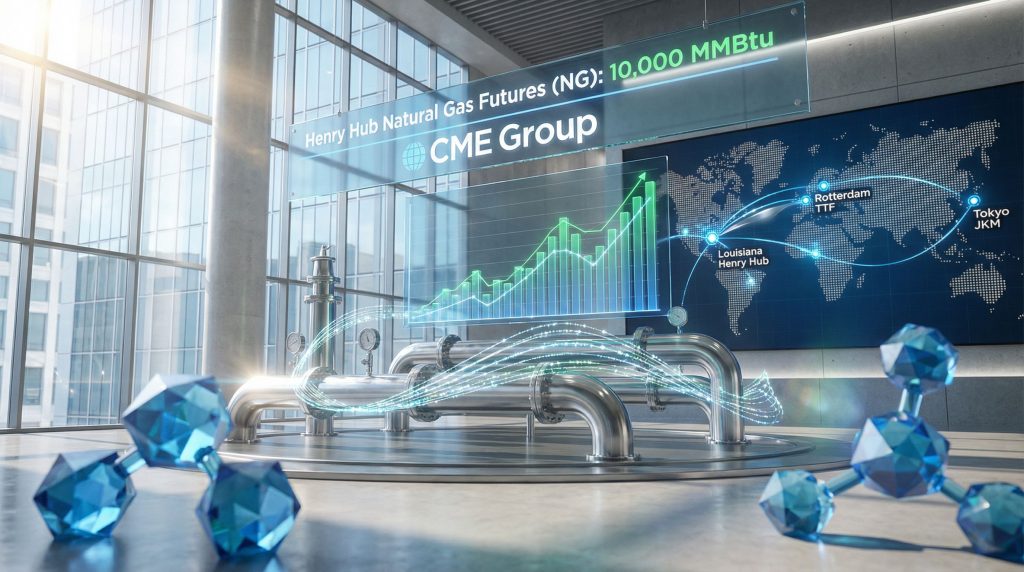
Henry Hub Natural Gas Futures contracts represent the cornerstone of North American natural gas price discovery, with standardised specifications of 10,000 MMBtu per contract and delivery at the Henry Hub facility in Erath, Louisiana. These contracts serve as the primary benchmark for continental price formation and influence global LNG contract indexation mechanisms.
Micro Natural Gas Futures, denominated at 1,000 MMBtu, address market access limitations for smaller commercial participants, including regional distribution companies, industrial consumers, and emerging market players requiring proportionate hedging capabilities without the capital requirements of full-sized contracts.
Regional basis contracts capture geographic price differentials between Henry Hub and local delivery points, including Tennessee Zone 6, Chicago Citygate, and numerous other hub-specific instruments. These products enable sophisticated basis trading strategies where participants exploit temporary pricing inefficiencies between interconnected pipeline systems.
Revolutionary Indian Market Development
The National Stock Exchange of India's collaboration with Indian Gas Exchange represents a significant advancement in domestic energy derivatives infrastructure. This initiative introduces India's first exchange-traded natural gas derivatives linked to the Gas Index of India (GIXI), a benchmark derived from actual transaction data on the IGX platform.
Key Implementation Features:
- GIXI Methodology: Transaction-based pricing reflecting actual market settlements rather than survey-based assessments
- Regulatory Framework: Securities and Exchange Board of India approval enabling domestic benchmark derivatives
- Market Participants: Indian producers, utilities, distribution companies, and industrial consumers
- Risk Management Applications: Hedging domestic supply-demand imbalances without international market exposure
According to NSE's Chief Business Development Officer Sriram Krishnan, this development enables NSE to become the first Indian exchange launching domestic benchmarked energy derivatives contracts. The initiative aims to create robust risk management tools, enhance market efficiency, deepen liquidity, and support transparent competitive gas market growth in India.
Options and Strategic Derivatives Applications
Natural gas options provide asymmetric risk management capabilities through call and put structures. Call options grant purchasers the right to acquire natural gas futures at predetermined strike prices, enabling utilities and industrial consumers to protect against price escalation while preserving upside participation benefits.
Put options provide producers with downside price protection through the right to sell futures at established floor levels. However, implementing exchange‐traded commodities can offer additional flexibility for institutional investors seeking diversified exposure.
Calendar spread strategies involve simultaneous purchase and sale of futures contracts across different delivery months, hedging seasonal price differentials that characterise natural gas markets. These strategies prove particularly valuable during winter heating season transitions when supply-demand dynamics create predictable pricing patterns.
Basis trading represents sophisticated arbitrage opportunities capturing location-specific price differentials. Traders exploit temporary disconnections between benchmark prices and regional delivery points, profiting from expected convergence as transportation and storage constraints resolve.
Strategic Role of Benchmark Pricing in Derivatives Valuation
Henry Hub Global Influence
Henry Hub pricing serves as the foundational benchmark for North American natural gas derivatives while influencing global LNG contract structures and international price discovery mechanisms. Located in Erath, Louisiana, this facility represents the physical delivery point for NYMEX futures contracts and anchors forward curve construction across multiple delivery periods.
The benchmark's influence extends globally through LNG contract indexation, where international suppliers frequently reference Henry Hub pricing for long-term supply agreements. This creates cross-market arbitrage opportunities when regional price differentials deviate from historical transportation and conversion cost relationships.
Regional Price Discovery Evolution
European markets utilise Title Transfer Facility (TTF) pricing as the primary continental benchmark, reflecting deregulation success and pipeline interconnection development. TTF futures and options enable European market participants to hedge continental supply-demand exposures independently of North American market dynamics.
Asian markets increasingly reference Japan Korea Marker (JKM) indices for LNG spot market transactions, representing approximately 10-15% of global LNG volumes. JKM pricing reflects regional supply-demand fundamentals and provides hedging capabilities for Asian utilities and industrial consumers.
Emerging Market Benchmark Innovation
India's GIXI development addresses long-standing domestic price discovery gaps by establishing transaction-based benchmark pricing derived from actual IGX platform settlements. This methodology ensures pricing accuracy reflecting genuine market activity rather than estimated or assessed values.
GIXI enables Indian market participants to hedge domestic natural gas exposure without requiring international market hedging, thereby avoiding foreign exchange risk and basis exposure to global price volatility. This development supports India's energy security objectives while providing commercial participants with sophisticated risk management capabilities.
Natural Gas Liquids Derivatives Transformation in Petrochemical Markets
NGL Market Structure and Applications
Natural gas liquids derivatives enable petrochemical producers, midstream processors, and refiners to manage distinct exposure categories across the hydrocarbon value chain. These instruments address ethane, propane, butane, and natural gasoline pricing risks while facilitating optimisation of processing margins and feedstock costs.
Primary NGL Derivative Products:
| Product | Contract Size | Primary Applications | Key Market Participants |
|---|---|---|---|
| Propane Futures | 42,000 gallons | Seasonal heating demand, petrochemical feedstock | Distributors, petrochemical producers |
| Butane Options | Customisable | Gasoline blending, octane enhancement | Refiners, blending facilities |
| Ethane Swaps | OTC structures | Ethylene production input costs | Petrochemical manufacturers |
| NGL Crack Spreads | Multiple legs | Processing margin capture | Midstream processors |
Processing Margin Optimisation Strategies
NGL fractionation spreads represent sophisticated multi-commodity positions designed to capture processing margins between natural gas inputs and separated NGL outputs. These strategies involve purchasing natural gas futures while simultaneously selling propane, butane, and ethane futures, effectively locking in fractionation margins.
Gasoline blending spreads enable refiners to optimise butane utilisation by simultaneously managing crude oil input costs, finished gasoline sales prices, and butane blending component values. These strategies prove particularly valuable during seasonal transitions when butane blending specifications and demand patterns shift significantly.
Petrochemical producers utilise ethane swap agreements to stabilise feedstock costs for ethylene production while maintaining operational flexibility for alternative feedstock utilisation. These arrangements enable long-term cost predictability essential for polyethylene and other derivative product pricing strategies.
Market Dynamics Driving Natural Gas Derivatives Pricing
Supply-Side Transformation Factors
United States shale gas production continues reshaping global natural gas markets, with the Energy Information Administration projecting shale gas comprising approximately 80% of domestic production by 2040. This structural transformation affects derivatives pricing through enhanced production flexibility, reduced drilling cycle times, and improved price responsiveness to market signals.
Pipeline infrastructure constraints create regional basis differentials exploitable through derivatives trading. Capacity limitations between production regions and consumption centres generate predictable seasonal patterns and occasional price dislocations providing arbitrage opportunities for sophisticated market participants.
Storage injection and withdrawal cycles create seasonal derivatives trading patterns reflecting natural gas's role in heating applications and electricity generation backup capacity. Underground storage capacity utilisation rates influence forward curve structures and volatility patterns across different delivery months.
Demand-Side Evolution Patterns
LNG export facility expansion continues connecting North American natural gas production to global markets, creating new derivatives trading opportunities and arbitrage relationships between domestic and international pricing benchmarks. Export capacity growth influences domestic price formation while establishing cross-market correlation patterns.
Additionally, recent oil price rally insights demonstrate how interconnected energy markets affect natural gas derivatives pricing through fuel switching mechanisms and cross-commodity arbitrage opportunities.
Power generation fuel switching between natural gas and alternative sources creates demand elasticity affecting derivatives pricing. Environmental regulations, carbon pricing mechanisms, and renewable energy penetration rates influence natural gas demand patterns reflected in forward curve structures.
Industrial consumption patterns, particularly in petrochemical production and manufacturing applications, provide derivatives demand from commercial hedging activities. These sectors require sophisticated risk management tools addressing both feedstock costs and competitive product pricing dynamics.
Geopolitical Risk Premium Integration
International supply disruptions, sanctions regimes, and infrastructure security threats create risk premiums reflected in derivatives pricing across global markets. European markets particularly demonstrate geopolitical sensitivity through elevated volatility and basis differentials relative to North American benchmarks.
Furthermore, the trade war market impact continues influencing global energy commodity flows and derivatives pricing relationships as nations adjust supply chain strategies and trade partnerships.
Weather-driven demand variations generate significant derivatives trading activity as market participants attempt to predict and hedge seasonal consumption patterns. Temperature anomalies create unexpected supply-demand imbalances requiring dynamic hedging strategy adjustments.
Regulatory Framework Impact on Market Structure
Exchange Oversight and Position Management
The Commodity Futures Trading Commission establishes position limits and reporting requirements designed to prevent excessive speculation while maintaining adequate market liquidity. These regulations affect derivatives market structure by limiting individual participant exposure and requiring transparency for large positions.
International regulatory coordination becomes increasingly important as cross-border derivatives trading expands. European MiFID II regulations and United States Dodd-Frank compliance create operational complexities for global market participants while enhancing market surveillance capabilities.
Market surveillance systems monitor for potential manipulation through coordinated trading activities, information asymmetries, and attempts to distort price discovery mechanisms. These systems protect market integrity while maintaining confidence in benchmark pricing accuracy.
Compliance and Documentation Requirements
Derivatives trading requires comprehensive documentation including master agreements, credit support arrangements, and regulatory reporting compliance. These requirements create operational overhead while ensuring market participant protection and systemic risk mitigation.
Accounting standards such as ASC 815 mandate specific treatment of derivatives positions, influencing corporate hedging strategy design and implementation. Financial reporting requirements affect how commercial entities structure and document risk management programs.
The next major ASX story will hit our subscribers first
Technology Innovation Reshaping Derivatives Trading
Algorithmic Trading System Development
High-frequency trading algorithms now represent significant portions of natural gas derivatives trading volume, providing continuous market liquidity while exploiting micro-second price discrepancies across related instruments. These systems enhance market efficiency through rapid arbitrage execution and spread trading.
Machine learning models analyse comprehensive datasets including weather forecasts, storage reports, production data, and economic indicators to generate trading signals and optimise hedging strategies. Artificial intelligence applications continue expanding across price forecasting, risk management, and automated execution capabilities.
Blockchain and Smart Contract Applications
Distributed ledger technology enables automated settlement processes and reduces counterparty risk in over-the-counter derivatives transactions. Smart contracts can automatically execute hedging strategies based on predetermined market conditions, reducing operational risk and settlement delays.
Digital clearing and settlement infrastructure improvements reduce transaction costs while enhancing transparency and regulatory compliance capabilities. These technological advances democratise market access while maintaining institutional-quality risk management standards.
Strategic Evaluation Framework for Natural Gas Derivatives
Risk Assessment Methodologies
Effective derivatives utilisation requires comprehensive risk assessment including Value-at-Risk calculations, scenario analysis, and stress testing across multiple market conditions. Market participants must understand correlation risks between natural gas derivatives and related energy commodities while managing basis exposure between benchmark and local pricing.
Key Performance Metrics:
- Hedge Effectiveness Ratios: Measuring correlation between derivatives positions and underlying exposures
- Volatility Reduction Achievement: Quantifying risk mitigation through derivatives implementation
- Risk-Adjusted Return Enhancement: Evaluating portfolio optimisation through commodity exposure
- Basis Risk Management: Monitoring differential performance between hedged and actual prices
Implementation Best Practices
Successful derivatives strategies require clear policy frameworks defining hedging objectives, position limits, and performance measurement criteria. Documentation and governance processes ensure regulatory compliance while enabling strategy optimisation based on market condition changes.
Regular strategy evaluation and adjustment processes account for evolving market dynamics, regulatory changes, and operational developments affecting underlying business exposures. This flexibility enables responsive risk management while maintaining strategic consistency.
Future Market Development Trajectories
Carbon Market Integration Opportunities
Emerging carbon pricing mechanisms create opportunities for natural gas derivatives linked to emissions reduction credits. Clean-burning natural gas may benefit from carbon pricing frameworks favouring lower-emission alternatives to coal and oil-fired generation.
Environmental regulations continue influencing natural gas derivatives through renewable energy penetration effects on backup power generation demand. Consequently, the energy transition challenges demonstrate how policy frameworks affect commodity derivatives markets and hedging strategy evolution.
Moreover, grid stability requirements create new hedging applications as natural gas generation provides flexibility services complementing renewable energy sources.
Global Market Integration Expansion
Expanding LNG infrastructure creates arbitrage opportunities between regional markets while enabling global price integration through physical trade flows. Derivatives products will evolve to capture inter-market relationships and provide comprehensive global price exposure capabilities.
Technology improvements in LNG transportation, storage, and regasification enhance market liquidity while reducing transportation costs. These developments affect derivatives pricing through improved arbitrage efficiency and reduced regional price disconnections.
For comprehensive market analysis and trading insights, investors can reference IG's natural gas trading strategies which provide detailed guidance on technical analysis and market timing considerations for natural gas derivatives.
Disclaimer: This analysis is for informational purposes only and does not constitute investment advice. Natural gas derivatives involve substantial risk and may not be suitable for all investors. Past performance does not guarantee future results. Prospective participants should consult with qualified financial advisors and conduct independent research before engaging in derivatives trading activities.
Want to Capitalise on Energy Market Opportunities?
Discovery Alert's proprietary Discovery IQ model delivers real-time alerts on significant ASX mineral discoveries, instantly empowering subscribers to identify actionable opportunities ahead of the broader market, including those within the energy and commodity sectors. Begin your 14-day free trial today at Discovery Alert to secure your market-leading advantage.