
June 3, 2026
When a Correction Notice Means More Than It Appears: Iron Ore Index Governance Unpacked
Price reporting agency governance rarely makes headlines, but for the thousands of traders, steel mills, and mining companies whose contracts are anchored to published benchmarks, even a minor correction notice carries significant operational weight. Understanding the difference between a price correction and a rationale correction is not a technicality reserved for index administrators. It is foundational knowledge for anyone operating in the seaborne iron ore market.
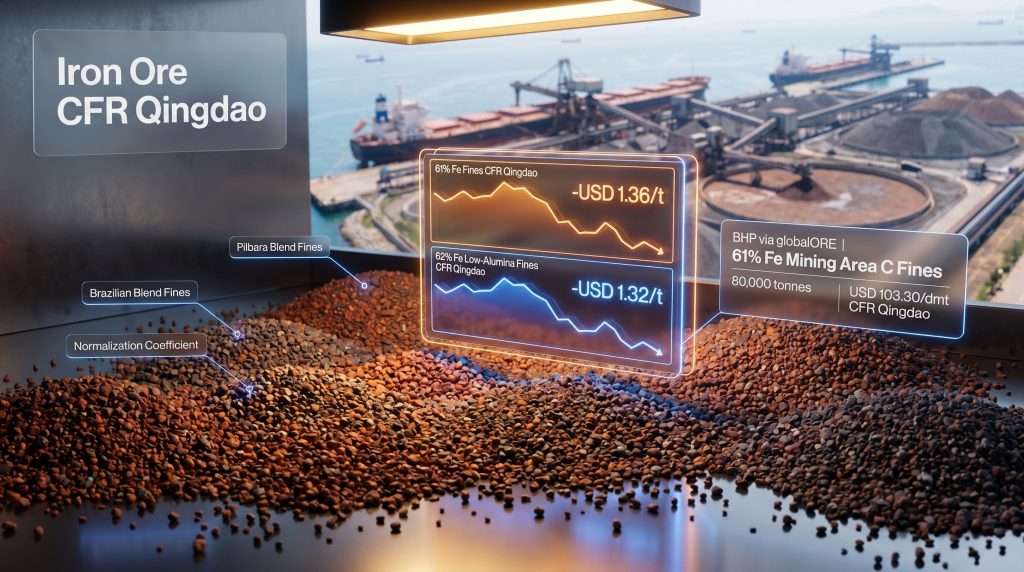
The recent correction to iron ore 61% and 62% Fe fines CFR Qingdao rationale documentation, published by Fastmarkets on June 3, 2026, is a useful case study in how price reporting agencies maintain integrity, manage data errors, and communicate with market participants. Crucially, the published benchmark prices for both MB-IRO-0191 and MB-IRO-0008 were confirmed as unaffected by the error. What changed was the accuracy of the supporting trade log narrative, not the assessed values themselves.
When big ASX news breaks, our subscribers know first
Rationale Corrections vs. Price Corrections: A Critical Distinction
Not all correction notices are equal. Within PRA governance frameworks, two fundamentally different types of corrections can be issued, and conflating them can lead market participants to misread risk or misinterpret benchmark movements.
-
A price correction occurs when the assessed benchmark value itself was calculated or published incorrectly. This is a substantive revision that can affect contracts, hedges, and settlement values tied to that index.
-
A rationale correction occurs when the narrative or trade log supporting an assessment contains an inaccuracy, but the underlying methodology and final price remain valid and unchanged.
In this instance, Fastmarkets identified that the fixed-price equivalent of a floated-price Pilbara Blend fines offer had been incorrectly recorded in the trade log section of the rationale documents for both the 61% Fe and 62% Fe CFR Qingdao indices. The correction updated the public record to reflect the accurate calculation. No revision to the published price was required or made.
This distinction matters enormously in practice. A rationale correction is evidence of a functioning governance system, not a signal of analytical failure. It demonstrates that the PRA's internal review processes are operating as intended, catching documentation errors before they harden into the permanent record.
How CFR Qingdao Became the World's Iron Ore Pricing Anchor
The Mechanics Behind the Benchmark
Qingdao, located in China's Shandong province, serves as the reference delivery port for the majority of seaborne iron ore price assessments. The cost-and-freight (CFR) pricing basis means the seller absorbs both the cost of the ore and the ocean freight to Qingdao, establishing a landed-price reference that is directly comparable across shipments originating from Australia, Brazil, South Africa, and elsewhere.
This standardisation is critical. Because iron ore cargoes originate from different hemispheres with vastly different freight cost profiles, a CFR Qingdao price strips out origin-specific freight variability and allows buyers and sellers to negotiate on a normalised landed-cost basis. Chinese steel mills, which account for roughly 70% of global seaborne iron ore imports, rely on this benchmark to structure procurement contracts and manage input cost exposure. For further context on how these dynamics interact, the China steel and iron ore market continues to shape global benchmark behaviour in meaningful ways.
Why Grade Matters More Than Many Realise
The distinction between 61% Fe fines and 62% Fe low-alumina fines is not merely a percentage point of iron content. It reflects meaningfully different metallurgical performance profiles in the blast furnace environment.
Higher iron content directly reduces the volume of coke required per tonne of hot metal produced, improving energy efficiency and lowering slag generation. Low-alumina specifications matter independently because alumina increases slag viscosity, which can disrupt furnace drainage patterns and reduce campaign life.
Steel mills operating under environmental production caps, which have been a recurring feature of China's industrial policy in recent years, are particularly incentivised to maximise the productivity yield of every tonne of ore consumed. This is why the 62% Fe low-alumina grade consistently commands a structural premium over standard 62% Fe material, and why premium Brazilian ores such as Vale's Brazilian Blend fines (BRBF) tend to attract positive Value-in-Use (VIU) adjustments relative to the benchmark index. Monitoring iron ore price trends therefore requires an understanding of these grade-level dynamics, not simply headline index movements.
The Corrected Trade Log: What the Data Actually Shows
The corrected trade log for the June 2, 2026 assessment contains three principal market observations that fed into the index construction for both the 61% Fe and 62% Fe CFR Qingdao indices.
Confirmed Trade
| Component | Detail |
|---|---|
| Seller | BHP via globalORE platform |
| Product | 61% Fe Mining Area C fines |
| Volume | 80,000 tonnes |
| Price | USD 103.30/dmt CFR Qingdao |
| Laycan | June 21 to 30 |
Offer 1: Brazilian Blend Fines
| Component | Detail |
|---|---|
| Product | Brazilian Blend fines |
| Volume | 170,000 tonnes |
| Pricing Basis | June average of 62% Fe low-alumina fines index plus VIU adjustment plus USD 2.00/dmt premium |
| Laycan | June 10 to 19 |
Offer 2: Pilbara Blend Fines (corrected entry)
| Component | Detail |
|---|---|
| Product | 61% Fe Pilbara Blend fines |
| Volume | 170,000 tonnes |
| Pricing Basis | June average of 61% Fe index minus USD 0.40/dmt discount |
| Fixed Price Equivalent | USD 105.06/dmt CFR Qingdao |
| Laycan | June 19 to 28 |
The error specifically involved the fixed-price equivalent calculation for the Pilbara Blend fines offer. A floating offer indexed to a monthly average requires the assessor to apply a real-time estimate of that average to derive a comparable outright price. This intermediate calculation step, if performed or recorded incorrectly, will produce a misleading data point in the trade log even when the final assessed index value remains sound.
The Floating-to-Fixed Conversion: A Hidden Complexity
The conversion of floating-price offers into fixed-price equivalents is one of the least understood aspects of iron ore index construction among non-specialist readers. When a cargo is offered at a monthly average index value plus or minus a specified differential, the PRA assessor must estimate what that monthly average will be at the time of settlement.
This introduces a layer of forward-looking calculation that is distinct from simply recording an outright traded price. It also creates a legitimate source of documentation error, as the calculation depends on interim average values that change daily throughout the month. An incorrect fixed-price equivalent does not necessarily corrupt the final index value, however, because assessors apply a broader suite of market evidence when triangulating the assessment. Nevertheless, an inaccurate trade log entry can distort the historical record of market conditions and undermine participant confidence in the transparency of the process.
The Normalization Coefficient: A Daily Calibration Tool
One of the more technically sophisticated elements of these indices is the normalization coefficient, a mathematical adjustment factor that enables heterogeneous iron ore brands to be assessed on a comparable basis within the same index construction window.
Iron ore is not a homogeneous commodity. Pilbara Blend fines from BHP carry different alumina, silica, phosphorus, and moisture characteristics than Mining Area C fines from the same company, or Brazilian Blend fines from Vale. The normalization coefficient adjusts for these quality differences, ensuring that brand-specific characteristics do not distort the benchmark price when multiple brands are assessed simultaneously. Understanding the full range of iron ore market types and deposits helps contextualise why such calibration tools are necessary.
Fastmarkets recently transitioned the update frequency of this coefficient from monthly to daily for its 61% Fe and 62% Fe CFR Qingdao indices. This change allows the coefficient to respond to intraday and day-over-day market dynamics more accurately, reducing the risk of outdated normalization factors producing misaligned assessments.
The shift to daily coefficient updates is a technically meaningful governance improvement. In volatile market periods, monthly coefficients can become stale within days, potentially causing certain high-volume brands to fall outside the acceptable assessment range before the scheduled recalibration occurs.
Reading Price Movements in Context: What the Index Declines Signal
On the assessment date in question, both key benchmarks recorded declines:
-
The 61% Fe fines CFR Qingdao index fell by USD 1.36 per tonne
-
The 62% Fe low-alumina fines CFR Qingdao index declined by USD 1.32 per tonne
The near-parallel movement across grades is informative. When the 61% Fe and 62% Fe indices move in close alignment, it typically signals that broad market sentiment, rather than grade-specific demand dynamics, is the primary driver. Grade-specific premiums tend to expand or contract when steel mill profitability margins shift, environmental production controls tighten, or when one origin's supply logistics are disrupted.
Parallel declines of this magnitude, while not dramatic in absolute terms, become significant when considered against the contract volumes to which these indices are applied. Across a 170,000-tonne cargo, a USD 1.32 per tonne price movement represents a value shift of approximately USD 224,000. Multiplied across the hundreds of cargoes settled monthly against CFR Qingdao benchmarks, daily index movements of this scale translate into hundreds of millions of dollars of aggregate value transfer across the supply chain.
The next major ASX story will hit our subscribers first
Low Liquidity and Assessor Judgement: What Happens When Market Evidence Is Thin
Iron ore spot markets do not always offer abundant transactional data within a single pricing window. During periods of Chinese steel mill destocking, seasonal demand softness, or broader macroeconomic uncertainty, the number of observable transactions and firm bids and offers within a given 24-hour assessment window can shrink considerably.
When liquidity is thin, PRA assessors apply structured editorial judgement using two primary tools:
-
Carryover methodology: Prior-period data that remains relevant to current market conditions is retained and applied where no new information is available, with appropriate disclosure.
-
Outlier exclusion: Indications that fall materially outside the consensus price range are discarded, particularly when they cannot be corroborated by independent market evidence.
Both tools require transparent documentation. The published rationale must explain what data was used, what was excluded, and why. This is precisely why accurate trade log entries are essential even in low-liquidity environments. An incorrect fixed-price equivalent can create a phantom outlier that distorts the assessor's exclusion decision, or conversely, a phantom consensus point that anchors the assessment at an inaccurate level.
The Broader Benchmark Landscape: Iron Ore Index Comparisons
The 61% Fe and 62% Fe CFR Qingdao indices do not operate in isolation. They sit within a broader family of iron ore benchmarks that serve distinct commercial purposes across the steel supply chain.
| Index | Grade | Delivery Basis | Primary Application |
|---|---|---|---|
| 61% Fe Fines CFR Qingdao | 61% Fe | CFR Qingdao | Mid-grade Australian ore contracts |
| 62% Fe Low-Alumina Fines CFR Qingdao | 62% Fe, low alumina | CFR Qingdao | Premium Brazilian and high-grade contracts |
| 65% Fe Fines CFR Qingdao | 65% Fe | CFR Qingdao | High-grade direct reduction and premium blast furnace feed |
| 58% Fe Fines CFR Qingdao | 58% Fe | CFR Qingdao | Low-grade discount tracking and blending economics |
These indices are embedded in long-term supply agreements between major mining houses and Chinese integrated steel mills, as well as in financial instruments including iron ore futures contracts traded on the Dalian Commodity Exchange and the Singapore Exchange. Furthermore, how tariffs impact iron ore pricing and trade flows adds another layer of complexity to how these benchmark values are interpreted commercially. Their integrity is therefore a matter of commercial consequence that extends far beyond the daily spot market participants providing price data to the assessment process.
Key Iron Ore Brands and Their Index Roles
Understanding which ore brands anchor each index adds important context to how trade log entries are interpreted by market participants.
-
Pilbara Blend Fines (PBF): BHP's flagship blended product from its Pilbara operations in Western Australia. The most widely traded Australian iron ore brand and a central reference in 61% Fe index assessments.
-
Mining Area C Fines (MAC): A higher-iron-content Pilbara product from BHP, typically traded in discrete spot cargoes and used to test the upper end of the 61% Fe assessment range.
-
Brazilian Blend Fines (BRBF): Vale's flagship blended product, assessed against the 62% Fe low-alumina index with a VIU adjustment reflecting its superior quality profile. BRBF typically carries a positive VIU premium due to lower alumina and higher iron content relative to standard 62% Fe fines.
The use of electronic trading platforms such as globalORE for discrete spot transactions, as seen in BHP's MAC fines sale at USD 103.30 per dmt in the corrected trade log, provides a higher tier of price evidence than bilateral over-the-counter deals. Platform-traded volumes are fully auditable, timestamp-verified, and directly attributable to named counterparties, making them the highest-weight evidence category in the PRA assessment hierarchy. For those interested in global iron ore tariff impact dynamics, these platform-traded benchmarks also serve as critical reference points for trade policy analysis.
Governance, Feedback, and Market Participant Rights
Fastmarkets' correction framework includes a formal feedback mechanism through which market participants can engage directly with the pricing team. For the iron ore 61% and 62% Fe CFR Qingdao indices specifically, participants can direct correspondence to the designated pricing team contacts, specifying the index in question.
Feedback may be submitted confidentially or on the public record. Comments not marked as confidential are available upon request, supporting the broader transparency obligations that PRAs operating in regulated commodity markets are expected to uphold. Fastmarkets serves more than 14,000 global customers across its commodity coverage universe, and its iron ore indices form part of the steelmaking raw materials package used in both physical and financial market applications.
Full methodology documentation, including assessment criteria, data hierarchy specifications, and quality normalisation frameworks for all iron ore indices, is publicly available via the Fastmarkets iron ore methodology portal. In addition, S&P Global's iron ore index pricing explained resource provides a complementary perspective on how benchmark assessments are constructed across different pricing agencies.
What This Correction Tells Us About Index Maturity
Viewed through a governance lens, this correction to iron ore 61% and 62% Fe fines CFR Qingdao rationale documentation reflects positively on the health of the iron ore price reporting infrastructure. The fact that an error in a fixed-price equivalent calculation was identified, disclosed, and corrected within 24 hours of publication demonstrates that the review and feedback systems surrounding these benchmarks are functioning as designed.
For market participants, the key takeaways from this episode are the following:
-
Rationale corrections do not revise published prices and should not be interpreted as evidence of benchmark instability.
-
Floating-to-fixed price equivalent calculations are technically complex and represent a legitimate source of documentation error in iron ore trade logs.
-
The transition to daily normalisation coefficient updates improves benchmark responsiveness but also introduces new documentation requirements that must be managed carefully.
-
Low-liquidity market environments elevate the operational importance of accurate trade log entries because assessor judgement relies more heavily on the quality of documented evidence when live market data is thin.
-
Both the 61% Fe and 62% Fe CFR Qingdao indices serve as foundational infrastructure for the global steel supply chain, and their governance standards directly affect the reliability of billions of dollars in physical and derivative market positions.
Disclaimer: This article is intended for informational purposes only and does not constitute financial, investment, or trading advice. Price movements, index values, and market observations referenced herein reflect specific historical assessment dates and should not be used as the basis for forward-looking commercial or investment decisions. All index methodology details are subject to change; readers should consult Fastmarkets' official methodology documentation for current specifications.
Want to Stay Ahead of Major ASX Mineral Discoveries Before the Broader Market Does?
While iron ore benchmark governance shapes the macro landscape, the real wealth-creation opportunities often emerge at the exploration end of the market — and Discovery Alert's proprietary Discovery IQ model delivers real-time alerts the moment significant ASX mineral discoveries are announced, turning complex data across more than 30 commodities into clear, actionable insights. Explore historic discovery returns to understand the scale of opportunity these moments can represent, and begin a 14-day free trial to position yourself ahead of the market.