Metallium Ltd
Metallium Cracks the Code on Multi-Unit Scale-Up: Three FJH Reactors, One Major Milestone
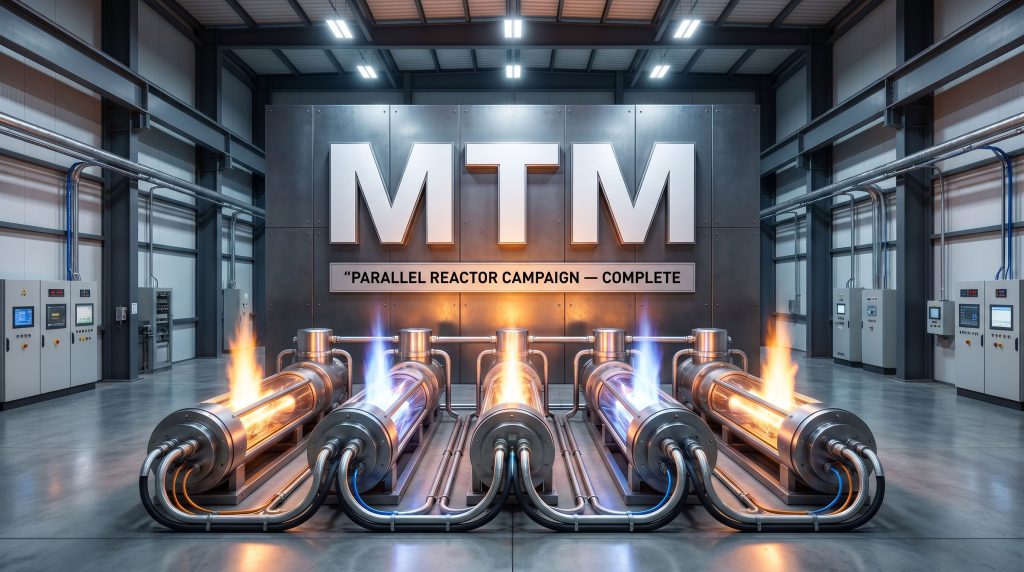
Metallium Ltd (ASX: MTM | OTCQX: MTMCF | OTCQX ADR: MTLMY) has reported the successful completion of its first Metallium multi-unit Flash Joule Heating reactor milestone in Texas, marking a significant step forward in the company's scale-up pathway. Three FJH reactors were operated simultaneously over a 12-hour period, achieving 83% availability, approximately 100% utilisation during active operation, 18 successful batches, and processing around 0.3 tonnes of inert material, with no safety incidents or lost-time injuries.
For a business model that is expected to rely on multiple reactors operating in parallel, this engineering result represents a material development in the company's scale-up pathway.
"The successful completion of our first multi-unit FJH operations campaign represents an important milestone in the development of our FJH technology platform. While the campaign was intentionally focused on mechanical performance, fluidisation behaviour and process control rather than chlorination chemistry or metal recovery, successful sustained operation of three units simultaneously provides valuable confidence in the scalability of the technology and generates important engineering data for future development programs.
"Importantly, the campaign achieved 83% availability and approximately 100% utilisation during active operation, exceeding our internal expectations for a first multi-unit commissioning campaign," said Michael Walshe, Managing Director & CEO, Metallium Ltd.
According to Metallium Ltd, operating rates recorded in this campaign were broadly consistent with reactor feed volumes that would be derived from several tonnes per day of incoming commercial feedstocks after preprocessing and upgrading.
When big ASX news breaks, our subscribers know first
Campaign Performance at a Glance
The company's reported key performance metrics from the 12-hour multi-unit campaign are summarised below.
| Metric | Result |
|---|---|
| Active FJH units | 3 |
| Campaign duration | 12 hours |
| Successful batches completed | 18 |
| Material processed in reactors | ~0.3 tonnes* |
| Availability | 83% |
| Utilisation during active operation | ~100% |
| Safety incidents | 0 |
| Lost-time injuries (LTI) | 0 |
*Prepared feed material refers to feedstock after preprocessing and upgrading. Depending on feedstock type, the mass reporting to the FJH reactor may be only a fraction of the original incoming material.
The multi-unit campaign was conducted using inert feed material in a nitrogen atmosphere, with a full 12-person team comprising engineers, operators and safety personnel. According to Metallium Ltd, the objectives were to validate:
- Stable fluidisation and material handling across multiple operating trains
- Coordinated operation of three independent processing trains
- Repeatable batch processing and mechanical reliability over an extended shift
- Integrated control systems and data capture from human–machine interfaces (HMI)
- Multi-unit operating procedures under real-world conditions
For investors, this represents early evidence of how the FJH platform behaves when moved away from single-unit, laboratory-style testing and into multi-unit, shift-length operation.
Why Multi-Unit FJH Operation Matters
Metallium Ltd is developing its FJH platform for commercial deployment as a parallel-processing architecture. In practice, this means:
- Multiple FJH reactors are expected to operate side by side
- Each reactor runs similar sequences but must be controlled and monitored individually
- Overall throughput is the sum of each reactor's output
In such a configuration, validating a single unit is not sufficient. Each additional reactor introduces:
- More complex control logic
- Synchronisation requirements for feed handling
- Increased demands on instrumentation, monitoring and safety systems
- A need for consistent fluidisation behaviour across all units
The reported campaign outcome addresses a central technical question: can multiple reactor units run in parallel over a sustained period with acceptable availability and utilisation?
The reported 83% availability indicates the proportion of scheduled time in which the system was functional and ready to operate. The approximately 100% utilisation during active operation means the units were essentially being used continuously whenever they were available.
Together, these metrics indicate that the equipment could be run in a manner that may resemble future commercial operations, subject to ongoing optimisation. From an investor perspective, this begins to shift the FJH concept from theoretical scale-up assumptions to data-backed engineering performance for Metallium Ltd.
What This Campaign Validated – and What It Did Not
The ASX announcement makes clear that this campaign was designed to validate the operating platform rather than metallurgical performance. In other words, the campaign focused on whether the hardware and control systems worked as intended, not on how much metal could be recovered.
According to Metallium Ltd, the multi-unit campaign achieved:
- Sustained multi-unit operation over a full operating shift
- Stable fluidisation and effective movement of material within each reactor
- Coordinated operation of three independent processing trains
- Reliable batch cycling, with 18 successful batches completed
- Effective HMI-based data capture for automation and optimisation work
In parallel, the campaign was used to evaluate:
- Reactor mechanical functionality
- Materials of construction (MOC) integrity, meaning how well the chosen construction materials tolerated operating conditions
- Instrumentation performance, including sensors and control devices
- Material handling systems, such as feed loading and discharge
By contrast, the following were not evaluated in this specific campaign:
- Chlorination reactions involving chlorine gas and catalysts
- Metal recovery performance or extraction yields
- Final product purity or saleable product streams
This distinction is relevant for investors. The FJH platform still needs to demonstrate robust metallurgical performance at multi-unit scale, which Metallium Ltd plans to address in upcoming chlorination campaigns using commercial feedstocks.
Educational Focus: Understanding Flash Joule Heating and TRL
What Is Flash Joule Heating (FJH)?
FJH is an electrical heating process where a rapid electrical current is passed through a material, generating very high temperatures in a very short time. For Metallium Ltd, FJH is used as part of a process to help extract critical and precious metals from:
- Mineral concentrates
- High-grade waste streams such as electronic waste (e-waste)
- Refinery scrap and other industrial residues
Key concepts explained:
- Flash: The heating occurs extremely quickly, often within seconds.
- Joule: Refers to the unit of energy used for electrical work and heat.
- Heating: The material heats from the inside as electrical energy turns into heat.
In Metallium's application, FJH creates conditions that, when combined with chlorination and other processing steps, may allow metals like gallium, germanium, antimony, rare earth elements and gold to be separated from complex feedstocks. The recent Metallium multi-unit Flash Joule Heating reactor milestone in Texas tested the mechanical and operational aspects of running several of these heating systems at once.
What Is Technology Readiness Level (TRL)?
The Technology Readiness Level (TRL) framework is a nine-step scale used to describe how mature a technology is, from basic research to full commercial deployment.
| TRL Level | General Description |
|---|---|
| 1 – 3 | Basic principles and early research concepts |
| 4 – 5 | Laboratory and component-level validation |
| 6 | Integrated system validation in a relevant environment |
| 7 | Prototype demonstrated in an operational environment |
| 8 | System complete and qualified, typically at demonstration scale |
| 9 | Full commercial deployment |
According to Metallium Ltd, the multi-unit inert campaign supports progression through TRL 5 and contributes towards TRL 6, which focuses on validating an integrated system in relevant operating environments.
Furthermore, the company indicates that:
- TRL 8 is expected to align with demonstration-scale operation at the Texas Technology Campus
- TRL 9 is expected to correspond to full commercial deployment and technology transfer to additional sites
For investors, TRL provides a structured view of where the FJH platform sits between laboratory concept and full commercial plant, and what technical steps remain.
Metallium's FJH Development Roadmap
Metallium Ltd describes its FJH development as a layered and parallel, stage-gated program. In practice, this means multiple activities (field, laboratory, desktop) progress at the same time, across several reactor prototypes ranging from bench-scale to commercial-scale units.
The programme targets multiple dimensions, including:
- Mechanical performance
- Materials of construction
- Chemical reaction behaviour (reaction kinetics)
- Production and throughput optimisation
- Overall plant operability
The company summarises its broad iterative pathway as:
- Single-unit operation – completed
- Multi-unit inert commissioning – completed (this campaign)
- Multi-unit chlorination commissioning – expected in the coming weeks, subject to permitting
- Commercial feedstock campaigns
- Demonstration-scale operation
- Commercial deployment
In the near term, Metallium Ltd plans to implement minor design modifications and instrumentation upgrades and calibration improvements. These activities are scheduled prior to the multi-unit chlorination campaigns that will incorporate commercial feedstocks, chlorine and proprietary catalysts.
Permitting, Facilities and Next Development Steps
The multi-unit inert campaign was hosted at an interim testing facility constructed and commissioned by Metallium Ltd after structural deficiencies were identified in the roof of its primary reactor development building. Roof replacement works are currently in progress on the main building.
To maintain development timelines, the company built and commissioned the interim facility, completed the first multi-unit operations campaign within this structure, and submitted amendments to its existing permitting framework to allow chlorination activities at the interim facility.
Metallium Ltd reports that it is working with relevant regulatory authorities and expects the permitting process to be completed in the coming weeks. Receipt of this chlorination permit is described by the company as the next major scale-up milestone and will enable commencement of multi-unit reactive commissioning campaigns and allow testing of catalytic converter scrap and electronic waste-derived feedstocks in a multi-unit chlorination environment.
Once approvals are in place, the company intends to conduct multi-unit chlorination campaigns at its Texas Technology Campus, whilst continuing chlorinated bench-scale and desktop assessments in parallel to refine reactor performance.
What Multi-Unit Chlorination Campaigns Are Expected to Test
The transition from inert to reactive (chlorination) multi-unit campaigns is where metallurgical performance and process economics begin to be quantified. According to Metallium Ltd, the chlorination campaigns are expected to generate data on:
- Multi-unit chlorination performance across several reactors
- Product recovery and purity, indicating how much and how cleanly metals can be recovered
- Reagent utilisation and process economics, including chlorine and catalyst usage
- Throughput optimisation, used to refine plant design and operating parameters
- Commercial operating parameters, such as preferred temperatures, residence times and cycle settings
- Product qualification activities, which support potential discussions with customers and offtake partners
These data points will be important for assessing whether the FJH-based process can extract metals efficiently from real-world feedstocks, how operating costs may compare with existing recovery routes, and what scale and configuration might be appropriate for demonstration and commercial facilities.
Investment Relevance: What This Means for Investors
For investors monitoring the critical and precious metals recovery space, the announcement highlights several points relevant to evaluating Metallium Ltd.
1. Parallel Reactor Architecture Now Tested at Multi-Unit Scale
The campaign confirms that three FJH reactors can run simultaneously over a full shift, reported availability and utilisation metrics exceeded internal expectations, and no safety incidents or lost-time injuries were recorded.
This addresses an important technical risk: the ability of a parallel-reactor architecture to function in practice, which is central to the company's intended operating model.
2. Structured, TRL-Based Development Pathway
The use of the TRL framework and an explicit multi-step roadmap provides defined technical milestones and clear linkages between pilot results and progress towards demonstration and commercial scales. For investors, this gives a way to track progress and assess how technical risk might be changing over time for Metallium Ltd.
3. Focus on High-Value Waste and Concentrate Feedstocks
The company's stated focus is on recovering metals such as gallium, germanium, antimony, rare earth elements and gold from:
- Refinery scrap
- E-waste and electronic scrap
- Monazite and other mineral concentrates
These are existing industrial and mineral streams rather than greenfield mining projects. However, the feasibility of extracting value from these feedstocks at scale using FJH remains subject to ongoing technical and economic evaluation.
4. Safety and Operational Discipline
The report of zero safety incidents, zero lost-time injuries, and a 12-person multi-disciplinary team across a 12-hour multi-unit campaign suggests the presence of formalised operating procedures and safety management, which are relevant to potential partners and regulators.
Key Milestones to Monitor
The ASX announcement outlines a sequence of milestones that investors may wish to track.
| Milestone | Status | Expected Timing |
|---|---|---|
| Single-unit FJH operation | Completed | Not stated |
| Multi-unit inert commissioning (3 units) | Completed | June 2026 |
| Chlorination permit for interim facility | Pending | Expected in coming weeks |
| Multi-unit chlorination commissioning | Upcoming | Subject to permitting |
| Commercial feedstock campaigns | Upcoming | Post-chlorination |
| Demonstration-scale operation (TRL 8) | Planned | To be determined |
| Commercial deployment (TRL 9) | Planned | To be determined |
The near-term focus for Metallium Ltd following the Metallium multi-unit Flash Joule Heating reactor milestone in Texas is on securing chlorination approvals, executing multi-unit chlorination and metal recovery trials, and generating process performance, recovery and economic data at relevant scales.
These steps will be key in assessing whether the positive mechanical and operational results from the inert campaign translate into viable metallurgical and commercial outcomes.
The next major ASX story will hit our subscribers first
Glossary of Key Terms
Flash Joule Heating (FJH)
A rapid electrical heating process where high current is passed through a material to generate very high temperatures in a short time, used by Metallium Ltd to help enable metal extraction from concentrates and waste feedstocks.
Technology Readiness Level (TRL)
A nine-step scale used globally to describe technology maturity, ranging from basic research (TRL 1) to full commercial deployment (TRL 9).
Availability
The proportion of scheduled time that equipment is ready and able to operate.
Utilisation
The proportion of available time that equipment is actively operating.
Chlorination campaign
A test or production run where chlorine and catalysts are used in a process to convert metals into forms that can be more easily separated or recovered.
Fluidisation
A process where solid particles are suspended by a gas flow so that they behave like a fluid, improving contact and mixing inside a reactor.
Human–Machine Interface (HMI)
A digital control and display system used by operators to monitor equipment and adjust operating parameters.
Materials of construction (MOC)
The specific materials (such as particular steels or alloys) chosen to build equipment, selected for their ability to withstand heat, corrosion and mechanical stresses.
Texas Technology Campus (TTC)
The technology development and planned demonstration site in Texas operated through Metallium's wholly owned subsidiary, Flash Metals USA Inc.
Ready to Follow Metallium's Scale-Up Journey From Pilot to Commercial Deployment?
Metallium Ltd (ASX: MTM) has just demonstrated that three FJH reactors can run simultaneously with 83% availability and zero safety incidents — a meaningful engineering milestone on the path to commercial metal recovery. If you're an investor looking to track the company's progress through chlorination commissioning, commercial feedstock campaigns, and demonstration-scale operation, head to Metallium's investor hub to stay up to date with the latest developments directly from the company.