June 3, 2026
The Gap Between ESG Pledges and Operational Reality in Mining
Across capital markets, a quiet but consequential repricing is underway. Institutional investors, once content to accept high-level climate commitments from mining companies at face value, are now demanding something altogether more difficult to manufacture: evidence. The shift from aspiration to accountability is redefining how the global mining sector is evaluated, financed, and ultimately positioned for long-term survival. For an industry responsible for extracting the very minerals that underpin the global energy transition, the pressure to decarbonise its own operations while simultaneously scaling output represents one of the most complex strategic challenges of this decade.
Mining decarbonisation and ESG commitments are no longer peripheral concerns managed by sustainability departments in isolation. They have migrated to the boardroom, embedded themselves into capital allocation decisions, and begun influencing everything from permit approvals to the terms of project financing. Understanding the mechanics of this shift, and what credible execution actually requires, is essential for anyone operating in or investing across the sector.
When big ASX news breaks, our subscribers know first
Why ESG Has Moved From Voluntary Framework to Strategic Prerequisite
The South African Institute of Mining and Metallurgy (SAIMM) has characterised ESG integration not merely as responsible corporate practice, but as a foundational condition for long-term business viability. This framing is significant. It removes the optionality that once allowed companies to treat sustainability reporting as a reputational exercise while continuing to operate with minimal structural change.
Several converging forces have driven this transition:
- Climate-related financial disclosure frameworks, including TCFD-aligned reporting requirements, are steadily converting what were once voluntary pledges into enforceable performance standards subject to audit and regulatory review
- The International Council on Mining and Metals (ICMM), whose members collectively account for a substantial share of global metals production, has committed its member companies to achieving net-zero Scope 1 and Scope 2 emissions by 2050, with interim targets requiring meaningful near-term progress
- Customer procurement standards in downstream industries such as electric vehicle manufacturing and battery production increasingly screen supplier emissions profiles, meaning a mining company's carbon intensity is becoming a commercial selection criterion, not merely a reputational metric
- Financing institutions, including development finance institutions and commercial lenders operating sustainability-linked loan structures, are tying borrowing terms directly to verified ESG performance
Furthermore, the mining decarbonisation benefits that flow from early ESG integration are now sufficiently well-documented to constitute a material commercial argument, not merely an ethical one.
The net effect is that mining companies now face a single, converging pressure system in which investor mandates, regulatory requirements, and customer expectations are all pointing in the same direction simultaneously.
How Investor Capital Flows Are Reshaping Decarbonisation Incentives
The Capital Consequences of Falling Short
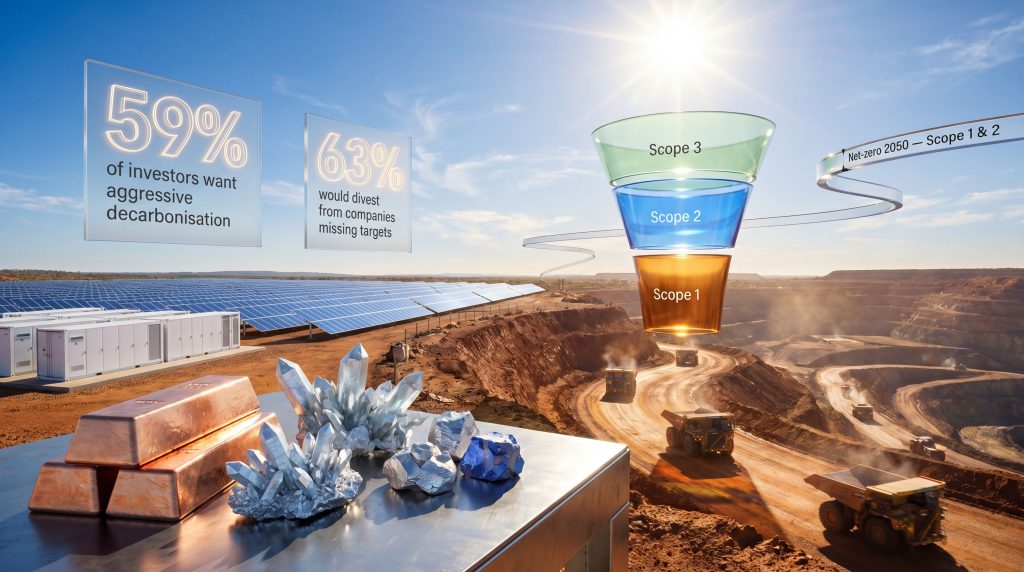
The investor dimension of mining decarbonisation is frequently discussed in qualitative terms, but the quantitative picture is becoming increasingly concrete. According to an Accenture study cited by global law firm White and Case, approximately 59% of global mining and metals investors want mining companies to pursue aggressive decarbonisation strategies. More pointedly, around 63% of investors indicate they would divest from or actively avoid companies that fail to meet their published decarbonisation targets.
These are not marginal figures. They represent majority sentiment among the capital allocators whose decisions determine a mining company's cost of equity, its ability to refinance debt, and its access to the institutional pools that fund large-scale project development.
The practical consequences extend beyond equity markets. ESG credentials are now scrutinised during permitting processes in several jurisdictions, integrated into export credit agency assessments, and increasingly referenced in offtake negotiations. The link between Scope 1 and Scope 2 emissions performance and a company's cost of capital, once theoretical, is now empirically observable across the sector.
Understanding Scope 1, 2, and 3 Emissions in a Mining Context
| Emissions Scope | Definition | Primary Mining Sources | Investor Scrutiny Level |
|---|---|---|---|
| Scope 1 | Direct emissions from owned or controlled sources | Diesel haul fleets, blasting agents, combustion in processing plants | Very High |
| Scope 2 | Indirect emissions from purchased electricity | Grid power consumption across site operations | High |
| Scope 3 | Value chain emissions upstream and downstream | Supplier-embodied carbon, product end-use and transportation | Rapidly Growing |
Scope 1 and Scope 2 reductions represent the current primary battleground for investor confidence. However, Scope 3 accountability is accelerating as the next compliance frontier, particularly for producers of thermal coal and other commodities whose end-use contributes substantially to downstream emissions. In addition, ICMM's net-zero by 2050 commitment explicitly covers Scope 1 and Scope 2 emissions, and leading member companies are already publishing Scope 3 disclosure roadmaps in anticipation of regulatory formalisation. Compliance requirements around carbon emissions reporting are also tightening considerably across major jurisdictions.
What a Credible Mining Decarbonisation Roadmap Actually Requires
Five Structural Elements of an Effective Transition Plan
A meaningful decarbonisation programme in a mining context is architecturally distinct from a sustainability report. The difference lies in operational integration. Based on current industry practice and advisory frameworks, credible roadmaps share five structural characteristics:
- Baseline Establishment — Digital maturity assessments and systematic energy baselining quantify current emissions intensity across all operational assets, identifying the highest-impact inefficiencies before capital is committed to interventions
- Scenario Modelling — Integrated digital platforms allow mining companies to simulate electrification pathways, model renewable integration scenarios, and project emissions trajectories under multiple capital deployment assumptions before locking in investment
- Technology Deployment — Operational interventions are sequenced and deployed, including hybrid microgrids, battery energy storage systems, variable speed drives with low-harmonic capability, and fleet electrification programmes on achievable timelines
- Asset Lifecycle Optimisation — Installed base audits, retrofit programmes, and eco-fit assessments extend equipment life while systematically reducing environmental footprint, delivering emissions reductions without the full capital cost of asset replacement
- Ongoing Monitoring and Adaptation — ESG key performance indicators are embedded into enterprise asset management systems with senior-level accountability structures, treating decarbonisation as a continuous operational discipline rather than a project milestone
Strategic Warning: Decarbonisation plans that exist as standalone documents, disconnected from operational KPIs, capital allocation cycles, and enterprise performance metrics, are increasingly being identified by both investors and regulators as greenwashing risk indicators. The presence of a published roadmap without auditable progress against it is now a liability rather than a shield.
Digitalisation as a Decarbonisation Accelerator
One of the less widely understood dimensions of mining decarbonisation and ESG commitments is the enabling role of digital infrastructure. Integrated energy management and automation platforms provide real-time operational visibility that transforms the quality of decision-making available to mine managers and sustainability teams.
Digitalisation allows mining companies to model energy consumption patterns, simulate the financial impact of renewable energy in mining at scale, and quantify the return on efficiency investments before committing capital. Software-defined automation is also emerging as a process efficiency enabler in energy-intensive mineral processing and materials handling operations, where marginal improvements in throughput efficiency translate directly into measurable Scope 1 and Scope 2 reductions across high-volume operating cycles.
Technology Delivering Measurable Emissions Reductions in Mining Operations
A Comparative Assessment of Deployed Low-Carbon Technologies
| Technology | Primary Application | Emissions Impact | Commercial Maturity |
|---|---|---|---|
| Hybrid Microgrids with BESS | Remote and off-grid mine site power | Scope 2 reduction | Commercially proven |
| Low-Harmonic Variable Speed Drives | Processing plant equipment | Scope 1 and 2 reduction | Commercially proven |
| Fleet Electrification | Surface haulage vehicles | Scope 1 reduction | Scaling through 2025 to 2030 |
| Renewable Energy Integration | Site-wide power supply | Scope 2 reduction | Commercially proven |
| Software-Defined Automation | Process efficiency optimisation | Scope 1 and 2 reduction | Emerging at scale |
| Fugitive Methane Capture | Underground coal operations | Scope 1 reduction | Established in coal sector |
The Electrification Frontier
ICMM members have committed to deploying zero-emission surface mining vehicles by 2040, a commitment with profound implications for fleet procurement planning across the sector. Large-format surface haul trucks are among the most carbon-intensive assets in a mine's operational portfolio. Consequently, replacing even a portion of a diesel fleet with battery-electric equivalents demands careful infrastructure planning, substantial capital allocation, and revised operational logistics.
The broader mining electrification trends shaping this transition are being driven by two parallel developments: rapid improvement in battery energy density at the cell chemistry level, and the emergence of purpose-built charging infrastructure solutions designed specifically for the scale and duty cycle requirements of open-pit and surface mining environments.
Hybrid Microgrids and the African Energy Context
For mining operations across Sub-Saharan Africa, grid unreliability has historically forced dependence on diesel generation, creating a structural Scope 2 emissions challenge that national grid improvement alone cannot resolve on the timescales the sector requires. Hybrid microgrids, combining solar photovoltaic generation with battery energy storage systems and backup generation capability, are enabling mines to decarbonise their power supply independently of national grid quality.
The scale of renewable deployment now underway in the region is substantial. AMEA Power's commissioning of a 120 MWp solar plant in South Africa illustrates the commercial scale at which renewable energy projects are now being executed across Southern Africa, providing meaningful context for what mine-scale renewable integration can realistically achieve within existing financing and engineering frameworks.
Decarbonisation Pressures Across Adjacent Heavy Industries
Mining does not operate in an emissions accountability vacuum. Steel, cement, and glass manufacturing face structurally comparable decarbonisation pressures, driven by the same convergence of regulatory requirements, capital market expectations, and customer procurement standards. These industries are collectively among the most carbon-intensive in the global economy, and the frameworks being developed to manage their transition share significant architectural similarities with those emerging in mining.
This cross-sector learning dynamic is practically valuable. Process efficiency improvements driven by automation, for example, are delivering measurable emissions reductions in energy-intensive industrial processing without sacrificing throughput. The barriers encountered in steel sector electrification, particularly around capital intensity and operational continuity requirements during transition, mirror almost precisely the implementation constraints mining companies are navigating as part of mining and the energy transition.
The next major ASX story will hit our subscribers first
The Strategic Function of Decarbonisation Advisory Services
Beyond One-Time Audits
As mining companies move from pledging to delivering on ESG commitments, structured advisory services are playing an increasingly material role in closing the execution gap. Sustainability assessments help quantify emissions baselines, benchmark operational performance against relevant industry peers, and identify the capital-efficient pathways that offer the highest emissions reduction per dollar invested.
Electrification advisory services, in particular, are performing a dual function: enabling compliance with evolving disclosure regulations while simultaneously structuring the evidence base that unlocks access to green bonds, sustainability-linked loans, and ESG-screened institutional capital. The relationship between a credible, independently verified transition roadmap and a mining company's ability to access preferential financing terms is direct and increasingly well-documented.
Critically, the most effective advisory relationships in this space are not structured as one-time diagnostic exercises. They function as ongoing strategic partnerships, embedding continuous measurement, adaptation, and performance improvement across the full value chain, treating decarbonisation as a perpetual operational discipline rather than a milestone event.
Unlocking Capital Through Verified ESG Performance
The financing implications of credible decarbonisation progress deserve particular attention from an investor perspective. Companies that can demonstrate auditable, measurable advancement against published transition roadmaps are accessing capital on terms that structurally advantage them over peers who cannot. Sustainability-linked loan structures, where borrowing margins are tied directly to verified ESG KPI performance, are creating a measurable cost-of-capital differential between ESG leaders and laggards.
The inverse is equally important to understand. Companies that delay ESG integration face a compounding disadvantage: rising compliance costs as disclosure requirements tighten, a shrinking pool of available institutional capital as ESG-screened mandates expand, and weakening social licence in communities where environmental performance is subject to increasingly rigorous public and regulatory scrutiny.
The Structural Paradox at the Heart of Mining's Role in Decarbonisation
Perhaps the most strategically important, and least frequently examined, tension in this space is the dual mandate confronting the mining sector. The minerals required to build the infrastructure of the global energy transition — copper for electrical systems, lithium for batteries, cobalt and nickel for cathode chemistry, and rare earth elements for permanent magnets in wind turbines and electric motors — all require mining to produce.
Global copper demand alone is projected to nearly double by 2035 relative to 2023 levels, driven overwhelmingly by electrification and grid expansion requirements. Lithium demand trajectories under aggressive electric vehicle adoption scenarios are even more pronounced. The mining sector is therefore simultaneously pressured to reduce its own emissions footprint while scaling the output of the specific materials without which decarbonisation in every other industry is physically impossible.
Leading mining companies are beginning to reframe this structural paradox as a competitive positioning opportunity. The argument runs as follows: a mining company that can supply critical transition minerals at scale while demonstrating measurable progress against its own decarbonisation roadmap occupies a uniquely defensible commercial position, commanding premium access to capital, partnerships, and customer relationships simultaneously. The IGF's analytical framework on decarbonisation in the mining sector provides further context on how this dual mandate is being addressed at a policy level internationally.
The Full ESG Spectrum Beyond Carbon
It is worth noting that investor and regulatory scrutiny of mining ESG performance extends well beyond carbon metrics. The full evaluation framework encompasses:
- Social licence to operate and community engagement quality, particularly in relation to Indigenous and local community relations in African and other emerging market contexts
- Water stewardship, which in water-scarce Southern African mining environments represents a material operational and reputational risk
- Tailings storage facility management, which following several high-profile international failures has become subject to significantly heightened investor and regulatory attention
- Labour standards, occupational health performance, and workforce development practices
- Biodiversity impact management and post-closure rehabilitation commitments, including considerations around natural capital in mining that are increasingly integrated into ESG frameworks
- Governance transparency, anti-corruption frameworks, and board-level accountability structures
WSP's analytical framework for mining ESG explicitly positions mining decarbonisation and ESG commitments as inseparable from human rights performance and community engagement, particularly across African operating contexts where social licence dynamics are often more complex and consequential than in established mining jurisdictions.
What Separates ESG Leaders From Laggards in Mining
The Characteristics of Genuine Competitive Differentiation
The distinction between mining companies building genuine competitive advantage through ESG integration and those managing reputational optics is becoming clearer as disclosure requirements sharpen. Credible programmes share identifiable structural characteristics: dedicated sustainability teams with direct reporting lines to C-suite leadership, ESG KPIs formally embedded within enterprise performance management systems, and senior executive accountability for measurable progress against published interim targets.
Furthermore, Sustainalytics' research on mining decarbonisation challenges and opportunities reinforces that the cost of delay for companies on the wrong side of this divide is not merely reputational — it is financial, operational, and strategic. Regulatory penalties for disclosure non-compliance are escalating across major mining jurisdictions. Institutional investment mandates with explicit ESG exclusion screens are expanding. And in an increasingly transparent information environment, the gap between published commitments and auditable delivery is becoming harder to obscure.
Disclaimer: This article contains forward-looking analysis, industry projections, and references to market data that are subject to change. Nothing in this article constitutes financial advice or a recommendation to buy or sell securities. Readers should conduct independent research and consult qualified advisers before making investment decisions.
Readers seeking further analysis on ESG integration and decarbonisation strategy across the African mining sector are encouraged to explore related coverage published by African Mining Market at africanminingmarket.com, including ongoing features examining sustainability commitments and operational strategy across Southern African mining operations.
Want to Track ASX Mining Companies Navigating the ESG and Decarbonisation Shift?
As institutional capital increasingly flows toward miners demonstrating credible emissions progress, identifying the companies making significant discoveries ahead of the market has never been more critical. Discovery Alert's proprietary Discovery IQ model delivers real-time ASX mineral discovery alerts, transforming complex geological data into actionable investment insights — explore historic discovery returns or start your 14-day free trial today to position yourself ahead of the broader market.