June 3, 2026
When Crude Markets Price the Unthinkable: Anatomy of a Multi-Layer Oil Shock
Energy markets have a long memory for chokepoints. From the Arab embargo of 1973 to the tanker wars of the 1980s, history repeatedly demonstrates that when physical oil flows and diplomatic stability fracture simultaneously, benchmark prices do not simply rise — they re-rate to reflect an entirely different risk environment. What traders are navigating in early June 2026 bears the hallmarks of precisely that kind of structural repricing.
Understanding why oil prices rise on Middle East hostilities and stalled Iran-US talks requires looking beyond individual data points. The current environment is the product of interlocking pressures that individually would move prices, but together create a self-reinforcing cycle of supply anxiety that markets struggle to cap without a credible resolution signal. Furthermore, the broader context of oil trade and geopolitics makes this moment particularly consequential.
When big ASX news breaks, our subscribers know first
The Mechanics of a Risk Premium Environment
What Separates a Spike From a Sustained Repricing?
Not all oil price increases are created equal. Energy analysts draw a critical distinction between fundamental supply disruption — where actual barrels are physically removed from global circulation — and a risk premium, which is the additional price component markets assign to reflect the probability of future disruption.
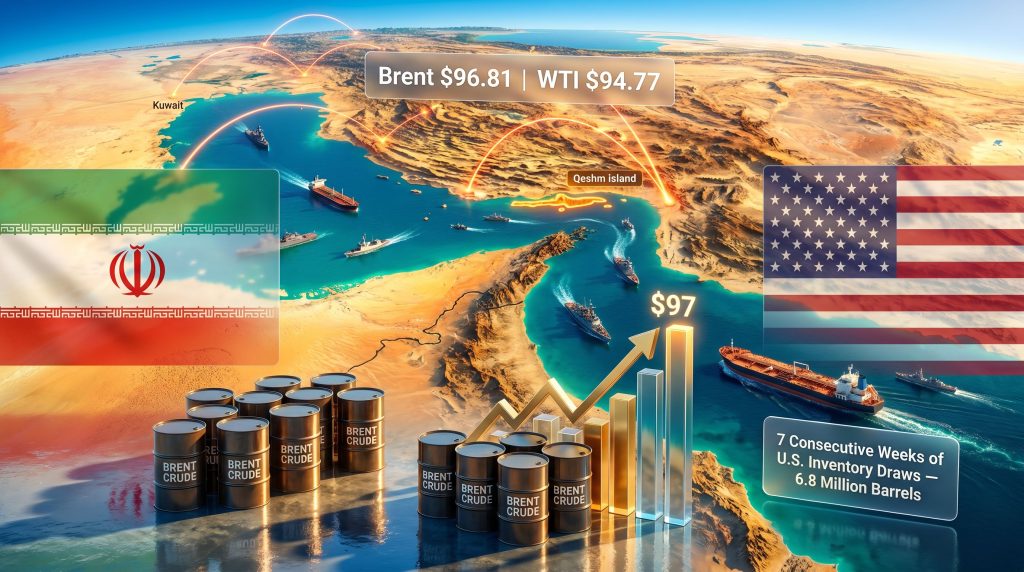
What makes the mid-2026 oil market so unusual is that both mechanisms are active simultaneously. Brent crude futures have climbed to $96.81 per barrel, a gain of approximately 0.8% in a single session, while U.S. West Texas Intermediate has advanced to $94.67, representing roughly a 1% rise on the day.
Critically, both benchmarks had already settled at a one-week high in the prior session, meaning this is directional momentum with duration, not a single-session reaction. Geopolitical oil price drivers of this nature are rarely resolved quickly, which is precisely what makes the current repricing so significant.
LSEG senior oil analyst Emril Jamil identified the convergence of deteriorating Iran-U.S. negotiations alongside International Energy Agency warnings about dangerously depleted global inventories as the twin forces layering additional risk premium onto already-elevated benchmark prices. This dual-driver dynamic means the price floor keeps rising even without a single dramatic escalation event.
When geopolitical uncertainty and physical supply tightness activate simultaneously, markets enter what traders informally call a double premium environment, where both the present reality and the feared future are being priced into the same contract.
The Psychology Behind Oil Market Positioning
A less commonly discussed dimension of this price environment is how institutional positioning amplifies moves. When large commodity funds and trading houses perceive that downside scenarios are asymmetrically less likely than upside scenarios, they shift their hedging posture toward protection against further rallies rather than corrections.
This creates a self-fulfilling dynamic where the positioning itself helps sustain prices at elevated levels, even during sessions without fresh negative headlines.
What the Missile Strikes Mean for Energy Infrastructure Risk
Iran's Ballistic Attacks on Kuwait and Bahrain
On June 3, 2026, Iran launched ballistic missiles targeting both Kuwait and Bahrain. U.S. military authorities confirmed the missiles failed to reach their intended destinations. American forces responded with direct strikes against Iran's Qeshm Island, broadening the geographic scope of the conflict beyond the original Iran-Israel theatre that had defined earlier hostilities.
This sequence matters to energy markets for reasons that go beyond the immediate military exchange. The strategic geography of these targets is deeply intertwined with global oil infrastructure. As Reuters reported, the renewed hostilities drove fresh gains across crude benchmarks in immediate trading sessions.
| Country / Location | Strategic Significance | Primary Energy Risk |
|---|---|---|
| Kuwait | Major OPEC producer; adjacent to Saudi oil fields | Infrastructure vulnerability from proximity to conflict |
| Bahrain | Hosts U.S. Fifth Fleet; key GCC financial hub | Military escalation risk; regional stability signal |
| Qeshm Island (Iran) | Positioned at the mouth of the Strait of Hormuz | Direct threat to regional shipping lane control |
| Strait of Hormuz | Transit corridor for roughly 20% of global daily oil supply | Mining, interdiction, and closure risk |
The Broader Conflict Timeline and What Stalemate Signals to Markets
The current hostilities began when the United States and Israel launched coordinated strikes against Iran. More than three months on, neither side has achieved a decisive outcome, and a nominally operative ceasefire remains visibly fragile. Markets interpret prolonged military stalemates as a signal that resolution is not imminent, which translates into sustained rather than temporary risk premium.
The June 3 missile exchanges represent a potential fracture of that ceasefire architecture, which energy traders are treating as a material escalation indicator rather than a routine incident. Consequently, the trade war impact on oil compounds these pressures still further, adding another layer of uncertainty to an already strained market.
The Strait of Hormuz: From Psychological Risk to Physical Reality
Why This Chokepoint Cannot Be Quickly Resolved
Few geographic features carry the same weight in global energy markets as the Strait of Hormuz. In normal operating conditions, the waterway handles an estimated 20 to 21 million barrels per day of crude oil and petroleum products, representing approximately one-fifth of the world's total daily oil supply. No alternative routing exists that can absorb a major disruption at comparable cost or speed.
ANZ Bank senior commodity strategist Daniel Hynes highlighted that Iran has mined substantial portions of this critical waterway, creating navigational hazards that cannot be rapidly neutralised. While vessel traffic attempting the passage has shown a marginal uptick, total transits through Hormuz remain significantly below pre-conflict levels, according to Hynes. This is a crucial distinction: the constraint is not purely psychological but physically embedded in the waterway itself.
The Strait of Hormuz situation illustrates a key concept in energy security analysis: infrastructure risk that requires active remediation rather than diplomatic resolution. Even a signed ceasefire does not instantly restore safe passage while mines remain in the water.
The World Bank's Supply Shock Assessment
The World Bank has characterised the combination of military hostilities and persistent Hormuz shipping disruption as triggering a large oil supply shock. Brent crude prices have remained substantially above early-2026 levels as a direct consequence, with the Bank's assessment reinforcing the view that this is a structural dislocation rather than a transient price event.
For downstream consumers, the implications extend beyond pump prices. Refineries in Asia-Pacific and European markets that depend on Gulf crude as primary feedstock face a sustained period of higher input costs and potential feedstock security concerns.
The Diplomatic Vacuum and Its Amplifying Effect on Prices
A Communication Gap at the Worst Possible Moment
Iranian media reported on June 3 that Tehran had not been in contact with Washington for several days. U.S. President Trump offered a contrasting characterisation, asserting that negotiations had been maintained on a continuous basis. The contradiction itself is analytically significant: when the two principal parties cannot agree on whether talks are even occurring, markets have no credible signal to anchor a de-escalation expectation.
Reports indicated that Tehran was reviewing a proposed framework agreement with the United States, though no formal counter-proposal or acceptance had been transmitted as of the time of reporting. Investing.com's coverage of the session confirmed that the communication impasse was among the most closely watched variables for near-term price direction.
Three Scenarios the Market Is Pricing Simultaneously
Rather than pricing a single outcome, oil markets price a probability-weighted distribution of future states. The current Brent price near $97 reflects the market's collective assessment of three plausible scenarios:
-
Scenario A – Credible Diplomatic Breakthrough: Verifiable progress in Iran-U.S. talks would likely trigger a rapid unwinding of risk premium, with Brent potentially pulling back toward the $85 to $88 range as supply normalisation becomes a realistic prospect.
-
Scenario B – Full Diplomatic Collapse: A definitive breakdown in negotiations combined with renewed large-scale military operations would place $100 per barrel within reach for Brent, a threshold that carries both psychological weight and real economic consequences for import-dependent economies.
-
Scenario C – Prolonged Stalemate: The most probable near-term baseline, characterised by intermittent hostilities, fragile ceasefire mechanics, and stalled diplomacy, sustains elevated prices in the $93 to $98 range with elevated volatility around each news cycle.
Supply Fundamentals Are Independently Bullish
Seven Consecutive Weeks of U.S. Inventory Declines
The geopolitical narrative is reinforced by independently bearish supply fundamentals. American Petroleum Institute data released on Tuesday June 3 showed that U.S. crude oil inventories declined for a seventh consecutive week, with the most recent draw totalling 6.8 million barrels for the week ended May 29, 2026.
| Supply Metric | Data Point |
|---|---|
| Consecutive weeks of U.S. inventory decline | 7 weeks |
| Most recent weekly draw volume (API estimate) | 6.8 million barrels |
| Reference week for most recent data | Ended May 29, 2026 |
| Official EIA data release timing | June 3, 2026 at 17:30 Saudi time |
| Market implication | Accelerating physical supply tightness |
A single week of elevated draws might be dismissed as seasonal noise. However, seven consecutive weeks of draws constitutes a structural trend that removes the inventory buffer markets rely on to absorb supply shocks without immediate price impact. In addition, OPEC demand revisions have further tightened the outlook for available supply across key producing regions.
The IEA Warning That Shifts the Narrative
The head of the International Energy Agency's oil industry and markets division issued a warning on Tuesday that global oil inventories are at risk of reaching critically low levels ahead of the peak summer demand period if current drawdown rates persist. This statement is analytically important because it reframes the price driver from a purely geopolitical story to one of structural undersupply — a more durable and harder-to-reverse condition than a temporary risk premium.
When the IEA signals inventory concern ahead of summer demand peaks, it removes the safety valve assumption that has historically capped oil price spikes — namely, the belief that ample stored supply can be released to bridge temporary production shortfalls. Furthermore, OPEC's market influence over production decisions adds yet another variable that could either stabilise or further tighten the supply picture in coming months.
The next major ASX story will hit our subscribers first
How These Forces Compound: The Multi-Layer Price Architecture
Six Simultaneous Price-Support Mechanisms
The current oil price elevation cannot be attributed to any single catalyst. It reflects the concurrent activation of at least six distinct upward price mechanisms:
-
Active armed conflict within the geographic zone containing the world's most critical oil transit infrastructure
-
Diplomatic communication breakdown between the two parties most capable of negotiating a de-escalation
-
Physical supply restriction through Hormuz mining and the associated collapse in vessel transit volumes
-
Seven-week consecutive decline in U.S. crude inventories removing a critical demand buffer
-
IEA warnings about approaching critical global stock thresholds directly ahead of peak seasonal demand
-
Sustained ceasefire fragility preventing markets from pricing any meaningful probability of near-term resolution
Historical Context: How This Shock Compares
| Geopolitical Event | Approximate Brent Price Impact | Duration of Elevated Prices |
|---|---|---|
| 1973 Arab Oil Embargo | Approximately +300% over six months | Around 12 months |
| 1990 Gulf War (Iraq invasion of Kuwait) | Approximately +100% over three months | Approximately six months |
| 2019 Abqaiq-Khurais facility attacks | Around +15% intraday spike | Approximately two weeks |
| 2022 Russia-Ukraine war outbreak | Approximately +50% over three months | Around nine months |
| 2026 Iran conflict (ongoing) | Well above early-year price levels | Three-plus months and continuing |
Historical comparisons are indicative only. Market structure, spare capacity levels, demand contexts, and available strategic reserves differ substantially across periods. Past price patterns do not predict future outcomes.
Key Risk Factors for Price Direction in Both Directions
Conditions That Could Push Oil Higher
-
A complete ceasefire collapse and resumption of large-scale Gulf-wide hostilities
-
Intensified Hormuz mining operations or naval confrontation that effectively closes the strait to commercial traffic
-
Direct strikes on Saudi Arabian or UAE production infrastructure that remove OPEC+ barrels from the market
-
Failure of any IEA emergency stock release mechanism to offset accelerating physical shortfalls
Conditions That Could Bring Prices Lower
-
A verifiable and credible diplomatic breakthrough in Iran-U.S. negotiations accompanied by independently confirmed ceasefire compliance
-
Successful naval demining operations that restore Hormuz vessel transit volumes toward pre-conflict levels
-
A coordinated OPEC+ emergency production increase designed to compensate for Iranian supply disruptions
-
Demand destruction driven by sustained high prices reducing industrial output and consumer energy consumption in price-sensitive economies
Frequently Asked Questions
Why Do Middle East Conflicts Consistently Cause Oil Prices to Rise?
The region accounts for approximately one-third of global oil production and is home to the Strait of Hormuz, through which roughly 20% of the world's daily oil supply moves. Any credible threat to production capacity or transit infrastructure activates an immediate supply-risk premium in global benchmark pricing, regardless of whether physical disruption has yet occurred.
What Makes the Strait of Hormuz Irreplaceable in Global Energy Trade?
The Strait is a narrow maritime passage between Iran and Oman connecting the Persian Gulf to the broader Indian Ocean trade network. It is the only feasible exit route for crude exports from Kuwait, Iraq, Iran, Qatar, and a significant portion of Saudi and UAE production. There is no alternative routing capable of absorbing equivalent volumes at comparable cost or transit time.
How Does a Stalled Iran-U.S. Negotiation Actually Move Oil Prices?
When talks show genuine progress, markets typically discount some probability of supply restoration and route normalisation, reducing the risk component embedded in oil prices. When negotiations stall or communication breaks down entirely, that probability collapses, leaving the full weight of conflict-era risk premium in place. This consequently creates conditions for further upward price movement, as the market has no credible signal on which to anchor expectations of relief.
What Does a Seven-Week Consecutive Inventory Draw Actually Signal?
Consecutive inventory draws signal that demand is consistently outpacing supply replenishment, eroding the buffer that normally absorbs price shocks. Seven consecutive weeks of draws, including a single-week reduction of 6.8 million barrels, creates a compounding tightness signal. When this trend coincides with geopolitical disruption, it eliminates the market's primary shock absorber mechanism.
Is $100 Per Barrel Brent a Realistic Near-Term Scenario?
With Brent already above $96, the distance to the $100 threshold is narrow. Analysts broadly identify a full Hormuz closure, a major Gulf production infrastructure strike, or a definitive collapse of Iran-U.S. diplomacy as individually sufficient triggers to push Brent through that level. Counterbalancing forces, including potential OPEC+ responses and eventual demand destruction from elevated prices, provide some ceiling, but those mechanisms typically operate with a lag.
What the Market Is Communicating Right Now
The price signal being generated by crude benchmarks in early June 2026 is not a short-term reaction to a single news event. Oil prices rise on Middle East hostilities and stalled Iran-US talks in ways that compound one another, and Brent near $97 alongside WTI near $94.77 represents a market that has absorbed more than three months of sustained conflict and concluded that the probability of rapid normalisation is low.
The Iran-U.S. diplomatic communication gap remains the single most watched variable for near-term price direction. The physical constraint from Hormuz mining is structural and cannot be resolved by diplomatic announcements alone. Seven consecutive U.S. inventory draws combined with IEA critical stock warnings mean the market's buffer capacity against further shocks has materially diminished.
For traders, energy economists, and policy analysts alike, the current environment illustrates a core principle of oil market dynamics: when geopolitical risk and supply fundamentals align in the same direction, price discovery becomes less about where oil should trade and more about identifying what credible signal could break the momentum.
This article is intended for informational purposes only and does not constitute financial or investment advice. Oil price forecasts and scenario analyses are inherently speculative and subject to rapid change based on evolving geopolitical and macroeconomic conditions. Readers should conduct independent research before making any investment decisions.
Want to Stay Ahead of the Next Major Resource Discovery Triggered by Shifting Energy Markets?
While crude benchmarks respond to geopolitical shocks in real time, significant mineral discoveries on the ASX can move just as rapidly — and Discovery Alert's proprietary Discovery IQ model delivers instant alerts the moment a high-potential announcement hits the exchange, turning complex data across 30-plus commodities into clear, actionable insights. Explore historic discoveries and their remarkable returns or start your 14-day free trial today to position yourself ahead of the broader market.