June 3, 2026
The Dual-Commodity Advantage: Why Co-Located Uranium and Lithium Deposits Are Reshaping Critical Mineral Strategy
Across the global mining landscape, a quiet but consequential shift is underway. Resource-rich nations are no longer content to serve as passive suppliers in the critical minerals supply chain. Instead, governments from South America to Southeast Asia are deploying formal policy instruments to assert sovereign control over the minerals that will power the next century of technological development. Peru's issuance of a Supreme Decree formally designating both uranium and lithium as minerals of national importance — what has become known as the Peru national importance decree for uranium and lithium — represents one of the most structurally significant policy moves in South American resource governance in recent years.
What makes this moment particularly notable is not simply that Peru has acted, but how it has acted. The decree co-designates two mineralogically distinct but strategically complementary resources under a single national importance instrument, reflecting a sophisticated understanding of their combined role in the global energy transition. Understanding what this means, why it matters, and who stands to benefit requires stepping back from the headline announcement and examining the deeper geological, regulatory, and geopolitical forces at play.
When big ASX news breaks, our subscribers know first
Peru's Policy Architecture: What a Supreme Decree Actually Does
Within Peru's constitutional framework, a Supreme Decree carries the weight of executive authority and sits above ordinary ministerial resolutions in the regulatory hierarchy. Unlike standard legislation, which requires congressional passage, a Supreme Decree can be issued by the executive branch to implement policy directives with immediate legal effect. This distinction matters considerably for investors and project developers, because it signals direct and unambiguous political will at the highest level of government.
Peru's critical minerals policy has evolved through several distinct phases:
| Policy Instrument | Year | Minerals Covered | Key Provision |
|---|---|---|---|
| Law No. 31283 | 2021 | Lithium only | Declared lithium a resource of public necessity and national strategic interest |
| Uranium regulatory framework (draft) | 2018 onwards | Uranium only | Regulatory gap formally acknowledged; framework remained incomplete |
| New Supreme Decree | 2026 | Uranium and Lithium | Joint national importance designation; inaugural forum declared of national importance |
The 2021 lithium law established an important precedent but left uranium in a regulatory grey zone. Former President Vizcarra's administration acknowledged as far back as 2018 that Peru lacked an adequate legal framework for radioactive mineral extraction, yet nearly eight years passed before uranium received formal co-designation alongside lithium. The 2026 Supreme Decree closes that gap for the first time, though it does not automatically resolve the deeper permitting complexities that uranium's radioactive classification creates.
The decree formally recognises both minerals as critical and strategic resources of increasing international relevance, citing their foundational roles across four policy domains:
- Energy transition infrastructure development
- Electro-mobility and transport decarbonisation
- Clean energy storage systems
- Smart city technology platforms
Furthermore, the decree articulates low-carbon, low-environmental-impact energy development as an explicit government objective within a sustainable development framework, signalling that resource extraction ambitions are being paired with environmental governance commitments.
The Macusani Plateau: Understanding the Geological Significance
To appreciate why this policy shift carries real weight, it is essential to understand the geological setting it is designed to unlock. The Macusani Plateau, situated in the Puno region of south-eastern Peru at high altitude in the Andean highlands, hosts one of the most unusual dual-commodity mineral systems documented in South America.
The plateau is characterised by hard-rock lithium and cesium mineralisation occurring within peraluminous granites and rhyolitic volcanic sequences. What distinguishes the Macusani geology from more conventional lithium brine systems found in Chile and Argentina is the hard-rock nature of the deposit, which allows for different processing pathways and avoids the water-intensive lithium extraction methods associated with evaporite brines.
The Falchani Lithium Project
The Falchani project, controlled by TSX-V listed American Lithium Corporation, is regarded as one of the world's largest hard-rock lithium and cesium deposits. The project has a completed Preliminary Economic Assessment, and its mineral resource base has been expanded through continued exploration programmes. Several aspects of Falchani's mineralogy deserve particular attention from investors and technical observers:
-
Cesium co-product: Falchani hosts meaningful cesium mineralisation alongside lithium. Cesium is an exceptionally rare specialty metal used in precision drilling fluids, atomic clocks, photoelectric cells, and advanced electronics. Its market is small but characterised by very high unit values and near-total supply concentration among a handful of global producers. The presence of a commercially significant cesium co-product adds a high-value specialty chemical dimension that most lithium project financial models do not capture adequately.
-
Hard-rock classification: Unlike brine-hosted lithium, hard-rock deposits require crushing and processing, but they also offer more consistent grade profiles and are generally less sensitive to seasonal variation in water availability, a material operational advantage in high-altitude Andean environments.
-
Battery-grade relevance: Growing demand from battery manufacturers seeking non-brine, geopolitically diversified lithium sources has elevated hard-rock projects outside Australia and Chile into sharper strategic focus.
The Macusani Uranium Project
The Macusani uranium project holds a completed Preliminary Economic Assessment and carries the distinction of being the largest undeveloped uranium project in Latin America. Uranium mineralisation on the plateau is broadly associated with the same volcanic and intrusive geological sequences that host the lithium system, creating genuine infrastructure and permitting synergies that could reduce per-tonne development costs relative to standalone projects.
From a market perspective, the uranium market dynamics have shifted materially since the post-Fukushima demand trough of the 2010s. The nuclear renaissance narrative, once treated with scepticism by mainstream energy analysts, has gained considerable traction as net-zero emissions targets force policymakers to confront the baseload generation gap that intermittent renewables cannot fill alone. Demand from new nuclear build programmes in Asia, the United Kingdom, and Eastern Europe is creating structural pressure on uranium supply that historically dominant producers in Kazakhstan and Canada may not fully absorb.
Uranium from Latin America represents a geographically diversified supply source that does not depend on Central Asian production corridors, a characteristic increasingly valued by energy utilities seeking to reduce sovereign supply concentration risk in their fuel procurement strategies.
The co-location of uranium and lithium on the same plateau creates a genuinely rare scenario: a single geographic zone that can supply both the nuclear energy sector and the battery technology sector from a shared infrastructure footprint. Very few mineral provinces globally offer this kind of dual-commodity strategic relevance.
Peru's Positioning Within the Latin American Critical Minerals Landscape
Peru's approach to critical mineral governance differs meaningfully from its regional neighbours, and understanding those differences is important for investors assessing sovereign risk and development timelines.
| Country | Key Critical Mineral | Policy Model | Notable Assets |
|---|---|---|---|
| Chile | Lithium | State-led, nationalisation framework (2023) | Atacama brine operations |
| Argentina | Lithium | Provincial-led, open to foreign investment | Lithium Triangle projects |
| Bolivia | Lithium | State monopoly model | Salar de Uyuni |
| Peru | Lithium and Uranium | National importance decree model (2026) | Falchani, Macusani |
| Brazil | Rare earths, lithium | Emerging policy framework | Multiple early-stage assets |
Peru's model occupies an interesting middle ground. It has stopped short of the full nationalisation approach adopted by Chile under its 2023 lithium strategy, but it has also moved beyond the relatively laissez-faire provincial frameworks that characterise Argentina's development environment. The national importance designation model preserves space for private and foreign capital while asserting sovereign strategic priority — a calibration that could prove attractive to institutional investors and multilateral development finance institutions.
Consequently, the global lithium market is watching Peru's policy evolution closely, particularly as demand from battery manufacturers and energy storage developers continues to intensify. Furthermore, the critical minerals energy transition agenda is lending additional urgency to countries that can demonstrate both resource endowment and credible governance frameworks.
The International Forum: Strategic Convening Power and What It Signals
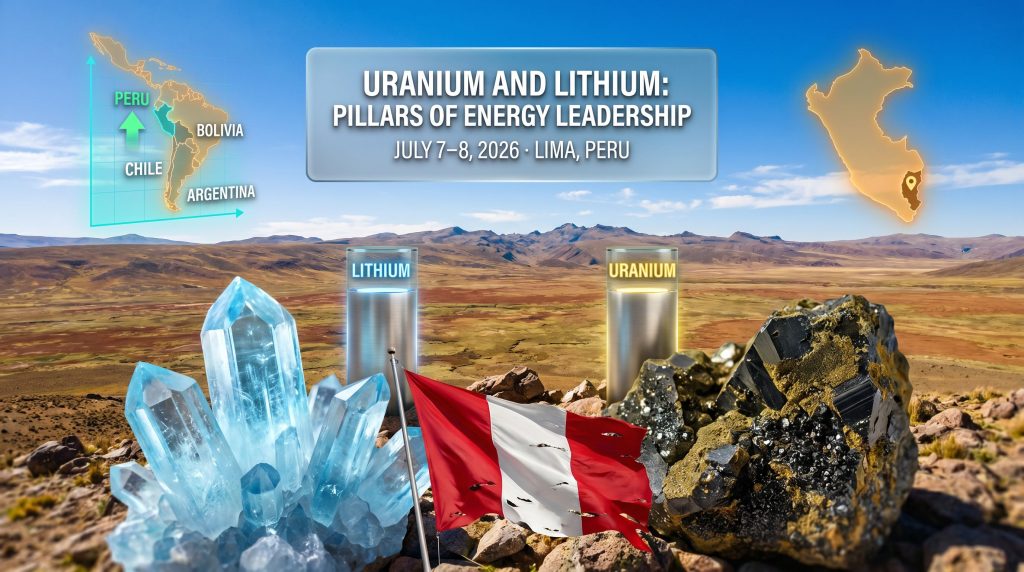
The declaration of the upcoming international forum as an event of national importance carries strategic significance that extends well beyond the two-day programme itself. The forum, titled Uranium and Lithium: Pillars of Energy Leadership for Mining, Technological and Smart City Development in Peru and the World, is scheduled for July 7 and 8, 2026, in Lima.
Several structural features of the forum deserve attention:
-
Dual ministerial co-organisation: The forum is being jointly organised by Peru's Ministry of Energy and Mines and the Ministry of Housing, Construction and Sanitation. The inclusion of the housing ministry signals that the government is thinking about critical mineral development not merely as an extraction exercise, but as a pillar of broader urban and technological development policy.
-
Inaugural status: This is the first forum of this kind held under the new policy framework, giving it a precedent-setting character that subsequent editions will build upon.
-
Forum timing relative to the World Mining Congress: Peru is also hosting the 27th World Mining Congress in Lima in 2026, compounding the country's profile as a global mining governance hub during this period.
The forum creates a platform for Peru to engage directly with governments, multilateral institutions, battery supply chain operators, and nuclear energy utilities, positioning the country as a convener rather than merely a commodity supplier.
Regulatory Complexity: The Outstanding Uranium Challenge
The Supreme Decree is a significant policy signal, but sophisticated investors should understand precisely what it does and does not resolve. The staged pathway from decree to production involves several distinct regulatory layers:
Stage 1 — Policy Declaration (Completed):
The Supreme Decree establishes national importance status and signals political will at the executive level.
Stage 2 — Regulatory Harmonisation (Pending):
Uranium mining must be aligned with Peru's nuclear regulatory authority, the Instituto Peruano de Energía Nuclear (IPEN), as well as international safeguards obligations under the International Atomic Energy Agency framework.
Stage 3 — Permitting Acceleration:
Formal fast-track pathways for nationally designated strategic mineral projects need to be operationalised through secondary regulation.
Stage 4 — Investment Mobilisation:
International capital attraction requires bilateral investment frameworks, offtake agreements, and project-level financing structures.
Stage 5 — Production and Export:
Operational development of plateau-region assets, beginning with advancement from PEA to Pre-Feasibility Study stage.
The critical bottleneck in this sequence is Stage 2. Uranium's radioactive classification creates a fundamentally different regulatory environment compared to conventional hard-rock mining. Environmental impact assessment frameworks for radioactive mineral extraction in Peru remain less developed than those governing gold, copper, or even lithium mining. Resolving this harmonisation challenge between the mining ministry and IPEN will ultimately determine whether the Peru national importance decree for uranium and lithium translates into development velocity or remains a symbolic designation.
The next major ASX story will hit our subscribers first
Investment Considerations: Reading the Risk Profile Shift
For investors tracking critical minerals demand in Latin America, Peru's Supreme Decree represents a meaningful shift in the sovereign risk profile of the Puno region projects, though it is not a risk elimination event.
Key considerations for investors evaluating this development include:
-
PEA completion is a floor, not a ceiling: Both Falchani and Macusani have completed Preliminary Economic Assessments. The next value-inflection milestone for both projects is advancement to Pre-Feasibility Study stage, which would provide materially more detailed economic and technical parameters and unlock access to a broader institutional investor base.
-
Cesium optionality is underappreciated: The cesium mineralisation at Falchani represents a specialty chemical value stream that is rarely modelled adequately in junior miner valuations. As the global cesium market tightens, the strategic value of a primary cesium source embedded within a major lithium project could become a more prominent investment narrative.
-
Policy designation reduces but does not eliminate permitting risk: National importance status has historically improved project standing in community consultation processes and ministerial prioritisation queues in comparable jurisdictions, but it does not substitute for completing the underlying environmental and nuclear regulatory compliance work.
-
Uranium supply dynamics are structurally supportive: The long-term uranium demand outlook, driven by nuclear energy's rehabilitated role in net-zero energy policy, favours projects with completed economic studies and defined resource bases in jurisdictions making regulatory progress. American Lithium's recent legal win over 32 uranium concessions in Peru further reinforces the project's legal standing and development momentum.
In addition, it is worth noting that community and indigenous stakeholder considerations in the Carabaya-Puno region remain an important dimension of the social licence to operate. The Peru national importance decree for uranium and lithium will need to be accompanied by robust community engagement frameworks if long-term project viability is to be assured.
This article is informational in nature and does not constitute financial or investment advice. Investors should conduct independent due diligence and consult qualified financial advisers before making investment decisions related to any mining project or company mentioned herein. Forward-looking assessments regarding project timelines, regulatory outcomes, and commodity markets involve material uncertainty.
Frequently Asked Questions
What is Peru's national importance decree for uranium and lithium?
A Supreme Decree issued by the Peruvian government in 2026 that formally designates both uranium and lithium as critical and strategic minerals of national importance, recognising their centrality to the energy transition, electro-mobility, clean energy storage, and smart city development objectives.
How does the 2026 decree differ from Peru's 2021 lithium law?
Law No. 31283 declared lithium a resource of public necessity and national strategic interest but excluded uranium. The 2026 Supreme Decree extends national importance status to uranium for the first time, addressing a regulatory gap that had persisted since at least 2018.
Where are Peru's main uranium and lithium deposits?
Both resources are concentrated on the Macusani Plateau in the Puno region of south-eastern Peru. The Falchani project is one of the world's largest hard-rock lithium and cesium deposits, while Macusani is the largest undeveloped uranium project in Latin America. American Lithium Corporation holds both projects.
Does the decree resolve all permitting barriers for uranium mining?
No. Uranium remains subject to Peru's nuclear regulatory authority (IPEN) and IAEA international safeguards obligations. The decree signals political intent but does not automatically harmonise the separate regulatory frameworks applicable to radioactive mineral extraction.
Why does uranium matter for the energy transition?
Nuclear power is increasingly recognised as a low-carbon baseload energy source capable of complementing intermittent renewable generation within net-zero frameworks. Rising demand from new nuclear build programmes across Asia and Europe is creating structural pressure on global uranium supply, elevating the strategic importance of undeveloped projects in politically stable jurisdictions outside the traditional production corridors of Kazakhstan and Canada.
Want to Track the Next Major Critical Mineral Discovery Before the Market Does?
Discovery Alert's proprietary Discovery IQ model delivers real-time alerts on significant ASX mineral discoveries — including critical minerals like lithium and uranium — transforming complex data into actionable investment insights the moment announcements hit the exchange. Explore historic examples of extraordinary discovery returns and begin your 14-day free trial today to position yourself ahead of the broader market.