
June 3, 2026
The Hidden Economics of Primary Crushing: Why Equipment Choice Defines Mine Profitability
Few decisions in the lifecycle of a mining project carry as much long-term financial consequence as the selection of primary crushing equipment. While exploration results and commodity prices dominate investor attention, the comminution circuit — and specifically the primary crusher at its front end — quietly determines whether a processing plant meets its throughput targets, stays within its energy budget, and generates acceptable returns over a 15 to 25-year operating life.
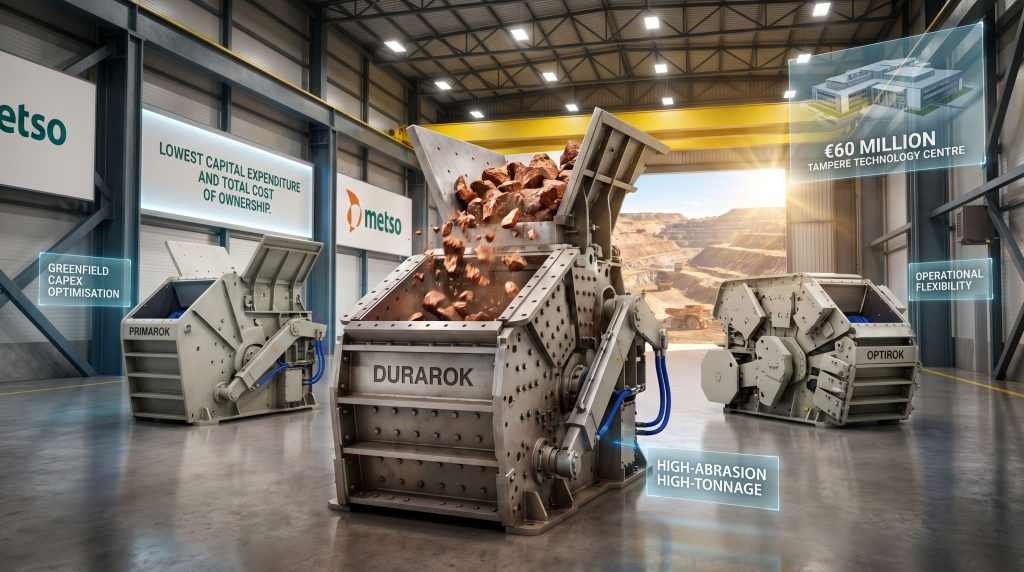
This is the industrial context into which Metso launches three primary crushers: the Primarok, Optirok, and Durarok. Each model is engineered around a distinct operational philosophy, and together they represent the Finnish OEM's most deliberate repositioning of its primary crushing portfolio in recent memory.
When big ASX news breaks, our subscribers know first
Understanding the Problem These Crushers Are Solving
The mining industry's cost structure has shifted materially over the past decade. Energy prices have risen across most major mining jurisdictions, ore grades at established operations continue to decline, and capital budgets are under sustained pressure as financing conditions tighten. Consequently, processing plant economics are being scrutinised at a level of detail that was largely absent during the commodity supercycle years.
Primary crushing sits at the convergence of these pressures. It is the first stage of comminution, where run-of-mine ore is reduced from its largest particle size before entering the broader processing circuit. As the initial mechanical intervention, it sets the energy and throughput parameters for everything downstream.
Key industry dynamics reshaping primary crusher procurement include:
- Comminution accounts for approximately 30 to 50% of total mine site energy consumption, making crusher efficiency a direct lever on operating costs and carbon emissions
- Primary crushers typically represent 15 to 25% of total processing plant capital expenditure, making them among the highest-value individual equipment decisions in a project
- Unplanned primary crusher downtime creates cascading losses across the entire processing circuit, with high-throughput operations potentially losing hundreds of thousands of dollars per day during stoppages
- Ore body complexity is increasing, particularly in copper porphyry deposits, where ore mineralogy economics and variable hardness require equipment capable of handling fluctuating feed characteristics
In high-throughput copper operations, a 1 to 2% improvement in primary crusher mechanical availability can translate to millions of dollars in additional recovered metal value over a single operating year. The equipment decision made at project sanction compounds across decades of production.
Metso Launches Three Primary Crushers: Breaking Down the Architecture
Rather than engineering a single universal solution, Metso's approach segments the primary crushing challenge into three distinct value propositions. This tiered architecture is significant because it acknowledges that no single crusher design can optimally serve the full range of mine sizes, ore types, and capital environments present in the modern mining industry.
| Crusher Model | Core Design Priority | Optimal Application Context |
|---|---|---|
| Primarok | Capital expenditure minimisation | Greenfield projects with constrained budgets |
| Optirok | Operational flexibility and adaptability | Variable ore body and brownfield integration scenarios |
| Durarok | Durability and wear performance | High-abrasion, high-tonnage, long-life operations |
Each model's naming convention communicates a functional identity. Prima references the primary positioning and cost-first philosophy. Opti signals optimisation across variable conditions. Dura reflects durability-led design for the most demanding hard rock environments. This is deliberate product branding architecture, not incidental naming.
All three models are positioned by Metso as delivering the lowest capital expenditure and total cost of ownership within their respective operational categories — a claim that, if validated in field deployment, would represent a meaningful competitive proposition against established alternatives.
How These Models Compare to Existing Crusher Technologies
To appreciate the significance of this launch, it helps to understand where these crushers sit within the broader competitive landscape of primary crushing technology.
| Crusher Technology | Typical Scale | Core Strength | Primary Limitation |
|---|---|---|---|
| Primary Gyratory | Very large (>5,000 tph) | Ultra-high throughput capacity | Very high CapEx, complex installation |
| Jaw Crusher | Small to medium | Lower CapEx, mechanical simplicity | Limited throughput ceiling |
| Impact Crusher | Softer, less abrasive ores | High reduction ratio | Rapid wear in hard rock environments |
| Primarok / Optirok / Durarok | Mid to large scale | CapEx and TCO optimisation | Field performance pending validation |
Critically, these new models are entirely distinct from Metso's HPe cone crusher series — the HP600e, HP800e, and HP900e — which are designed for secondary and tertiary crushing stages. The Primarok, Optirok, and Durarok operate at the front end of the comminution circuit, upstream of any cone or impact crushing equipment.
The competitive field for primary crushing equipment includes major OEMs such as FLSmidth, Sandvik, and Terex MPS, each with established product portfolios in this segment. Metso's differentiation rests primarily on the tiered three-model architecture and its explicit total cost of ownership positioning, rather than raw throughput performance alone.
The Tampere Investment: Why the €60 Million Commitment Matters
The timing of this product launch is not coincidental. In the same week that Metso announced the Primarok, Optirok, and Durarok, the company also confirmed a €60 million investment in its Tampere technology centre in Finland — its primary R&D and manufacturing hub for crushing and screening equipment.
This dual announcement is strategically meaningful for several reasons:
- It signals that these products represent a sustained technology platform, not a one-off model refresh
- The Tampere investment strengthens Metso's in-house engineering capability, reducing dependence on external supply chains for critical components
- Long-term manufacturing investment typically implies a commitment to extended spare parts availability and engineering customisation support for customers
- Concurrent capital allocation to facilities and products suggests a multi-year product renewal cycle is underway across Metso's crushing portfolio
For mining operators evaluating primary crusher procurement, the longevity of OEM engineering support is a material consideration. Equipment with a 20-year operating life requires assured access to wear parts, technical support, and potential upgrade pathways throughout that period. The Tampere investment provides some structural assurance on this front.
Total Cost of Ownership vs. Capital Expenditure: The Core Trade-Off
One of the more technically nuanced aspects of primary crusher selection is the tension between upfront capital cost and total lifecycle cost. This trade-off is more complex than it might initially appear, particularly when considered alongside cut-off grade economics that determine the volume of ore requiring processing.
CapEx-Focused Procurement
This approach prioritises minimising the initial purchase and installation cost. It suits projects where capital is scarce, where the mine life is uncertain, or where operators are willing to accept higher ongoing maintenance and energy costs in exchange for lower initial commitment.
TCO-Focused Procurement
This approach accepts higher initial equipment investment in exchange for lower wear part consumption rates, better energy efficiency, longer maintenance intervals, and higher mechanical availability over the asset life.
The full TCO calculation for a primary crusher must account for:
- Initial equipment purchase price
- Civil and structural installation costs
- Energy consumption across the full operating life (often the largest single TCO component)
- Wear part replacement frequency and unit cost
- Scheduled and unplanned maintenance labour
- Mechanical availability rates and their downstream production impact
- Residual value or decommissioning cost at end of life
Metso's positioning of all three new models as delivering both lowest CapEx and lowest TCO is a notable claim. Historically, these objectives exist in tension. If the engineering solutions genuinely compress this trade-off, it would represent a substantive advance in primary crushing economics rather than a marketing repositioning.
The next major ASX story will hit our subscribers first
ESG Pressures Are Reshaping How Crushers Are Evaluated
A dimension of primary crusher procurement that has grown considerably in importance is the energy efficiency and emissions profile of equipment. Institutional investors and regulators are applying increasing pressure on mining companies to reduce Scope 1 and Scope 2 emissions, and the broader mining decarbonisation benefits of energy-efficient comminution circuits are now firmly on the agenda.
The practical implication is that specific energy consumption — measured in kilowatt-hours per tonne of material crushed — is now being incorporated into equipment evaluation frameworks alongside traditional metrics like throughput and availability. A crusher that processes ore at lower energy intensity delivers both operating cost advantages and ESG benefits.
This shift was largely absent from primary crusher purchasing criteria a decade ago. Today it is becoming a standard evaluation parameter, particularly for projects attracting institutional financing where sustainability credentials are scrutinised at the asset level.
Target Markets and Commodity Applications
The three-model architecture creates applicability across a wider range of project types than a single-model approach could serve. Understanding which models align with which operational contexts helps clarify the commercial logic of the product range.
Primarok Applications
- Greenfield projects in capital-constrained jurisdictions
- Mid-tier mining companies where upfront equipment cost is a primary procurement driver
- Emerging mining regions across Central Asia, Southeast Asia, and Sub-Saharan Africa where financing efficiency is critical
Optirok Applications
- Brownfield expansions requiring integration with existing processing infrastructure
- Operations where ore body characteristics vary significantly across the mine plan
- Projects requiring configuration flexibility to accommodate staged production ramp-ups
Durarok Applications
- Large copper porphyry operations processing high-abrasion hard rock
- Iron ore operations in West Africa, Latin America, and the Pilbara processing high-tonnage, high-silica feeds
- Long-life operations where wear part longevity directly drives cost competitiveness
From a commodity perspective, copper mining represents the highest-volume addressable market for this product range. Furthermore, current copper market trends point to sustained demand growth driven by the global energy transition, while the industry simultaneously navigates lower ore grades at mature operations and increasingly complex new deposits. Both dynamics favour investment in primary crushing technology that can handle variable feed characteristics at competitive lifecycle costs.
Critical minerals projects — encompassing lithium, nickel, and cobalt development — represent a growing secondary market. These operations frequently operate at mid-tier throughput rates that sit between the scale served by traditional large primary gyratories and smaller jaw crusher configurations. The tiered Metso range appears well-positioned to address this gap.
What the Industry Should Monitor Going Forward
The commercial significance of this launch will ultimately be determined in field deployment. Several factors warrant ongoing monitoring:
- First reference site performance: The initial deployments of each model will generate the operational data that either validates or challenges Metso's TCO and CapEx positioning claims
- Wear part pricing and availability: The long-term economics of any crusher are substantially determined by the cost and supply chain reliability of wear components
- Energy performance data: Independent measurement of specific energy consumption across ore types will be critical for operators conducting rigorous equipment comparisons
- Competitive OEM responses: FLSmidth, Sandvik, and other major players are likely to respond to this product architecture with their own positioning adjustments
The timing of this launch, amid elevated copper project development pipelines across Latin America, Central Asia, and Africa, positions Metso to engage procurement decisions at a strategically important moment. Primary crusher selection typically occurs during the definitive feasibility study and early detailed engineering phases of a project — a window that, for many currently active copper and critical minerals developments, is open now. Metso launches three primary crushers at precisely the point where these procurement conversations are most active.
Disclaimer: This article contains analysis and commentary based on publicly available information. Statements regarding equipment performance, total cost of ownership, and market positioning represent assessments based on available data and should not be construed as investment advice. Field performance of newly launched equipment should be independently verified before procurement decisions are finalised.
Want to Know Which ASX Mining Companies Are Developing the Next Major Mineral Discovery?
Discovery Alert's proprietary Discovery IQ model scans ASX announcements in real time, instantly identifying significant mineral discoveries across copper, critical minerals, and beyond — turning complex data into actionable investment insights before the broader market catches on. Explore historic discoveries and their remarkable returns, then begin your 14-day free trial at Discovery Alert to position yourself ahead of the next major find.