June 3, 2026
The Electricity Bottleneck That Decides Which Mines Get Built
In large-scale mining development, the conversation about project viability rarely begins with ore grades or reserve tonnages. It begins with power. Across remote and sub-arctic jurisdictions worldwide, the single most persistent constraint on bringing a mine from feasibility into production is not geological uncertainty or even environmental permitting. It is the availability of reliable, affordable, and grid-connected electricity at scale.
This reality makes the recent 70 MW power allocation secured by Troilus Mining Corporation (TMC) — a milestone better known as Troilus granted 70 MW power allocation in Québec — far more significant than a routine infrastructure checkbox. It represents the resolution of one of the most structurally complex variables in the mine development equation, and it does so at a moment when the global appetite for domestically sourced copper and gold has rarely been stronger.
When big ASX news breaks, our subscribers know first
What the Troilus Project Represents in Canada's Critical Minerals Landscape
Scale, Resource Significance, and Strategic Positioning
The Troilus project is not a junior exploration story. It is a fully defined, large-tonnage, multi-decade resource in one of the world's most mining-friendly jurisdictions. To contextualise its significance:
- Troilus is currently the largest copper project at the permitting stage in Québec
- It ranks among the largest undeveloped gold projects in Canada
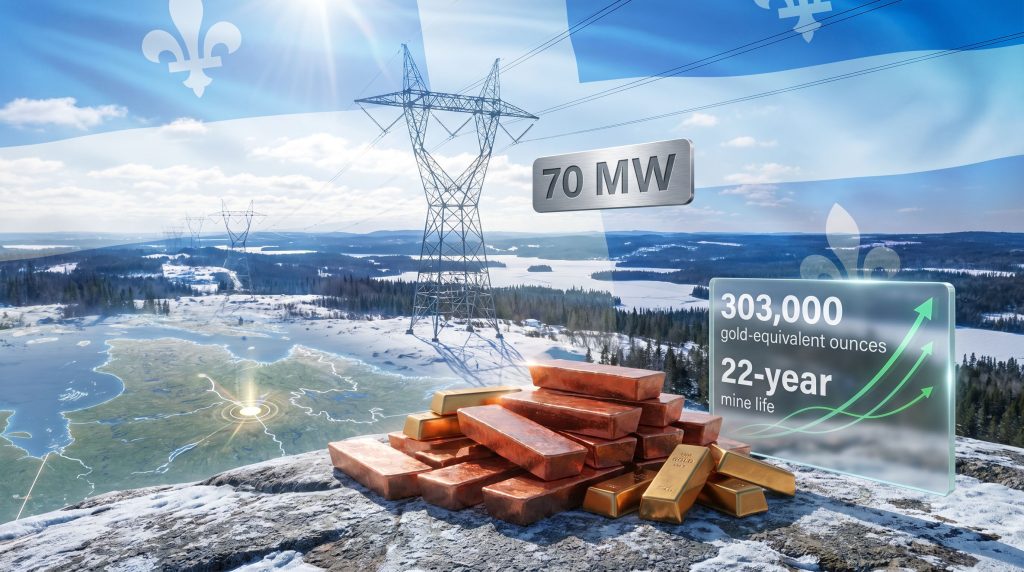
- Projected annual output stands at 303,000 gold-equivalent ounces across a 22-year mine life
- This output can alternatively be expressed as approximately 135 million copper-equivalent pounds per year
A 22-year operational lifespan fundamentally changes the category in which this project belongs. It is not a short-cycle extraction play designed to capitalise on a commodity price window. It is a generational infrastructure asset, the kind that reshapes regional economies, anchors long-term employment, and creates durable fiscal contributions to both provincial and national accounts.
"A mine with a 22-year operational life is not a resource extraction event. It is a permanent feature of a regional economy, with procurement chains, workforce development cycles, and infrastructure dependencies that extend well beyond the mine gate."
The Copper-Gold Dual-Commodity Advantage
One underappreciated structural feature of the Troilus project is its dual-commodity nature. Copper and gold respond to fundamentally different demand drivers, which means the project's revenue profile carries a form of built-in hedging that single-commodity operations cannot replicate.
The ongoing copper supply crunch has made domestically sourced copper even more strategically valuable, particularly as electrification infrastructure and renewable energy deployment continue to accelerate global demand. Gold demand, by contrast, is driven by monetary policy uncertainty, central bank reserve diversification, and risk-off investor sentiment. Furthermore, the current gold price outlook reinforces the investment case for projects with this kind of dual-commodity exposure.
A project capable of producing both commodities simultaneously is better positioned to maintain economic viability across varying macroeconomic conditions — a meaningful consideration for lenders evaluating debt serviceability over a two-decade project life.
Breaking Down the 70 MW Power Allocation
Who Approved It and What the Process Involved
The 70 MW power allocation for the Troilus project received dual approval from Hydro-Québec and Québec's Ministry of Economy, Science and Innovation (MEIE). TMC submitted the formal power request in early 2025, which was followed by sustained, constructive engagement with both Hydro-Québec and key government stakeholders across multiple quarters before the approval was formalised.
This is not a trivial process. Power allocation requests in Québec involve detailed load assessments, grid capacity modelling, connection feasibility studies, and alignment with provincial industrial electricity planning frameworks. Consequently, the fact that both Hydro-Québec and the MEIE reached approval positions the Troilus project within a recognised tier of industrial priority in the province.
Infrastructure Already in Place: A Rare Competitive Advantage
Perhaps the most underappreciated element of this milestone is what was already on the ground before the approval was even granted. TMC confirmed that the following power infrastructure is fully operational and connected to the project site:
| Infrastructure Asset | Specification |
|---|---|
| Existing powerline length | 107 km |
| Voltage capacity | 161 kV high-tension |
| Connection point | On-site substation at Troilus project |
| Power allocation approved | 70 MW |
The presence of 107 kilometres of 161 kV high-tension transmission lines already connected to an on-site substation is a material differentiator that cannot be overstated. In greenfield mining contexts, constructing new high-voltage transmission infrastructure from scratch is routinely one of the most capital-intensive, time-consuming, and logistically complex pre-construction workstreams.
Costs for new remote transmission lines can reach hundreds of millions of dollars depending on terrain, distance, and regulatory requirements, and the permitting process alone can add years to a project timeline. This is an advantage that very few projects at a comparable stage can claim.
What 70 MW Actually Powers at Mine Scale
For context, 70 megawatts of continuous power is sufficient to operate a full-scale open-pit or underground mine processing facility, including crushing and grinding circuits, flotation plants, tailings management systems, site services, and camp infrastructure. At the scale projected for Troilus, this allocation is architecturally aligned with the operational requirements of a mine producing in the range of 303,000 gold-equivalent ounces annually.
How This Milestone Changes the Investment Risk Profile
The Mine Development Lifecycle and Where Energy Fits
Understanding why this approval matters to investors requires understanding how risk is sequentially reduced in mine development. The critical path typically follows this progression:
- Resource definition — establishing the geological case through drilling and modelling
- Permitting advancement — environmental assessments and regulatory approvals
- Energy allocation — securing reliable, costed power supply at the required scale
- Detailed engineering — converting resource and energy parameters into construction-ready plans
- Project financing — attracting debt and equity capital on bankable terms
- Construction commencement — capital deployment at operational scale
With permitting, detailed engineering, and project financing advancing concurrently rather than sequentially, TMC is executing a parallel-track development strategy. The Troilus financing package being structured alongside these workstreams further illustrates how the project's various development threads are being deliberately coordinated. The 70 MW energy allocation removes one of the most critical potential blockers from the financing workstream.
Why Lenders Require Energy Certainty Before Committing Capital
Mine project lenders — whether development finance institutions, commercial banks, or streaming and royalty companies — require a fully costed and contractually secured energy supply before finalising credit terms. An unsecured or unpriced power supply creates an open variable in the project's operating cost model, which in turn makes cash flow projections unreliable.
Unreliable cash flow projections undermine debt service coverage ratios, which are the central metric lenders use to assess repayment capacity. By locking in a 70 MW hydroelectric allocation from Hydro-Québec, a regulated utility with well-established and publicly available industrial tariff structures, TMC has effectively converted its energy cost from an unknown variable into a plannable, modellable line item. This is a bankability prerequisite, not a nice-to-have.
Hydroelectric vs. Alternative Power Sources: A Cost and Carbon Comparison
| Power Source | Estimated Carbon Intensity | Reliability | Cost Stability |
|---|---|---|---|
| Hydro-Québec grid (hydroelectric) | Very low | High | High (regulated) |
| Diesel generation (remote operations) | Very high | Moderate | Volatile |
| Natural gas generation | Moderate-high | High | Moderate |
| Wind/solar (off-grid hybrid) | Low | Variable | Moderate |
Remote diesel-dependent mining operations face a compounding cost challenge. Diesel fuel must be transported to site over long distances, sometimes via seasonal roads or air freight, and its price is directly exposed to global oil market volatility. For a northern Québec operation without grid access, diesel power costs can exceed four to six times the equivalent grid electricity cost. The Troilus project's access to Hydro-Québec's regulated hydroelectric tariffs represents a structural operating cost advantage relative to any diesel-dependent peer in comparable remote jurisdictions.
The ESG Dimension: Low-Carbon Mining as a Financing Prerequisite
Hydroelectric Power and the Decarbonisation Imperative
Hydro-Québec operates one of the lowest-carbon electricity grids of any major utility in the world. Its generation portfolio is overwhelmingly hydroelectric, which means grid-connected industrial operations in Québec benefit from emissions intensities that are a fraction of those achievable with fossil fuel alternatives. The broader integration of renewable power in mining has become a decisive factor in how institutional capital is allocated across the sector.
For a copper-gold mine projecting a 22-year operational life, the emissions implications are substantial. Grid-connected hydroelectric power reduces Scope 2 emissions across the entire operational lifecycle, which supports the project's long-term environmental performance commitments. This matters increasingly because institutional investors, including pension funds and sovereign wealth funds, are applying stricter ESG screens to mining asset allocations.
Renewable Energy Access and Offtake Agreements
There is a less frequently discussed dimension to low-carbon power access in mining: its role in enabling favourable offtake agreements. Downstream copper consumers in the battery supply chain, electric vehicle manufacturing, and renewable energy infrastructure increasingly apply supply chain emissions criteria to their procurement decisions.
Furthermore, the growing importance of critical minerals and energy security means that projects like Troilus — which combine strategic resource significance with demonstrably low-carbon operational credentials — are attracting a new tier of institutional attention. A copper concentrate produced using hydroelectric power can attract premium pricing or preferential offtake terms from ESG-conscious buyers, particularly in European and Japanese markets where Scope 3 emissions accountability is most advanced.
Parallel Development Workstreams: What Is Advancing Simultaneously
Permitting, Engineering, and Financing in Parallel
TMC has confirmed that permitting, detailed engineering, and project financing are advancing in parallel alongside the energy approval process. This simultaneous multi-workstream approach is architecturally different from the traditional sequential development model, where each stage is completed before the next begins.
The strategic logic is straightforward: compress development timelines by eliminating the dead time between workstream completions. The full power allocation announcement reinforces that Troilus granted 70 MW power allocation in Québec is already beginning to accelerate the engineering and financing tracks by removing energy uncertainty as a potential blocker.
The next major ASX story will hit our subscribers first
Frequently Asked Questions: Troilus 70 MW Power Allocation
What is the Troilus copper-gold project?
The Troilus project is a large-scale, multi-decade copper and gold deposit located in northern Québec, Canada. It is currently the largest copper project at the permitting stage in Québec and one of the largest undeveloped gold projects in Canada by resource scale.
Who approved the 70 MW power allocation?
The allocation was jointly approved by Hydro-Québec and Québec's Ministry of Economy, Science and Innovation (MEIE), following a formal power request submitted by TMC in early 2025 and sustained engagement with government stakeholders.
Why is this considered a de-risking milestone?
Energy certainty is a prerequisite for project financing in large-scale mining. Securing a costed, regulated power supply converts energy cost from an unknown variable into a plannable project input, which directly improves the bankability of the project for debt and equity investors.
What power infrastructure already exists at the Troilus site?
A 107 km, 161 kV high-tension powerline is already in place and connected to an on-site substation, eliminating the need for new transmission infrastructure construction.
What is the projected production profile?
The Troilus project is projected to produce 303,000 gold-equivalent ounces per year, or approximately 135 million copper-equivalent pounds annually, over a 22-year mine life.
Key Takeaways: What This Approval Signals for the Troilus Project
The five strategic dimensions of this milestone can be summarised as follows:
- Energy security confirmed: The 70 MW allocation removes power availability as a development risk variable for lenders and equity partners
- Infrastructure advantage established: 107 km of existing 161 kV transmission lines materially reduce pre-construction capital requirements
- ESG credentials reinforced: Hydroelectric grid access supports low-carbon mine development commitments across a 22-year operational life
- Investor confidence strengthened: Concurrent permitting, engineering, and financing progress signals a deliberately accelerated path to construction decision
- Regional economic significance: A 22-year mine life anchors long-term employment, procurement, and fiscal contributions in northern Québec
In summary, Troilus granted 70 MW power allocation in Québec represents a watershed moment in this project's development trajectory. What comes next in the development sequence will be closely watched by critical minerals investors tracking Canada's ability to convert large, high-quality undeveloped deposits into producing assets. The Troilus project, with its pre-existing grid infrastructure, regulated hydroelectric power allocation, and parallel-track development strategy, has structured itself to move toward a construction decision with fewer unresolved variables than most projects of comparable scale anywhere in the country.
This article contains forward-looking statements and analysis based on publicly available information. Projected production figures, mine life estimates, and development timelines are subject to change based on engineering outcomes, financing conditions, regulatory processes, and commodity market conditions. This article does not constitute financial or investment advice. Readers should conduct their own due diligence before making any investment decisions.
Want To Catch The Next Major Mineral Discovery Before The Market Does?
Discovery Alert's proprietary Discovery IQ model delivers real-time alerts on significant ASX mineral discoveries — instantly translating complex geological and commodity data into actionable investment insights for both short-term traders and long-term investors. Explore historic discoveries and their extraordinary returns to understand the magnitude of opportunity, then begin your 14-day free trial to position yourself ahead of the broader market.