June 3, 2026
The Technology Gap at the Heart of Western Rare Earth Strategy
For decades, the conversation around rare earth supply chains has fixated on mining. Governments catalogued deposits, exploration companies raised capital, and policy documents warned of import dependency. Yet the deeper structural problem was never about where rare earths are dug out of the ground. It was always about what happens after that, specifically the transformation of raw ore into the precision-engineered permanent magnets that power electric motors, missile guidance systems, wind turbines, and medical imaging equipment.
Sintered neodymium-iron-boron (NdFeB) magnet manufacturing is one of the most technically demanding steps in the entire critical minerals value chain. It requires not just the right feedstock, but tightly controlled alloy composition, strip-casting technology, hydrogen decrepitation, jet milling, isostatic pressing, and a sintering process sensitive to oxygen contamination at the parts-per-million level. China did not come to dominate this industry by accident.
It built the knowledge base, the equipment supply chains, and the trained workforce over roughly four decades of deliberate industrial policy. Any serious effort to replicate that capability outside of China demands capital at a scale and a patience for complexity that most Western investors have historically been unwilling to commit.
That context makes the announcement of the USA Rare Earth South Carolina magnet plant something more than a corporate expansion story. It represents one of the most capital-intensive bets yet placed on the proposition that the West can rebuild what it gave away.
When big ASX news breaks, our subscribers know first
Why Upstream Mining Alone Cannot Solve the Problem
A persistent misconception in public debate around rare earth security is that finding and mining the ore is the hard part. In reality, rare earth mining is well understood technology. The rare earth processing challenges, separation, alloying, and especially the final magnet manufacturing stages are far more difficult to establish and far more concentrated geographically.
Consider the value chain from ore to finished magnet:
- Mining and ore concentration – Extracting rare earth bearing minerals from host rock.
- Hydrometallurgical separation – Isolating individual rare earth oxides from mixed concentrates, a chemical-intensive process requiring significant infrastructure.
- Metal reduction – Converting oxides into rare earth metals through high-temperature reduction processes.
- Strip casting – Producing the precise rare earth alloy precursors that form the feedstock for magnet manufacturing.
- Sintered magnet production – The multi-stage manufacturing process that transforms alloy into a finished permanent magnet with the required magnetic properties and dimensional tolerances.
Each stage requires different expertise, equipment, and quality controls. A country that can mine but cannot sinter has not achieved supply chain sovereignty. It has simply added a domestic link at the low-margin end of the chain while remaining dependent for the parts that actually matter to defence and industrial customers.
What the USA Rare Earth South Carolina Magnet Plant Actually Involves
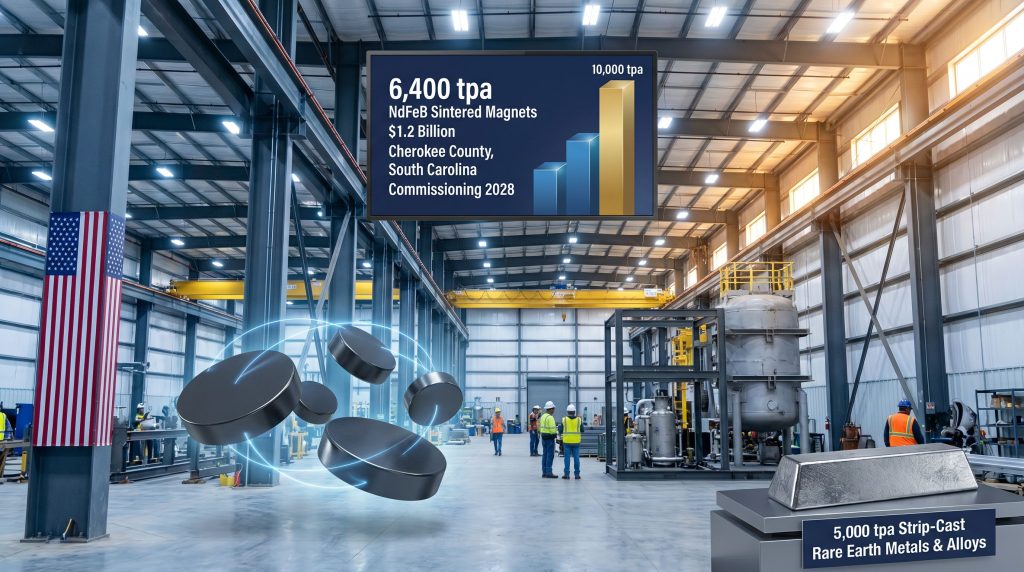
The facility being developed in Cherokee County represents a $1.2 billion capital commitment to close the downstream gap. Located within the Bailey Industrial Park in Blacksburg, South Carolina, the plant is specifically engineered to produce two distinct but related output streams.
| Metric | Detail |
|---|---|
| Total Investment | $1.2 billion |
| Location | Bailey Industrial Park, Blacksburg, South Carolina |
| Magnet Production Capacity | 6,400 tpa (sintered NdFeB permanent magnets) |
| Strip-Cast Metals and Alloys Output | 5,000 tpa |
| Projected Job Creation | Approximately 490 highly skilled positions |
| Target Commissioning Year | 2028 |
| Combined Domestic Capacity (with Oklahoma) | 10,000 tpa (both magnets and strip-cast metals) |
The first output stream, 6,400 tonnes per annum of sintered NdFeB permanent magnets, positions this single facility as a meaningful contributor to domestic magnet supply at industrial scale. The second stream, 5,000 tpa of strip-cast rare earth metals and alloys, is equally significant. Strip-cast alloys are the immediate precursor material for magnet manufacturing, and producing them domestically removes a critical chokepoint that has undermined earlier Western magnet projects that relied on imported alloy feedstock.
Engineering work and equipment procurement were already underway at the time of the June 2026 announcement, with site preparation work expected to begin in the months following. Commissioning is targeted for 2028.
How This Node Fits a Multi-Continent Value Chain
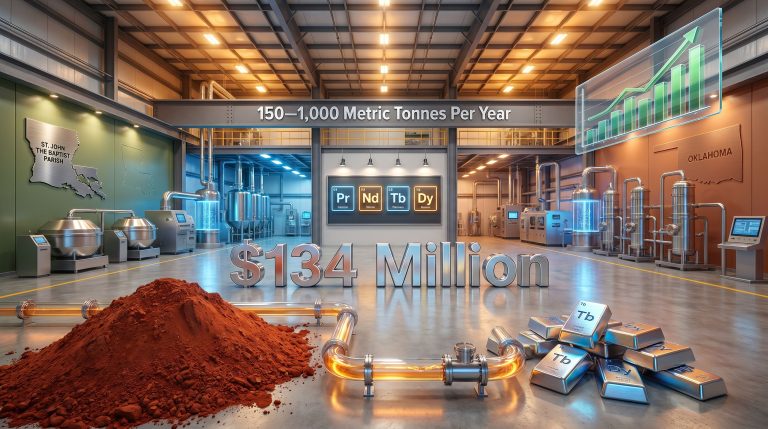
The South Carolina facility does not exist in isolation. It is one node within an integrated mine-to-magnet architecture that spans multiple continents and production stages. America's rare earth supply chain through USA Rare Earth's existing and planned operations extends across Texas, Colorado, the United Kingdom, and France, in addition to the Oklahoma processing facility that began its first commercial production line in March 2026.
The relationship between the Stillwater, Oklahoma site and the Blacksburg, South Carolina facility is deliberately complementary rather than competitive. Oklahoma provides an existing commercial production base and demonstrates that the company can translate plans into operating output. South Carolina adds capacity at a different geographic node, serving distinct regional customer bases and providing redundancy against single-point-of-failure risk.
Together, the two US facilities are engineered to reach a combined domestic ceiling of 10,000 tpa for both magnets and heavy rare earth strip-cast metals and alloys following planned expansions at the Stillwater site.
The Serra Verde Acquisition and Feedstock Security
Perhaps the most strategically significant development underpinning the South Carolina investment was the April 2026 definitive agreement to acquire Serra Verde Group for approximately $2.8 billion (13.87 billion reais). Serra Verde owns the Pela Ema rare earth mine and processing facility in Goiás, Brazil.
This upstream acquisition directly addresses one of the most persistent failure modes in Western magnet manufacturing attempts: feedstock insecurity. Without a reliable, cost-competitive supply of separated rare earth oxides and metals, downstream magnet plants face input cost volatility and potential supply disruption that makes long-term customer commitments difficult to underwrite. By securing Brazilian upstream production, the South Carolina facility gains a dedicated feedstock pipeline that does not route through Chinese separation capacity.
The Serra Verde deal is notable not just for its scale but for the quality of the Pela Ema deposit, which is an ionic clay-type rare earth deposit. These deposits, common in southern China, are prized for their relatively simple extraction chemistry and their elevated concentration of the heavy rare earth elements, including dysprosium and terbium, which are critical for producing high-coercivity magnets capable of operating at elevated temperatures in demanding applications like traction motors and aerospace actuators.
The End Markets This Facility Is Built to Serve
The customer base for the Blacksburg plant's output spans several sectors with distinct requirements around supply chain traceability:
- Defence and aerospace: Military procurement guidelines increasingly require domestically sourced or allied-nation-sourced critical materials. Rare earth magnets are embedded in guided munitions, radar systems, electromechanical actuators, and naval propulsion equipment. The ability to certify material provenance from mine to finished magnet is a formal procurement requirement in this sector, not an optional preference.
- Semiconductor manufacturing equipment: High-precision ion implantation and lithography tools rely on powerful permanent magnet assemblies. The demand for critical minerals for semiconductors is an active procurement priority following disruptions experienced earlier this decade, with the sector geographically concentrated in the US, Netherlands, and Japan.
- Medical technology: MRI systems and proton therapy equipment use rare earth magnets in configurations where performance consistency and regulatory traceability are non-negotiable.
- Allied nation supply chains: The facility's leadership has been explicit that its output is intended not only for domestic consumption but for allied defence and industrial customers across the UK and Europe, reflecting an understanding that supply chain sovereignty is a collective challenge among allied nations rather than a purely national one.
Two South Carolina Rare Earth Magnet Plants: What the Parallel Development Signals
An underappreciated feature of South Carolina's emerging industrial position is that the USA Rare Earth South Carolina magnet plant is not the state's only rare earth magnet investment. eVAC Magnetics opened its facility in Sumter, South Carolina, in the second half of 2025, having received a defence department-backed package totalling $94.1 million.
| Comparison Factor | USA Rare Earth (Cherokee County) | eVAC Magnetics (Sumter) |
|---|---|---|
| Investment Scale | $1.2 billion | $94.1 million DoD-backed package |
| Announcement/Opening | Announced June 2026 | Opened fall 2025 |
| Primary Output | NdFeB magnets and strip-cast metals | NdFeB magnets |
| Target Markets | Defence, aerospace, semiconductors, medical | EV and defence supply chains |
| Commissioning Status | Targeted 2028 | First commercial magnets shipped |
| Job Creation | Approximately 490 | Not specified |
The co-location of two separate rare earth magnet manufacturing investments within a single US state raises a natural question about whether domestic overcapacity risk is emerging. The answer requires understanding the scale of current US magnet imports. Furthermore, China's rare earth export restrictions have reinforced the urgency, given that China accounts for the dominant share of global sintered magnet production, estimated at above 90% of world output by volume.
Even at full combined capacity across both South Carolina facilities and the Oklahoma operations, US domestic production would represent a fraction of current domestic consumption, let alone total allied demand. The more relevant risk for investors is not oversupply but whether commissioning timelines hold and whether the technical complexity of scaling sintered magnet production is managed effectively.
The next major ASX story will hit our subscribers first
Why Cherokee County Was Selected Over Competing States
Site selection for advanced manufacturing facilities of this complexity involves a multi-variable assessment that goes well beyond land availability and headline incentive packages. The Cherokee County selection followed a competitive evaluation across multiple states, with the following factors reported as decisive:
- Access to state and county-level financial incentive structures including grants and tax abatements
- Affordable and reliable power supply, which is a significant operating cost in energy-intensive sintering and strip-casting processes
- Proximity to defence and aerospace end-users and tier-one contractors concentrated in the broader Southeast US industrial corridor
- Depth of workforce capability in advanced manufacturing disciplines within the regional labour market
- Infrastructure readiness within the Bailey Industrial Park itself
South Carolina Governor Henry McMaster acknowledged the investment as reinforcing the state's position in American manufacturing, noting the significance of both the capital commitment and the approximately 490 job positions for Cherokee County specifically.
Construction Roadmap and Commissioning Risk Factors
The development pathway from announcement to full commercial operation involves several sequential phases, each carrying its own execution risk:
- Engineering and equipment procurement – Already initiated as of mid-2026, this phase involves specifying and ordering the specialised sintering furnaces, strip-casting lines, hydrogen decrepitation systems, and jet milling equipment that form the core of NdFeB magnet production.
- Site preparation and civil works – Ground preparation within the Bailey Industrial Park, expected to commence in the months following the June 2026 announcement.
- Facility construction – The multi-year build-out of the manufacturing structure itself, including cleanroom-standard production areas required to prevent oxygen contamination during magnet processing.
- Commissioning and qualification – The 2028 target encompasses not just starting equipment but producing magnets that meet the dimensional, magnetic, and metallurgical specifications required by defence and aerospace customers, a qualification process that itself can take months.
- Production ramp-up – Scaling toward the full 6,400 tpa nameplate capacity post-commissioning.
Several variables could influence whether the 2028 commissioning target is achieved on schedule. Equipment lead times for specialised sintering and strip-casting lines have historically been extended, particularly when global demand for rare earth processing equipment is elevated simultaneously across multiple projects. Workforce recruitment for approximately 490 specialist positions in a county-level labour market also requires sustained effort well ahead of the commissioning date.
The Broader Investment Signal
A $1.2 billion capital commitment to rare earth magnet manufacturing carries significance beyond the project itself. For institutional observers watching the critical minerals sector, it represents evidence that private capital is prepared to underwrite the full downstream value chain, not just the mining and exploration stages that have historically attracted most investment.
The conventional wisdom in Western markets for many years held that China's accumulated manufacturing advantage in rare earth magnets was essentially insurmountable at competitive cost. However, what has shifted is the recognition that defence, aerospace, and allied nation customers are prepared to pay a security premium for traceable, domestically produced magnets. According to Fast Markets analysis of the sector, this premium, when contracted at scale, can underwrite the economics of facilities that would otherwise struggle against Chinese production costs.
For investors assessing the rare earth sector, the lesson embedded in this announcement is that supply chain sovereignty increasingly requires vertical integration from mine to magnet. Companies that control only one or two steps of the value chain remain exposed to the segments they do not control. The USA Rare Earth model, combining upstream acquisition via Serra Verde with mid-stream processing in Oklahoma and downstream magnet manufacturing in South Carolina, represents the most complete Western rare earth value chain architecture announced to date.
This article contains references to forward-looking statements including production targets, commissioning timelines, and financial projections. These involve inherent risks and uncertainties. Readers should conduct independent due diligence and consult qualified financial advisers before making investment decisions. Past performance and announced project parameters do not guarantee future outcomes.
Want To Stay Ahead Of The Next Major Mineral Discovery On The ASX?
Discovery Alert's proprietary Discovery IQ model delivers real-time alerts on significant ASX mineral discoveries — instantly transforming complex mineral data into actionable insights for both short-term traders and long-term investors. Explore historic examples of major discovery returns and begin your 14-day free trial today to position yourself ahead of the broader market.