June 3, 2026
The Long-Duration Storage Problem Nobody Warned Us About
For most of the past decade, the energy storage conversation has centred almost entirely on a single metric: cost per kilowatt-hour. As lithium-ion prices fell dramatically, the assumption took hold that the technology would simply scale to meet every storage need. What that framing missed was the distinction between how cheap storage could get and how long it could actually store energy. Those are fundamentally different questions, and the difference matters enormously when you are trying to keep a remote industrial grid stable across an entire day.
This is precisely the tension that makes the 50-MW vanadium battery tender in Western Australia one of the most consequential storage procurement decisions in Australian energy history. It is not simply about capacity. It is about duration, chemistry, and a deliberate industrial bet on a technology that behaves in ways lithium-ion physically cannot replicate.
When big ASX news breaks, our subscribers know first
Why Conventional Battery Technologies Fall Short Beyond Four Hours
The dominant narrative in battery storage has been shaped by the economics of frequency regulation and short-duration arbitrage, applications where lithium iron phosphate chemistry genuinely excels. Most lithium-ion installations deployed globally today are optimised for discharge windows of two to four hours. Beyond that threshold, the economics deteriorate and the degradation curves become less favourable.
The core issue is electrochemical. In a lithium-ion cell, energy and power are structurally coupled within the same physical unit. Scaling duration requires adding more cells, which also adds more power capacity, driving up costs non-linearly. More significantly, each deep charge-discharge cycle contributes to irreversible degradation of the electrode materials.
A system designed to cycle deeply every single day for a decade will deliver noticeably less capacity by year five than it did at commissioning. For a grid operator managing a remote network with limited interconnection, that degradation trajectory introduces a planning risk that is difficult to price and harder to hedge. Understanding the broader battery metals investment landscape helps contextualise why these technology distinctions matter so much for long-term infrastructure planning.
The Eastern Goldfields Grid: Pressure Points in an Isolated System
Kalgoorlie sits at the heart of Western Australia's Eastern Goldfields, a region that hosts some of the most energy-intensive mining operations on the continent. The local grid operates with a fundamentally different risk profile from interconnected southeastern Australia. It lacks the depth of generation backup that larger interconnected systems enjoy, which means any sudden supply shortfall has a disproportionate impact on grid frequency and industrial operations.
As renewable penetration increases across the region, the intermittency challenge becomes more acute rather than less. Solar generation ramps hard during daylight hours but contributes nothing after sunset. Wind patterns in the goldfields are inconsistent. Without long-duration storage capable of bridging the overnight gap, renewable integration in this geography will always hit a ceiling.
A 10-hour discharge capability directly addresses this structural gap. It means a battery that absorbs renewable generation during the day can continue supplying the grid through the full evening peak and into the early morning, covering the periods when solar is absent and mining loads remain high. Furthermore, the role of critical minerals and energy transition planning makes this kind of long-duration infrastructure increasingly essential across remote industrial regions.
How Vanadium Flow Chemistry Solves the Duration Problem
Vanadium flow batteries operate on a fundamentally different architectural principle compared to solid-state chemistries. Rather than storing energy within the electrodes themselves, these systems use liquid vanadium electrolyte stored in external tanks. The electrochemical reactions occur in a cell stack, but the energy reservoir is physically separate from the power conversion hardware.
This decoupled architecture means that scaling storage duration is simply a matter of adding more electrolyte volume, with no corresponding obligation to add more power capacity. For long-duration applications, this modularity delivers meaningful capital efficiency advantages.
Several properties make vanadium flow technology particularly well suited to the Kalgoorlie application:
- Cycle life exceeding 20,000 cycles, compared to approximately 3,000 to 6,000 for lithium iron phosphate systems
- Near-zero capacity degradation over the operating life, because vanadium ions in solution do not undergo the same structural fatigue as solid electrode materials
- Full electrolyte recyclability, since the vanadium itself is not consumed in the reaction and retains its value at end of life
- Non-flammable aqueous electrolyte, which significantly simplifies fire safety requirements at large-scale deployments
- No risk of thermal runaway, eliminating one of the most serious safety concerns associated with large lithium-ion installations
Vanadium Flow vs. Lithium-Ion vs. Pumped Hydro: Technology Comparison
| Attribute | Vanadium Flow | Lithium-Ion (LFP) | Pumped Hydro |
|---|---|---|---|
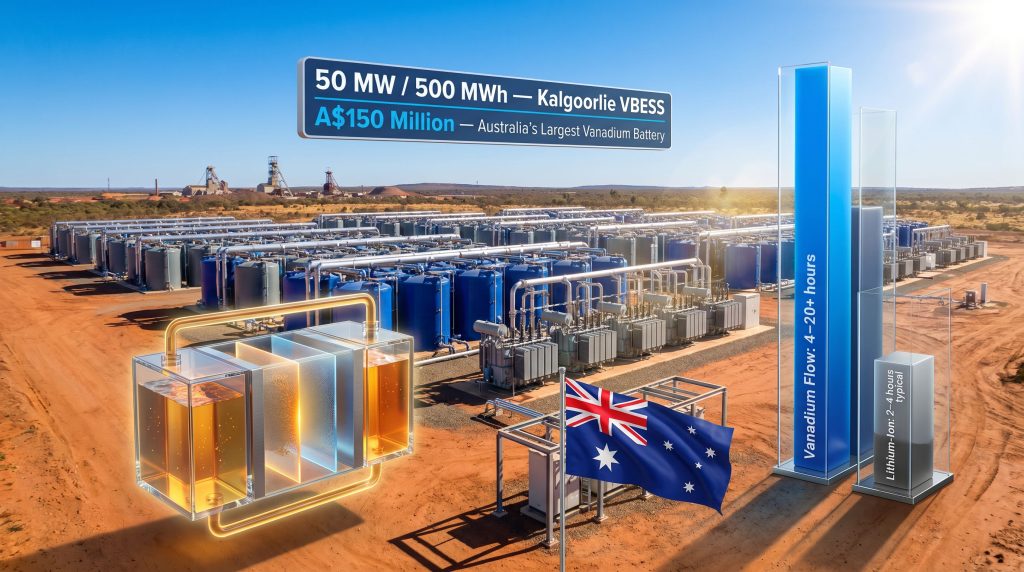
| Discharge Duration | 4 to 20+ hours | 2 to 4 hours typical | 6 to 20+ hours |
| Cycle Life | 20,000+ cycles | 3,000 to 6,000 cycles | 50+ years |
| Degradation Rate | Near-zero | Moderate over time | Minimal |
| Geographic Constraints | Low | Low | High |
| Electrolyte Recyclability | High (vanadium reusable) | Limited | N/A |
| Scalability | Modular | Modular | Fixed |
| Thermal Runaway Risk | None | Present | N/A |
What Is the Kalgoorlie Vanadium Battery Energy Storage System?
The Kalgoorlie Vanadium Battery Energy Storage System, known as the VBESS, represents the most ambitious long-duration storage project yet proposed in Australia. At 50 MW of power capacity and 500 MWh of energy storage, the system is designed to deliver up to 10 continuous hours of discharge, making it not only Australia's largest planned vanadium battery but potentially the largest vanadium flow battery to be deployed outside of China.
Project Specifications at a Glance
| Parameter | Detail |
|---|---|
| Power Capacity | 50 MW |
| Energy Capacity | 500 MWh |
| Maximum Discharge Duration | Up to 10 hours |
| Location | Kalgoorlie, Western Australia |
| State Funding Commitment | A$150 million |
| Project Classification | Australia's largest planned vanadium battery |
| Global Significance | Potentially the largest vanadium flow battery outside China |
The choice of Kalgoorlie as the host location reflects both grid necessity and strategic logic. The city is the administrative and operational centre of the Eastern Goldfields mining region, sits at the end of a long transmission corridor from Perth, and represents the most logical anchor point for any large-scale storage investment in the region. Its proximity to vanadium mineral resources across Western Australia adds an additional dimension of supply chain coherence to the project rationale.
How the Two-Stage Procurement Process Works
The Western Australian government structured the procurement as a sequential two-stage process designed to separate market sounding from formal capital commitment. This approach reduces procurement risk by establishing technical and commercial credibility before locking in preferred proponents.
-
Stage 1, Expression of Interest: Opened on 24 November 2025 and closed 30 January 2026. This phase assessed the depth of market interest and the technical capability of potential proponents without constituting a binding procurement decision.
-
Stage 2, Detailed Business Case Evaluation: Expected to proceed through early to mid-2026, culminating in the selection of a preferred proponent based on technical merit, local manufacturing credentials, and commercial terms.
Procurement Timeline Summary
| Milestone | Date or Period |
|---|---|
| EOI Stage 1 Opens | 24 November 2025 |
| EOI Stage 1 Closes | 30 January 2026 |
| Stage 2 Business Case Evaluation | Early to Mid-2026 |
| Preferred Proponent Announcement | Mid-2026 (anticipated) |
| Formal Tender Launch | June 2026 |
Bidders at the EOI stage were expected to demonstrate credible experience with vanadium flow technology at meaningful scale, a coherent approach to electrolyte supply security, and a clear connection to local manufacturing capability. The emphasis on domestic industry credentials reflects the project's dual purpose as both energy infrastructure and industrial development anchor.
The next major ASX story will hit our subscribers first
Why Western Australia Is Committing A$150 Million to Vanadium Storage
The A$150 million state funding commitment is not simply an energy infrastructure investment. It sits within a broader strategic framework that connects grid modernisation to resource sector development and domestic manufacturing ambition. Western Australia holds some of the world's most significant vanadium mineral deposits, concentrated in regions including the Pilbara and the Goldfields.
Developing a large-scale domestic vanadium battery project creates an obvious alignment between what comes out of the ground and what gets built above it. In addition, Australia's green metals leadership ambitions make this kind of vertically integrated project a natural fit for the state's long-term industrial strategy.
The project is structured to catalyse a vertically integrated domestic vanadium industry, linking upstream mineral extraction to electrolyte production and ultimately to utility-scale grid storage deployment. This is an unusual level of supply chain intentionality for a single infrastructure project.
The investment also carries significance for the competitive position of the resources sector itself. Mining operations in the Eastern Goldfields are major electricity consumers. Cost-effective and reliable renewable integration enabled by long-duration storage directly reduces operating costs for these industries, strengthening the economic case for continued investment in the region.
How A$150M Compares to Other Australian State Storage Investments
| Project | Location | Capacity | State Funding |
|---|---|---|---|
| Kalgoorlie VBESS | WA, Australia | 50 MW / 500 MWh | A$150 million |
| Victorian Big Battery | VIC, Australia | 300 MW / 450 MWh | State-backed |
| Waratah Super Battery | NSW, Australia | 850 MW / 1,680 MWh | NSW Government |
The Global Vanadium Market and What This Project Signals
One of the least discussed aspects of the Kalgoorlie project is its potential signalling effect on global vanadium demand. The electrolyte for a 500 MWh vanadium flow battery requires a substantial quantity of vanadium pentoxide, the primary feedstock for electrolyte production. A project of this scale, if replicated even modestly across Australia and other markets, represents a material new demand category for vanadium beyond its traditional use in steel hardening alloys.
Vanadium currently derives approximately 85 to 90 percent of its global demand from the steel industry, where it serves as a micro-alloying agent to increase tensile strength. Battery applications have historically been a marginal demand segment. A project like the Kalgoorlie VBESS, particularly if it leads to further state-backed deployments, begins to shift that composition meaningfully.
This dynamic is speculative in its full implications but grounded in observable supply chain logic. However, several considerations are worth noting:
- Vanadium electrolyte is not consumed during battery operation, meaning the vanadium remains recoverable and recyclable at end of system life
- This creates a secondary electrolyte market over time, which could soften the long-term demand signal for primary vanadium
- The initial build-out phase of large vanadium flow deployments will, nonetheless, drive concentrated demand for primary vanadium pentoxide during the fabrication period
- Western Australia's domestic deposits position the state to capture upstream value if electrolyte manufacturing capacity is developed locally
Key Risks That Bidders and Investors Should Understand
The 50-MW vanadium battery tender in Western Australia is genuinely precedent-setting in scale, and that ambition carries execution risk. Several dimensions warrant careful consideration.
Supply Chain Constraints in Vanadium Electrolyte
The global vanadium electrolyte supply chain is currently dominated by Chinese producers. While vanadium ore is mined across multiple continents, the conversion to battery-grade electrolyte at scale has not been meaningfully developed outside Asia. A preferred proponent that commits to local electrolyte manufacturing will face real capital investment and timeline risk in establishing that capability from a low base.
Consequently, the integration of renewable energy in mining operations will depend partly on whether these upstream supply chain gaps can be bridged domestically over the coming years.
Scale-Up Risk at 500 MWh
While vanadium flow battery technology is commercially proven at smaller scales, a 50 MW / 500 MWh deployment represents a significant step-up in project size. Ensuring electrolyte supply security and local technical workforce capability will be critical execution risks for the preferred proponent.
The largest vanadium flow installations deployed globally to date have been concentrated in China, with several projects in the 100 to 200 MWh range. A 500 MWh system pushes beyond the established reference case envelope, introducing engineering and commissioning complexity that will need to be managed carefully.
Remote Location Logistics
Kalgoorlie's distance from major manufacturing and logistics hubs adds cost and complexity to both the construction phase and long-term operations. Component procurement, specialist labour mobilisation, and electrolyte logistics all carry a regional premium that will flow through to project economics.
Australia's Accelerating Battery Storage Pipeline
The Kalgoorlie VBESS tender does not exist in isolation. Australia is experiencing a broad acceleration in battery energy storage procurement activity across multiple states and technologies. Several developments in mid-2026 illustrate the depth of this pipeline:
- Enervest advanced its 50-MW Australian BESS portfolio by securing a new development partner in June 2026
- Recharge Power established a solar-storage joint venture with Energy Decarb in June 2026
- Naturgy commissioned 360 MW of solar capacity across Australian sites in June 2026, adding to the renewable generation base that will ultimately require long-duration storage to integrate effectively
What distinguishes the Kalgoorlie project from this broader pipeline is the combination of technology specificity, duration ambition, and explicit industrial development intent. Most Australian BESS projects are lithium-ion deployments optimised for two to four hour applications. Furthermore, Australia's critical minerals strategy gives projects like this one an additional policy tailwind that standard BESS deployments do not enjoy.
Frequently Asked Questions: The 50-MW Vanadium Battery Tender in Western Australia
What is the Kalgoorlie Vanadium Battery Energy Storage System?
The Kalgoorlie VBESS is a 50 MW / 500 MWh vanadium flow battery project located in Kalgoorlie, Western Australia, supported by A$150 million in state funding. It is designed to provide up to 10 hours of continuous discharge to support regional grid reliability in the Eastern Goldfields and to anchor the development of a domestic vanadium battery industry.
How does it compare in scale to other vanadium flow projects globally?
At 500 MWh of energy storage, the Kalgoorlie project is positioned as Australia's largest vanadium battery and potentially the largest vanadium flow battery system deployed outside of China, where the bulk of commercial-scale installations have been concentrated.
What stage is the tender process at?
The formal tender was launched in June 2026 following completion of the two-stage EOI process. Stage 1 EOIs closed on 30 January 2026, and Stage 2 business case evaluations were expected to conclude with a preferred proponent announcement during mid-2026.
Why was vanadium flow chosen over lithium-ion?
The 10-hour discharge requirement makes vanadium flow chemistry significantly more appropriate than lithium-ion, which is generally optimised for two to four hour applications. The superior cycle life and near-zero degradation of vanadium flow systems also deliver better long-term total cost of ownership for a high-cycling utility-scale application. The state's strategic interest in developing a domestic vanadium supply chain provided additional rationale for the technology choice.
Who is funding the project?
The Western Australian state government has committed A$150 million to support the project, reflecting its dual purpose as critical energy infrastructure and an anchor investment for the state's emerging vanadium industry. The WA government's formal call-out provides further detail on the funding framework and eligibility requirements for proponents.
This article contains forward-looking statements regarding procurement timelines, project development milestones, and market dynamics. These reflect publicly available information and independent analysis as of the date of publication and should not be construed as financial or investment advice. Actual outcomes may differ materially from those anticipated. Readers should conduct their own due diligence before making any investment decisions related to companies or sectors discussed in this article.
Further Exploration: Readers seeking additional context on Australia's renewable energy storage pipeline and tender activity can explore related industry coverage available through Renewables Now, which provides ongoing reporting on energy storage projects, policy developments, and procurement activity across the Asia-Pacific region.
Want To Identify The Next Major Mineral Discovery Before The Market Does?
The emerging vanadium storage sector is reshaping Australia's critical minerals landscape, and Discovery Alert's proprietary Discovery IQ model delivers real-time ASX alerts the moment significant mineral discoveries are announced — explore historic examples of major discovery returns to understand the scale of opportunity, then begin your 14-day free trial at Discovery Alert to position yourself ahead of the broader market.