July 31, 2026
When One Company Controls 40% of a Metal the World Cannot Replace
The global economy runs on materials most people never think about. Palladium sits near the top of that invisible list. Without it, catalytic converters in petrol and hybrid vehicles cannot function. Without it, a growing range of chemical refining processes stall. And without a single company headquartered in Siberia, roughly 40% of the world's annual palladium supply simply does not exist.
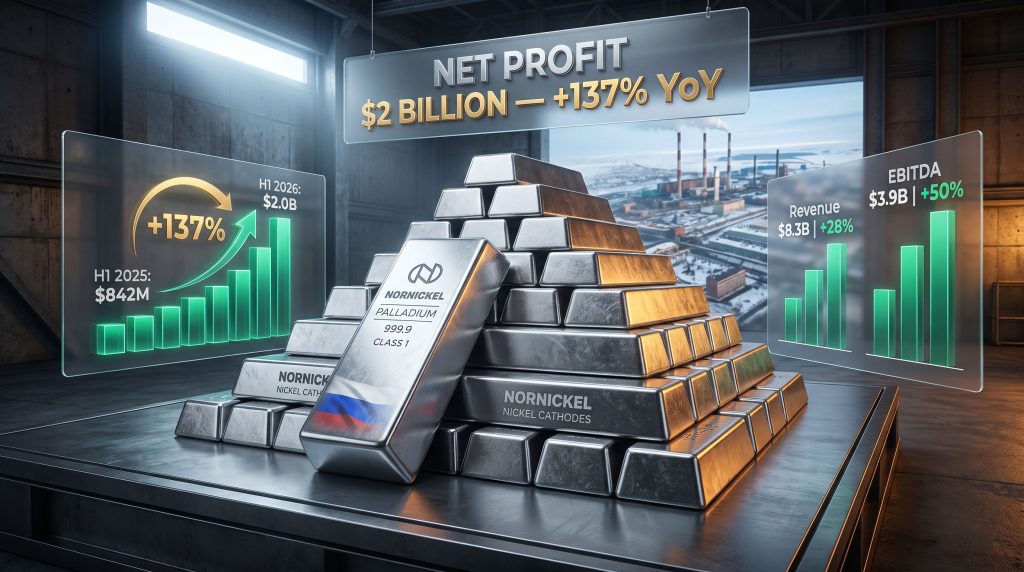
That structural reality makes Nornickel's financial results more than a corporate earnings story. When Nornickel H1 net profit doubled to $2 billion in the first half of 2026, the number carried implications far beyond the balance sheet of one Russian mining giant.
When big ASX news breaks, our subscribers know first
Understanding the Magnitude of a 137% Profit Jump
A doubling of net profit in a single comparable period is unusual in any industry. In mining, where commodity price cycles, geopolitical disruptions, and infrastructure constraints routinely suppress earnings for years at a time, it is genuinely rare.
Nornickel's H1 2026 net profit of $2.0 billion compares to $842 million in H1 2025, representing a 137% year-on-year increase. To frame that in another way, the company generated nearly as much profit in six months as it did across the entirety of certain recent fiscal years during the commodity price trough of 2023 and early 2024.
The accompanying financial metrics reinforce the scale of this shift:
| Metric | H1 2025 | H1 2026 | Change |
|---|---|---|---|
| Net Profit | $842 million | $2.0 billion | +137% |
| Revenue | ~$6.46 billion | $8.3 billion | +28% |
| EBITDA | ~$2.6 billion (est.) | $3.9 billion | +50% |
| EBITDA Margin | ~40% | ~47% | +7 percentage points |
What makes these numbers analytically significant is not the revenue growth alone, but the way EBITDA expanded at nearly twice the rate of revenue. That relationship between the two figures reveals a business absorbing its fixed costs more efficiently as pricing and volume improved simultaneously.
The Three-Year Earnings Arc That Puts H1 2026 in Context
It is difficult to appreciate the magnitude of the current recovery without understanding what preceded it. Nornickel endured a prolonged earnings contraction through 2023 and into 2024, driven by a combination of palladium price weakness, cost inflation aggravated by sanctions-related supply chain complexity, and a global nickel market increasingly disrupted by Indonesian nickel supply from laterite production.
The company's multi-year trajectory tells a story of trough, stabilisation, and now acceleration:
| Period | Net Profit | YoY Change | Primary Driver |
|---|---|---|---|
| FY 2024 | ~$1.82 billion (est.) | Declining | Commodity price weakness, cost pressures |
| FY 2025 | $2.47 billion | +36% | Inventory optimisation, partial price recovery |
| H1 2026 | $2.0 billion | +137% vs H1 2025 | Commodity price surge, margin expansion |
Critically, Nornickel H1 net profit doubled to $2 billion already represents approximately 81% of the company's entire 2025 annual profit in just six months. If the second half of 2026 sustains comparable momentum, full-year earnings could plausibly approach or exceed $3.5 to $4 billion, which would represent one of the most significant single-year recovery events in the company's modern financial history.
This projection is speculative and dependent on commodity price stability, geopolitical conditions, and operational continuity. Investors should treat forward-looking earnings estimates with appropriate caution.
What Actually Drove the Revenue Surge
Revenue growth of 28% to $8.3 billion does not happen in isolation. Several compounding forces converged in the first half of 2026:
-
Palladium price recovery: After multi-year weakness that pushed prices well below levels seen during the 2021–2022 peak, palladium staged a meaningful rebound in early-to-mid 2026, directly amplifying per-tonne revenue across Nornickel's largest earnings contributor.
-
Platinum group metals basket appreciation: The platinum and palladium market collectively moved higher alongside rhodium and ruthenium, benefiting the overall PGM revenue line.
-
Class 1 nickel premium maintenance: Despite Indonesian laterite supply flooding the lower-purity nickel market, Nornickel's high-purity Class 1 nickel continued to attract a premium from buyers requiring precise metallurgical specifications, particularly battery cathode manufacturers.
-
Copper's structural demand floor: Electrification infrastructure, grid expansion, and EV manufacturing continued to support copper pricing, providing a resilient secondary revenue stream.
-
Inventory management improvements: A pattern identified as a contributing factor during 2025 results, whereby accumulated inventory drawdowns improved realised revenue recognition, appears to have continued providing operational benefit into 2026.
The EBITDA Margin Story: Why 47% Matters More Than the Headline
Margin analysis often reveals more about business health than headline profit figures. Nornickel's EBITDA margin expansion from an estimated 40% in H1 2025 to approximately 47% in H1 2026 reflects something technically described as positive operating leverage, and it is worth unpacking precisely why this occurred.
Nornickel's cost structure is predominantly ruble-denominated. Labour across its Arctic operations, energy inputs from its captive power infrastructure, and domestic logistics all carry costs priced in rubles. Its revenues, however, are priced in US dollars and euros, with an increasing share now settled in Chinese yuan as Asian trade flows have expanded.
When the ruble weakens against hard currencies, this mismatch works structurally in Nornickel's favour. The company effectively pays its bills in a depreciated currency while earning revenue in stronger ones. This dynamic has been operative through much of 2025 and into 2026, functioning as a built-in earnings amplifier during periods of ruble softness.
This ruble-dollar cost-revenue mismatch is one of the less discussed but most structurally important features of Nornickel's financial model. It partially explains why the company has maintained stronger margins than Western peers facing equivalent commodity price environments.
Furthermore, Nornickel's vertically integrated operational model deserves recognition. From ore extraction in Norilsk and the Kola Peninsula through to smelting, refining, and export logistics, the company controls each value-adding step internally. This integration compresses third-party margin leakage and insulates the business from cost volatility at individual supply chain nodes.
Palladium's Unique Market Position and Why It Cannot Be Easily Replaced
Understanding Nornickel's financial power requires understanding palladium's peculiar market characteristics. Unlike many commodities where multiple large producers compete on roughly equal terms, palladium supply is concentrated to a degree that few other industrial metals can match.
| Producer | Global Palladium Share (approx.) | Geographic Base |
|---|---|---|
| Nornickel | ~40% | Russia (Siberia, Kola) |
| Anglo American Platinum / Sibanye-Stillwater | ~35-38% combined | South Africa, USA |
| All other producers | ~22-25% | Global |
This concentration exists because economically viable palladium deposits are extraordinarily rare. The metal occurs almost exclusively as a byproduct within specific platinum group metal reef systems, primarily the Bushveld Igneous Complex in South Africa and the Norilsk-Talnakh sulphide ore bodies in Russia.
Why the Norilsk Deposits Are Geologically Distinctive
The Norilsk deposits represent magmatic nickel deposits of the sulphide nickel-copper-PGM variety, where palladium, platinum, nickel, copper, and cobalt occur together within the same orebody. This polymetallic co-production structure is central to Nornickel's economics: the company effectively mines all five metals simultaneously, spreading fixed infrastructure costs across multiple revenue streams.
This geological reality also explains why substituting Nornickel's palladium output with supply from elsewhere is not straightforward. New palladium-bearing deposits require decades to discover, permit, develop, and bring to production. South African PGM mines face their own structural challenges, including ageing infrastructure, deep-level mining complexity, and energy supply constraints from South Africa's electricity grid.
The next major ASX story will hit our subscribers first
Sanctions, Trade Route Redirections, and the Asian Pivot
Western sanctions imposed following geopolitical developments in Ukraine created genuine operational headaches for Nornickel, particularly around equipment procurement, financial settlement infrastructure, and access to certain logistics corridors.
Yet the financial results suggest the company has navigated these constraints more effectively than many analysts anticipated. Several factors explain this resilience:
-
Asian buyer substitution: China, India, Japan, and South Korea have absorbed export volumes previously destined for European buyers. Chinese buyers in particular have demonstrated willingness to engage with sanctioned Russian commodity suppliers.
-
Physical commodity indispensability: Palladium's role in autocatalytic converters has no near-term technological substitute at industrial scale. Automotive manufacturers globally continue to require the metal regardless of geopolitical preferences.
-
Financial settlement workarounds: Increasing use of yuan-denominated settlements and non-SWIFT banking infrastructure has partially compensated for restrictions on traditional financial channels.
-
Ruble cost insulation: As noted above, ruble weakness has paradoxically cushioned the earnings impact of increased operational costs associated with sanctions compliance.
Competitor Landscape and the Strategic Race to Diversify PGM Supply
Nornickel's dominant position has not gone unnoticed by governments and competing producers. The concentration of palladium supply within a single geopolitical jurisdiction represents a recognised industrial risk, and the competitive response has been building. In addition, the broader critical minerals demand environment driven by the energy transition is accelerating investment in alternative supply sources globally.
| Producer | Primary Focus | Geographic Base | Competitive Threat Level |
|---|---|---|---|
| Anglo American Platinum | Platinum, Palladium | South Africa | High (PGMs) |
| Sibanye-Stillwater | Palladium, Platinum | South Africa, USA | Moderate-High |
| Vale | Nickel, Copper | Brazil, Canada | Moderate (Nickel) |
| BHP | Nickel, Copper | Australia, Global | Moderate (Nickel) |
Projects like Canada Nickel's Crawford deposit in Ontario, which received federal approval in July 2026, reflect the broader policy environment in which Western governments are actively working to develop alternative critical mineral supply sources. Crawford is notable for its nickel-cobalt mineralisation within a serpentinised dunite host rock, representing a different geological model from Nornickel's sulphide-hosted deposits. While the processing pathways and product specifications differ, projects of this nature signal that the strategic gap Nornickel currently occupies is not invisible to policymakers.
Class 1 Nickel: The Battery Market Distinction That Matters
A widespread misconception in commodity analysis treats all nickel as interchangeable. It is not. The distinction between Class 1 nickel (high purity, greater than 99.8% Ni) and Class 2 nickel (lower purity intermediates like nickel pig iron) is technically and commercially significant.
Battery cathode chemistries used in electric vehicles, specifically NMC (nickel manganese cobalt) and NCA (nickel cobalt aluminium) formulations, require consistent, high-purity nickel inputs. Class 2 nickel produced from Indonesian laterite processing is less suited to direct battery application without additional costly upgrading steps.
Nornickel's Class 1 nickel product, refined through its established Norilsk smelting and electrorefining infrastructure, meets battery-grade specifications directly. Consequently, as EV adoption continues scaling globally, this quality distinction provides Nornickel with a premium market segment that Indonesian laterite producers cannot easily access without significant processing investment.
Five Strategic Takeaways From Nornickel's H1 2026 Results
-
The profit doubling is structural, not incidental: EBITDA growing at twice the rate of revenue demonstrates genuine operational leverage, separating this result from a purely commodity price-driven windfall.
-
The ruble-dollar cost structure is an underappreciated earnings amplifier: Western analysts frequently underestimate this currency dynamic when modelling Nornickel's margin resilience.
-
Palladium's geological scarcity creates durable pricing power: New supply cannot be created quickly, and the Norilsk-Talnakh ore system has no near-equivalent globally in terms of polymetallic co-production economics.
-
The Asian trade pivot has proven more durable than expected: Concerns that sanctions would severely impair Nornickel's revenue base have not materialised at the scale initially feared.
-
Full-year 2026 earnings momentum deserves close attention: If H2 2026 conditions remain broadly comparable, annual results could reach levels not seen in the company's recent history, with significant implications for global critical mineral supply chain economics.
This article contains forward-looking analysis and projections that are inherently uncertain. Readers should not interpret financial scenario modelling as investment advice. Commodity prices, geopolitical conditions, and operational factors can change materially and without warning.
Want to Stay Ahead of the Next Major Critical Minerals Discovery?
Discovery Alert's proprietary Discovery IQ model instantly scans ASX announcements across more than 30 commodities — including nickel, copper, and platinum group metals — delivering real-time alerts on significant discoveries before the broader market reacts. Explore historic examples of major mineral discoveries and their market returns, then begin your 14-day free trial at Discovery Alert to position yourself at the forefront of the next transformative find.