
July 23, 2026
The Corporate Architecture of Large-Scale Gold Development
Few forces reshape the investment profile of a mining project as decisively as ownership structure. Before a single gram of gold reaches a processing facility, the legal and corporate framework surrounding a deposit determines who controls decisions, who bears risk, and critically, who lenders are willing to finance. Joint venture arrangements, while common in the exploration and early development phases of large mining projects, introduce a layer of complexity that becomes increasingly burdensome as capital requirements escalate and construction timelines crystallise.
This structural reality sits at the heart of the NOVAGOLD Donlin Gold ownership consolidation, a transaction that moves one of the world's largest undeveloped gold deposits from a multi-party joint venture into a single, U.S.-domiciled corporate entity. Understanding why this matters requires looking beyond the headline percentage shift and examining the deeper mechanics of how project finance, stakeholder governance, and resource development interact at scale.
When big ASX news breaks, our subscribers know first
From Shared Ownership to Unified Control: How the Structure Evolved
The Two-Stage Consolidation
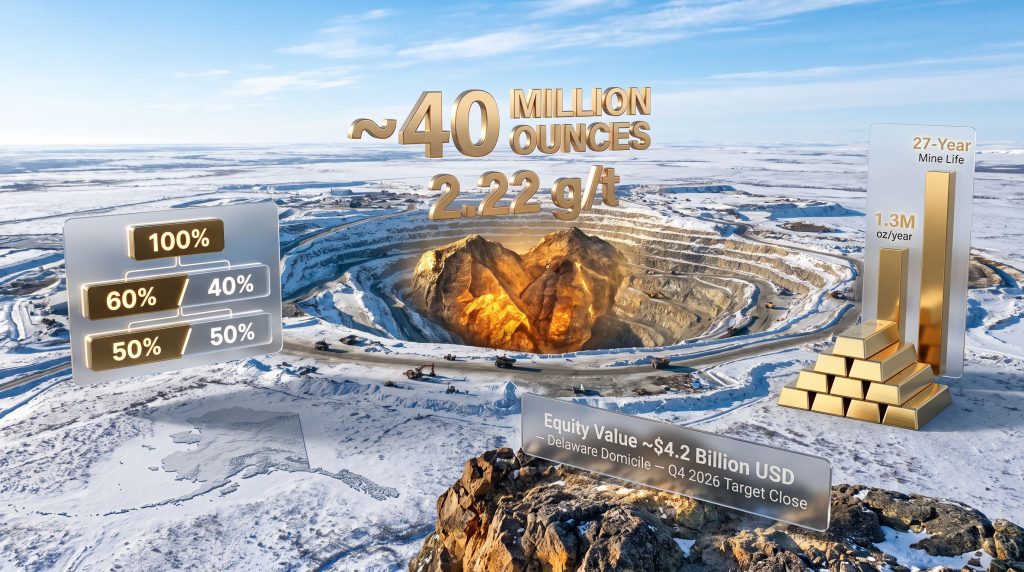
The path to full NOVAGOLD Donlin Gold ownership consolidation unfolded across two distinct transactions spanning less than twelve months. The first stage occurred in June 2025, when NOVAGOLD and Paulson Advisers LLC jointly acquired Barrick Mining's 50% interest in the Donlin Gold project. Following that acquisition, ownership divided between NOVAGOLD at 60% and Paulson-backed Donlin Gold Holdings at 40%.
The second and final stage involves NOVAGOLD acquiring Paulson's remaining 40% interest through an all-share transaction, meaning no cash changes hands. The result is a shift from a fractured joint venture to 100% unified ownership, with the existing structure replaced by a newly incorporated Delaware parent company.
| Ownership Stage | NOVAGOLD | Paulson / Donlin Gold Holdings | Barrick Mining |
|---|---|---|---|
| Pre-June 2025 | 50% | 0% | 50% |
| Post-Barrick Acquisition (June 2025) | 60% | 40% | 0% |
| Post-Consolidation (Target Q4 2026) | 100% | 0% (equity converted) | 0% |
The transaction is expected to close in Q4 2026, subject to NOVAGOLD shareholder approval and relevant regulatory clearances. What makes this two-stage process strategically coherent is its deliberate sequencing: Barrick's exit removed a major institutional voice with its own corporate priorities, while the Paulson absorption eliminates the final governance overlap and creates a clean, singular chain of decision-making authority.
Why Barrick's Exit Was the Unlocking Event
Barrick Mining, one of the world's largest gold producers, brought both credibility and friction to the Donlin joint venture. As a senior producer with a global portfolio of operating mines, Barrick's development priorities for Donlin were never guaranteed to align with those of a pure-play development company. Joint ventures between majors and juniors or mid-tiers frequently stall when the larger partner deprioritises a non-core asset in favour of producing operations that generate immediate cash flow.
Barrick's decision to exit created an opportunity that NOVAGOLD and Paulson moved quickly to capture. Furthermore, that acquisition repositioned Donlin from a project co-managed by a senior producer with competing priorities into one controlled by parties whose entire investment thesis depends on Donlin's advancement. The broader mining industry consolidation trend has made such strategic exits increasingly common as majors rationalise their portfolios.
The New Corporate Structure and Its Governance Design
How Shareholder Interests Are Distributed
Once the consolidation closes, the reorganised entity will carry an equity value of approximately $4.2 billion USD, incorporated in Delaware as a U.S.-domiciled gold developer. Existing NOVAGOLD shareholders will hold roughly 65% of the new company, while Paulson's economic interest will represent approximately 40% in exchange for its Donlin stake.
The governance design contains a deliberate and important feature: Paulson's voting rights are capped at 19.99%, despite holding a significantly larger economic position. John Paulson will serve as Co-Chair of the new entity alongside NOVAGOLD Chairman Thomas Kaplan.
The Significance of Separating Economic and Voting Rights
Capping voting rights well below economic exposure is not an arbitrary governance choice. It serves a specific institutional function that becomes critical during large-scale project financing. In addition, it signals to the broader market that governance discipline has been built into the structure from the outset:
- Minority shareholders and institutional investors are protected from concentrated decision-making power
- The structure satisfies governance screening criteria applied by sovereign wealth funds and development finance institutions
- It signals that no single economic stakeholder can unilaterally redirect the project's strategic trajectory
- Lenders evaluating security packages are presented with a governance framework that limits the risk of ownership-driven disruption to loan covenants
This separation of economic exposure from voting authority is a well-established mechanism in institutional-grade infrastructure and resource finance. It is particularly relevant when a project requires capital from government-affiliated lending bodies that apply environmental, social, and governance criteria to governance structures before committing funds.
Why 100% Ownership Transforms Donlin's Financing Prospects
The Joint Venture Problem in Project Finance
Project finance for large-scale mining is fundamentally different from corporate lending. Lenders assess the project itself as the primary security, which means the legal clarity of ownership, the enforceability of security packages, and the simplicity of the borrower entity all carry outsized weight in credit decisions.
Joint ventures create several friction points that complicate this process:
- Dual-board approval requirements extend decision timelines and introduce veto risk at critical junctures
- Aligned financing strategies are difficult to maintain when partners have different balance sheet constraints or return requirements
- Security package complexity increases when lenders must evaluate liens across multiple corporate entities with overlapping interests
- Due diligence timelines lengthen when credit assessors must model governance risk across a joint venture rather than a single borrower
A 100%-owned project eliminates each of these obstacles. Consequently, NOVAGOLD's management has noted that consolidated ownership creates a single counterparty for potential lenders — whether private institutional investors, government lending agencies, or sovereign wealth funds — dramatically simplifying the credit assessment process.
Accretion Metrics: Immediate Shareholder Impact
| Financial / Operational Metric | Impact of Consolidation |
|---|---|
| Net Asset Value per Share | Increases upon deal close |
| Attributable Gold Reserves | Expanded to 100% of Donlin's resource base |
| Projected Attributable Annual Production (First Decade) | Adds 520,000+ oz to NOVAGOLD's attributed output |
| Equity Value of Reorganized Entity | ~$4.2 billion USD |
| Corporate Domicile | Delaware, USA |
The all-share structure means existing shareholders do not face dilution through a cash raise, while the absorption of the remaining 40% interest immediately increases every per-share metric tied to the underlying asset.
The U.S. Jurisdiction Premium
Re-domiciling as a U.S. company is not merely administrative. Donlin Gold's location in Alaska positions it within one of the world's most politically stable, rule-of-law mining jurisdictions at a time when capital allocation decisions increasingly reflect geopolitical risk. The current gold market outlook reinforces this dynamic, with investors placing a premium on assets in secure jurisdictions.
A U.S.-domiciled company developing what could become the largest operating gold mine in the United States carries a jurisdictional premium that is difficult to quantify in a feasibility study but highly relevant to institutional capital allocation decisions.
Donlin Gold's Resource Profile: Understanding the Tier-1 Designation
Scale, Grade, and What They Mean in Practice
Donlin Gold contains approximately 40 million ounces of measured and indicated gold resources at an average grade of 2.22 grams per tonne (g/t). To contextualise that grade figure: the global average for comparable large-scale undeveloped gold projects is broadly estimated at below 1.0 g/t, meaning Donlin's ore quality is more than double the benchmark for deposits of similar scale. Our Tier-1 deposit guide provides further context on how such classifications are determined.
Grade matters to project economics in ways that go beyond simple arithmetic. Higher-grade ore:
- Reduces the total volume of material that must be mined and processed per ounce of gold recovered
- Improves operating cost efficiency at the mill, since processing costs are largely fixed per tonne regardless of gold content
- Provides a buffer against gold price declines, as the revenue per tonne of ore processed remains elevated even during price weakness
- Enhances the project's ability to service debt during lower gold price cycles, which is a primary concern for project finance lenders
Production Projections Across the Mine Life
| Production Period | Projected Annual Output |
|---|---|
| First Decade of Operation | ~1.3 million oz/year average |
| Full Mine Life Average | ~1.1 million oz/year average |
| Mine Life Duration | ~27 years |
At 1.3 million ounces per year during its first decade of operation, Donlin Gold would rank among the most productive gold mines globally, comparable in annual output to major operating assets currently managed by the world's largest senior producers.
A 27-year mine life is also significant from a financing perspective. Long-duration assets attract a different category of capital than shorter-lived projects. Infrastructure funds, pension capital, and sovereign wealth funds with multi-decade liability horizons are structurally suited to assets that generate stable cash flows over extended periods, provided the project economics and governance structures meet their criteria.
Critical Milestones Before Construction: What Comes Next
The Updated Bankable Feasibility Study
The single most important near-term deliverable for Donlin Gold is the completion of an updated bankable feasibility study, currently being led by Fluor Corporation with support from WSP, Worley, and Hatch. Management has guided that this document will be issued in the first half of 2027. A definitive feasibility study of this nature is the foundational document that lenders require before committing project finance.
It establishes:
- Definitive capital cost estimates with accepted engineering tolerance levels
- Detailed construction schedules and critical path timelines
- Confirmed production plans, processing assumptions, and recovery rates
- The economic model against which debt service capacity is assessed
Without this document, financing discussions remain conceptual. Its completion transforms Donlin from a development-stage asset with indicative economics into a project with the technical documentation required to support binding financing commitments.
Permitting: Further Progressed Than Most Peers
Federal permitting for Donlin Gold is substantially complete, which represents a major de-risking milestone that many comparable large-scale undeveloped projects have not yet achieved. The primary outstanding approvals relate to the tailings dam and associated water retention infrastructure.
In the context of large U.S. mining projects, completing federal environmental permitting typically represents the longest, most uncertain, and most capital-intensive phase of pre-construction development. However, Donlin's position beyond that phase is a meaningful differentiator from projects still navigating federal review processes that can extend across many years.
Stakeholder Relationships: Consolidation as a Communication Tool
The Donlin Gold project sits on land with significant Alaska Native interests. Two key landowner entities — Calista Corporation and The Kuskokwim Corporation — have established relationships with the project that require ongoing engagement across land access, environmental stewardship, and community benefit commitments.
A consolidated ownership structure creates a single, unambiguous point of contact for these relationships. Under the prior joint venture, questions of corporate responsibility and community commitments involved multiple entities with overlapping but distinct obligations. A single corporate parent removes that ambiguity, potentially accelerating community engagement processes that are often as time-sensitive as regulatory approvals.
The next major ASX story will hit our subscribers first
Scenario Analysis: Donlin at Full Production
What Different Gold Price Environments Could Mean
The following projections are illustrative and speculative. They are not investment advice, and actual outcomes will depend on construction costs, operating performance, financing terms, and prevailing commodity prices at the time of production.
| Scenario | Gold Price Assumption | Estimated Annual Revenue (First Decade) |
|---|---|---|
| Base Case | $2,500 to $3,000/oz | ~$3.25 billion to $3.9 billion |
| Elevated Price Environment | Above $3,500/oz | ~$4.55 billion+ |
| Price Stress Scenario | Below $2,000/oz | Project economics tighten materially |
The high-grade nature of Donlin's resource provides a meaningful degree of protection in price stress scenarios. Furthermore, the gold price outlook for 2025 and beyond suggests elevated price conditions may persist, which would strengthen the project's financing case considerably. Projects with sub-1.0 g/t grades face significantly more acute margin compression when gold prices decline, as their revenue per tonne processed drops toward operating cost thresholds more quickly.
Key Risk Factors to Monitor
- Tailings dam permitting: The remaining outstanding regulatory approval could affect construction timelines if processing extends beyond current expectations
- Feasibility study outcomes: Capital cost estimates in the updated study will set the financing requirement and determine the debt-to-equity structure available to the project
- Gold price trajectory: Sustained elevated prices improve project NPV and could accelerate institutional interest; a sustained price decline would require reassessment of financing terms
- Shareholder and regulatory approval: The consolidation transaction itself requires both NOVAGOLD shareholder approval and regulatory clearance before Q4 2026 closing can be confirmed
Frequently Asked Questions: NOVAGOLD Donlin Gold Ownership Consolidation
What is the NOVAGOLD Donlin Gold ownership consolidation?
NOVAGOLD has entered into a definitive agreement to acquire the remaining 40% interest in the Donlin Gold project from Paulson Advisers LLC through an all-share transaction. This moves NOVAGOLD's ownership from 60% to 100%, dissolving the existing joint venture and placing the entire project under a single Delaware-incorporated corporate entity.
When is the transaction expected to close?
The deal is targeted to close in Q4 2026, subject to approval from NOVAGOLD shareholders and relevant regulatory bodies.
How large is the Donlin Gold deposit?
Donlin Gold holds approximately 40 million ounces of measured and indicated gold resources at an average grade of 2.22 g/t, more than double the global benchmark for comparable undeveloped projects of similar scale.
What will NOVAGOLD's equity value be after closing?
The reorganised entity is expected to carry an equity value of approximately $4.2 billion USD, incorporated in Delaware as a U.S.-domiciled gold developer.
What is John Paulson's role in the new structure?
Paulson's investment vehicle will hold an economic interest of approximately 40% in the reorganised company, with voting rights capped at 19.99% under governance agreements. John Paulson will serve as Co-Chair alongside NOVAGOLD Chairman Thomas Kaplan.
What permits remain outstanding for Donlin Gold?
Federal permitting is largely complete. The primary remaining approvals relate to the tailings dam and associated water retention structures, which represent the final regulatory hurdle before construction authorisation.
When will the updated feasibility study be released?
Management has guided that the updated bankable feasibility study, led by Fluor and supported by WSP, Worley, and Hatch, is expected in the first half of 2027.
Key Takeaways for Investors and Industry Observers
The NOVAGOLD Donlin Gold ownership consolidation is best understood not as a single corporate event but as the conclusion of a multi-year strategy to position one of the world's most significant undeveloped gold deposits for large-scale project financing. Several structural outcomes deserve particular attention:
- Ownership simplification removes joint venture governance friction that historically delays large project financing timelines
- 100% attributable reserves and production improve every per-share metric for existing NOVAGOLD shareholders without a cash raise
- U.S. domicile and jurisdiction enhances appeal to institutional capital pools increasingly sensitive to geopolitical risk in resource investment
- Governance design separating economic interest from voting authority reflects institutional-grade discipline that sovereign and government-affiliated capital sources require
- Feasibility study completion in H1 2027 is the next major value catalyst and the document that transforms financing discussions from exploratory to executable
- Grade quality at 2.22 g/t provides a structural cost advantage and price-cycle resilience that lower-grade peers cannot match at comparable scale
This article is for informational purposes only and does not constitute investment advice or a solicitation to buy or sell any securities. Mining development projects involve significant risks including permitting delays, cost overruns, commodity price volatility, and financing uncertainty. Readers should conduct their own due diligence and consult a qualified financial adviser before making investment decisions.
Want to Stay Ahead of Significant ASX Mineral Discoveries Before the Broader Market Does?
Discovery Alert's proprietary Discovery IQ model delivers real-time alerts on major ASX mineral discoveries, translating complex geological and market data into clear, actionable opportunities for both short-term traders and long-term investors — explore historic discovery returns on Discovery Alert's dedicated discoveries page to see what's possible, then begin your 14-day free trial at Discovery Alert to position yourself ahead of the market.