The nuclear fuel supply chain faces unprecedented challenges as geopolitical tensions reshape global uranium markets. Recent developments in West Africa highlight the complex intersection of resource nationalism, international law, and transport safety protocols. Understanding these dynamics requires examining how political instability affects radioactive material handling, the role of international regulatory frameworks, and the critical importance of maintaining safety standards during transport operations. Moreover, uranium convoy safety risks have become increasingly complex due to evolving uranium market volatility.
What Are the Primary Safety Hazards in Radioactive Material Transportation?
Radioactive material transportation presents multiple risk categories that require comprehensive assessment and mitigation strategies. The fundamental hazards stem from radiation exposure, potential accidents, and environmental contamination scenarios.
Radiation Exposure Categories and Dose Limits
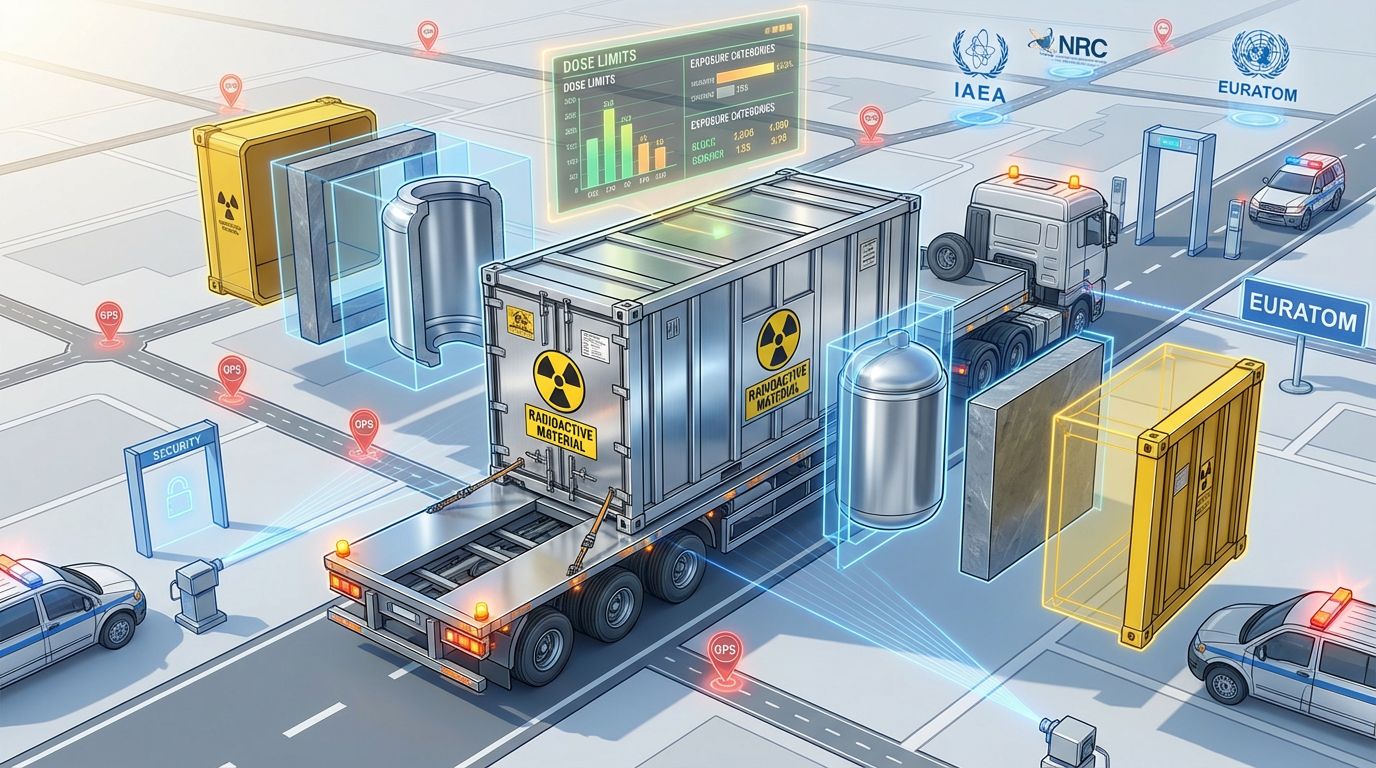
Transportation personnel face occupational exposure risks during loading, transit, and unloading operations. International standards establish strict dose limits, typically restricting annual exposure to 20 millisieverts for radiation workers and 1 millisievert for the general public. Furthermore, cumulative dose monitoring becomes critical during extended transport operations, particularly when multiple shipments occur within short timeframes.
Recent events in Niger demonstrate the importance of proper exposure monitoring. When approximately 1,050 tons of uranium concentrate were transported from the SOMAIR mine in late November 2025, questions arose regarding whether adequate radiation protection measures were implemented. The lack of involvement from the original mine operator raised concerns about whether standard occupational safety protocols were followed during the loading process.
Worker safety protocols require specialised training, personal dosimetry equipment, and regular health monitoring. In addition, transport crews must understand radiation protection principles, including time, distance, and shielding concepts that minimise exposure during routine operations. These measures are particularly crucial given the current uranium spot price trends and increasing transport activities.
Physical Accident Scenarios and Impact Assessment
Vehicle collisions involving radioactive cargo present unique challenges beyond conventional traffic accidents. The potential for container breach, environmental contamination, and public exposure requires specialised emergency response capabilities. Consequently, fire scenarios pose particular risks, as elevated temperatures can compromise container integrity and increase the likelihood of radioactive material dispersal.
Infrastructure quality directly affects accident probability. Orano's assessment that Niger's transport routes involved roads unsuited for heavy loads highlights how inadequate infrastructure increases collision and rollover risks. Poor road conditions can cause excessive vibration, container damage, and driver fatigue, all contributing to accident scenarios.
Environmental dispersion modelling helps predict contamination patterns in various accident scenarios. However, factors including wind speed, precipitation, and topography influence how radioactive particles might spread following a transport incident. These assessments inform emergency response planning and evacuation zone determination.
How Do International Regulatory Frameworks Govern Uranium Convoy Operations?
International atomic energy regulations provide the foundation for safe radioactive material transport, though enforcement varies significantly across jurisdictions. These frameworks establish technical standards, documentation requirements, and oversight mechanisms designed to prevent accidents and unauthorised diversions.
IAEA Transport Regulations and Compliance Standards
The International Atomic Energy Agency sets global standards through its Transport Regulations, which classify packages by radioactivity level and establish corresponding safety requirements. Type A packages handle lower-activity materials, whilst Type B packages accommodate higher-activity substances requiring more robust containment systems.
| Container Type | Maximum Uranium Content | Drop Test Height | Fire Resistance Duration | Regulatory Authority |
|---|---|---|---|---|
| Type A Package | 15 kg U-235 equivalent | 1.2 metres | 30 minutes at 800°C | National regulators |
| Type B Package | Unlimited fissile content | 9 metres | 30 minutes at 800°C | IAEA certification |
| Type C Package | Air transport only | 90 metres | 60 minutes at 800°C | IAEA certification |
Documentation protocols require detailed manifests, chain-of-custody records, and notification procedures for cross-border shipments. For instance, the Niger uranium transport case revealed significant gaps in these processes, with Orano stating it received no confirmation that international transport regulations were observed or that proper loading conditions were maintained.
National Implementation Variations
Individual countries adapt IAEA standards to their specific regulatory frameworks, creating variations in enforcement mechanisms and penalty structures. The United States Nuclear Regulatory Commission, European Union EURATOM directives, and other national authorities maintain jurisdiction over transport activities within their territories.
The World Bank's International Centre for Settlement of Investment Disputes issued a ruling in September 2025 barring Niger from selling or transferring SOMAIR uranium, demonstrating how international arbitration mechanisms attempt to resolve disputes. However, enforcement remains challenging when national governments choose to disregard tribunal decisions.
These regulatory variations create complexity for international transport operations. Therefore, they require operators to navigate multiple legal frameworks whilst maintaining consistent safety standards across borders. This complexity has intensified following the US Senate uranium ban and related trade restrictions.
What Security Threats Target Uranium Transportation Networks?
Uranium transport operations face diverse security challenges ranging from criminal theft to state-sponsored diversion attempts. The valuable nature of nuclear materials combined with their potential dual-use applications creates attractive targets for various threat actors.
Theft and Diversion Risk Factors
Criminal organisations may target uranium shipments for financial gain, either through direct sale or ransom demands. The Niger case illustrates how political instability increases diversion risks, with approximately 1,500 metric tons of uranium stockpiled at the SOMAIR site potentially accessible to unauthorised parties.
State-sponsored interception capabilities pose particularly complex challenges. Reuters reporting identified potential buyers for Niger's uranium including Turkish, Iranian, and Russian interests, demonstrating how geopolitical considerations can create demand for diverted materials outside normal commercial channels.
Insider threats represent another significant vulnerability. When original operators lose access to their facilities, as occurred with Orano's exclusion from SOMAIR operations, institutional knowledge about security procedures may be compromised or deliberately circumvented.
Sabotage and Terrorism Considerations
Transport routes through regions experiencing insurgency activity face elevated sabotage risks. Niger battles Islamist militants in its northern and western regions, where fighters have seized territory and blocked key transport routes. Such conditions create opportunities for hostile actors to target convoys carrying radioactive materials.
The potential for radiological dispersal device construction adds another dimension to security concerns. While uranium concentrate requires significant processing before weapons use, even crude dispersal could cause public panic and economic disruption far exceeding the actual radiological hazard.
Critical Security Assessment: Transport through unsecured corridors where militant groups control territory represents an unacceptable risk multiplication factor for radioactive material convoys.
How Are Uranium Transport Containers Engineered for Maximum Safety?
Container engineering represents the primary technical barrier preventing radioactive material release during transport incidents. Multi-layer containment systems must withstand extreme conditions including impacts, fires, and prolonged exposure to harsh environments.
Multi-Barrier Containment Design Principles
Primary containment vessels directly hold radioactive materials, typically constructed from corrosion-resistant materials with welded seams to prevent leakage. Secondary shielding provides radiation protection, often incorporating lead or depleted uranium to attenuate gamma emissions. Furthermore, tertiary protective packaging offers impact resistance and structural integrity during normal transport conditions.
Quality assurance testing validates container performance through standardised protocols. Drop tests simulate accident impacts, with Type B packages required to survive 9-metre falls onto unyielding surfaces. Consequently, fire resistance testing subjects containers to 800°C temperatures for 30 minutes, ensuring structural integrity under severe thermal stress.
Impact and Environmental Resistance Testing
Crush tests apply 500-kilogram forces to verify structural integrity under compression loads. Puncture resistance evaluations use steel bars to test container wall strength against sharp object penetration. Additionally, water immersion testing validates leak-tightness over extended periods, simulating scenarios where containers might be submerged following accidents.
Vibration endurance testing ensures containers maintain integrity during extended transport over rough terrain. This testing becomes particularly relevant for routes involving poor road conditions, such as those described in the Niger uranium transport case.
The absence of container verification in the Niger situation highlights uranium convoy safety risks associated with bypassing standard certification processes. Without proper loading condition verification, the integrity of containment systems cannot be assured.
What Emergency Response Protocols Apply to Uranium Transport Incidents?
Emergency response capabilities must address the unique challenges posed by radioactive material incidents, including radiation protection for first responders, public evacuation procedures, and environmental contamination assessment.
First Responder Safety Procedures
Radiation detection equipment deployment allows emergency personnel to assess hazard levels and establish appropriate safety zones. Portable survey meters, dosimeters, and air sampling equipment enable real-time monitoring of radioactive contamination levels.
Evacuation zone establishment follows predetermined criteria based on potential exposure levels and meteorological conditions. Initial response zones typically extend several hundred metres from incident sites, with adjustments based on actual contamination measurements and wind patterns.
Decontamination facilities require rapid setup to process potentially exposed individuals. Medical treatment protocols for radiation exposure involve specialised procedures not commonly available in standard emergency medical services, necessitating coordination with radiation medicine specialists.
Environmental Contamination Mitigation
Soil sampling and analysis procedures help define contamination boundaries and guide cleanup efforts. Water source protection measures prevent radioactive materials from entering drinking water supplies or irrigation systems. In addition, air quality monitoring tracks potential inhalation hazards downwind from incident sites.
Long-term cleanup and remediation standards vary by jurisdiction but generally aim to restore affected areas to background radiation levels. The complexity and cost of environmental remediation provide strong incentives for preventing incidents through robust transport safety measures.
How Do Route Planning and Security Measures Minimise Transport Risks?
Strategic route selection and comprehensive security planning form critical components of safe uranium transport operations. These measures must account for population density, infrastructure quality, security conditions, and emergency response capabilities along transport corridors.
Strategic Route Selection Criteria
Population density considerations prioritise routes that minimise potential public exposure in accident scenarios. Transport through urban areas generally receives greater scrutiny due to higher population concentrations and limited emergency response space.
Infrastructure quality assessment evaluates road conditions, bridge capacities, and gradient limitations for heavy transport vehicles. The Niger case demonstrates consequences of inadequate infrastructure assessment, with routes described as unsuited for the transported loads.
Weather pattern analysis identifies seasonal restrictions that might affect safe transport. However, high wind conditions can increase rollover risks, whilst ice or flooding may necessitate route diversions or transport delays.
Real-Time Monitoring and Communication Systems
GPS tracking and satellite communication requirements ensure continuous monitoring of transport progress and immediate notification of any deviations or incidents. Modern systems provide real-time location data, vehicle status information, and direct communication channels with emergency response centres.
Escort vehicle coordination protocols establish procedures for security personnel, emergency response teams, and law enforcement agencies accompanying high-risk shipments. The absence of such coordination in the Niger transport case contributed to security concerns and regulatory compliance questions.
Route Planning Risk Assessment Matrix:
• Low Risk: Well-maintained highways, stable political conditions, comprehensive emergency services
• Moderate Risk: Adequate infrastructure, limited security concerns, basic emergency response capabilities
• High Risk: Poor road conditions, political instability, inadequate emergency services
• Unacceptable Risk: Active conflict zones, infrastructure failure, no emergency response capability
What Are the Economic and Operational Costs of Uranium Transport Safety?
Comprehensive safety measures require significant financial investments across multiple operational areas. These costs must be balanced against the potential consequences of safety failures, which can include cleanup expenses, legal liabilities, and long-term reputational damage.
Regulatory Compliance Cost Analysis
Container certification and testing expenses represent substantial upfront investments, with Type B packages requiring international certification processes that can cost hundreds of thousands of dollars per design. Personnel training and qualification investments ensure transport crews understand radiation protection principles and emergency procedures.
Insurance premiums for radioactive material transport reflect the elevated risks and potential consequences of incidents. Coverage must address both traditional transport risks and unique liabilities associated with radioactive contamination scenarios.
Security escort and monitoring system costs vary significantly based on route risk assessments and regulatory requirements. Furthermore, high-risk routes may require armed escorts, satellite tracking systems, and coordinated emergency response capabilities that substantially increase operational expenses.
Industry Best Practices for Cost-Effective Safety
Consolidated shipment strategies reduce convoy frequency whilst maintaining safety standards, achieving economies of scale in security and escort arrangements. Shared security resources among transport operators can distribute costs whilst maintaining comprehensive coverage.
Standardised equipment procurement enables bulk purchasing agreements that reduce per-unit costs for specialised transport containers, monitoring equipment, and safety systems. Risk-based security level adjustments allow operators to scale protection measures according to specific threat assessments rather than applying maximum security to all shipments.
Cost-Benefit Analysis Considerations:
• Prevention costs: Container certification, security escorts, route planning, personnel training
• Incident costs: Emergency response, environmental cleanup, legal liabilities, regulatory penalties
• Opportunity costs: Transport delays, route restrictions, additional security requirements
How Do Recent Geopolitical Developments Impact Uranium Transport Security?
Resource nationalism and shifting geopolitical alignments significantly affect uranium transport security considerations. Recent events in West Africa illustrate how political changes can rapidly transform operating environments and create new risk factors for international mining operations.
Resource Nationalism and Supply Chain Disruptions
Government seizure risks in uranium-producing regions have increased following Niger's nationalisation of the SOMAIR mine in December 2024 under a June ordinance. This action stripped Orano of operational control despite holding a 63.4% stake, demonstrating how political changes can override commercial agreements and property rights.
The pattern reflects broader trends across West Africa, where governments seek greater control over natural resources to capture more revenue from commodity price increases. Niger, as the world's seventh-largest uranium producer, provides 15% of Orano's uranium supplies when operations run at full capacity.
Alternative supply route development becomes critical when traditional partnerships face political disruption. Mining companies must evaluate backup suppliers and transport corridors to maintain supply chain resilience amid changing political landscapes. This development particularly affects US uranium production strategies and related safety protocols.
Sanctions and Trade Restriction Implications
Export licence revocation impacts transport planning by creating uncertainty about legal frameworks governing cross-border movements. Third-party buyer verification requirements become more complex when traditional regulatory oversight is absent or compromised.
Financial transaction monitoring for uranium sales faces challenges when buyers prefer opacity, as demonstrated in the Niger case where destination and buyer information remained undisclosed. Diplomatic immunity considerations for transport personnel may offer some protection but cannot guarantee safe passage through politically unstable regions.
International arbitration mechanisms, whilst available, face enforcement limitations when national governments choose to disregard tribunal decisions. However, the World Bank ICSID ruling against Niger's uranium sales demonstrates legal recourse availability but limited practical effectiveness in forcing compliance. These developments coincide with the US production executive order and related national security initiatives.
What Future Technologies Could Enhance Uranium Transport Safety?
Emerging technologies offer potential improvements to uranium transport safety through enhanced monitoring capabilities, advanced container designs, and automated safety systems. These developments may address current limitations in tracking, containment, and incident response.
Advanced Monitoring and Detection Systems
Real-time radiation level monitoring during transport provides continuous assessment of container integrity and early warning of potential leaks. Advanced sensor networks can detect minute changes in radiation levels that might indicate developing problems before they become serious incidents.
Artificial intelligence-powered threat detection systems analyse transport route data, security intelligence, and operational parameters to identify emerging risks. These systems can recommend route adjustments, security enhancements, or transport delays based on dynamic threat assessments.
Blockchain-based chain of custody documentation creates tamper-proof records of transport activities, addressing concerns about documentation integrity that arose in the Niger case. Distributed ledger technology ensures all stakeholders have access to verified transport information without relying on potentially compromised intermediaries.
Next-Generation Container Technologies
Smart packaging with integrated sensors provides continuous monitoring of internal conditions including temperature, pressure, radiation levels, and structural integrity. These systems can transmit real-time data to monitoring centres and automatically alert operators to developing problems.
Self-healing containment materials represent an emerging technology that could automatically seal minor breaches before they become significant leaks. Advanced polymer systems can respond to damage by initiating chemical reactions that restore barrier properties.
Modular design approaches allow scalable security levels based on specific threat assessments and transport requirements. Standardised components can be configured for different risk scenarios whilst maintaining compatibility with existing transport infrastructure.
Technology Integration Timeline:
• Near-term (1-3 years): Enhanced GPS tracking, improved communication systems, advanced sensors
• Medium-term (3-7 years): AI-powered threat detection, blockchain documentation, smart packaging
• Long-term (7+ years): Self-healing materials, autonomous transport systems, integrated safety networks
Technological Advancement Caveat: Future safety technologies must undergo rigorous testing and regulatory approval processes before implementation in uranium transport operations, potentially extending development timelines significantly.
The uranium transport industry continues evolving in response to changing security environments, technological capabilities, and regulatory requirements. Recent events in Niger highlight the critical importance of maintaining international safety standards even amid political disruption and resource nationalism trends. Effective uranium convoy safety risks management requires comprehensive approaches combining robust engineering, strict regulatory oversight, advanced security measures, and continuous adaptation to emerging threats and technologies.
Disclaimer: This analysis incorporates publicly available information and industry standards current as of the publication date. Uranium transport regulations, security conditions, and technological capabilities continue evolving. Readers should consult current regulatory guidance and professional expertise for specific operational decisions.
Ready to Capitalise on Uranium Market Volatility?
Discovery Alert's proprietary Discovery IQ model delivers real-time alerts on significant ASX uranium discoveries, empowering subscribers to identify actionable opportunities as geopolitical tensions reshape global markets. Explore Discovery Alert's dedicated discoveries page to understand how historic mineral discoveries have generated substantial returns, then begin your 30-day free trial to position yourself ahead of market movements in this rapidly evolving sector.