June 4, 2026
The 46-Year Gap That Made One Oklahoma Town the Center of America's Industrial Ambitions
For more than four decades, the United States has not built a single new primary aluminum smelter. That extraordinary industrial atrophy is not the result of declining aluminum demand, quite the opposite. American consumption of aluminum has grown substantially across automotive, aerospace, packaging, and defence sectors. The gap between domestic production capacity and national requirements has instead been filled by imports, with the US now sourcing more than half of its annual aluminum needs from foreign suppliers. That structural vulnerability has quietly accumulated into one of the more consequential supply chain risks in American manufacturing.
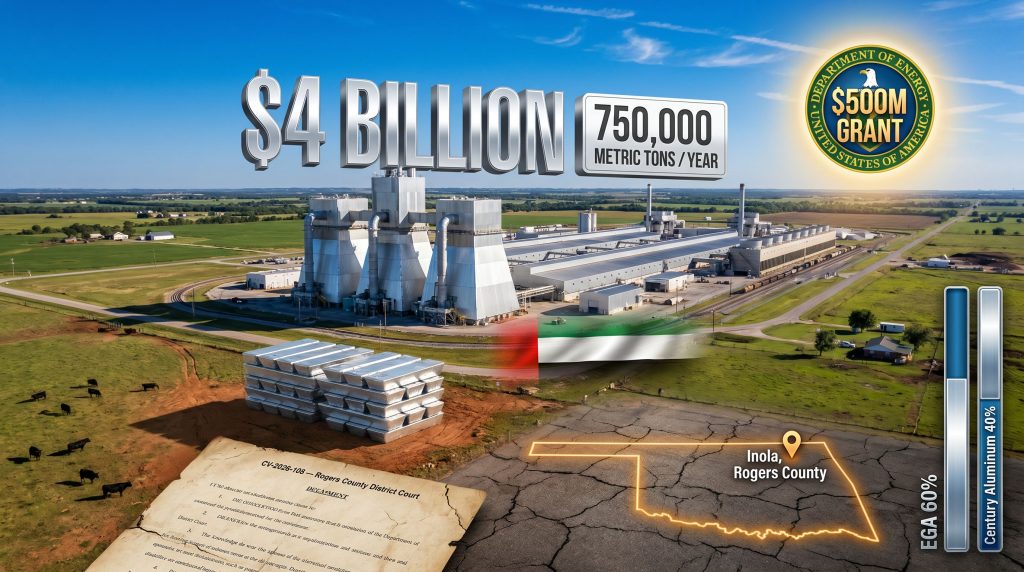
Against this backdrop, a proposed $4 billion primary aluminum smelter in Inola, Oklahoma, roughly 30 miles east of Tulsa, emerged as the most ambitious attempt in a generation to reverse that trajectory. Now, the project sits at the centre of a legal and political storm that reveals just how complicated the path to industrial onshoring has become in modern America.
The Oklahoma attorney general sues to block aluminum smelter story captures only the surface of what is actually a multi-layered collision between environmental law, foreign investment policy, electoral politics, and the strategic imperatives of US critical minerals supply chains.
When big ASX news breaks, our subscribers know first
Why Primary Aluminum Smelting Disappeared from the United States
Understanding the lawsuit requires understanding why no new primary smelter has been built in the US since 1980, a 46-year absence that left the country structurally dependent on imports and vulnerable to geopolitical supply disruptions.
Primary aluminum production is extraordinarily energy-intensive. The Hall-Heroult process, which converts alumina into molten aluminum through electrolysis, consumes roughly 13 to 15 megawatt-hours of electricity per metric ton of aluminum produced. This makes access to large volumes of reliable, competitively priced electricity the single most important variable in smelter economics, far more decisive than labour costs or proximity to raw materials.
As US electricity prices rose relative to those in the Middle East, Canada, and Iceland, domestic primary smelting became economically uncompetitive. Plants closed. Investment dried up. The US shifted toward secondary production, recycling aluminium scrap rather than producing new primary metal, which is a lower-energy process but one that cannot substitute fully for primary production in applications requiring high-purity aluminum.
Industry advocates have consistently made this point explicit: the steel and aluminium tariffs alone cannot rebuild domestic primary aluminum capacity. The decisive variable is affordable, large-scale power supply. Oklahoma's pitch to project developers centred heavily on access to competitive electricity, positioning the state as a viable host for the kind of energy-intensive industrial facility that had become economically unthinkable in most of the continental US.
Project Profile: Who Is Behind the Inola Smelter?
The Inola facility is structured as a joint venture between two significant industry players with very different ownership profiles.
| Parameter | Detail |
|---|---|
| Projected Annual Output | 750,000 metric tons of aluminum |
| Total Project Investment | $4 billion |
| Federal Grant Awarded | $500 million (US Department of Energy) |
| Project Location | Inola, Rogers County, Oklahoma |
| Last US Primary Smelter Built | 1980 (46-year gap) |
| EGA Ownership Stake | 60% (controlling interest) |
| Century Aluminum Stake | 40% |
| Construction Timeline | Targeted to begin by end of 2026 |
| Production Target | Operational by end of the decade |
Emirates Global Aluminum (EGA) holds the controlling 60% stake. EGA is one of the world's largest primary aluminum producers, operating large smelting complexes across the UAE and running an aluminum recycling facility in Minnesota, the latter giving it an existing operational presence on US soil. EGA is owned by sovereign wealth funds linked directly to the governments of Abu Dhabi and Dubai, meaning the entity that holds the controlling vote in the joint venture is, in a formal sense, an instrument of UAE state ownership.
Century Aluminum, the US-based partner holding the remaining 40%, is headquartered in Chicago and operates primary smelters in South Carolina and Kentucky, as well as a facility in Iceland. Notably, Swiss-based commodity trading giant Glencore holds approximately a 30% stake in Century Aluminum, making it an indirect financial participant in the Oklahoma project. Furthermore, the involvement of multiple international stakeholders adds considerable complexity to an already politically charged development.
The US Department of Energy awarded the project a $500 million grant, and Oklahoma Governor Kevin Stitt has championed the facility as a cornerstone of his vision for the state as a critical minerals processing hub. President Donald Trump has also publicly backed the project as consistent with his administration's domestic supply chain priorities. Similar in structure to the Alcoa joint venture model, this arrangement illustrates how large-scale aluminium projects increasingly rely on complex multi-partner structures.
What the Attorney General's Lawsuit Actually Argues
The Legal Foundation
On June 3, 2026, Oklahoma Attorney General Gentner Drummond filed a petition in Rogers County District Court (Case No. CV-2026-108), seeking a permanent injunction to halt construction of the Inola smelter before it begins.
The legal theory underpinning the action is anticipatory public nuisance, a doctrine that allows courts to intervene before harm occurs when there is credible evidence that harm is sufficiently likely. Rather than waiting for the facility to be built and operational, Drummond's petition argues that the court should act now to prevent future damage.
The core allegations cluster into three distinct areas:
Environmental and Health Harm
- The filing contends that smelter operations would release air and water pollutants capable of injuring the health, comfort, and safety of residents in and around Inola
- The petition frames smelter emissions as inherently incompatible with a rural residential and agricultural community, arguing that industrial pollutants do not observe property boundaries
Agricultural and Economic Damage
- A central plank of the lawsuit is the alleged threat to Oklahoma's cattle industry, with Drummond arguing that farming and ranching communities in the Inola region face disproportionate exposure to industrial contamination
- This argument is politically strategic as well as legally substantive: Oklahoma's cattle industry is a major economic and cultural pillar of the state, and framing the smelter as a threat to ranchers resonates strongly with rural Republican voters
Foreign Sovereign Control Over Locally Subsidised Infrastructure
- Perhaps the most legally novel aspect of the filing is its direct targeting of EGA's ownership structure
- The petition raises concerns that local taxpayer funds, including state incentives, are being channelled toward a facility where strategic control rests with entities answerable to a foreign sovereign government
- The attorney general's language characterises this as both a governance risk and a matter of state sovereignty, arguing that the entity that will profit and hold the controlling vote in the plant's operations does not answer to Oklahoma or to the United States
Core Legal Claims at a Glance
- Anticipatory public nuisance, seeking intervention before construction begins
- Alleged air and water pollution threatening Inola-area residents
- Claimed threat to agricultural livelihoods, particularly cattle ranching
- Foreign sovereign control over a facility receiving local taxpayer support
- Argument that public resources are being misallocated toward a foreign-majority-owned enterprise
The Electoral Dimension: Why Timing Is Everything
The lawsuit's filing date is impossible to separate from its political context. Drummond submitted the petition four days after President Trump endorsed his rival, former state Senator Mike Mazzei, in the June 16, 2026 Republican gubernatorial primary. Both candidates were polling in a near-tied position heading into that race.
| Date | Event |
|---|---|
| 2022 | Drummond elected as Oklahoma Attorney General |
| Early 2026 | US DOE awards $500 million grant to Oklahoma aluminum project |
| Pre-June 2026 | Trump endorses Mike Mazzei in Republican primary |
| June 3, 2026 | Drummond files lawsuit in Rogers County District Court |
| June 16, 2026 | Republican gubernatorial primary |
| November 3, 2026 | Oklahoma general election |
Governor Stitt publicly and forcefully alleged that Drummond was using his office as a political instrument rather than acting in the public interest, pointing directly to the timing of the filing relative to the Trump endorsement. Stitt described the action as an attempt to settle scores rather than serve Oklahomans.
Drummond's supporters maintain that the legal action reflects a genuine commitment to environmental protection and the interests of agricultural communities, arguing that the timing is coincidental rather than calculated. The winner of the Republican primary is broadly expected to prevail in the November general election given Oklahoma's strong partisan lean, making the primary itself the decisive contest.
What makes the political dimension particularly layered is that Drummond, in filing the lawsuit, is effectively positioning himself against a project backed by the sitting US president. This creates an unusual dynamic: a Republican state official using the tools of his office to oppose a federally endorsed industrial investment backed by his own party's president.
Power, Not Tariffs: The Real Economics of US Aluminum Revival
The Inola project and the legal challenge surrounding it cannot be fully understood without grasping the specific economics of primary aluminum production. The impact of US aluminium tariffs was designed to make domestic production more attractive by raising the cost of imports. In theory, tariffs create margin space for US producers. In practice, the industry has been clear that tariffs are a necessary but insufficient condition for a genuine domestic production revival.
The core constraint is electricity. A facility producing 750,000 metric tons per year at the energy intensities typical of modern smelting technology would require a sustained, large-volume power supply agreement at rates that are competitive with those available in the Middle East, Canada, or Iceland. Without that foundation, the economics of primary smelting in the continental US remain challenging regardless of the tariff environment.
Oklahoma's pitch to EGA and Century Aluminum apparently addressed this constraint sufficiently to attract a $4 billion commitment. The details of the power supply arrangements underpinning the project have not been fully disclosed publicly, but the investment decision itself signals that project developers believed the electricity economics were workable.
This is a critical piece of context often missing from media coverage of the lawsuit: the legal challenge is not occurring in a vacuum. It is targeting a project that already cleared the threshold of commercial viability assessment by two experienced aluminum producers.
The next major ASX story will hit our subscribers first
Foreign Sovereign Investment in US Critical Infrastructure: A Precedent in the Making
Perhaps the most consequential long-term implication of the Drummond lawsuit is the legal and regulatory precedent it may establish around foreign sovereign ownership of US critical minerals infrastructure.
The EGA ownership structure is not unusual by global standards. Sovereign wealth funds and state-owned enterprises from the Gulf, China, Japan, South Korea, and other nations have long been active investors in US industrial and resource assets. What is unusual about the Oklahoma case is the explicit use of state-level litigation as a mechanism to challenge federal approval of foreign-majority-owned critical infrastructure.
This raises a question with implications far beyond Inola. Consequently, the broader industry is watching closely, particularly the top aluminium companies with exposure to US market dynamics:
- At what ownership threshold does foreign sovereign investment in US industrial infrastructure cross from legitimate foreign direct investment into a governance or national security concern?
- Does a 60% controlling stake by an entity ultimately answerable to a foreign government, in a facility receiving US federal grant funding, create a structural accountability gap?
- Can state attorneys general use anticipatory nuisance doctrine as a practical veto over federally endorsed industrial projects where foreign entities hold controlling positions?
If the Rogers County District Court entertains the lawsuit seriously, let alone grants the injunction, it will signal to other state-level legal officers that this approach is viable. That could have a chilling effect on foreign sovereign investment in US critical minerals processing more broadly, at precisely the moment when the US is seeking to attract exactly such investment to rebuild domestic capacity.
Four Scenarios for the Inola Smelter's Future
The lawsuit introduces genuine uncertainty into a project that had appeared to be advancing toward a construction start before the end of 2026. Four distinct trajectories are plausible from this point.
Scenario 1: Injunction Granted, Construction Halted
The court finds sufficient grounds to issue preliminary or permanent injunctive relief. Construction is paused or permanently blocked, creating material sunk-cost exposure for both EGA and Century Aluminum on planning, permitting, and preparatory expenditure already incurred. DOE grant disbursement timelines face disruption, potentially triggering review provisions within the grant agreement.
Scenario 2: Lawsuit Dismissed, Project Proceeds
The court finds the anticipatory nuisance claim legally insufficient and dismisses the petition. Construction begins as planned, with production targeting the end of the decade. Drummond's legal challenge becomes a political liability if courts characterise it as an unsupported interference with legitimate industrial development.
Scenario 3: Negotiated Settlement with Enhanced Conditions
Rather than litigate to conclusion, project partners negotiate enhanced environmental monitoring frameworks, emissions control commitments, or community benefit agreements directly with the attorney general's office or Rogers County stakeholders. Construction proceeds under modified conditions, potentially establishing a template for how foreign-majority-owned industrial projects navigate state-level opposition in the US.
Scenario 4: Political Resolution After the Primary
If Drummond loses the June 16 primary to Mazzei, the lawsuit's political momentum dissipates substantially. A successor attorney general could withdraw, deprioritise, or settle the litigation on terms favourable to the project. The smelter proceeds, though reputational and timeline damage may already be embedded in the project record.
What This Means for US Critical Minerals Supply Chains
The stakes of the Inola dispute extend well beyond a single industrial facility. If the Oklahoma attorney general sues to block aluminum smelter efforts succeed, the US aluminum supply chain remains structurally dependent on imports for the foreseeable future. Downstream industries, including automotive manufacturers, aerospace companies, packaging producers, and defence contractors, would continue to face exposure to global aluminum price volatility and geopolitical supply risk.
A 750,000-metric-ton annual production facility would represent one of the most significant expansions of US primary aluminum capacity in modern industrial history. Its absence, or its indefinite deferral, is not a neutral outcome. It perpetuates the 46-year production gap that made Inola an industrial frontier in the first place.
For investors and developers active in the US critical minerals space, the Oklahoma case introduces a risk category that has historically received insufficient attention in project feasibility assessments: state attorney general intervention. The precedent-setting potential of this lawsuit means that foreign ownership structures, particularly those involving sovereign wealth funds or state-owned enterprises, may now need to be stress-tested against the possibility of state-level legal challenge regardless of federal approval status.
Furthermore, the global commodity tariff impacts of such disputes extend beyond individual projects. The broader lesson is structural: rebuilding industrial capacity in the United States after decades of attrition is not simply an engineering, financial, or policy challenge. It is also a political and legal one, requiring durable social licence in the communities where that capacity will be located, and careful navigation of the overlapping jurisdictions that govern large-scale industrial development in a federal system.
This article is intended for informational purposes only and does not constitute financial, investment, or legal advice. The scenario analysis presented reflects possible outcomes based on available information and should not be interpreted as a forecast or prediction. Readers should conduct their own due diligence before making any investment or business decisions related to the companies or projects discussed.
Want to Track the Next Major Mineral Discovery Before the Market Does?
Discovery Alert's proprietary Discovery IQ model delivers real-time alerts on significant ASX mineral discoveries, turning complex mineral data into actionable insights for both short-term traders and long-term investors — explore historic discoveries and the returns they generated, then begin your 14-day free trial to position yourself ahead of the market.