June 3, 2026
The Fault Lines Beneath America's Industrial Revival
Every generation or so, the United States confronts a version of the same dilemma: how to rebuild the industrial foundations of national strength without sacrificing the communities closest to the smokestacks. That tension has never been more visible than in a small Oklahoma town called Inola, where a $4 billion aluminum smelter has become a battleground for environmental law, foreign investment governance, electoral politics, and the future of domestic metals production, all at once.
The conflict playing out in Rogers County District Court is not simply a local zoning dispute. Furthermore, it is a stress test for U.S. critical minerals policy, exposing structural contradictions that federal planners have not yet resolved.
When big ASX news breaks, our subscribers know first
What Is Being Proposed and Where
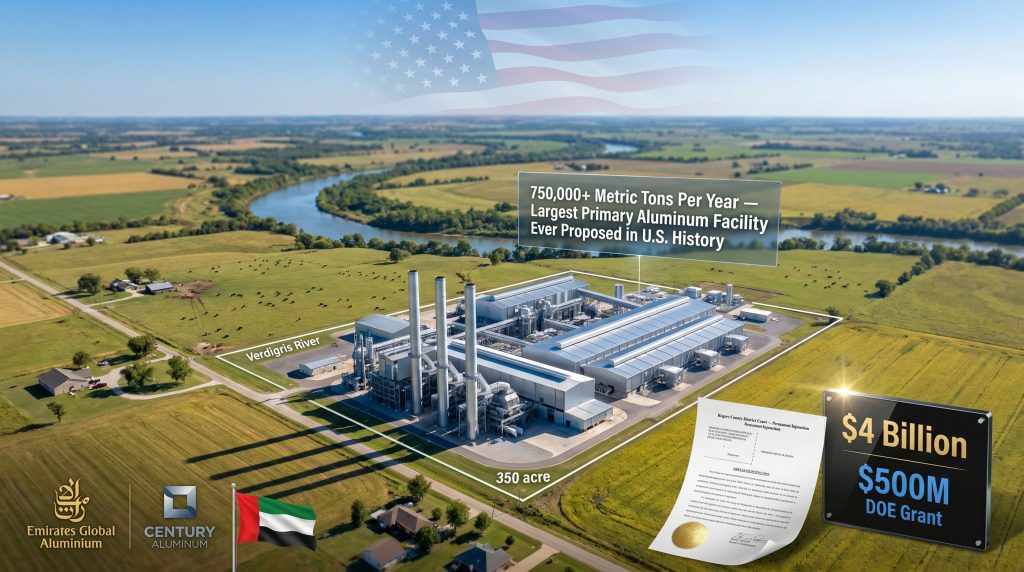
The facility at the centre of this dispute is the Oklahoma Primary Aluminum project, planned for a roughly 350-acre site along the Verdigris River near Inola, approximately 30 miles east of Tulsa. If constructed as designed, the plant would produce more than 750,000 metric tons of primary aluminum annually, making it the largest primary aluminum production facility ever built on U.S. soil.
That scale matters enormously in context. The United States has not commissioned a new primary aluminum smelter since 1980, a gap of more than four decades during which domestic smelting capacity has steadily eroded whilst import dependence has grown. Today, the U.S. sources more than half of its annual aluminum supply from overseas, a structural vulnerability that has drawn increasing scrutiny from policymakers concerned about supply chain resilience in sectors ranging from aerospace to defence manufacturing.
The Ownership Structure
The project is a joint venture between two companies with very different profiles:
- Emirates Global Aluminium (EGA) holds a 60% controlling interest and brings deep smelting expertise from its Middle East operations, along with an aluminum recycling facility already operating in Minnesota.
- Century Aluminum, headquartered in Chicago, controls the remaining 40% and operates smelters in South Carolina, Kentucky, and Iceland.
- Glencore, the Swiss-headquartered commodities giant, holds approximately 30% of Century Aluminum, making it an indirect but meaningful stakeholder in the Inola project's outcome.
The U.S. Department of Energy awarded the project a $500 million grant, alongside state-level incentive packages championed by Oklahoma Governor Kevin Stitt, who has actively positioned the state as a hub for America's critical minerals resurgence. This backdrop of industrial ambition is closely tied to the broader critical minerals demand surge reshaping U.S. policy priorities.
Oklahoma Attorney General Sues to Block Aluminum Smelter
On June 2, 2026, Oklahoma Attorney General Gentner Drummond filed a petition in Rogers County District Court seeking a permanent injunction that would halt all construction on the proposed facility. The lawsuit does not seek financial damages. Its singular objective is to stop the project from being built.
The Oklahoma attorney general sues to block aluminum smelter construction on the grounds that operating a primary aluminum smelter in close proximity to Inola's schools, residential neighbourhoods, farms, and the Verdigris River would expose surrounding communities to unacceptable levels of air and water pollution. Consequently, the petition characterises the facility as a direct threat to the health, safety, and livelihoods of Oklahomans living within the project's impact radius.
Alleged Environmental Risks
The petition identifies several distinct categories of harm:
| Alleged Risk Category | Specific Concern Raised |
|---|---|
| Air Quality | Industrial emissions affecting residential, school, and agricultural zones |
| Water Contamination | Potential pollutant leaching into the Verdigris River watershed |
| Land Use Impact | 350-acre heavy-industrial footprint within a rural, agricultural community |
| Community Health | Proximity to schools and homes within approximately three miles |
| Livestock and Agriculture | Risks to cattle operations and farming activity in surrounding areas |
Primary aluminum smelting is an energy-intensive electrochemical process that carries well-documented emission profiles. The Hall-Heroult process, which is the industry standard for converting alumina into aluminum metal, generates perfluorocarbon (PFC) gases, fluoride emissions, and particulate matter. Communities near primary smelters in other parts of the world have historically raised concerns about fluoride deposition on pastureland and its effects on livestock, a concern that is particularly resonant in a cattle-farming region like Rogers County.
The core legal argument is straightforward: the communities that would bear the environmental burden of the facility are not the same parties that would capture the majority of its financial returns.
Foreign Ownership at the Heart of the Dispute
Beyond the environmental allegations, the petition raises a governance dimension that gives this lawsuit unusual geopolitical weight. EGA, which holds the controlling 60% stake and therefore exercises the decisive operational vote over how the facility is run, is majority-owned by sovereign wealth funds linked to the governments of Abu Dhabi and Dubai.
This means the entity with the largest financial interest and management authority in a strategically significant U.S. industrial facility answers, ultimately, to foreign government institutions rather than domestic regulatory or shareholder accountability structures.
Drummond's petition draws an explicit contrast: when pollutants settle over Inola, the affected parties are Oklahoma residents. The entity collecting the profits and directing operations, however, has its principal loyalties and legal obligations elsewhere.
Why This Matters Beyond Oklahoma
The foreign ownership question connects to a much wider national conversation about the appropriate role of state-linked enterprises in U.S. critical infrastructure. Similar scrutiny has been applied to:
- Chinese-linked investment in lithium processing and rare earth refining facilities
- State-adjacent entities seeking involvement in battery manufacturing supply chains
- Foreign participation in semiconductor fabrication and advanced materials production
The Committee on Foreign Investment in the United States (CFIUS) exists precisely to evaluate these governance risks. Whether CFIUS has completed or is conducting a review of EGA's controlling position in a facility that would produce a material classified as strategically important to U.S. defence and aerospace manufacturing is a question the lawsuit implicitly raises, even if it does not name CFIUS directly. This tension sits squarely within the broader debate around U.S. critical minerals production and who ultimately controls it.
The Inola case surfaces a structural question that U.S. industrial policy has not yet answered cleanly: can the federal government simultaneously accelerate domestic critical materials production and maintain rigorous scrutiny of foreign state-linked enterprise control over that production?
The Electoral Dimension
Any honest analysis of this lawsuit must engage with its political timing. Drummond, a Republican elected as attorney general in 2022, is currently contesting the June 16 Oklahoma Republican gubernatorial primary against former state Senator Mike Mazzei. President Trump endorsed Mazzei four days before the lawsuit was filed, at a point when the two candidates were polling in an effective deadlock.
Governor Kevin Stitt, who is term-limited and cannot run again, publicly criticised the lawsuit's timing. Stitt characterised the filing as a political manoeuvre rather than a genuine exercise of prosecutorial responsibility, noting its proximity to the presidential endorsement of Drummond's rival.
The winner of the Republican primary is widely expected to win the November 3 general election in a state with a strong Republican lean, making the primary outcome functionally equivalent to selecting the next governor.
What This Means for the Lawsuit's Credibility
The electoral context does not automatically invalidate the environmental and governance arguments in the petition. Both can be true simultaneously: the lawsuit can be substantively grounded in legitimate concerns and be filed with electoral calculation in mind. Courts assess legal merit, not political motivation.
What the timing does create, however, is a visibility problem. Observers sympathetic to the project's industrial policy rationale will cite the political backdrop to dismiss the petition. The Rogers County court will ultimately be required to evaluate the legal merits independently of both narratives. For further context on how governor candidates' stances have shaped this debate, the divergence between Drummond and Stitt is particularly instructive.
The Economic Case For and Against
The Inola project's supporters point to a compelling set of economic arguments:
| Metric | Detail |
|---|---|
| Total Investment | $4 billion |
| Annual Production Capacity | 750,000+ metric tons of primary aluminum |
| Federal Grant | $500 million (U.S. Department of Energy) |
| Last Comparable U.S. Facility Built | 1980 |
| Current U.S. Import Dependency | More than 50% of annual supply |
| Key End-Use Sectors | Aerospace, defence, automotive, construction, packaging |
At the community level, a facility of this scale would represent one of the largest single industrial investments in Oklahoma's history, with the potential to generate substantial direct employment and an expanded tax base for Rogers County. For rural communities with limited large-scale industrial employers, those economic arguments carry real weight.
On the other side, local farmers and ranchers have raised concerns about long-term impacts on land values, livestock health, and the agricultural viability of the Verdigris River corridor. Historical precedent from other primary aluminum smelting regions suggests these concerns are not unfounded. Fluoride emissions from smelting operations have been documented to affect pastureland and cattle health in proximity to facilities in multiple countries.
The Tariff Context
The U.S. aluminium tariffs introduced under the Trump administration have elevated the urgency of domestic smelting capacity. By raising the cost of imported aluminum, these tariffs strengthen the economic logic for onshore production. However, they also raise a less-discussed question: if the primary beneficiary of protected U.S. aluminum pricing is a foreign state-controlled enterprise holding a 60% stake in the domestic facility, how much of the tariff-driven economic benefit actually accrues to American workers versus to sovereign wealth funds in the Gulf?
This is not a rhetorical question. In addition, it is a legitimate policy accounting exercise that has not received sufficient public attention. Trump's mining policy impact more broadly has generated similar questions about who ultimately captures the value of reshored industrial investment.
The next major ASX story will hit our subscribers first
Regulatory Frameworks in Play
Several overlapping regulatory structures govern a project of this type:
- Environmental Impact Assessment (EIA) requirements under both federal and Oklahoma state law apply to large-scale industrial facilities with significant pollution potential.
- Clean Air Act permitting through the EPA requires facilities of this scale to demonstrate compliance with National Ambient Air Quality Standards before construction can proceed.
- Clean Water Act Section 404 and related provisions govern industrial activity near waterways like the Verdigris River.
- CFIUS review authority could theoretically apply to foreign state-linked enterprise control over strategically significant U.S. industrial infrastructure, though whether a formal review has been triggered is not publicly confirmed.
- State-level environmental permitting through the Oklahoma Department of Environmental Quality would be required regardless of federal approvals.
The interplay between the DOE grant, federal permitting, and state-level environmental regulation creates a complex multi-agency landscape. A permanent injunction from a state court would not necessarily resolve all of these dimensions, but it would effectively halt the project while the legal challenge is litigated.
Possible Outcomes and What They Signal
The Rogers County District Court petition could resolve in several directions:
- Permanent injunction granted: Construction halts indefinitely, creating a significant timeline setback for a project originally scheduled to begin construction by end of 2025 and reach full production by the end of the decade.
- Petition dismissed: The project proceeds, potentially with renewed political momentum given its federal backing and the governor's public support.
- Negotiated resolution: The parties reach a settlement involving enhanced environmental mitigation commitments, modified site design, or potentially a restructured ownership arrangement designed to reduce the foreign governance concern.
- Appellate escalation: Either outcome is likely to be challenged on appeal, given the financial scale involved and the competing interests of federal industrial policy versus state environmental authority.
A prolonged legal battle carries its own strategic cost: every month of delay is a month during which the U.S. remains dependent on imported aluminum in sectors where supply chain security has become a national priority.
The Inola dispute will not be the last of its kind. As the United States accelerates its critical minerals onshoring agenda, more projects will emerge at the intersection of industrial necessity, environmental protection, foreign investment governance, and local community interest. The aluminium industry leaders navigating these aluminium industry leaders will be watching this case closely, as the legal and policy frameworks that resolve it will shape how all future conflicts of this nature are approached. The case in which the Oklahoma attorney general sues to block aluminum smelter development may ultimately prove as significant for what it reveals about U.S. industrial governance as for its direct outcome in Rogers County.
This article is intended for informational purposes only and does not constitute financial, legal, or investment advice. Forward-looking statements regarding project timelines, legal outcomes, and policy developments involve uncertainty and should not be relied upon as predictions of future events.
Want To Stay Ahead of Major Mineral Discoveries Reshaping U.S. Critical Minerals Policy?
Discovery Alert's proprietary Discovery IQ model delivers real-time alerts on significant ASX mineral discoveries, instantly translating complex data into actionable investment opportunities — explore historic examples of exceptional discovery returns to understand the scale of what's possible, then begin your 14-day free trial at Discovery Alert to position yourself ahead of the market.