
June 5, 2026
When Gold Prices Rise, Labor Tensions Follow
There is a well-documented pattern in the mining industry that rarely gets discussed in quarterly earnings calls: when commodity prices surge, the gap between what workers receive through statutory compensation mechanisms and what they believe they deserve tends to widen. This phenomenon is not unique to any single country or company, but Mexico's profit-sharing framework makes it particularly visible, and particularly volatile.
The Orla Mining Camino Rojo work stoppage, which began on June 1, 2026, is a textbook illustration of this dynamic. Furthermore, understanding why it happened, what it means operationally, and how it fits within a broader structural tension in Mexican mining requires more than a surface reading of the event. Indeed, the gold price surge in recent years has amplified these pressures considerably across the sector.
When big ASX news breaks, our subscribers know first
What Triggered the Blockade at Camino Rojo
On June 1, 2026, unionised workers at the Camino Rojo gold mine in Zacatecas, Mexico initiated an unannounced work stoppage and physical blockade, bringing mining operations to a halt. Critically, the action was not preceded by a formal emplazamiento a huelga, the strike notice mandated under Mexico's Federal Labor Law (Ley Federal del Trabajo) before any lawful work stoppage can be initiated. On this basis, Orla Mining characterised the stoppage as illegal under Mexican law.
The dispute centred on two distinct but overlapping compensation issues:
| Compensation Type | Description | Orla's Position |
|---|---|---|
| Productivity Bonus | Performance-linked payment negotiated between company and union | Under active negotiation at the time of the stoppage |
| PTU (Participación de los Trabajadores en las Utilidades) | Mandatory statutory profit-sharing under Mexican law | Orla states the legally required maximum was calculated and disbursed |
A critical detail worth emphasising: this was not a dispute about whether the PTU was paid. Orla states it paid the legally mandated maximum. The grievance arose because workers contested the amount of the distribution, a distinction that carries significant legal and procedural weight when assessing whether the stoppage had merit under Mexican labor law.
A formal meeting involving company representatives, union leadership, and the Department of Federal Labour Conciliation was scheduled for June 2, 2026, signalling that the dispute had entered Mexico's official mediation framework. According to Orla Mining's official report, the company was committed to resolving the matter through proper legal channels.
Understanding PTU: The Structural Fault Line in Mexican Mining
Mexico's PTU system entitles workers to 10% of a company's taxable profits, but this figure is subject to a legally prescribed cap formula that limits individual payments. Under normal commodity price environments, this cap seldom generates friction. However, in high-gold-price years, the formula can produce a situation where company revenues and profits climb substantially while the per-worker PTU payment remains constrained by statutory limits.
This creates a recurring structural mismatch that is not widely understood outside of Mexican labor relations. Consequently, Mexico mine strikes have become increasingly common as this structural gap widens:
- As gold prices rise, mine-site profitability increases sharply
- PTU obligations grow in absolute terms, but individual entitlements are capped under a two-component formula involving salary multiples and days worked
- Workers observing elevated gold prices and company profits may reasonably expect proportionally larger distributions, only to receive a payment bounded by formulas designed for average commodity cycles
- The gap between worker expectation and legal entitlement widens precisely when operations are most profitable
This structural asymmetry is the hidden engine behind many PTU disputes in Mexican mining, and Camino Rojo appears to be no exception.
How Mexican Labor Law Governs Work Stoppages
The Procedural Requirements for a Lawful Strike
Mexico's Federal Labor Law establishes a clear sequence that unions must follow before initiating any work stoppage. The required steps include:
- Filing a formal emplazamiento a huelga (strike notice) with the relevant labor authority
- Observing a mandatory conciliation period during which both parties must attempt mediated resolution
- Waiting for the legally prescribed notice period to expire before any work action can commence
Bypassing these steps does not simply weaken a union's legal position, it exposes the action to formal characterisation as an illegal stoppage, which is precisely how Orla has framed the June 1 event. This procedural framing matters because it affects what legal remedies are available to the company and what outcomes the federal conciliation body can impose.
Mexico's 2019 Labor Reform: A Changed Playing Field
Any analysis of the Camino Rojo situation must be read against the backdrop of Mexico's sweeping 2019 labor reform. That legislation fundamentally restructured the country's industrial relations architecture by:
- Introducing independent union registration processes, reducing the influence of legacy protection contracts
- Strengthening collective bargaining rights and transparency requirements
- Establishing new labor courts to replace the old Juntas de Conciliación y Arbitraje system
- Creating federal and local conciliation centres as mandatory first-step dispute resolution bodies
For foreign-owned mining operations in particular, the post-2019 environment means that labor disputes are subject to greater regulatory scrutiny and that unions operate with stronger institutional backing than was historically the case. This context adds complexity to how the Camino Rojo stoppage will be interpreted by authorities, even if the procedural failure weakens the union's immediate legal standing.
Why Heap Leach Operations Are Uniquely Vulnerable to Stoppages
The Processing Mechanics That Make Interruptions Costly
Not all mine stoppages carry equal operational consequences. The specific processing method at Camino Rojo, heap leach gold recovery, makes even a short-duration interruption meaningfully more complex to recover from than a conventional milling operation.
Here is why:
- Heap leach processing involves stacking crushed ore on large lined pads and continuously irrigating it with a cyanide or acid solution over extended periods, typically weeks to months
- Gold dissolves into the solution and is recovered through adsorption circuits; this is a time-continuous process, not a batch operation
- Interruptions to solution irrigation, pad management, or recovery circuits do not simply pause the clock, they can disrupt the leaching cycle and push gold recovery timelines into subsequent quarters
- Unlike a milling circuit that can be stopped and restarted with predictable output recovery, heap leach operations carry a lag effect that persists even after normal operations resume
A multi-week heap leach stoppage does not produce a linear production shortfall. The recovery lag means that ounces delayed in June may not appear in reported output until late Q3 or Q4, complicating short-term guidance accuracy.
Throughout the stoppage period, Orla confirmed that all safety-critical and environmental monitoring systems remained operational. This includes solution containment management, liner integrity monitoring, and environmental compliance infrastructure, which are both legal obligations and reputational necessities for operators in Mexico's regulatory environment.
Camino Rojo's Production Profile and the Guidance Risk Window
Output Track Record and Annualized Exposure
Camino Rojo is Orla Mining's cornerstone producing asset. Its recent output history provides important context for assessing the scale of disruption risk:
| Period | Gold Production |
|---|---|
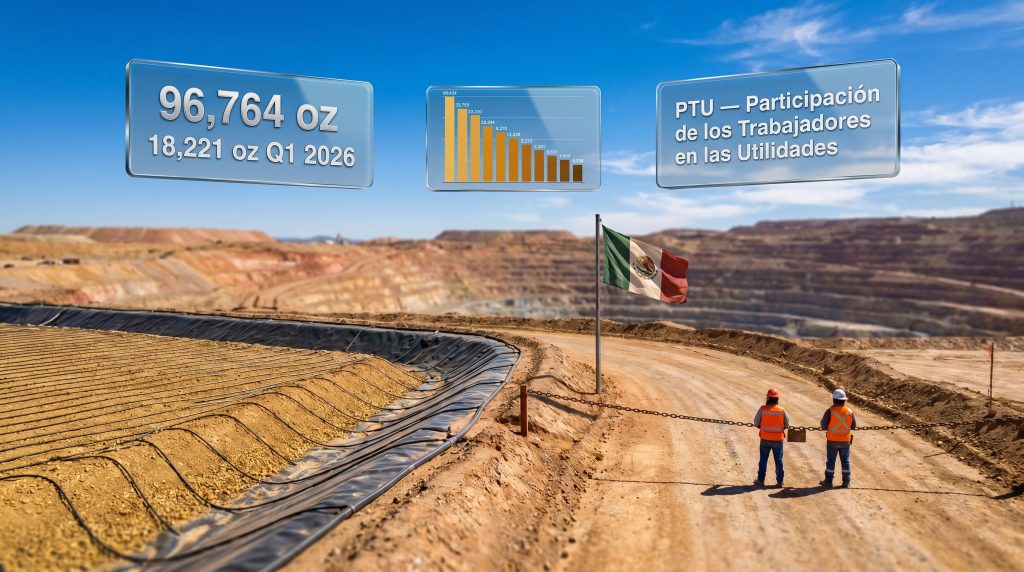
| Full Year 2025 | 96,764 ounces |
| Q1 2026 | 18,221 ounces |
The Q1 2026 figure implies an annualised production rate of approximately 72,884 ounces, which already sits below the 2025 full-year pace. Any multi-week disruption layered onto this run rate creates material variance against full-year guidance, particularly when the heap leach lag effect is factored in. In addition, the gold price impact on miners means that investor scrutiny during such disruptions is considerably heightened.
Orla has publicly stated it will assess the impact of the stoppage duration on its 2026 production guidance once the length of the interruption becomes clearer, and will provide an update in due course. As of early June 2026, no formal guidance revision had been announced.
What Investors Should Watch Closely
| Timeframe | Potential Market Impact |
|---|---|
| Days 1 to 7 | Share price volatility; increased bid-ask spreads; analyst caution |
| Weeks 2 to 4 | Production estimate revisions; guidance risk escalation |
| Months 1 to 3 | ESG labor governance scrutiny; institutional investor reassessment |
| Months 3 and beyond | Structural renegotiation risk; potential long-term labor cost inflation |
Key variables to monitor include:
- Stoppage duration: Each additional week compounds the heap leach recovery lag and widens the production shortfall window
- Federal conciliation outcome: A mediated resolution signals institutional stability; a prolonged impasse signals systemic labor governance concerns
- Guidance revision timing: Any formal production guidance update will likely function as a near-term share price catalyst
- Settlement precedent: The terms of any negotiated resolution could establish a baseline for future PTU and productivity bonus negotiations at the site, with potential long-term cost implications
The next major ASX story will hit our subscribers first
Zacatecas, Organized Labor, and the Broader Context
Zacatecas is not an ordinary mining jurisdiction. It is one of Mexico's most historically significant silver and gold-producing states, with a labor movement that carries deep roots and a demonstrated willingness to use work stoppages as leverage, even when procedural requirements are not fully satisfied. Foreign-owned operations in the state navigate a labor relations environment where institutional memory, community expectations, and union culture all exert meaningful influence on how disputes evolve.
The productivity bonus dimension of this dispute adds another layer of complexity. Unlike PTU, which is a statutory entitlement with a fixed legal calculation framework, productivity bonuses are negotiated instruments subject to collective bargaining outcomes. When bonus negotiations are ongoing at the same time that PTU distributions are being made, the two processes can become entangled in worker perceptions, even if they are legally and procedurally distinct. This overlap appears to have been a contributing factor at Camino Rojo.
Furthermore, with gold as an inflation hedge driving sustained interest in gold-producing assets, the broader M&A landscape means that operational disruptions carry amplified reputational consequences. Indeed, gold M&A activity has intensified scrutiny of labor governance standards at key producing assets across Latin America.
Scenario Analysis: Three Pathways Forward
Scenario A: Rapid Resolution Through Federal Conciliation
Union and company representatives reach agreement through the Department of Federal Labour Conciliation within days of the June 2 scheduled meeting. Operations resume with minimal cumulative production impact, and full-year guidance is maintained. Settlement terms likely incorporate a negotiated productivity bonus figure, with the PTU dispute acknowledged but legally resolved in Orla's favour given the statutory calculation framework.
Scenario B: Prolonged Dispute With Legal Escalation
Conciliation fails to produce an agreement. Orla pursues formal legal remedies to have the stoppage declared unlawful, while the blockade continues. An extended interruption creates a material production shortfall, triggering a downward guidance revision. Heightened ESG scrutiny from institutional investors follows, and Orla's operational credibility in Mexico faces reputational pressure. Reuters reporting on the halt highlights the international attention this type of dispute attracts.
Scenario C: Negotiated Settlement With Structural Cost Implications
Both parties reach a resolution, but on terms that implicitly reset expectations for future PTU disputes and productivity bonus negotiations. Short-term operational normalcy is restored, but the long-term labor cost structure at the site is elevated. This scenario has broader relevance: other foreign-owned mining operators in Mexico facing PTU disputes in a high-gold-price environment will be watching the terms of any settlement closely.
The Orla Mining Camino Rojo work stoppage is a microcosm of a tension that runs across Latin American resource extraction: statutory compensation frameworks built for average commodity cycles struggle to contain worker expectations during extended price booms. How this dispute resolves may quietly influence labor negotiations at other Mexican gold operations for years.
Frequently Asked Questions
What is the Orla Mining Camino Rojo work stoppage?
Unionised workers at Orla Mining's Camino Rojo gold mine in Zacatecas, Mexico initiated an unannounced work stoppage and physical blockade on June 1, 2026, halting mining operations. The action did not follow the procedural requirements mandated under Mexican federal labor law, including the filing of a formal strike notice, leading Orla to characterise it as an illegal stoppage.
What caused the dispute?
The stoppage arose from disagreements over two separate payment mechanisms: a negotiated worker productivity bonus and Mexico's statutory profit-sharing entitlement known as PTU. Orla states it paid the legally required maximum PTU amount, but workers contested the distribution and initiated the blockade during ongoing bonus negotiations.
How does PTU work in Mexico?
PTU (Participación de los Trabajadores en las Utilidades) entitles workers to 10% of a company's annual taxable profits, distributed according to a formula that considers salary levels and days worked. Individual payments are subject to a statutory cap, which can create tension in high-profit years when workers expect distributions proportional to elevated company revenues.
How much gold does Camino Rojo produce?
Camino Rojo produced 96,764 ounces of gold in full-year 2025 and 18,221 ounces in Q1 2026, making it Orla Mining's primary producing asset.
Will Orla revise its 2026 production guidance?
Orla has stated it will evaluate the impact of the stoppage on its full-year production guidance once the duration of the interruption is clearer, and will provide an update in due course. No formal guidance revision had been announced as of early June 2026.
Why does heap leach processing matter for this disruption?
Heap leach gold recovery is a continuous process sensitive to interruptions in solution application and pad management. Unlike conventional milling, which can be paused and restarted with predictable results, heap leach operations carry a lag effect, meaning gold recovery volumes delayed by a stoppage may not be reflected in reported output until subsequent quarters.
Disclaimer: This article is intended for informational purposes only and does not constitute financial or investment advice. References to production figures, guidance, and forward-looking scenarios are based on publicly available information and carry inherent uncertainty. Investors should conduct their own due diligence before making any investment decisions.
Want to Stay Ahead of the Next Major ASX Mineral Discovery?
Discovery Alert's proprietary Discovery IQ model delivers real-time alerts on significant ASX mineral discoveries, transforming complex mineral data into clear, actionable insights for investors at every level — explore the historic returns major discoveries have generated and begin your 14-day free trial today to position yourself ahead of the broader market.