June 3, 2026
Understanding Oxide Ore Formation in Nevada's Carlin Trend
Nevada's Carlin Trend represents one of the world's most significant gold mining districts, hosting approximately 48 million ounces of historical gold production across multiple operations. The geological processes responsible for creating high-grade oxide ore South Carlin reflect broader weathering mechanisms that have shaped mineralization patterns throughout this prolific mining region.
Geological Processes Behind Oxide Zone Development
Supergene weathering mechanisms in Nevada's arid climate create distinct advantages for oxide ore formation. The transformation process begins when primary sulfide minerals encounter oxidizing conditions near the surface, typically occurring within the upper 100-400 meters of deposits depending on groundwater depth and weathering intensity.
Key factors driving oxide zone development include:
• Low precipitation rates limiting sulfide preservation in near-surface environments
• High evaporation rates concentrating leachable elements and accelerating chemical reactions
• Seasonal water table fluctuations creating oxidation-reduction cycles that enhance mineral transformation
• Structural controls such as fracture networks that channel meteoric water through mineralized zones
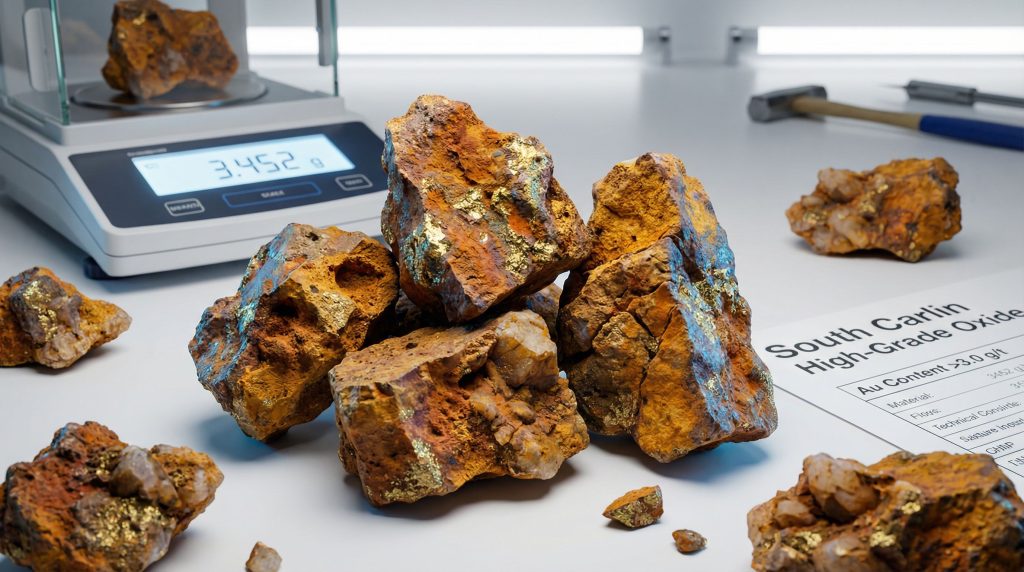
The chemical transformation process involves primary sulfides like pyrite and arsenopyrite oxidizing to iron oxides, hydroxides, and other oxide minerals. This metamorphosis reduces overall ore hardness and significantly improves amenability to heap leaching operations.
Metallurgical Advantages of Oxide Ores
Oxide ore processing offers substantial operational benefits compared to refractory sulfide treatment. The simplified mineralogy eliminates the need for roasting facilities required for sulfide ore processing, creating both capital and operational cost advantages that align with current mining innovation trends.
Processing Method Comparison:
| Ore Type | Recovery Method | Gold Recovery Rate | Capital Requirements |
|---|---|---|---|
| High-grade oxide | Heap leach/CIL | 70-85% | $200-400 million |
| Refractory sulfide | Roast + leach | 85-92% | $400-700 million+ |
| Complex sulfide | Float + roast | 88-95% | $500-800 million+ |
The metallurgical advantages extend beyond initial capital savings. Oxide ore processing typically costs $8-15 per ton of ore processed through heap leaching, compared to $25-40 per ton for mill-based sulfide processing. These cost differentials directly impact project economics and financing attractiveness.
When big ASX news breaks, our subscribers know first
How Do High-Grade Oxide Intercepts Compare to Industry Standards?
Defining High-Grade in Modern Gold Mining Context
Contemporary gold mining economics have refined grade classifications based on processing methodology and economic viability. The threshold for high-grade classification has evolved with rising operational costs and commodity price volatility, particularly as the gold price forecast continues to influence operational thresholds.
Industry Grade Classification Framework:
• Low-grade deposits (below 1.0 g/t): Require large-scale operations and optimal processing efficiency
• Medium-grade deposits (1.0-3.0 g/t): Support multiple processing options and moderate capital requirements
• High-grade deposits (above 3.0 g/t): Enable accelerated payback periods and flexible development approaches
These classifications align with modern break-even economics where operating costs frequently exceed $1,200-$1,400 per ounce for conventional heap leach operations. This cost structure makes lower-grade material economically marginal without significant processing efficiency improvements.
South Carlin Grade Distribution Analysis
The recent exploration results from South Carlin demonstrate grade distributions that position the discovery within Nevada's high-grade oxide category. The systematic drilling campaign revealed mineralized intercepts outside current pit designs, suggesting additional high-grade oxide ore South Carlin zones beyond initial resource calculations.
Comparative analysis with established Carlin Trend operations indicates that South Carlin's oxide zones exhibit grade characteristics consistent with economically robust development scenarios. Historical Carlin Trend discoveries have demonstrated that high-grade oxide zones often occur as satellite bodies adjacent to primary mineralization centers.
Grade Continuity Implications:
The distribution of high-grade intercepts provides insight into resource modelling accuracy and expansion potential. Continuous high-grade zones support simplified mine planning and predictable cash flow generation, while scattered high-grade intercepts may require selective mining techniques to maintain mill feed quality.
What Exploration Techniques Revealed These High-Grade Zones?
Systematic Drilling Campaign Methodology
The 18,000-meter drilling program completed in 2025 represents a focused exploration approach targeting oxide zone delineation. According to official company announcements, this campaign builds upon 57,800 meters of total drilling completed across 266 holes since acquisition, demonstrating systematic geological understanding development.
Modern exploration programs emphasise cost-per-meter optimisation while maintaining geological targeting precision. The drilling methodology integrates multiple technical disciplines:
-
Three-dimensional geological modelling reconstructing primary sulfide bodies and oxidation envelopes
-
Geochemical pathfinding utilising indicator elements in soil and rock samples
-
Structural interpretation recognising fault zones and fracture networks controlling fluid flow
-
Target prioritisation ranking exploration targets by geological prospectivity and economic parameters
Geochemical Indicators for Oxide Ore Bodies
Pathfinder elements in oxidised environments provide critical targeting intelligence for exploration programs. Arsenic, antimony, mercury, selenium, and thallium concentrations in rock and soil samples indicate proximity to gold mineralisation in Carlin-type systems.
Oxidation Markers Include:
• Iron oxide abundance (hematite, goethite) visible in drill core analysis
• Carbonate alteration patterns associated with Carlin-type mineralisation
• Boxwork textures indicating sulfide replacement by oxide minerals
• Quartz liberation features showing enhanced gold accessibility
The integration of these geochemical and textural indicators enables systematic identification of oxide zones with enhanced metallurgical characteristics. Successful targeting requires understanding the relationship between surface geochemical signatures and subsurface mineralisation patterns.
Why Are Oxide Discoveries Critical for Near-Term Production Planning?
Processing Infrastructure Requirements
Oxide ore discoveries fundamentally alter project development timelines and capital allocation strategies. The simplified processing requirements eliminate complex metallurgical infrastructure while maintaining competitive gold recovery rates. Furthermore, these discoveries require careful consideration of mining permitting insights to ensure regulatory compliance.
Oxide ores require significantly less capital investment in processing facilities compared to sulfide ores, making them ideal for early-stage production scenarios with accelerated cash flow generation potential.
Timeline Advantages:
• Permitting duration: Oxide operations typically require 18-24 months for final approvals
• Construction timeline: Simple heap leach facilities achieve operation within 12-18 months
• Environmental compliance: Reduced emissions profile streamlines regulatory approval
• Infrastructure complexity: Lower technical risk in construction and commissioning phases
Development Timeline Acceleration
The South Railroad Project timeline illustrates oxide ore development advantages. With final permitting status reached in January 2026, optimised feasibility study completion scheduled for early Q1 2026, construction commencement planned for mid-2026, and first production targeted for 2028, the project demonstrates compressed development schedules possible with oxide ore processing.
This timeline compares favourably to sulfide operations requiring roasting facilities, which typically extend development periods by 12-18 months due to additional air quality compliance and emissions control infrastructure requirements.
How Does South Carlin's Resource Base Support Long-Term Operations?
Current Resource Inventory Assessment
South Carlin Complex maintains a robust resource foundation supporting extended operational planning. The current inventory demonstrates both established reserves and exploration upside potential across the district-scale land package, particularly as gold and copper exploration continues to evolve industry practices.
| Resource Category | Gold Ounces (Moz) | Confidence Level | Development Status |
|---|---|---|---|
| Proven Reserves | 1.604 | High | Feasibility complete |
| Total Resources | 1.753 | Variable | Ongoing expansion |
| Mine Life Projection | 8 years | Based on 2022 study | Under optimisation |
This resource base positions South Carlin among significant Nevada gold operations while maintaining expansion potential through ongoing exploration activities. The 149,000-ounce differential between total resources and proven reserves indicates opportunities for reserve conversion through additional drilling and metallurgical testing.
District-Scale Potential Evaluation
The Carlin Trend's geological continuity supports district-scale exploration targeting across Orla Mining's extensive land package. Historical production patterns throughout the trend demonstrate that initial discoveries frequently lead to satellite deposit identification and resource expansion.
Exploration Expansion Factors:
• Structural continuity of mineralised corridors extending beyond current resource boundaries
• Geochemical anomalies identified through systematic soil sampling and rock chip analysis
• Analogous geological settings within the broader land package requiring systematic evaluation
• Under-explored depth extensions below current drilling coverage
Regional geological mapping indicates that mineralisation controls extend across multiple prospect areas, suggesting potential for significant resource additions through continued exploration investment.
What Operational Strategies Maximise Oxide Ore Value?
Mine Planning Optimisation for Oxide Zones
Effective oxide ore extraction requires specialised mine planning approaches that recognise the distinct characteristics of oxidised versus sulfide mineralisation. The geological boundary between oxide and sulfide zones creates opportunities for selective mining strategies.
Strategic Considerations:
-
Pit design optimisation accounting for oxide/sulfide transitions and grade distributions
-
Selective mining techniques maintaining ore quality through grade control protocols
-
Waste rock management differentiating oxidised and sulfide waste materials
-
Equipment selection appropriate for oxidised material handling characteristics
Oxide zones typically exhibit different geotechnical properties compared to fresh sulfide rock, influencing slope design parameters and blast fragmentation requirements. These factors directly impact mining costs and operational efficiency.
Processing Flow Sheet Design
Heap leach processing of high-grade oxide ore South Carlin requires specialised infrastructure design optimised for solution chemistry management and gold recovery efficiency. The flowsheet development considers crushed ore size distribution, leaching kinetics, and solution management protocols.
Essential Infrastructure Components:
• Heap leach pad construction with appropriate liner systems (if required by regulation)
• Solution management systems including pregnant leach solution recovery and barren solution recycling
• Gold recovery plant utilising carbon adsorption/desorption or electrowinning technology
• Water management systems incorporating evaporation ponds or treatment facilities
The capital intensity of oxide processing facilities represents 35-50% of total project capital, compared to 50-65% for comparable sulfide operations requiring milling and roasting infrastructure.
The next major ASX story will hit our subscribers first
How Do Market Conditions Affect Oxide Ore Development Decisions?
Gold Price Sensitivity Analysis
Oxide ore development decisions require careful analysis of gold price sensitivity and margin optimisation potential. The simplified processing characteristics create different economic sensitivities compared to more capital-intensive sulfide operations. Moreover, gold market technical analysis plays a crucial role in timing development decisions.
Break-even Economics Framework:
• Variable cost structure: Lower processing costs provide margin protection during commodity price volatility
• Capital recovery period: Reduced initial investment enables faster payback periods
• Operating leverage: High-grade zones amplify margin expansion during favourable gold price environments
• Operational flexibility: Simple processing enables production rate adjustments responding to market conditions
Current gold market dynamics favour oxide ore development due to rising operational costs across the industry and increased investor focus on cash flow generation timelines.
Supply Chain Integration Benefits
Nevada's established mining infrastructure provides significant advantages for oxide ore development projects. The state's skilled workforce availability, established regulatory framework, and existing supplier networks reduce development risks and operational costs.
Infrastructure Advantages:
• Skilled workforce availability from experienced Nevada mining operations
• Established supplier networks providing specialised mining equipment and services
• Transportation infrastructure enabling efficient logistics and material handling
• Regulatory stability through experienced permitting agencies familiar with oxide operations
These factors contribute to more predictable development timelines and operational cost structures compared to greenfield projects in less developed mining jurisdictions.
What Technology Innovations Enhance Oxide Ore Recovery?
Advanced Leaching Technologies
Modern heap leaching operations incorporate technological innovations that optimise gold recovery rates and operational efficiency. Column leaching optimisation techniques enable precise solution chemistry control and improved leaching kinetics.
Technology Integration Areas:
-
Solution chemistry management maintaining optimal pH and cyanide concentrations
-
Irrigation system optimisation ensuring uniform solution distribution across heap surfaces
-
Temperature control systems enhancing leaching reaction rates in appropriate climates
-
Environmental monitoring providing real-time data on solution chemistry and environmental compliance
These technological advances enable oxide operations to achieve recovery rates approaching those of conventional milling operations while maintaining the capital and operational cost advantages of heap leaching.
Automation in Oxide Operations
Automation technologies increasingly support oxide mining operations through remote monitoring capabilities, predictive maintenance applications, and integrated safety systems. These innovations reduce operational costs while improving safety performance and equipment reliability.
Automation Applications:
• Remote monitoring systems tracking heap leach performance and solution chemistry
• Predictive maintenance protocols optimising equipment reliability and maintenance scheduling
• Safety system integration providing comprehensive monitoring and emergency response capabilities
• Data analytics platforms supporting operational optimisation and decision-making processes
The integration of these technologies supports margin enhancement and operational efficiency improvements that further strengthen the economic advantages of high-grade oxide ore South Carlin development.
Future Outlook for South Carlin Oxide Development
Production Timeline Projections
The South Railroad Project development schedule positions oxide ore production within established Nevada gold mining infrastructure. Furthermore, technical reports indicate that the 2028 first production target aligns with current permitting progress and construction planning timelines.
Development Milestones:
• Q1 2026: Optimised feasibility study completion
• Mid-2026: Construction commencement following permit approval
• 2027: Infrastructure development and equipment installation
• 2028: Production ramp-up and operational optimisation
This timeline reflects the accelerated development potential of oxide ore operations compared to more complex sulfide processing requirements.
Exploration Expansion Opportunities
Continued exploration across the South Carlin Complex land package offers potential for additional high-grade oxide ore discoveries. The geological continuity of the Carlin Trend and systematic exploration approach support ongoing target development.
Expansion Strategy Elements:
-
Step-out drilling programmes extending known mineralisation boundaries
-
Regional target prioritisation focusing on analogous geological settings
-
Technology application utilising advanced geophysical and geochemical techniques
-
Depth exploration investigating oxide zone extensions below current drilling coverage
The combination of established resources, ongoing exploration success, and oxide ore processing advantages positions South Carlin for sustained operational development within Nevada's established gold mining framework.
Important Disclaimer: This analysis contains forward-looking statements regarding exploration results, production timelines, and economic projections. Actual results may vary significantly due to geological, technical, economic, and regulatory factors. Mining investments carry inherent risks, and readers should conduct independent due diligence before making investment decisions.
Want to Stay Ahead of Mining Discovery Opportunities?
Discovery Alert's proprietary Discovery IQ model delivers instant notifications on significant ASX mineral discoveries like high-grade oxide finds, transforming complex geological data into actionable investment insights for both short-term traders and long-term investors. Explore how major mineral discoveries can generate substantial market returns and begin your 14-day free trial today to position yourself ahead of the market.