Understanding the pCAM-as-a-Service Partnership Model in Battery Manufacturing
Strategic shifts in battery supply chain management are reshaping how manufacturers approach critical material processing. Traditional vertical integration models face mounting pressure as companies seek specialized partnerships to optimize production efficiency while maintaining quality standards. This transformation particularly impacts precursor cathode active material (pCAM) manufacturing, where pCAM-as-a-service partnership approaches offer compelling alternatives to conventional ownership structures.
Defining Precursor Cathode Active Material Services
Precursor cathode active materials represent a critical component in lithium-ion battery production, typically containing nickel, cobalt, and other specialised elements essential for cathode functionality. These powder-like substances require precise compositional control and manufacturing consistency to meet automotive-grade specifications demanded by battery manufacturers serving electric vehicle and energy storage markets.
The technical specifications for pCAM integration into lithium-ion batteries involve maintaining strict quality parameters throughout the manufacturing process. Material consistency becomes paramount when serving downstream customers across North America and Europe, where battery manufacturers require reliable feedstock meeting evolving performance standards for next-generation battery chemistries.
Quality consistency requirements across manufacturing batches present significant challenges for new market entrants. Established processing facilities utilising proven technology, such as methodologies licensed from Japan-based companies like Kansai Catalyst Co., demonstrate the importance of technical partnerships in achieving the high-consistency pCAM production necessary for competitive market positioning.
Service-Based Manufacturing vs. Traditional Ownership Models
The pCAM-as-a-service toll processing model fundamentally differs from traditional manufacturing approaches by allowing customers to retain ownership of raw materials throughout the transformation process. This arrangement enables battery manufacturers to maintain control over material provenance and sustainability certification while accessing specialised processing capabilities without significant capital investment.
Capital expenditure reduction emerges as a primary driver for battery manufacturers evaluating service partnerships versus facility ownership. Companies can redirect resources from processing infrastructure development toward core competencies while accessing proven manufacturing technologies through established toll processing arrangements.
Risk mitigation through specialised processing partnerships offers additional advantages in fluctuating market conditions. Service providers assume operational risks associated with facility management, regulatory compliance, and technology updates, while customers benefit from flexible capacity access aligned with production requirements and market demand variations.
How Does Toll Processing Transform Battery Supply Chain Economics?
Economic transformation through toll processing fundamentally alters traditional supply chain cost structures and risk allocation models. This shift enables more efficient capital deployment while creating specialised processing nodes that serve multiple customers across diverse market segments.
Revenue Models in pCAM-as-a-Service Agreements
The pCAM-as-a-service partnership business model aligns with downstream customer preferences to secure high-provenance, sustainable critical mineral feedstocks while maintaining processing flexibility. This approach enables customers to purchase battery raw materials independently while accessing specialised upgrading services for conversion to finished pCAM products.
Service providers generate revenue through processing fees rather than material sales, creating predictable income streams tied to production volumes. This model supports long-term planning while allowing pricing adjustments based on processing complexity, material specifications, and market conditions affecting operational costs.
Furthermore, the toll processing framework enables customers to maintain direct relationships with upstream suppliers while accessing midstream processing capabilities. This arrangement particularly benefits companies seeking to establish localised supply chains with transparent material sourcing and environmental responsibility standards.
Customer Material Sourcing Flexibility
Customer-controlled feedstock procurement strategies provide significant advantages in managing supply chain risks and material costs. Companies can establish direct relationships with multiple suppliers, including major mining groups like Glencore and Eurasian Resources Group, while maintaining processing consistency through specialised service providers.
Provenance tracking and sustainability certification requirements become increasingly manageable when customers control material sourcing decisions. This approach enables compliance with evolving environmental standards and regulatory requirements across different jurisdictions while maintaining operational flexibility.
Multi-supplier risk diversification strategies reduce dependence on single-source feedstock arrangements. Companies can adjust sourcing patterns based on market conditions, quality requirements, and cost considerations while maintaining consistent processing capabilities through established service partnerships.
Regional Integration Strategies: Canada's Battery Materials Ecosystem
Canada's emerging battery materials ecosystem demonstrates strategic integration between upstream refining and midstream processing capabilities. Geographic distribution of facilities across provinces creates opportunities for material flow optimisation while supporting regional economic development objectives.
Upstream-Midstream Connection Points
The partnership between Electra Battery Materials' Ontario refinery and Positive Materials' New Brunswick processing facility illustrates horizontal integration across Canada's battery supply chain. Electra's planned production of 6,500 metric tons of battery-grade lithium refinery cobalt sulfate annually by 2027 provides critical feedstock for pCAM manufacturing operations.
Transportation logistics between Ontario and New Brunswick facilities require careful coordination to maintain material quality and optimise delivery schedules. The approximately 1,400-kilometre distance between processing locations necessitates efficient logistics management to support integrated production planning across the supply chain.
Material flow coordination becomes essential when connecting battery-grade cobalt sulfate production with pCAM processing requirements. Quality specifications must align with downstream customer needs while maintaining efficient inventory management across multiple processing stages and geographic locations.
Government Policy Support Mechanisms
Federal and provincial funding allocation demonstrates significant government commitment to domestic battery supply chain development. However, Electra Battery Materials has secured between $82 million and $112 million in combined support from U.S., Canadian, and Ontario government sources for refinery upgrades and expansion projects.
The funding structure reflects multi-jurisdictional cooperation in supporting critical mineral processing capabilities. This approach enables companies to access diverse funding sources while meeting various policy objectives related to supply chain security, environmental responsibility, and economic development in targeted regions.
Indigenous partnership requirements create additional frameworks for community engagement and benefit-sharing arrangements. Positive Materials' partnership with Pabineau and Ugpi'Ganjig First Nations for Project Positive+ demonstrates integration of Indigenous stakeholder involvement in resource processing operations as fundamental to project legitimacy and long-term sustainability.
What Production Capacity Targets Define Market Viability?
Production scaling strategies reveal the economic thresholds necessary for competitive market positioning in North American battery materials processing. Consequently, capacity targets demonstrate phased growth approaches that balance market validation with capital efficiency requirements.
Phase Development Scaling Analysis
| Phase | Timeline | Capacity (metric tons/year) | Market Positioning |
|---|---|---|---|
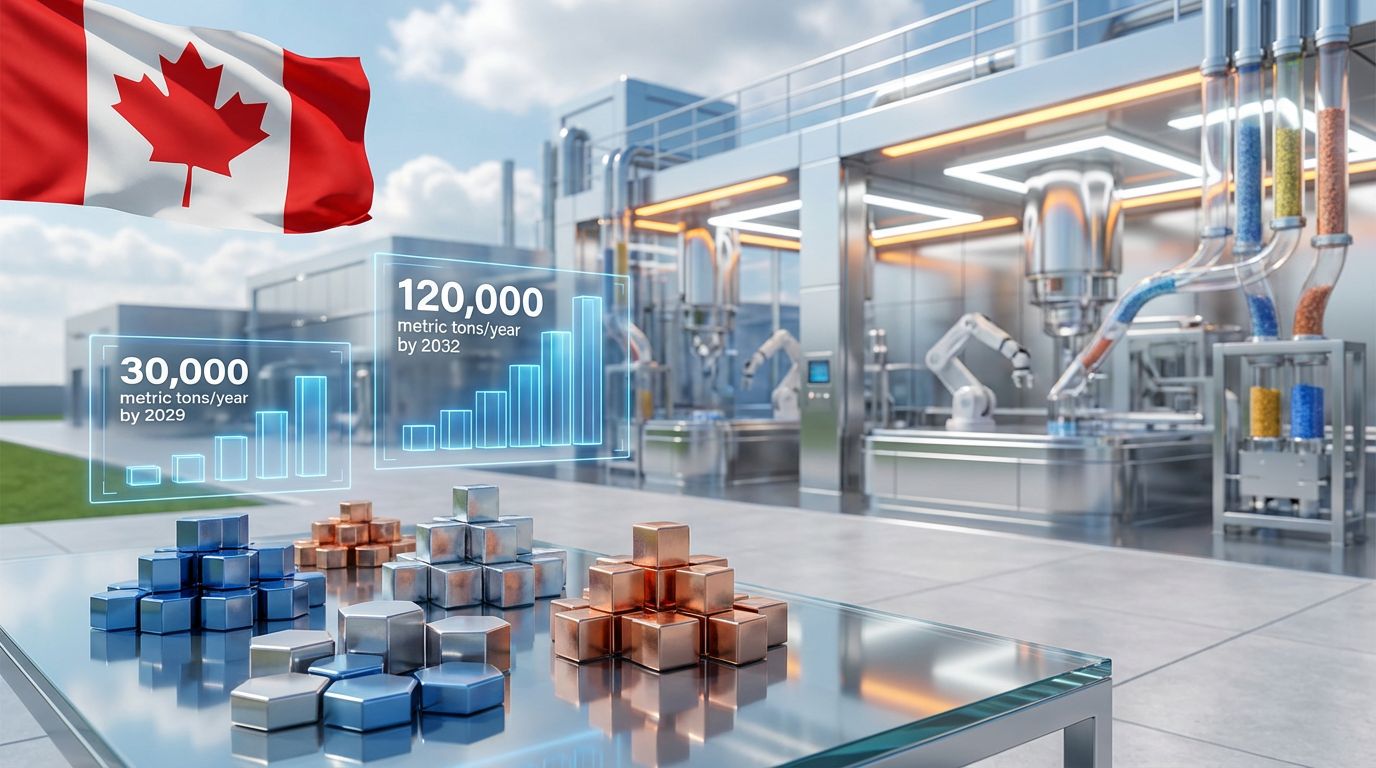
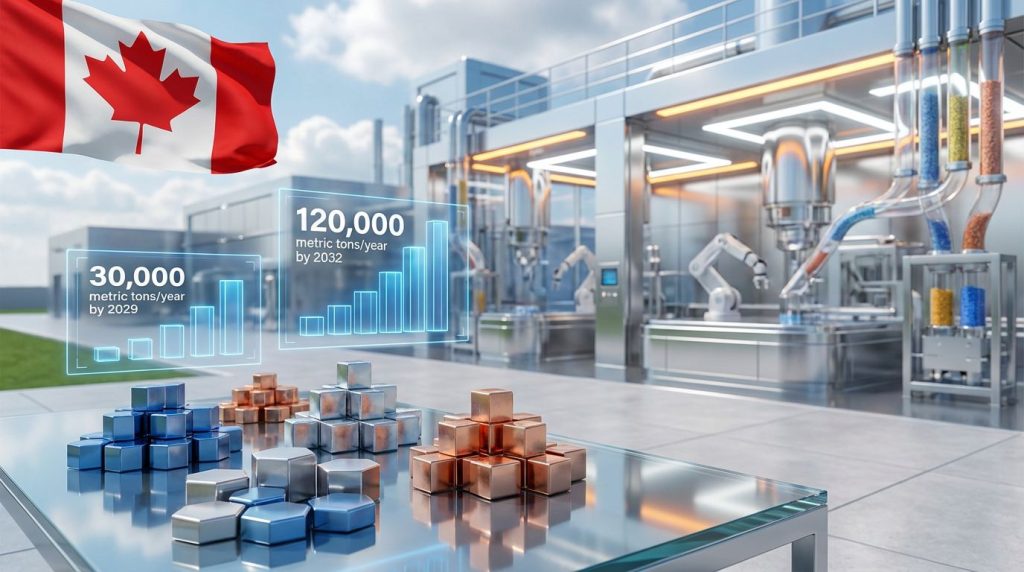
| Phase 1 | 2029 | 30,000 | Regional market establishment |
| Phase 2 | ~2032 | 120,000 | Continental supply significance |
The four-fold capacity expansion from Phase 1 to Phase 2 operations reflects anticipated market growth and customer adoption rates for pCAM-as-a-service partnership models. This scaling approach enables market validation at initial capacity levels before committing to full-scale production infrastructure investments.
Timeline coordination between different supply chain participants becomes critical for successful capacity utilisation. Electra's 6,500 metric tons of cobalt sulfate production by 2027 provides established feedstock availability before Positive Materials' Phase 1 capacity targets commence in 2029.
Market share potential increases substantially between operational phases, with Phase 2 capacity approaching levels necessary for significant North American market participation. This progression supports long-term strategic positioning while enabling gradual customer base expansion and operational optimisation.
Technology Licensing and Manufacturing Standards
Japanese processing technology integration through Kansai Catalyst Co. licensing provides proven manufacturing methodologies for achieving high-consistency pCAM production. This technology partnership enables quality control protocols meeting automotive-grade material specifications required by major battery manufacturers.
Manufacturing standards must accommodate evolving customer requirements across North America and Europe as battery chemistries advance and performance specifications change. For instance, flexible processing capabilities become essential for maintaining competitiveness in rapidly developing markets.
Environmental compliance frameworks require continuous adaptation to changing regulatory requirements across multiple jurisdictions. Processing facilities must meet increasingly stringent environmental standards while maintaining operational efficiency and cost competitiveness against international suppliers.
Which Market Forces Drive pCAM Partnership Demand?
Market dynamics driving pCAM partnership adoption reflect fundamental shifts in battery metals investment strategy and risk management approaches. Companies increasingly prioritise supply chain localisation and environmental responsibility while managing cost pressures and quality requirements.
North American Battery Manufacturing Growth Projections
Battery manufacturer commitments demonstrate significant market demand for localised pCAM processing capabilities. LG Energy Solution's offtake agreement with Electra Battery Materials indicates established customer relationships supporting integrated supply chain development across multiple processing stages.
Electric vehicle production forecasts through 2030 suggest substantial growth in battery material requirements, creating opportunities for service-based processing models that offer flexibility and scalability advantages over traditional manufacturing approaches.
Energy storage system deployment requirements add additional demand drivers beyond automotive applications. Grid-scale storage projects require large-volume battery production, supporting demand for efficient pCAM processing capabilities serving diverse end-use applications.
Competitive Positioning Against Asian Suppliers
North American pCAM processing addresses identified weaknesses in regional battery supply chains while offering advantages in delivery timelines, sustainability certification, and supply chain transparency compared to overseas suppliers.
Cost structure competitiveness requires continuous optimisation through operational efficiency improvements, technology advancement, and economies of scale achievement. Service-based models enable shared cost structures across multiple customers, potentially improving overall competitiveness.
Sustainability certification premiums provide competitive advantages for companies prioritising environmental responsibility and supply chain transparency. Domestic processing capabilities enable better environmental impact monitoring and compliance with evolving regulatory standards.
Risk Assessment Framework for pCAM Service Partnerships
Comprehensive risk evaluation encompasses technical, market, and operational factors affecting pCAM-as-a-service partnership viability. Understanding these risk categories enables better strategic planning and mitigation strategy development.
Material Quality and Consistency Challenges
Feedstock variability management requires robust quality control protocols and supplier relationship management. Processing facilities must accommodate different material grades and compositions while maintaining consistent output quality meeting customer specifications.
Customer specification adaptation demands flexible processing capabilities and quality assurance systems. As battery recycling breakthrough technologies evolve and performance requirements change, processing facilities must adapt quickly to maintain customer relationships and competitive positioning.
Quality assurance testing methodologies become increasingly sophisticated as automotive-grade specifications demand higher precision and reliability standards. Investment in testing equipment and personnel training represents ongoing operational requirements for maintaining market competitiveness.
Market Demand Volatility Considerations
Electric vehicle adoption rate dependencies create uncertainty around demand projections and capacity utilisation planning. Processing facilities must balance capacity investments with market demand uncertainty while maintaining operational flexibility.
Battery chemistry evolution impacts affect long-term demand patterns for specific pCAM compositions. Service providers must monitor technology developments and maintain processing flexibility to accommodate changing customer requirements and market preferences.
Geopolitical supply chain disruption scenarios require contingency planning and supply source diversification strategies. Companies must balance supply chain security with cost optimisation while maintaining operational continuity across different market conditions.
Future Outlook: Scaling pCAM-as-a-Service Beyond 2030
Long-term strategic positioning in pCAM processing requires anticipating technology developments, market evolution, and competitive landscape changes. Service providers must balance current operational requirements with future capacity and capability needs.
Technology Evolution and Capacity Expansion
Next-generation cathode chemistry requirements will influence processing technology investments and facility design considerations. Companies must maintain processing flexibility while achieving economies of scale necessary for competitive cost structures.
Automated processing system implementations offer potential for operational efficiency improvements and quality consistency enhancement. Technology investments must balance cost considerations with competitive advantages in processing capability and customer service.
Cross-border partnership expansion opportunities emerge as North American battery supply chains mature and regional integration deepens. Service providers can leverage established capabilities to serve broader geographic markets while maintaining operational efficiency.
Investment Return Projections and Market Positioning
Revenue growth trajectories depend on successful capacity utilisation and customer relationship development across multiple market segments. Phased expansion approaches enable risk management while capturing market opportunities as they develop.
Strategic acquisition potential increases as integrated battery supply chain players seek to control critical processing capabilities. Service providers with established operations and customer relationships represent attractive acquisition targets for companies pursuing vertical integration strategies.
Long-term competitive advantages in North American markets require continuous investment in processing capabilities, customer relationship management, and operational efficiency improvements. Companies must balance current profitability with strategic positioning for future market opportunities through industry innovation trends.
Investment Disclaimer: This analysis contains forward-looking statements and projections based on current market conditions and announced company plans. Actual results may differ significantly due to market volatility, regulatory changes, technology developments, and other factors. Readers should conduct independent research and consult financial advisors before making investment decisions related to battery materials processing companies or technologies discussed in this article.
Want to Capitalise on the Battery Materials Revolution?
Discovery Alert's proprietary Discovery IQ model delivers real-time alerts on significant ASX mineral discoveries in critical battery materials, instantly empowering subscribers to identify actionable opportunities ahead of the broader market. Begin your 30-day free trial today and secure your market-leading advantage in the rapidly evolving critical minerals sector.
https://discoveryalert.com.au/