July 6, 2026

Why the Monetary System's Cracks Are Widening Faster Than Markets Acknowledge
Commodity bull markets have a peculiar habit of remaining invisible to the majority of investors right up until the moment they become undeniable. The structural forces driving precious metals through multi-decade cycles rarely announce themselves through a single data point. Instead, they accumulate quietly beneath the surface, compressing like a coiled spring until the release becomes violent and self-reinforcing. Understanding Peter Schiff silver to $200 and dollar collapse predictions requires stepping back from short-term rate speculation and examining the deeper architecture of sovereign debt, monetary credibility, and reserve currency dynamics reshaping the global financial order.
When big ASX news breaks, our subscribers know first
Why Precious Metals Are Flashing Warning Signals the Mainstream Is Ignoring
The Macro Divergence Between Asset Prices and Structural Economic Reality
Gold hovering near $4,000 per ounce and silver consolidating above $60 per ounce are not expressions of speculative froth. They are market prices responding to genuine structural dislocations in sovereign debt architecture, fiat currency credibility, and the long-term viability of dollar-denominated reserve systems. The conventional financial media narrative tends to reduce precious metals movements to Federal Reserve rate expectations, framing gold as a simple inverse trade on interest rates.
This interpretation, while superficially plausible, misses the deeper and far more durable driver at work. The monetary debasement thesis does not rise or fall on any single Fed meeting. It is built on the mathematical trajectory of sovereign obligations, the accelerating erosion of purchasing power, and the directional shift in how central banks globally are choosing to hold their reserves.
What the Gold-Silver Ratio Reveals About the Current Market Phase
One of the most revealing technical and fundamental indicators in the precious metals complex is the gold-silver ratio, which measures how many ounces of silver are required to purchase one ounce of gold. Historically, this ratio has averaged between 40:1 and 60:1 over long periods. Prior to silver's explosive recent move, the gold-silver ratio analysis reached extreme levels exceeding 100:1, levels rarely sustained for extended periods without a subsequent and often dramatic compression.
When the gold-silver ratio reaches historically extreme territory, the reversion phase has consistently delivered outsized silver outperformance relative to gold. The structural bull case for silver is substantially grounded in this ratio compression dynamic, which has repeated across multiple historical cycles.
Silver's move from approximately $30 to over $120 in a compressed timeframe reflected exactly this dynamic. The subsequent pullback was entirely consistent with how markets correct following parabolic moves. With silver now consolidating above $60, former overhead resistance at the $50 level that capped silver in 1980 and again in 2011 appears to be transitioning into structural support. This technical behaviour is characteristic of a genuine bull market in its early stages.
Is Silver's Path to $200 an Ounce Realistic? Breaking Down the Price Thesis
A Historical Baseline: From $4 to $60 and What the Long-Term Chart Actually Shows
Context is everything when evaluating whether a price target is ambitious or achievable. Silver traded near $4 per ounce in the late 1990s. At current prices above $60, the metal has already delivered approximately a 15-fold return over roughly two decades. The move from $60 to a $200 target represents a 3.3-times increase from the current base, a substantially smaller percentage gain than what silver has already achieved from its prior starting point.
Framing a $200 silver price as extreme fundamentally misunderstands the asymmetric nature of commodity bull markets. Gold itself has delivered approximately a 13-fold return from its sub-$300 levels in the late 1990s to its current position near $4,000. Furthermore, Peter Schiff has outlined these dynamics in detail, noting that the percentage mathematics of the forward case are, if anything, more conservative than what has already been achieved.
The Two-Engine Model: Monetary Debasement and Industrial Demand
What makes silver's structural bull case particularly compelling is that it rests on two independent demand drivers operating simultaneously rather than requiring a single thesis to play out perfectly.
Engine 1: The Monetary Driver
Dollar purchasing power erosion means that more nominal dollars are required to acquire fixed quantities of real assets over time. Silver, viewed through this lens, is not rising in absolute terms so much as the dollar is declining in relative value. The same dynamic applies to all physical commodities, but silver carries a monetary premium that pure industrial metals like copper do not.
Engine 2: The Industrial Driver
Electrification infrastructure, solar energy expansion, and grid-scale power systems are generating structural demand for silver that is entirely independent of monetary dynamics. Furthermore, silver's dual role as both a precious and industrial metal makes it irreplaceable in a range of high-technology applications. Copper prices have reached record highs driven purely by industrial demand with no monetary premium attached. Silver benefits from both vectors simultaneously, a combination that copper cannot replicate.
Silver Price Forecast Summary
| Forecast Scenario | Price Target | Indicative Timeline | Primary Driver |
|---|---|---|---|
| Near-Term Realistic Target | $100/oz | ~2026 | Dollar depreciation + industrial demand |
| Long-Term Bull Case | $200/oz | 3 to 5 years | Monetary debasement + supply deficit |
| Gold Trajectory (Baseline) | $5,000/oz | ~2026 | Reserve asset repricing |
| Gold Trajectory (Extended) | $10,000/oz | Long-term | Full dollar reserve status erosion |
Disclaimer: Price forecasts are speculative in nature and represent analytical projections based on macro-structural arguments, not guaranteed financial outcomes. Past performance of precious metals is not indicative of future results. Investors should seek independent financial advice before making investment decisions.
Why Silver Offers Leveraged Exposure to Gold's Upside
Silver's smaller market size relative to gold means that capital flows into the silver market have a disproportionate price impact. When gold's bull market becomes well-established and broadly recognised, investors seeking amplified percentage exposure have historically rotated into silver. If gold advances toward $5,000 and beyond, silver's proportional gains are structurally expected to exceed gold's on a percentage basis. This leverage dynamic is not speculative; it is a well-documented feature of how the gold-silver relationship functions during bull market phases.
The U.S. Dollar's Structural Vulnerability: Why Reserve Status Is Under Threat
Understanding the Debt Spiral Redefining Dollar Risk
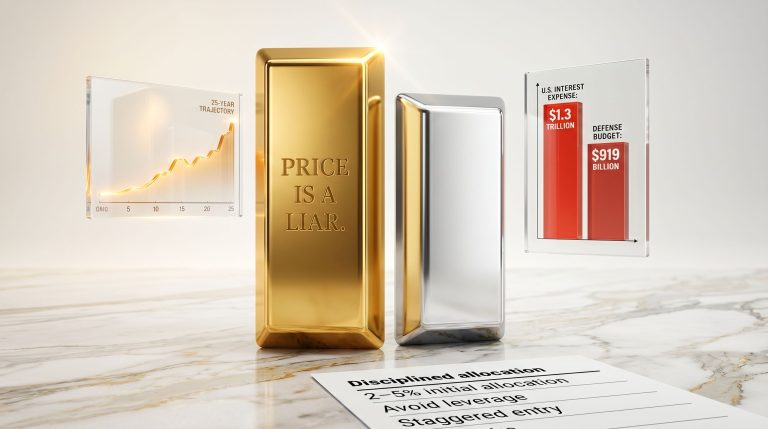
The arithmetic of the U.S. fiscal position is not ambiguous. National debt is approaching $40 trillion, with annual budget deficits running at approximately $3 trillion per year on an unofficial basis. The interest servicing cost on that accumulated debt is approaching $2 trillion annually, positioning debt interest as one of the fastest-growing and most structurally entrenched line items in the federal budget.
At current trajectory, interest payments alone will progressively crowd out productive government expenditure, creating a self-reinforcing fiscal deterioration cycle. The mathematical reality is that this path is unsustainable regardless of which political party controls the legislature or the executive. Consequently, the structure of the debt, combined with the trajectory of deficit spending, creates conditions where some form of effective default becomes increasingly likely.
Three Paths to Effective Default: A Structural Scenario Framework
| Default Pathway | Mechanism | Probability Assessment | Impact on Dollar |
|---|---|---|---|
| Outright Default | Government fails to service debt obligations | Low (politically untenable) | Catastrophic |
| Soft Restructuring | Maturity extensions, coupon reductions | Moderate | Severe confidence erosion |
| Inflationary Monetisation | Mass money printing to service obligations | High (historically precedented) | Gradual but sustained debasement |
Bond holders face losses under all three default pathways. The distinction is not whether losses occur, but through which mechanism they are delivered. Inflationary monetisation is historically the path of least political resistance because it distributes losses gradually and diffusely rather than concentrating them visibly on identifiable creditors.
The Yield Curve Signal the Market Missed
A particularly revealing market signal emerged when the Federal Reserve began cutting rates following its 2021 to 2023 hiking cycle. Rather than declining as conventional monetary theory would predict, long-term bond yields rose. This inversion of the expected rate-cut response signals that the Federal Reserve has materially lost control of the long end of the yield curve. Bond market participants are increasingly incorporating sovereign credit risk into their pricing, reflecting expectations of losses through one of the three default pathways outlined above.
The money supply continued to expand even as the Fed's public communications emphasised inflation-fighting resolve. Task forces were formed to study fiscal problems rather than implement solutions, a well-documented political deflection mechanism that substitutes the appearance of action for substantive policy change.
Is the Federal Reserve Trapped? Analysing the Policy Credibility Crisis
The Gap Between Rhetoric and Action in Monetary Policy
Central bank communication has consistently signalled inflation-fighting commitment while the structural conditions underpinning monetary accommodation have remained on trajectories inconsistent with genuine tightening. The political economy dynamics that govern central bank behaviour make authentic fiscal restraint structurally unlikely. When the choice is between acknowledging economic pain explicitly and distributing that pain through inflation invisibly, political systems have historically defaulted to the latter.
The Federal Reserve's credibility problem is compounded by the recognition that incremental rate adjustments may be insufficient to restore price stability without triggering the kind of economic contraction that would generate irresistible political pressure to reverse course. This is the structural trap that has characterised central bank policy for much of the post-2008 period.
Why Higher for Longer May Be a Temporary Narrative Rather Than a Durable Commitment
Weak economic conditions and labour market softness create political pressure for rate reductions that directly conflicts with price stability mandates. The pattern of falling behind the inflation curve and then implementing adjustments too modest to restore credibility is a well-documented feature of modern central banking during periods of fiscal dominance. When fiscal deficits are large enough to require monetary accommodation, the independence of monetary policy becomes more theoretical than operational.
Central Bank De-Dollarisation: How Fast Is the Shift Actually Happening?
From Dollar Reserves to Gold Reserves: The Structural Rotation Underway
Central banks across multiple jurisdictions are systematically reducing dollar-denominated reserve holdings and increasing gold allocations. This represents a meaningful reversal of the post-Bretton Woods reserve architecture that has dominated global monetary systems since 1971. The dollar became the global reserve asset because it was backed by gold and redeemable for gold on demand.
When convertibility was suspended in 1971, the world transitioned to a fiat reserve system, a system that is now showing structural strain after more than five decades. The current return to gold by central banks is not a novel development but rather a reversion toward the pre-dollar reserve framework that functioned for centuries before the dollar assumed its current role.
The SWIFT System and the Geopolitical Acceleration of De-Dollarisation
Geopolitical developments have accelerated foreign nation interest in settlement alternatives that bypass dollar-denominated infrastructure. For emerging market central banks, the strategic calculus is straightforward: holding dollar reserves simultaneously exposes them to confiscation risk through sanctions and purchasing power erosion through monetary debasement. The directional shift away from dollar reserves and toward gold is structurally confirmed by sustained central bank purchasing data, even if the pace of that shift remains a subject of analytical debate.
What Americans Stand to Lose If Reserve Status Erodes
The dollar's reserve status functions as a structural subsidy to the American standard of living. It enables persistent trade deficits and budget deficits that would be arithmetically unsustainable for any nation issuing a non-reserve currency. Loss of reserve status would eliminate this subsidy entirely, requiring a fundamental adjustment in consumption patterns, import volumes, and government expenditure. This dimension of the de-dollarisation debate receives remarkably little coverage in mainstream financial media, representing a significant gap in public financial literacy.
The next major ASX story will hit our subscribers first
Why Are Precious Metals Mining Equities Lagging the Metal Price Rally?
The Analyst Consensus Problem: Structural Undervaluation in Mining Stocks
One of the more puzzling features of the current precious metals bull market is the failure of gold and silver mining equities to fully reflect the dramatic increase in underlying metal prices. The explanation is rooted in how equity analysts construct their valuation models. Historically, analysts have applied conservative long-term metal price assumptions to mining company earnings forecasts, reflecting institutional scepticism about whether elevated commodity prices are sustainable.
When analysts price future earnings using gold assumptions of $1,500 to $2,000 per ounce while spot prices trade near $4,000, the resulting valuations systematically and substantially understate intrinsic value. However, undervalued mining stocks represent a structural disconnect between commodity price reality and equity price reality that has persisted throughout the rally.
The Investment Timing Argument for Mining Equities
The window between metal price confirmation and analyst consensus revision represents a potential asymmetric opportunity for investors who have accepted the structural precious metals thesis. The repricing catalyst arrives when analyst consensus shifts to incorporate structurally higher metal prices as the baseline assumption rather than an outlier scenario. The critical risk factors that distinguish outperformers from underperformers remain:
- Operational execution quality and management track record
- Cost inflation and labour availability in mining jurisdictions
- Geopolitical risk in the countries where mining operations are located
- Reserve grade quality and mine life duration
- Capital allocation discipline and hedging strategy
War, Deficits, and Inflation: How Geopolitical Conflict Becomes a Monetary Event
The Fiscal Mechanism Connecting Military Spending to Currency Debasement
Modern governments do not finance military operations through contemporaneous taxation. They finance them through debt issuance and monetary expansion. Each incremental military commitment adds to the deficit trajectory, compounds the existing debt burden, and accelerates the conditions that drive sustained precious metals demand.
The Iran conflict example is instructive as a case study in war-driven market dynamics. Precious metals rose in anticipation of conflict, a classic buy-the-rumour dynamic, before profit-taking emerged when hostilities commenced. The broader principle, that any geopolitical event increasing government spending without corresponding revenue increases is structurally supportive of hard asset prices, is independent of any specific conflict's outcome.
How Should Investors Evaluate the Too Early Criticism of the Precious Metals Thesis?
Reframing the Opportunity Cost Debate: Performance Across Asset Classes
The criticism most frequently levelled at long-term precious metals advocates is not that their thesis is wrong but that investors who acted on it too early paid a significant opportunity cost. Gold purchased at under $300 per ounce in the late 1990s has delivered approximately a 13-fold return to current prices near $4,000. Silver purchased at $4 per ounce over the same period has delivered approximately a 15-fold return at current prices above $60.
Both metals have outperformed the S&P 500 index on a total return basis over this period, a fact that substantially weakens the opportunity cost argument when measured against broad market benchmarks rather than against cherry-picked individual technology positions. Moreover, Yahoo Finance has reported on Peter Schiff silver to $200 and dollar collapse arguments extensively, noting the directional confirmation across measurable variables.
The Distinction Between Being Early and Being Wrong
| Assessment Criteria | Too Early Interpretation | Structural Thesis Interpretation |
|---|---|---|
| Metal price performance | Underperformed vs. peak technology stocks | Outperformed broad S&P 500 index |
| Dollar purchasing power | Dollar has weakened over 20+ years | Thesis directionally confirmed |
| Debt trajectory | Debt has grown from ~$10T to ~$40T | Structural deterioration confirmed |
| Fed credibility | Multiple policy reversals observed | Credibility erosion thesis confirmed |
| Bond market real returns | Negative after inflation over extended periods | Thesis directionally confirmed |
The relevant distinction is between being early on timing and being wrong on direction. The structural thesis that dollar purchasing power would erode, that sovereign debt would grow unsustainably, and that the Fed would ultimately prioritise accommodation over genuine price stability has been directionally confirmed across multiple measurable variables.
The Poker Chip Principle: Why Paper Gains in Asset Bubbles May Not Be Preserved
A useful analytical framework for evaluating the opportunity cost argument is what might be called the poker chip principle. Accumulating nominal gains in a market environment and subsequently surrendering them during a correction produces the same terminal outcome as never having realised those gains. The relevant metric for long-term financial planning is not peak portfolio value but sustainable, inflation-adjusted wealth preservation over full market cycles.
High-dividend-paying international equities represent one structural alternative that has been advocated as a substitute for U.S. fixed income exposure. On a real return basis, international dividend income has substantially outperformed U.S. bond market returns over extended periods, particularly when inflation is factored into the calculation of purchasing power preservation.
FAQ: Peter Schiff's Silver and Dollar Collapse Predictions Explained
What is Peter Schiff's silver price prediction?
Peter Schiff has articulated a near-term silver target of $100 per ounce by approximately 2026, characterising this as achievable given current monetary and industrial dynamics. His long-term target of $200 per ounce operates on a 3 to 5 year horizon, contingent on sustained dollar debasement and continued industrial demand growth from electrification and power infrastructure. Critically, Schiff frames the $200 target not as silver appreciating in absolute terms but as the dollar declining in relative purchasing power.
Why does Peter Schiff believe the U.S. dollar will collapse?
The structural argument rests on four interconnected pillars:
- National debt approaching $40 trillion with no credible fiscal consolidation mechanism in place
- Annual interest servicing costs approaching $2 trillion, structurally unsustainable relative to tax revenue
- Loss of Fed yield curve control, evidenced by rising long-term rates despite rate cuts
- Accelerating central bank de-dollarisation into gold reserves globally, confirming a directional shift in reserve asset preferences
Is the dollar collapse prediction realistic or alarmist?
Mainstream economists typically argue that dollar reserve status is durable due to the absence of a credible fiat currency alternative. The structural counter-argument is that the alternative to the dollar as a reserve asset is not another fiat currency but gold, which served as the primary reserve asset before the dollar and remains the asset that central banks are actively accumulating in sustained quantities. The debate is not binary between full collapse and no change, but rather concerns the pace and mechanism of dollar purchasing power erosion.
How does war affect gold and silver prices?
Two channels are relevant. The direct channel, conflict-driven uncertainty increasing safe-haven demand, tends to produce shorter-term price effects. The indirect channel is structurally more significant: governments finance military operations through debt and monetary expansion, which increases inflation expectations and reduces currency purchasing power over time. This indirect mechanism is the primary driver of sustained precious metals appreciation during and after periods of extended military engagement.
Why haven't gold and silver mining stocks kept pace with metal prices?
Analyst valuation models have systematically applied conservative long-term metal price assumptions, resulting in valuations that understate intrinsic value at current spot prices. The repricing catalyst will be consensus recognition that elevated metal prices are structural rather than cyclical. Mining stocks represent a leveraged play on metal prices because rising commodity revenues expand operating margins faster than costs increase, delivering amplified earnings growth once analyst consensus catches up to the structural price reality.
Key Takeaways: The Structural Case for Precious Metals in a Deteriorating Dollar Environment
- Silver's path toward $200 per ounce rests on two independent demand drivers, monetary debasement and industrial electrification demand, that reinforce rather than substitute for each other
- The U.S. fiscal position is mathematically unsustainable at current debt and deficit trajectories, with inflationary monetisation representing the historically most probable resolution pathway
- Central bank de-dollarisation into gold is a confirmed directional trend supported by sustained purchasing data, with the debate centring on pace rather than direction
- Mining equities may represent an asymmetric opportunity if analyst consensus reprices to reflect structurally higher metal price assumptions as a durable baseline
- The too-early criticism of the precious metals thesis is substantially weakened when performance is measured against broad market indices rather than selective individual outperformers
- Geopolitical conflict functions as a monetary event through deficit-financed military spending, making any escalation in global tensions structurally supportive of hard asset prices over the medium to long term
- Americans' standard of living is more dependent on dollar reserve status than is widely appreciated, and the erosion of that status would require a fundamental economic adjustment with direct consequences for consumption and living standards
This article presents macro-structural analysis and includes speculative price forecasts and scenario projections. Nothing in this article constitutes financial advice. All investment decisions should be made in consultation with a qualified financial adviser, taking into account individual circumstances and risk tolerance.
Want to Identify the Next Major Mineral Discovery Before the Market Does?
While the structural case for precious metals strengthens, Discovery Alert's proprietary Discovery IQ model scans ASX announcements in real time, instantly identifying significant mineral discoveries across gold, silver, and over 30 other commodities — explore historic discoveries that have delivered extraordinary returns and begin your 14-day free trial today to position yourself ahead of the broader market.