August 22, 2026
When Supply Concentration Meets Structural Demand Shifts: Reading the 2025–2026 PGM Market
Few commodities reveal the complexity of global industrial systems quite like platinum group metals. These six rare elements, extracted predominantly from a narrow band of geological formations in southern Africa and Russia, sit at the intersection of legacy automotive manufacturing, emerging clean energy infrastructure, and cutting-edge electronics. The Johnson Matthey PGM market report platinum deficit palladium rhodium surpluses analysis provides the most comprehensive publicly available view of these intersecting forces, and its findings for 2025–2026 reveal a market undergoing profound structural divergence.
Understanding why some of these metals face persistent supply shortfalls while others teeter on the edge of surplus requires examining not just mine output statistics, but the tectonic shifts reshaping global transportation, energy, and technology demand simultaneously.
When big ASX news breaks, our subscribers know first
The Rarest of Market Conditions: Six Metals in Deficit at Once
Before examining where the PGM market is heading, it is worth pausing on where it has been. According to Johnson Matthey's analysis, 2025 marked an unusually rare episode in commodity market history: all six platinum group metals recorded supply deficits simultaneously. This convergence was not driven by a single shock but by the compounding of three independent pressures operating in parallel.
Primary mine supply was constrained across both major producing regions, South Africa and Russia. The secondary supply channel, specifically autocatalyst recycling, remained below trend following a pronounced cyclical trough in 2023 and 2024. Furthermore, industrial consumption across multiple end-use sectors, from petrochemicals to data storage to hydrogen technology, proved more resilient than market participants had anticipated heading into the year.
The result was an environment where the buffer provided by above-ground inventories was called upon across the entire PGM complex. This is a condition that historically puts upward pressure on prices and accelerates strategic purchasing decisions by industrial consumers.
The Supply Architecture: Why South Africa and Russia Hold the Balance of Power
South Africa's Structural Decline
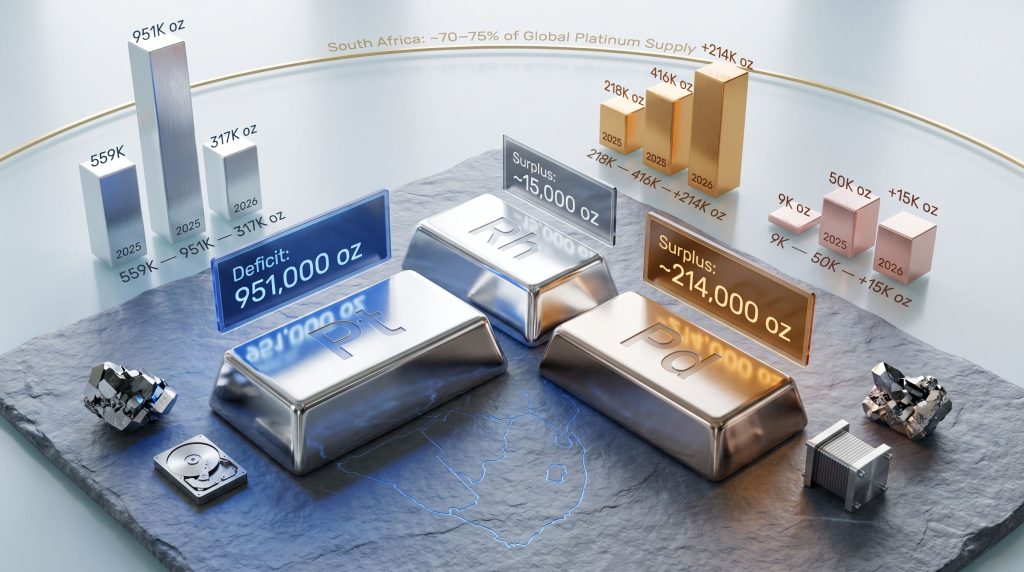
No analysis of PGM supply can avoid confronting the uncomfortable arithmetic of South African mine output. The country accounts for approximately 70% to 75% of global platinum mine supply, making its operational health the single most consequential variable in any supply-demand model. However, output has been on a long-term downward trajectory that shows no signs of reversing.
At its production peak in 2006, South Africa generated approximately 5.3 million ounces of platinum annually. By the mid-2020s, that figure had fallen to approximately 3.9 million ounces, a structural contraction of roughly 26% over two decades. This decline reflects a combination of factors that are geological, economic, and operational in nature: deeper, more expensive ore bodies, sustained cost pressures from energy and labour, load-shedding impacts on operational continuity, and deliberate rationalisation of marginal assets by major producers including Sibanye-Stillwater, Impala Platinum, and Anglo American Platinum.
The PGM supply constraints from South Africa are further compounded by Johnson Matthey's 2026 forecast, which anticipates a modest further decline, driven in part by a technical accounting factor: the prior two years had benefited from the release of work-in-progress (WIP) inventories, which temporarily inflated reported output figures. As that WIP benefit diminishes, reported supply numbers will compress even if underlying mining activity holds steady.
WIP inventory releases represent a timing effect rather than genuine production growth. When mines process ore that was previously stockpiled, it can temporarily boost reported output without reflecting new mining capacity. As these buffers are exhausted, the underlying structural supply trend reasserts itself.
Russia's Changing Mining Mix and Palladium Implications
Russia is the world's dominant palladium producer, with Norilsk Nickel historically supplying a significant share of global primary palladium output. The Johnson Matthey report indicates that Russian PGM production is expected to contract sharply in 2026, driven by changes in the mining mix at Norilsk's core operations.
This development carries an important nuance for palladium market analysis. Even as demand-side forces push palladium toward a surplus position, the Russian supply contraction partially offsets that surplus pressure. The net result is a surplus that looks modest on paper but remains highly sensitive to any shift in either the demand trajectory or Russia's operational decisions. Consequently, the platinum and palladium dynamics at play here are considerably more complex than headline figures suggest.
North America: Platinum Up, Palladium Down
North American PGM supply presents a bifurcated outlook for 2026. Platinum production from the region is expected to increase slightly, providing a marginal positive to global supply. In contrast, palladium supply from North America is projected to fall as Canada's Lac des Îles mine, operated by North American Palladium, approaches the end of its productive life.
The retirement of Lac des Îles removes a meaningful volume of primary palladium from the global supply pool and illustrates a broader dynamic facing the industry: natural depletion is steadily eliminating established production sources faster than new projects can reach commercial output.
Secondary Supply: The Recycling Recovery
Autocatalyst recycling represents the most dynamic swing variable in the 2026 PGM supply picture. Johnson Matthey forecasts double-digit percentage growth in autocatalyst recycling volumes in 2026, following several years of subdued secondary supply recovery. This growth is expected to materially boost the supply of platinum, palladium, and rhodium from scrap channels.
A notable regional contributor to this recovery is China, where vehicle trade-in incentive programmes implemented by the government have stimulated domestic scrap collection and processing activity. This creates a concentrated boost to secondary PGM supply from the world's largest automotive market, partially compensating for the ongoing constraints in primary mine supply.
A Metal-by-Metal Analysis: Diverging Trajectories Within the PGM Complex
Platinum: Persistent Deficit With a Diversifying Demand Base
| Year | Market Balance | Deficit Volume (oz) |
|---|---|---|
| 2024 | Deficit | 559,000 |
| 2025 | Deficit | 951,000 |
| 2026 (Forecast) | Deficit | ~317,000 |
Platinum's deficit widened sharply from 559,000 oz in 2024 to 951,000 oz in 2025, a 70% increase year-over-year that reflects the compounding of supply erosion and robust industrial demand. The projected narrowing to approximately 317,000 oz in 2026 is primarily a function of the anticipated recycling recovery and some softening in automotive demand, rather than any meaningful improvement in primary mine supply.
What distinguishes platinum from its PGM peers is the breadth of its industrial demand base. While palladium and rhodium are heavily concentrated in gasoline-engine autocatalysts, platinum serves a far wider range of applications:
- Petrochemical refining: Platinum catalysts are essential in processes including reforming and dehydrogenation
- Glass manufacturing: Used in high-temperature forming equipment for specialty glass and fibre optics
- Electronics: Applied in hard disks, sensors, and thermocouples
- Hydrogen fuel cells: A critical component in proton exchange membrane fuel cell vehicles
- Jewellery: A significant demand category, though expected to soften in 2026
This demand diversification means platinum retains structural support even as battery electric vehicle adoption reduces its autocatalyst role. The energy transition demand for hydrogen fuel cell vehicles and green hydrogen infrastructure, furthermore, adds a demand vector that did not exist at meaningful scale during platinum's previous deficit cycles.
The World Platinum Investment Council has indicated that above-ground platinum stocks have declined to below five months of forward demand coverage, a threshold that market analysts historically associate with conditions preceding price appreciation.
Palladium: The Deficit-to-Surplus Transition
| Year | Market Balance | Volume (oz) |
|---|---|---|
| 2024 | Deficit | 218,000 |
| 2025 | Deficit | 416,000 |
| 2026 (Forecast) | Surplus | ~214,000 |
Palladium's transition from a 416,000 oz deficit in 2025 to a projected surplus of approximately 214,000 oz in 2026 represents the most dramatic directional shift within the PGM complex. This reversal is primarily demand-driven, with lower global output of gasoline-powered vehicles reducing autocatalyst consumption while secondary supply from recycling simultaneously grows.
However, the surplus position deserves careful qualification. A 214,000 oz surplus is modest relative to the historical scale of the palladium market and remains exposed to reversal from several potential disruptions:
- Unexpected recovery in gasoline vehicle production, particularly in markets where BEV adoption has slowed
- Further contraction in Russian export volumes, whether for operational or geopolitical reasons
- Any acceleration in platinum-to-palladium substitution running in reverse
The speculative dimension here is worth noting. Palladium has historically been subject to extreme price volatility, touching highs above $3,000 per ounce in 2021 before declining sharply. A nominal surplus does not preclude significant price volatility if supply disruption concerns re-emerge, particularly given Russia's dominant position in global primary palladium supply.
Rhodium: The Smallest Market, the Thinnest Surplus
| Year | Market Balance | Volume (oz) |
|---|---|---|
| 2024 | Deficit | 9,000 |
| 2025 | Deficit | 50,000 |
| 2026 (Forecast) | Surplus | ~15,000 |
Rhodium occupies a unique position in the PGM complex: it is simultaneously the most price-volatile and the most supply-concentrated of the autocatalyst metals. According to Mining Weekly's market coverage, the projected 2026 surplus of approximately 15,000 oz is so narrow that it lies within the margin of error of most supply or demand forecast revisions.
A modest disruption to South African mine output, a shift in automotive emission regulation stringency, or changes in the gasoline-to-diesel vehicle mix in key markets could flip rhodium from surplus back to deficit within a single quarter. This optionality in rhodium's market balance is a significant consideration for industrial consumers who rely on the metal for three-way catalytic converter manufacturing.
Ruthenium and Iridium: The Energy Transition Demand Story
While platinum, palladium, and rhodium dominate PGM market commentary due to their automotive sector connections, ruthenium and iridium represent a qualitatively different and arguably more structurally interesting investment thesis.
Both metals are forecast to remain in deficit through 2026, with demand growth driven by sectors that are expanding regardless of automotive industry cycles:
- Ruthenium is a critical material in hard disk drive manufacturing, where it is used in thin film layers that enhance data storage density. As global data generation continues to grow exponentially and cloud infrastructure expands, HDD production maintains surprisingly resilient demand even in an era of competing solid-state storage technologies
- Iridium is an essential component of proton exchange membrane (PEM) electrolysers, which are the preferred technology for producing green hydrogen from renewable electricity. The PEM technology expansion means that each megawatt of installed PEM electrolyser capacity requires a defined loading of iridium catalyst, creating a direct mathematical link between green hydrogen deployment targets and iridium demand volumes
The supply side for both metals is extraordinarily concentrated. Ruthenium and iridium are produced almost exclusively as minor co-products of platinum and palladium mining in South Africa and Russia. Their supply cannot be meaningfully increased in isolation from primary PGM mining decisions, creating a structural ceiling on supply growth that makes demand increases particularly impactful on market balances.
Demand Risks That Could Reshape the 2026 Outlook
Johnson Matthey explicitly acknowledges that the near-term PGM demand outlook carries material uncertainty. Several risk factors deserve specific attention from market participants.
Geopolitical and Trade Policy Uncertainty
Unresolved questions surrounding US trade policy, including automotive tariffs and broader import duties, introduce significant uncertainty into global vehicle production forecasts. If tariff escalation reduces automotive output in affected markets, autocatalyst demand for all three primary PGMs would face additional pressure beyond current forecasts.
Separately, ongoing conflict in the Middle East creates downside risk for petrochemical PGM consumption through potential disruption to shipping lanes and refinery operations. Johnson Matthey specifically identifies this as a source of uncertainty in its 2026 industrial demand outlook.
The EV Transition: Structural Erosion at Different Speeds
Battery electric vehicle adoption affects the three autocatalyst PGMs at very different rates. Palladium and rhodium face the most direct structural demand erosion, as their primary application is in gasoline-engine catalytic converters that BEVs do not require. Platinum's exposure is more nuanced: its autocatalyst demand declines as ICE vehicles are displaced, but its fuel cell and electrolyser applications grow as hydrogen technology scales.
This creates an asymmetry that is increasingly important for portfolio construction among PGM-exposed equities. In addition, the role of renewable energy in mining operations themselves may alter cost structures for producers navigating these transitions. Companies with concentrated palladium exposure, however, face a more challenging structural outlook.
Jewellery and Investment Demand Softening
Johnson Matthey's 2026 forecast anticipates that jewellery fabrication demand and investment demand for platinum will soften relative to 2025 levels. Weaker consumer sentiment in key jewellery markets including China and Japan, combined with potential US dollar strength reducing the attractiveness of commodity investments, could suppress these price-sensitive demand categories.
Comparative Market Outlook: All Six Metals at a Glance
| Metal | 2025 Deficit (oz) | 2026 Forecast | Primary Demand Driver | Key Supply Risk |
|---|---|---|---|---|
| Platinum | 951,000 | Deficit (~317,000 oz) | Industrial + Autocatalyst + Hydrogen | South Africa supply erosion |
| Palladium | 416,000 | Surplus (~214,000 oz) | Autocatalyst (gasoline) | Russian output contraction |
| Rhodium | 50,000 | Surplus (~15,000 oz) | Autocatalyst (gasoline/diesel) | SA mine rationalisation |
| Ruthenium | Deficit | Deficit (deepening) | Data storage + Chemical processes | Co-product supply constraints |
| Iridium | Deficit | Deficit (deepening) | PEM electrolysers | Extreme supply concentration |
The next major ASX story will hit our subscribers first
Implications for Industrial Buyers, Miners, and Investors
Industrial Procurement Strategy
Companies operating in petrochemicals, glass manufacturing, electronics, and hydrogen infrastructure are navigating structurally tighter platinum and iridium markets. The persistent deficit conditions that the Johnson Matthey PGM market report platinum deficit palladium rhodium surpluses analysis identifies across these metals favour proactive procurement strategies:
- Long-term supply agreements with primary producers or trading houses, locking in volume at current prices before potential further tightening
- Forward purchasing programmes building strategic inventory buffers against supply disruption scenarios
- Technology assessment of substitution possibilities, particularly the platinum-palladium interchange in certain catalyst formulations where technical specifications allow
Mining Sector Dynamics
The rationalisation of South African PGM mining operations reflects a structural, not cyclical, adjustment to the industry. Rising operating costs, electricity supply constraints from Eskom, and a period of lower PGM basket prices have collectively compressed margins and accelerated portfolio rationalisation by major producers.
Investors monitoring diversified miners with significant PGM exposure should note that the supply contraction narrative is likely to persist beyond the 2026 forecast horizon. New projects capable of replacing depleted capacity face long development timelines, substantial capital requirements, and the ongoing challenge of South African operating conditions.
The Speculative Case for Platinum
Beyond the near-term deficit arithmetic, there is a longer-term speculative thesis building around platinum's role in the hydrogen economy. PEM fuel cells for vehicles and PEM electrolysers for green hydrogen production both require platinum catalyst loading. As global investment in hydrogen infrastructure accelerates, the potential demand addition from these applications could prove transformative for platinum market balances over a multi-year horizon.
This represents a speculative projection rather than confirmed demand. Actual hydrogen infrastructure deployment timelines and the platinum content per unit of installed capacity remain subject to significant uncertainty and ongoing technology development.
The interplay between platinum's traditional autocatalyst role declining and its emerging clean energy role growing creates a demand transition that the market may be underweighting in current price levels.
Frequently Asked Questions: PGM Market Dynamics
What does the Johnson Matthey PGM Market Report cover?
The Johnson Matthey PGM market report platinum deficit palladium rhodium surpluses publication is released semi-annually and provides detailed analysis of supply, demand, and market balance for all six platinum group metals. It draws on Johnson Matthey's position as one of the world's largest PGM refiners and fabricators, giving the company direct visibility into both primary supply flows and downstream industrial consumption patterns. The report is widely used by miners, industrial consumers, investors, and policy analysts as a primary reference document for PGM market positioning.
Why is platinum's deficit widening while palladium moves toward surplus?
The divergence reflects fundamental differences in demand structure. Platinum serves a broad range of industrial applications beyond autocatalysts, providing demand resilience that palladium lacks. Palladium's demand is heavily concentrated in gasoline-engine catalytic converters, making it more directly exposed to the structural decline in gasoline vehicle production as electric vehicle adoption accelerates globally.
How reliable is the double-digit recycling growth forecast for 2026?
Autocatalyst recycling volumes depend on the age and volume of end-of-life vehicles being scrapped, collector and processor economics, and policy incentives stimulating scrap submission. The double-digit growth forecast reflects both a cyclical recovery from the 2023–2024 trough and a structural improvement in Chinese scrap collection linked to trade-in programmes. However, recycling volumes can be delayed or reduced by collection infrastructure constraints, metal price movements affecting scrapping economics, and changes to incentive programmes.
What makes rhodium's market balance so sensitive to small changes?
Rhodium is the smallest PGM market by volume and has no meaningful primary production source outside of South Africa. Its demand is almost entirely concentrated in three-way catalytic converters for gasoline and diesel vehicles. This means that even modest changes in South African output, automotive production mix, or emission regulation requirements can shift the market from surplus to deficit within a single year. Rhodium's price performance, which saw the metal trade above $29,000 per ounce in 2021 before collapsing to a fraction of that level, illustrates the consequences of these tight supply-demand dynamics.
Why do ruthenium and iridium face deepening deficits while other PGMs move toward surplus?
The demand drivers for ruthenium and iridium are structurally independent from the automotive cycle. Data centre expansion drives hard disk drive production requiring ruthenium, while global investment in green hydrogen infrastructure creates sustained demand for iridium in PEM electrolysers. Critically, neither metal can be produced independently of platinum and palladium mining decisions, as both are minor co-products of the same ore bodies. Consequently, supply growth is essentially capped by the primary production decisions of South African and Russian miners, regardless of how strong ruthenium or iridium demand becomes. The Johnson Matthey PGM market report platinum deficit palladium rhodium surpluses forecast underscores that this structural imbalance is unlikely to resolve within the near-term horizon.
Want to Stay Ahead of the Next Major Mineral Discovery on the ASX?
Discovery Alert's proprietary Discovery IQ model delivers real-time alerts on significant ASX mineral discoveries — instantly converting complex market data into actionable investment insights for both short-term traders and long-term investors. Explore historic discoveries and the returns they generated, then start your 14-day free trial at Discovery Alert to position yourself ahead of the broader market.