Phosco Ltd
- ASX Code: PHO
- Market Cap: $75,711,535
PhosCo Strikes High-Grade Phosphate at KH, Strengthening the Gasaat Economics Case
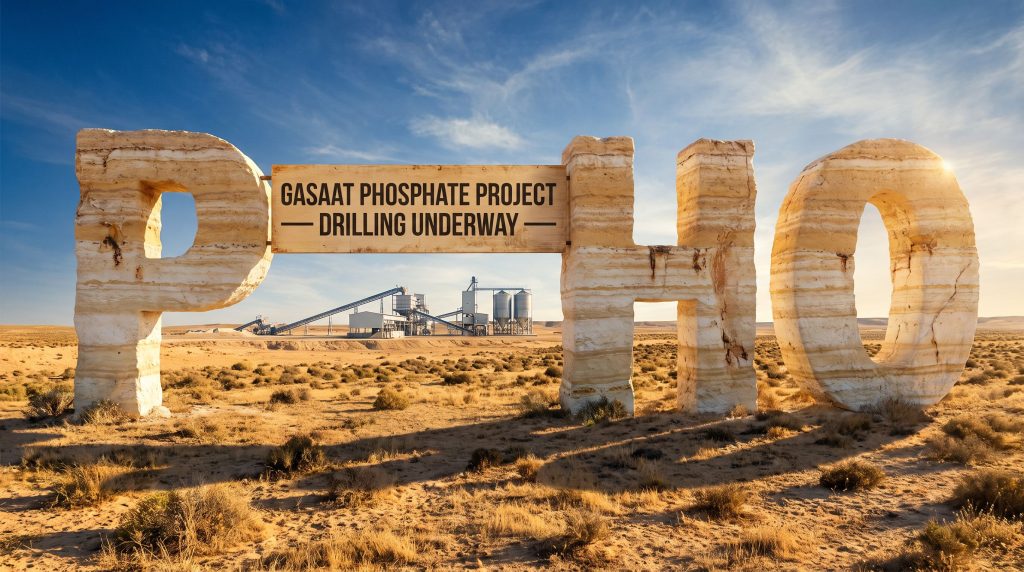
PhosCo Ltd (ASX: PHO) has reported strong maiden drilling results from the KH prospect at its wholly owned Gasaat Phosphate Project in Tunisia, with all five holes intersecting wide phosphate mineralisation and internal high-grade zones. The standout result was 19.4 metres at 20.66% P2O5 from 81.6 metres, including 9 metres at 24.21% P2O5 in hole GADD-2026-35.
The announcement matters for investors because KH sits just 3.5 kilometres from the proposed plant site and is described by the company as having low-strip mineralisation. In practical terms, that combination may improve mining economics in the early years of any future operation, when haulage distance and waste removal costs can have an outsized effect on cash flow.
"These outstanding drilling results from the new KH prospect are consistent with that objective because they point to further growth in the total Gasaat inventory while also offering the potential to boost the project's economics, particularly in the early years," said Taz Aldaoud, Managing Director of PhosCo Ltd.
When big ASX news breaks, our subscribers know first
What the KH Drilling Results Show
The maiden five-hole program at KH was designed to test a phosphate body indicated by outcrop mapping and two historic CPG drill holes from 1968. PhosCo stated the drilling confirmed the geometry and continuity of mineralisation across the prospect.
The reported intercepts are summarised below:
| Hole | Intercept | Grade | From |
|---|---|---|---|
| GADD-2026-31 | 16.3m | 17.68% P2O5 | 39.7m |
| including | 2.0m | 23.36% P2O5 | 45.7m |
| including | 5.3m | 22.52% P2O5 | 50.7m |
| GADD-2026-32 | 19.6m | 17.23% P2O5 | 103.4m |
| including | 3.0m | 22.62% P2O5 | 107.4m |
| including | 5.8m | 22.80% P2O5 | 114.4m |
| GADD-2026-33 | 18.8m | 18.83% P2O5 | 41.1m |
| including | 2.3m | 24.35% P2O5 | 42.1m |
| including | 8.3m | 22.72% P2O5 | 48.4m |
| GADD-2026-34 | 15.9m | 14.03% P2O5 | 29.9m |
| including | 2.7m | 20.82% P2O5 | 41.4m |
| GADD-2026-35 | 19.4m | 20.66% P2O5 | 81.6m |
| including | 9.0m | 24.21% P2O5 | 86.5m |
Several individual one-metre assays were also strong. The laboratory data released with the announcement shows a peak sample of 28.44% P2O5 in GADD-2026-35, with multiple one-metre samples above 23% P2O5 across the program.
That consistency is important. A single strong interval can attract attention, however a full set of successful holes across a maiden program is generally more relevant when investors assess whether a prospect may contribute meaningfully to future resource growth.
Why KH Could Matter to Project Economics
The company has linked KH directly to the economics of the Gasaat Phosphate Project in Tunisia, particularly in the early years of production. According to the announcement, the newly outlined KH mineralisation, together with resources at KM and SAB, is expected to boost project economics due to low strip ratio and proximity to the proposed plant.
What Is Strip Ratio?
Strip ratio is a mining term that describes how much waste rock must be removed to access a given amount of ore. For example, a strip ratio of 3:1 means three tonnes of waste are moved for every tonne of ore mined.
Lower strip ratios generally matter because they can reduce:
- Mining cost per tonne of ore
- Fuel and equipment usage
- Time required to access saleable material
For investors, lower strip ratio zones are often attractive in the early years of a mine plan because they may support stronger margins while capital is still being recovered.
Why Does KH Stand Out on This Measure?
Management described KH as having tabular, low-strip mineralisation. Furthermore, the prospect is only 3.5km from the proposed plant site, which may reduce haulage costs relative to more distant ore sources.
This does not in itself confirm final mine scheduling or economics. However, if later studies incorporate KH into an operating plan, its location and geometry could be relevant inputs in any updated development scenario.
KH combines three features that often matter in open-pit project development: grade, thickness, and short distance to infrastructure.
The Geology at KH in Simple Terms
The announcement states that geology at KH is the same as the broader Gasaat Phosphate Project in Tunisia, classified as a marine carbonate-hosted sedimentary phosphate deposit. In simpler terms, this means the phosphate formed in ancient marine sediments and now sits within a layered rock sequence that can often be traced across wide areas.
At Gasaat, the phosphate unit typically occurs as a single laterally continuous layer. PhosCo noted this layer varies in thickness from 1 metre to 53 metres, with an average thickness of 10 metres to 15 metres across the project.
The sequence is described as:
- Basal Cretaceous marls and mudstones
- The phosphate-bearing unit
- An overlying dolomitic limestone bed
Within the phosphate unit itself, the company identifies three internal layers:
- Layer C: a transition from mudstone into phosphate
- Layer B: the main phosphate-bearing section
- Layer A: the transition from phosphate into limestone
In mining and processing, consistent layering can make geological interpretation easier and may help with mine planning, grade control and metallurgical testing.
KH Prospect Geometry
At KH, the mineralised block sits within an Eocene limestone block covering about 150,000 square metres. It is reported to be displaced from the major Gasaat deposits by faulting and truncated on the northern side by an east-west fault forming the edge of the Rohia Graben.
The phosphate layer dips 20 to 30 degrees to the south-east, giving it the form of a tilted tabular body with limited structural complexity. This kind of geometry is generally easier to model than a heavily folded or fragmented orebody.
There is an important technical point in the drilling data. The holes were drilled vertically, while the mineralised layer dips at 20 to 30 degrees. As a result, the reported intercepts are apparent thicknesses, not true widths. Investors comparing KH with other projects should bear that distinction in mind.
Educational Guide: What P2O5 Means in Phosphate Projects
Phosphate project announcements usually report grade as P2O5, which stands for phosphorus pentoxide. This is the standard way phosphate content is measured in the fertiliser and mining industries.
A higher P2O5 percentage generally indicates more phosphate in the rock. That matters because phosphate is the key ingredient used to produce fertilisers such as:
- MAP or monoammonium phosphate
- DAP or diammonium phosphate
- Phosphoric acid feedstock
For non-specialist investors, a few simple concepts help:
- Grade tells you how much valuable phosphate is present in the rock
- Thickness tells you how much mineralised material is present across the drilled interval
- Continuity tells you whether that mineralisation extends from one hole to the next
- Metallurgy tells you whether the phosphate can be processed into a saleable concentrate
A project does not depend on grade alone. Mining cost, processing performance, impurity levels, infrastructure distance and future mine design all affect whether strong drill results translate into attractive economics.
Existing Metallurgical Context at Gasaat
While the KH announcement focused on drilling, the ASX release also referred to previous metallurgical work from Gasaat. According to previously reported results, test work on KM mineralisation indicated that a simple single-stage flotation circuit produced phosphate concentrate grading up to 31.4% P2O5.
The cited test work also reported:
- Concentrate grades between 29.5% and 31.4% P2O5
- Recoveries between 75.1% and 83.7% P2O5
- SiO2 content between 4.38% and 5.16%
- A Minor Element Ratio (MER) of 0.087
In practical terms, flotation separates valuable minerals from waste by using differences in surface properties. For phosphate investors, positive early metallurgical results can be relevant because they suggest the ore may respond to conventional beneficiation methods. That said, KH-specific sighter metallurgical test work is still planned, according to the announcement.
What Happens Next at Gasaat and Sekarna
PhosCo's announcement indicates that work at Gasaat is continuing on several fronts. Scout drilling is underway at Sekarna North, and the rig is expected to move on to Phase-2 drilling at DOH, where the company previously reported a significant phosphate discovery earlier in 2026.
The key upcoming activities outlined in the release are:
| Activity | Status |
|---|---|
| Scout drilling at Sekarna North | Underway |
| Phase-2 drilling at DOH | To follow Sekarna North |
| Updated Scoping Study for Gasaat | Due Q3 2026 |
| Additional drilling at KH and DOH | Planned |
| Sighter metallurgical test work | Planned |
The updated Scoping Study is the main development catalyst to watch. A scoping study is an early-stage economic assessment that reviews factors such as mining method, processing options, production profile and indicative financial outcomes. It is less detailed than later-stage studies, but it often shapes market expectations about project direction.
In this case, investors will likely watch whether KH is incorporated into early mine scheduling assumptions and whether its short distance to the proposed plant influences the economic profile presented by the company.
Why Investors Are Watching PhosCo
The KH drilling results add another prospect to a broader and still developing phosphate inventory at the Gasaat Phosphate Project in Tunisia. Gasaat already includes KM, SAB, GK and KEL, while DOH and now KH are being advanced through ongoing drilling.
Several features of the announcement may be relevant to investors:
- All five maiden holes at KH intersected phosphate mineralisation
- The best result returned 19.4m at 20.66% P2O5, including 9m at 24.21% P2O5
- KH is only 3.5km from the proposed plant site
- Management has linked KH's geometry and location to possible improvements in early-year economics
- The company's updated Scoping Study is due in Q3 2026
- Additional drilling at Sekarna North and DOH is ongoing or imminent
The project tenure is also clearly stated in the announcement. Gasaat is held 100% by Himilco Pty Ltd, a wholly owned subsidiary of PhosCo, and the exploration permit was granted on 6 March 2025 for a three-year term.
The broader investment case remains dependent on further drilling, future resource updates, metallurgical work and economic studies. Even so, the KH results appear to support the company's view that Gasaat may continue to grow both in scale and in the quality of tonnes available near planned infrastructure.
The next major ASX story will hit our subscribers first
Final Take
PhosCo's KH maiden drilling program has delivered a full set of phosphate intersections, with thick mineralised zones and internal high-grade layers across all five holes. According to the ASX announcement, the result strengthens confidence in the continuity and geometry of the prospect and may support improved early production economics at Gasaat.
For investors, the main question now is how KH is reflected in the Q3 2026 updated Scoping Study. If subsequent work confirms the low-strip, near-plant advantages highlighted in the announcement, KH could become an important part of the overall Gasaat Phosphate Project in Tunisia development profile.
Want to Stay Ahead of the Next Major Mineral Discovery on the ASX?
Discovery Alert's proprietary Discovery IQ model delivers real-time alerts the moment significant ASX mineral discoveries are announced, transforming complex geological data into clear, actionable insights for investors at every level — start your 14-day free trial today and see why historic discoveries have generated extraordinary returns.