August 7, 2026
The Mineral Beneath Two Crises: Why Phosphate Now Sits at the Heart of Western Supply Chain Strategy
There is a quiet convergence happening across Western industrial policy that rarely makes headlines but is reshaping how governments think about resource security. The same mineral that feeds crops also powers electric vehicles. Phosphate, long considered an agricultural commodity, has been repositioned in policy circles as a dual-use critical input, sitting simultaneously at the foundation of global food systems and next-generation battery chemistry. The Arianne Phosphate Lac à Paul Filon support service selection is a clear expression of this shift in strategic thinking.
For jurisdictions still dependent on imports from geopolitically concentrated sources, that dual exposure represents a structural vulnerability that domestic development programmes are now actively targeting. It is within this context that the selection of Arianne Phosphate's Lac à Paul project for Québec's Filon support service carries significance well beyond a routine administrative milestone.
When big ASX news breaks, our subscribers know first
What the Filon Support Service Actually Does
Understanding Filon requires first appreciating the problem it was designed to solve. Large-scale mining projects in Canada have historically encountered a fragmented regulatory landscape where multiple ministries, provincial agencies, and federal bodies each hold distinct permitting responsibilities. The sequential nature of this process has contributed to prolonged pre-construction timelines that inflate costs and erode investor confidence before a single tonne of ore has been extracted.
Furthermore, mining permitting challenges of this nature are not unique to Canada. Filon, established by Québec's Ministère des Ressources naturelles et des Forêts, introduces a structured coordination mechanism that sits between the project proponent and this web of regulatory bodies. Rather than leaving companies to navigate inter-agency communication independently, Filon functions as a dedicated facilitation layer, organising exchanges between developers and the authorities responsible for issuing permits and environmental authorisations.
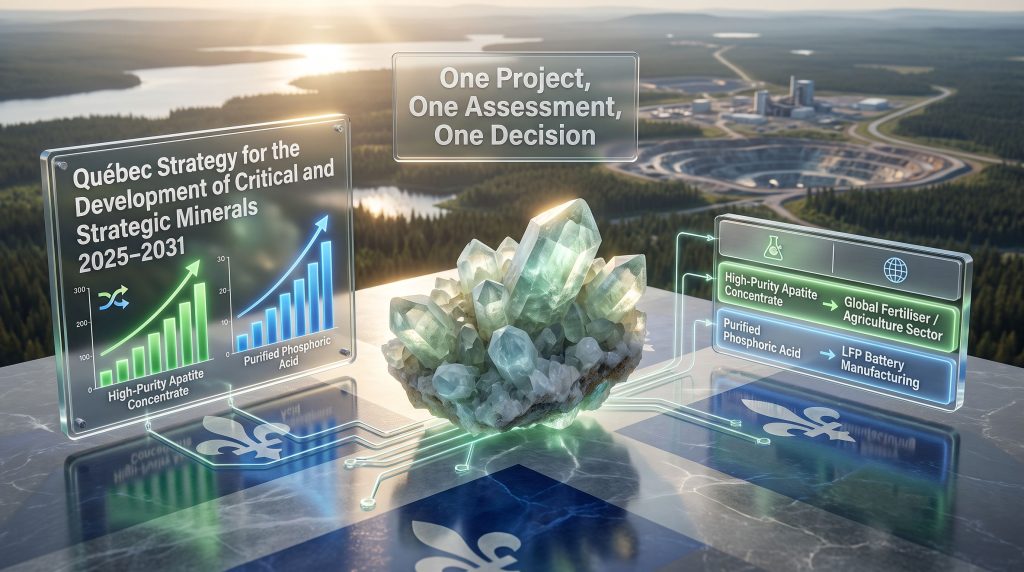
Critically, this is not a permitting shortcut. The framework operates within the bounds of the Québec Strategy for the Development of Critical and Strategic Minerals 2025-2031, a six-year policy roadmap that explicitly targets domestic mineral development while maintaining rigorous environmental protection standards as a non-negotiable baseline.
The distinction between streamlining and weakening is central to understanding Filon's design. Coordinated regulatory engagement reduces administrative lag and improves process transparency without altering the substantive environmental review thresholds that mining projects must satisfy.
The Federal-Provincial Alignment Dimension
Filon's coordination function is further reinforced by a proposed bilateral agreement between the governments of Québec and Canada built around the principle of one project, one assessment, one decision. This framework aims to eliminate the duplication that has historically arisen when both the federal government and Québec conduct parallel environmental assessments of the same project under their respective legislative mandates.
The practical implication is significant: instead of a project team managing two separate assessment tracks with potentially diverging timelines and requirements, a unified process consolidates review under a single coordinated structure. Comparable single-window permitting models have been implemented in Australia and parts of Scandinavia, where jurisdictional consolidation has demonstrably reduced pre-production timelines for strategically classified resource projects without compromising environmental outcomes.
Why Arianne Phosphate's Lac à Paul Project Was Selected
The Arianne Phosphate Lac à Paul Filon support service selection reflects the project's standing as one of the largest undeveloped phosphate deposits anywhere in the world. Located in Québec's Saguenay-Lac-Saint-Jean region, a jurisdiction with established mining infrastructure, hydroelectric power access, skilled labour availability, and political stability, Lac à Paul combines scale with strategic product design in a way that few undeveloped phosphate assets globally can match.
The project's output architecture is specifically engineered to serve two distinct high-value markets:
- High-purity apatite concentrate targeting global fertiliser and agricultural supply chains
- Purified phosphoric acid targeting lithium-iron-phosphate (LFP) battery manufacturing, a rapidly growing segment of the electric vehicle and stationary energy storage markets
This dual-market design is not merely a commercial diversification strategy. It positions Lac à Paul at the intersection of two of the most policy-sensitive supply chains in the Western world simultaneously, a characteristic that elevates its strategic classification above single-market phosphate projects that address only one dimension of the critical mineral demand picture.
The Strategic Calculus: Two Supply Chains, One Deposit
| Output Product | Target Market | Strategic Relevance |
|---|---|---|
| High-purity apatite concentrate | Global fertiliser and agriculture sector | Food security and import substitution |
| Purified phosphoric acid | LFP battery manufacturing | EV and energy storage supply chain localisation |
Arianne Phosphate has described Lac à Paul as a world-class asset located in a stable and responsible jurisdiction, with the capacity to support Western value chains connected to both agriculture and lithium-iron-phosphate battery production. The project's recognition under Filon confirms the provincial government's own assessment of its strategic merit for Québec and broader North American supply chain resilience.
Phosphate's Dual Role: Food Security Meets Battery Chemistry
The strategic reclassification of phosphate as a critical mineral across multiple Western jurisdictions, including Canada, the European Union under its Critical Raw Materials Act, and the United States under provisions of the Inflation Reduction Act, reflects an understanding that has taken time to penetrate mainstream policy discourse. Indeed, European critical raw materials policy has undergone similarly rapid evolution in response to these same supply chain pressures.
Phosphate has always been foundational to global food production. Approximately 85% of all phosphate rock mined globally is processed into fertilisers, making it an input with essentially no substitute in conventional agriculture. Supply disruption to phosphate flows would translate directly into fertiliser shortages, rising food production costs, and downstream food security consequences at scale.
What is less widely appreciated outside specialist circles is phosphate's indispensable role in LFP battery chemistry. Lithium-iron-phosphate cells use an iron phosphate cathode material and have gained significant market share in the EV sector due to their superior thermal stability, longer cycle life, and lower raw material cost compared to nickel-manganese-cobalt alternatives. Crucially, phosphate is a non-substitutable input in LFP cathode production.
This creates a compounding demand dynamic that most commodity analysts were slow to price:
- Agricultural phosphate demand remains structurally stable and grows with global population.
- LFP battery demand is growing rapidly as EV adoption accelerates and stationary storage deployments expand.
- Both demand streams draw on the same upstream phosphate rock supply base.
Geographic Concentration: The Vulnerability That Domestic Projects Address
Current global phosphate production is heavily concentrated in Morocco and China, which together account for the majority of both mined output and processing capacity. For Western manufacturers seeking to localise LFP battery supply chains, this concentration represents a strategic dependency directly analogous to the rare earth supply chain vulnerabilities that prompted significant policy responses over the past decade.
The broader critical minerals demand picture reinforces why Canada's dependence on imported phosphate amplifies this exposure. Developing a domestic high-purity phosphate source capable of serving both agricultural and battery markets would meaningfully reduce that dependency while creating a new node in North American critical mineral supply chains.
Saguenay-Lac-Saint-Jean: More Than a Geographic Address
The Saguenay-Lac-Saint-Jean region's selection as the site for one of the world's most strategically significant phosphate development projects is not coincidental. The region offers a combination of infrastructure advantages that directly support the economics of large-scale phosphate extraction and processing:
- Proximity to established port infrastructure enabling concentrate and acid export logistics
- Access to Québec's hydroelectric grid, providing low-carbon, competitively priced power critical for energy-intensive mineral processing
- An existing mining services ecosystem with qualified contractors, engineering capacity, and operational expertise
- A history of large-scale industrial project execution that provides social licence context and workforce familiarity
These factors collectively reduce the capital intensity of bringing a project like Lac à Paul into production relative to greenfield development in more remote or infrastructure-deficient locations. For context, similar phosphate project development elsewhere in the world has demonstrated how infrastructure access materially shapes project economics and timelines.
How Regulatory Risk Functions as a Valuation Discount
For investors evaluating pre-production mining assets, permitting uncertainty is not merely an operational inconvenience. It functions as a direct discount factor applied to net present value calculations. Projects with unpredictable regulatory timelines face higher weighted average costs of capital, reduced willingness from strategic partners to commit to offtake agreements, and suppressed equity valuations relative to projects with clearly defined approval pathways.
Selection for the Filon support service does not constitute regulatory approval and should not be interpreted as a guarantee of project advancement. It does, however, signal that a project has been formally recognised as strategically significant by the provincial government, warranting dedicated coordination resources that can materially improve timeline predictability for all project stakeholders.
This distinction matters for how investors interpret the milestone. The embedded signal is one of strategic prioritisation, not pre-approval, and the two carry very different implications for risk-adjusted return modelling.
Scenario Analysis: Three Development Pathway Projections
| Scenario | Key Assumptions | Projected Outcome |
|---|---|---|
| Accelerated Development | Filon delivers compressed timelines; federal-provincial assessment agreement ratified promptly | Project reaches construction decision within 3 to 4 years |
| Base Case | Filon improves coordination but some inter-agency delays persist | Development timeline aligns with established benchmarks for large Canadian mining projects |
| Constrained Pathway | Regulatory complexity or adverse market conditions slow progress despite Filon coordination | Extended pre-construction phase; project remains in advanced development for an extended period |
Disclaimer: The scenario projections above are illustrative and speculative in nature. They do not constitute investment advice, and actual project timelines will depend on a wide range of regulatory, financial, technical, and market factors that cannot be predicted with certainty.
The next major ASX story will hit our subscribers first
Québec's 2025-2031 Critical Minerals Strategy: The Architecture Behind Filon
Filon does not exist in isolation. It is one operational instrument within Québec's broader Strategy for the Development of Critical and Strategic Minerals 2025-2031, a framework built on several interconnected pillars:
- Prioritising domestic processing capacity to capture value beyond raw mineral extraction
- Integrating critical mineral projects into continental supply chain strategies
- Modernising regulatory frameworks to improve efficiency without compromising environmental standards
- Developing Indigenous partnership frameworks that build social licence alongside regulatory approval
The strategy reflects a deliberate effort to transform Québec from a jurisdiction that exports raw materials into one that captures processing and manufacturing value across critical mineral supply chains. For phosphate specifically, this means producing the purified phosphoric acid grades required by battery manufacturers, a processing step that commands substantially higher margins. The battery raw materials market increasingly rewards jurisdictions that can supply refined, battery-grade inputs rather than unprocessed ore.
Filon's role within this architecture is to ensure that projects with the strategic characteristics necessary to advance these objectives are not stalled by administrative friction. The Arianne Phosphate Lac à Paul Filon support service selection, as one of the first projects admitted to the service, reflects both the project's intrinsic strategic merit and the province's assessment of where coordination support can have the greatest developmental impact.
Frequently Asked Questions: Arianne Phosphate, Lac à Paul, and the Filon Support Service
What is the Filon support service in Québec?
Filon is a coordination mechanism established by Québec's Ministère des Ressources naturelles et des Forêts. It facilitates structured engagement between mining project developers and the government ministries and agencies responsible for issuing permits and environmental authorisations, with the objective of improving the efficiency, clarity, and predictability of regulatory processes for strategically classified mineral projects.
Why is phosphate classified as a critical mineral in Canada?
Phosphate is recognised as critical because it underpins both food security, as the primary input for agricultural fertilisers, and clean energy manufacturing, as a non-substitutable component in lithium-iron-phosphate battery chemistry. Canada's existing dependence on phosphate imports from geographically concentrated sources creates supply chain exposure that domestic project development is intended to address.
What distinguishes the Lac à Paul deposit from other phosphate projects?
Lac à Paul is distinguished by its scale as one of the largest undeveloped phosphate deposits globally, the high-purity grade of its apatite resource, its location in an established mining jurisdiction with strong infrastructure advantages, and its capacity to serve two distinct high-value output markets simultaneously through its dual-product development design.
What does the one project, one assessment, one decision principle mean in practice?
This principle underpins a proposed federal-provincial agreement designed to consolidate what have historically been parallel environmental assessment processes conducted independently by both the Canadian federal government and the Québec provincial government. The aim is to eliminate jurisdictional duplication and reduce timeline uncertainty without weakening environmental protection standards.
Does Filon selection mean the Lac à Paul project has received government approval?
No. Filon selection is a coordination and facilitation designation, not a regulatory approval. It signals that the project has been assessed as strategically significant and meriting dedicated government coordination support, which can improve process efficiency and timeline predictability. All substantive permitting and environmental review requirements remain fully applicable.
Want to Position Yourself Ahead of the Next Major Mineral Discovery?
Discovery Alert's proprietary Discovery IQ model scans ASX announcements in real time, instantly identifying significant mineral discoveries across phosphate, lithium, and more than 30 other commodities — delivering actionable insights to subscribers before the broader market reacts. Explore historic discovery returns on Discovery Alert's dedicated discoveries page and begin your 14-day free trial to secure a market-leading edge.