July 23, 2026
The Industrial AI Capital Shift Nobody Saw Coming
For most of the past decade, venture capital treated physical industries as a graveyard for software ambition. The friction was real: unpredictable environments, entrenched incumbents, regulatory complexity, and the brutal gap between a compelling pitch deck and functional machinery operating in a 50-metre deep open pit at 3am. Digital tools flourished at the edges of mining, construction, and heavy logistics, but the core operational layer remained stubbornly analogue.
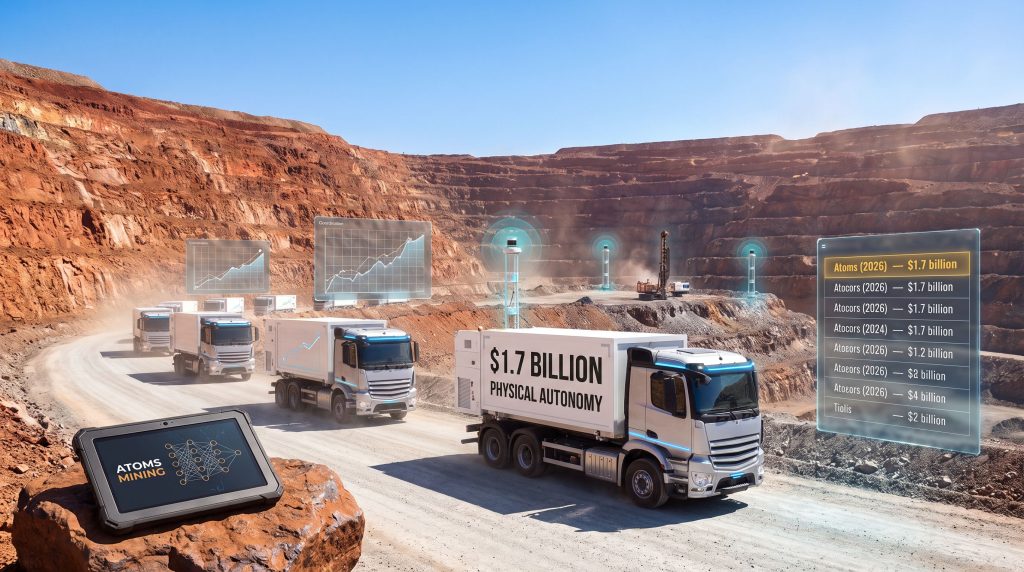
That calculation is now changing rapidly. The Atoms $1.7 billion investment in physical autonomy for mining represents something more significant than a single funding event. It signals that institutional capital, at the very highest tier, now believes the technical and commercial barriers to autonomous physical operations have fallen low enough to justify category-defining bets. Understanding what that means, and why it matters now, requires unpacking both the technology and the forces driving this inflection point.
When big ASX news breaks, our subscribers know first
What Physical Autonomy Actually Means, and Why It Is Different
The term autonomy gets used loosely across mining technology. Fleet management software, remote-operated equipment, and GPS-guided dozers are all routinely labelled as autonomous, but they represent a fundamentally different category of system.
Physical autonomy, in the sense Atoms is pursuing, refers to the integration of artificial intelligence, real-time sensor networks, robotics, and adaptive software into systems that can interpret dynamic physical environments and make operational decisions without human instruction on a task-by-task basis. The distinction matters enormously in practice:
- Traditional automation operates within pre-programmed parameters and requires human intervention when conditions deviate from expected ranges
- Physical autonomy systems continuously re-evaluate their environment, adapt to change, and execute decisions across variable terrain, weather, dust, vibration, and equipment states
- The AI layer is not a workflow assistant; it is the operational decision-maker
Mining environments are among the most demanding test cases on earth for this kind of technology. Dust concentrations can disable optical sensors. Underground gas environments create explosive risks that demand fail-safe logic beyond standard industrial robotics. Ground conditions shift between shifts. These are not edge cases in mining; they are the baseline operating reality. Furthermore, mining automation transformation has been accelerating precisely because these challenges are now being met with credible technical solutions.
The Three-Division Architecture and Why It Is Structured That Way
Atoms is not a single-product mining technology company. Its structure spans three distinct divisions:
| Division | Primary Focus | Target Environment |
|---|---|---|
| Atoms Mining | Productivity uplift and autonomous operations | Surface and underground mine sites |
| Atoms Transport | Autonomous heavy vehicle and logistics solutions | Industrial transport corridors |
| Atoms Food | Physical automation for large-scale food production | Agricultural and processing facilities |
This architecture is deliberate. By operating across three physically demanding sectors, Atoms can justify concentrated investment in shared AI model infrastructure, sensor fusion technology, and autonomous navigation systems, while spreading deployment risk across different revenue cycles and regulatory environments. Mining might face a permitting delay in one jurisdiction while food production systems are scaling commercially in another.
The shared infrastructure thesis is particularly important for investors evaluating long-term defensibility. AI models trained on autonomous vehicle coordination in mining haul roads generate data that improves navigation algorithms applicable to food production logistics. The compounding effect across divisions creates a technical moat that single-sector competitors cannot replicate.
Travis Kalanick and the Disruption-by-Infrastructure Playbook
The choice of founder matters in physical autonomy more than it does in pure software ventures. Physical deployment requires operational credibility, supply chain relationships, and the institutional stamina to navigate regulatory environments that move in years, not sprints.
Travis Kalanick's background as co-founder and former CEO of Uber is directly relevant here. Uber's core innovation was not the app itself; it was the application of software platform economics to a physical industry that had resisted structural change for decades. The matching algorithm, dynamic pricing, and driver network management were all mechanisms for optimising physical movement at scale through software logic.
Atoms applies an analogous framework. Instead of matching passengers with drivers, the system matches autonomous equipment with tasks, routes, and operational parameters across mine sites, transport corridors, and production facilities. The underlying logic of using AI to coordinate physical assets at scale is consistent with Kalanick's previous execution model, even if the hardware complexity is significantly greater.
Founders who have already restructured one physical industry through platform economics carry credibility that purely technical founders typically lack. Operators, investors, and enterprise customers in mining respond differently to a team that has demonstrated the ability to scale physical operations globally.
How Does Kalanick's Funding Round Break Down?
Andreessen Horowitz secured $1.7 billion for Atoms alongside ten major investors, including Uber. The funding structure combines equity and debt components, which is relevant for understanding how the capital is intended to be deployed.
Equity-heavy early tranches typically fund R&D, talent acquisition, and technology development. Debt components often support asset-heavy deployment phases, covering hardware procurement, site integration infrastructure, and equipment acquisition. The combination suggests Atoms is simultaneously building its core technology stack and preparing for near-term commercial deployment, not just research.
Ben Horowitz joining the Atoms board is a meaningful signal beyond headline optics. At a16z, board placement by a founding partner is reserved for investments the firm considers generational platform bets, not financially interesting experiments. The historical pattern is consistent: a16z placed founding partners on the boards of companies it believed would define new technology categories, not simply participate in existing ones.
Uber's participation as an investor adds another analytical layer. Uber is simultaneously a potential future customer of autonomous logistics technology, a distribution partner with deep expertise in coordinating physical asset networks, and a technology integrator that has spent years working on self-driving systems through its own prior ventures. Equity participation with this kind of strategic overlap typically signals more than passive financial interest.
The Pronto Acquisition: Accelerating the Go-to-Market Timeline
Building autonomous navigation capability for industrial environments from scratch requires years of sensor calibration, edge-case data collection, and hardware iteration. Atoms bypassed a significant portion of that timeline by acquiring Pronto, a self-driving technology startup with existing autonomous systems proven in mining and industrial settings.
The Pronto acquisition contributes several layers of technical capability that would otherwise take years to replicate:
| Capability Layer | Pronto Contribution | Atoms AI Overlay |
|---|---|---|
| Autonomous navigation | Proven off-road and industrial systems | AI-enhanced route optimisation |
| Sensor integration | Hardware-level industrial sensors | Cross-environment data fusion |
| Fleet coordination | Multi-vehicle autonomy protocols | Centralised AI fleet management |
| Safety systems | Collision avoidance and fail-safe logic | Predictive hazard modelling |
The significance of real-world deployment experience in this sector cannot be overstated. Autonomous navigation in mining environments differs fundamentally from highway or urban self-driving, which attracts the majority of autonomous vehicle research funding. Haul roads are unstructured, constantly reshaped by blasting and grading activity, and shared with human-operated machinery that does not always behave predictably. Systems that have accumulated operational hours in these conditions are worth considerably more than theoretically equivalent systems that have only been tested in controlled environments.
In addition, autonomous haulage technology in the broader sector has already demonstrated that this class of system can deliver measurable operational improvements when properly integrated into live site conditions.
Where the $1.7 Billion Fits in the Broader Mining Technology Investment Landscape
Context is essential for evaluating the scale of this capital commitment. The mining technology sector has historically attracted investment in layers, moving from geological data and analytics tools in the earliest phase, through fleet telematics and remote monitoring, toward the current wave targeting physical execution.
| Investment Category | Focus Area | Typical Round Scale |
|---|---|---|
| Atoms (2026) | Industrial AI across mining, transport, food | $1.7 billion |
| Major OEM autonomous haul programmes | Surface fleet autonomy (Caterpillar, Komatsu) | Multi-year, multi-billion OEM internal R&D |
| AI fleet management platforms (emerging) | Data and telematics layer | $10 million to $200 million |
| Underground autonomous navigation startups | Hard-rock and narrow-vein environments | Seed to Series B stage |
The structural drivers compressing this technology cycle include labour cost inflation in major mining jurisdictions, tightening workplace safety obligations that increase the regulatory liability of manned operations in hazardous zones, ESG pressure on operational efficiency and emissions intensity, and sustained critical minerals demand growth driven by energy transition requirements.
None of these forces are cyclical. They are structural, which means the investment thesis for physical autonomy is not contingent on commodity price peaks sustaining current levels. Even in a commodity price downturn, the pressure to reduce the cost per tonne through operational efficiency remains or intensifies. Consequently, data-driven mining operations are increasingly central to how operators are planning their long-term efficiency strategies.
The next major ASX story will hit our subscribers first
The Three Operational Levers: Productivity, Safety, and Cost
Physical autonomy targets three measurable dimensions of mine site performance simultaneously:
Productivity
Autonomous systems are not constrained by shift structures, fatigue regulations, or the cognitive degradation that affects human operators after extended hours. Industry modelling suggests autonomous haul truck fleets can improve equipment utilisation rates by 15 to 25 percent compared to equivalent manned operations, primarily by eliminating shift change dead time, reducing speed variance, and maintaining consistent load cycle timing across 24-hour operational windows.
Safety
The injury and fatality profile of mining operations is concentrated in specific high-risk activities: proximity to blast zones, operating heavy equipment in reduced visibility conditions, working in areas with unstable ground or elevated gas concentrations. Autonomous systems can be deployed in these environments without placing human operators at risk, directly reducing injury exposure and the regulatory and reputational consequences that follow serious incidents. Furthermore, AI in drilling and blasting is already demonstrating how intelligent systems can reduce human exposure in the most hazardous operational phases.
Cost
The total cost of ownership calculation for autonomous versus manned operations shifts significantly over multi-year horizons. Upfront capital investment is higher, but the elimination of shift labour costs, reduction in insurance premiums, and lower maintenance expenditure through predictive maintenance in mining create a compelling long-term cost structure. Improved fuel efficiency through consistent machine operation further strengthens the financial case.
The Mining Operations That Stand to Gain the Most
Not all mining environments present equal opportunity for physical autonomy deployment. The near-term commercial case is strongest in specific operational contexts:
- Large-scale open-cut operations running high-volume haul truck fleets, where route consistency and cycle time optimisation directly translate into measurable throughput improvement
- Remote and frontier operations where the logistical cost and human capital burden of attracting and retaining shift workers in geographically isolated locations creates a persistent operational drag
- Operations with documented safety incident histories in specific task categories, where regulatory pressure and insurance economics create strong financial incentives for removing human exposure
Underground hard-rock environments present greater technical complexity due to confined geometry, variable ground conditions, and the challenge of maintaining sensor reliability in high-dust, high-vibration, gas-present settings. Autonomous navigation in underground environments is advancing but remains at an earlier commercial maturity stage than surface applications.
Risks That Serious Investors Must Weigh
Physical autonomy in mining is not a risk-free deployment proposition, and the scale of the Atoms capital raise does not eliminate the technical and commercial challenges that have constrained previous attempts.
The key risk categories include:
-
Sensor reliability in mining conditions: Dust, vibration, temperature extremes, and electromagnetic interference from blasting create hostile operating environments for the optical and radar systems that autonomous navigation depends on. Hardware degradation rates in active mine environments significantly exceed those in laboratory testing conditions.
-
Regulatory complexity across jurisdictions: Autonomous equipment operation in mining is governed by a patchwork of national and state-level safety frameworks that are still evolving. Compliance timelines in conservative regulatory jurisdictions can add 12 to 24 months to commercial deployment schedules.
-
Legacy fleet interoperability: The majority of active mining operations run mixed fleets combining equipment from multiple OEMs spanning multiple generations of technology. Autonomous systems must integrate with machinery that was not designed with digital interoperability in mind, creating substantial engineering overhead.
-
Workforce transition management: Autonomous deployment at scale raises legitimate concerns about employment displacement that mine operators cannot ignore. Social licence considerations and union relationships in major mining jurisdictions mean that technically successful deployments can still face significant operational resistance.
Disclaimer: This article contains forward-looking analysis and scenario projections based on publicly available information and industry data. It does not constitute financial advice. Readers should conduct independent due diligence before making investment decisions.
What This Means for Mining Industry Stakeholders
The Atoms $1.7 billion investment in physical autonomy for mining carries different implications depending on where you sit in the industry ecosystem:
- Mine operators should treat this as confirmation that physical autonomy is transitioning from pilot phase to commercial scaling. The window for structured transition planning is narrowing.
- Equipment OEMs face a more complex competitive landscape. Well-capitalised AI-native companies entering the autonomous equipment space create pressure on proprietary automation programmes while simultaneously offering potential partnership structures.
- Technology investors looking at the mining sector should recognise that the next productivity cycle is more likely to originate from physical execution layer innovation than from further incremental improvements to data analytics and telematics tools.
- Workforce and regulatory stakeholders will need to engage proactively with the deployment frameworks being developed, as the pace of autonomous adoption will increasingly be set by regulatory clarity rather than technical readiness alone.
The deeper significance of the Atoms capital raise is what it implies about timing. When capital of this scale, from investors of this calibre, moves into physical autonomy for mining, it reflects a judgement that the technology is no longer the primary constraint. The primary constraints are now commercial, regulatory, and organisational. That is a fundamentally different problem set than the one the industry was working on five years ago, and it suggests the timeline to widespread autonomous mine operations is considerably shorter than most conventional industry forecasts have assumed.
Want to Know Which ASX Mining Companies Are Leading the Next Technological Leap?
Discovery Alert's proprietary Discovery IQ model scans ASX announcements in real time, instantly identifying significant mineral discoveries and transformative opportunities in sectors being reshaped by physical autonomy and industrial AI — explore historic discoveries and their exceptional returns, then begin your 14-day free trial at Discovery Alert to position yourself ahead of the market.