August 21, 2026
When Risk Premiums Unwind: Understanding Commodity-Equity Volatility in Metal Markets
Commodity-linked equities occupy a peculiar space in modern portfolio theory. Unlike diversified industrials or technology firms, whose valuations rest on proprietary assets, brand equity, or software moats, a vertically integrated metal producer is, in many respects, a leveraged bet on the spot price of a single element. When that price rises, earnings expand rapidly. When it falls, the same operational leverage works in reverse. This dynamic sits at the heart of understanding why Press Metal shares slide as aluminium prices retreat, and why investors monitoring this stock need to understand far more than just daily LME price feeds.
When big ASX news breaks, our subscribers know first
The Price Sensitivity Equation: How Integrated Producers Amplify Commodity Moves
Operational Leverage and Its Double-Edged Nature
Vertically integrated aluminium producers, by design, capture value across the full production chain, from bauxite refining and smelting through to finished product sales. This structure offers significant margin advantages during commodity upswings, because fixed costs are spread across higher realised prices. However, the same integration creates concentrated exposure when prices fall.
Unlike commodity trading companies that can hedge positions across multiple metals or adjust inventory dynamically, a primary aluminium producer is locked into its production cycle. Smelting is capital-intensive and energy-intensive; you cannot simply pause a potline without incurring substantial restart costs. The result is that revenue moves almost in lockstep with the aluminium price, while costs remain largely fixed in the short term, creating what analysts characterise as a highly sensitive correlation between the commodity and the equity.
For Press Metal Aluminium Holdings Bhd (KL: PMETAL), Southeast Asia's largest integrated aluminium producer, this sensitivity is compounded by the fact that aluminium represents its core and dominant revenue stream. There is no offsetting division in copper, zinc, or oil to cushion price-driven earnings volatility. Understanding commodity price sensitivity is therefore essential for anyone tracking this stock.
Why Equity Volatility Routinely Exceeds Commodity Volatility
A frequently overlooked dynamic in commodity equity investing is the amplification effect. When aluminium prices fall by, say, 5%, the impact on a producer's earnings per share can be multiples of that percentage, because operating costs do not fall proportionally. Fixed charges, depreciation on smelter assets, and energy contracts all remain broadly stable.
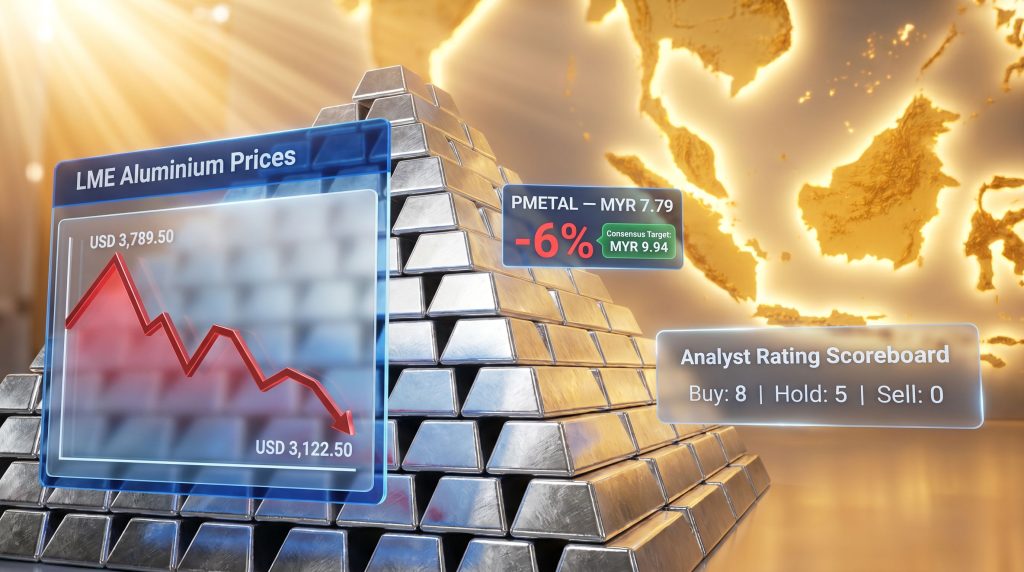
This earnings leverage means that a moderate commodity price correction can translate into a disproportionately large share price movement, particularly when equity markets are pricing in forward earnings expectations rather than just current profitability. This amplification is precisely why shares in PMETAL fell nearly 7% intraday during the June 2026 session before closing down 6% at MYR 7.79, even though the aluminium price itself declined by a smaller percentage on the day.
The Geopolitical Risk Premium Cycle: From Escalation to Unwind
How Risk Premiums Build Inside Commodity Markets
Commodity markets price uncertainty in real time. When a geopolitical event threatens to disrupt supply chains, traders and smelters purchase forward contracts to lock in availability, pushing futures prices higher. This bid-up is not driven by an actual physical shortage but by the fear of one. The resulting premium above fundamental value is known as the geopolitical risk premium.
The West Asia tension cycle of early-to-mid 2026 followed this pattern precisely. As conflict escalated and fears grew around the potential closure of the Strait of Hormuz, a narrow maritime passage through which substantial volumes of energy commodities and industrial raw materials transit, aluminium prices surged. The rationale was logical: aluminium smelting is extraordinarily energy-intensive, consuming roughly 13 to 14 megawatt-hours per tonne of aluminium produced. Any disruption to energy supply routes translates directly into higher input costs for smelters, and therefore into tighter global supply.
The Four-Stage Geopolitical Price Cycle
Understanding where a commodity sits within the geopolitical event cycle is one of the most underappreciated skills in commodity investing dynamics. The aluminium market's behaviour across the 2026 West Asia tension period illustrates a textbook four-stage progression:
- Escalation and initial risk premium build: Conflict news flow generates uncertainty bids across energy and industrial commodity markets.
- Supply disruption confirmation fears: Specific chokepoints, such as the Strait of Hormuz, become focal points for supply chain anxiety, accelerating the price rally.
- De-escalation signals and risk premium unwinding: Announcements of ceasefire, route reopening, or tension reduction trigger rapid selling of risk premium positions.
- Fundamental reassessment and price stabilisation: Markets recalibrate to underlying supply-demand fundamentals, establishing a new near-term price floor based on physical market conditions rather than fear.
The June 2026 session that drove Press Metal shares lower marked the transition from stage three to stage four. The announcement of the Strait of Hormuz reopening was interpreted by markets as the all-clear for risk premium removal, sending LME three-month aluminium futures to USD 3,122.50 per tonne, a level not seen since February 2026.
The Price Journey in Numbers
| Price Milestone | LME Aluminium (USD/tonne) | Catalyst |
|---|---|---|
| 52-Week High | USD 3,789.50 | West Asia conflict escalation peak |
| Pre-correction Level | USD 3,600+ | Strait of Hormuz closure fears |
| Post-announcement Drop | USD 3,122.50 | Hormuz reopening confirmed |
| Recent Market Level | USD 3,147.35 | Trade flow normalisation |
| Four-Week Low | USD 3,224.00 | Lowest close since March 2026 |
From its 52-week high, the aluminium price retreated by approximately 17.6%, with the bulk of that decline occurring within a compressed timeframe as risk premium positions were liquidated.
Record Earnings as a Valuation Anchor: What Q1 FY2026 Reveals
Financial Performance at the Peak of the Cycle
Before analysing the implications of falling aluminium prices, it is worth anchoring the discussion in the earnings context that elevated prices created. For the first quarter ended 31 March 2026, Press Metal delivered its strongest quarterly financial result on record.
| Financial Metric | Q1 FY2026 Result |
|---|---|
| Net Profit | MYR 624.5 million |
| Revenue | MYR 4.1 billion |
| Classification | Record quarterly performance |
These figures were generated against a backdrop of aluminium prices trading well above USD 3,500 per tonne for much of the period. The margin expansion during high-price cycles is dramatic for integrated producers because the cost base, anchored by long-term energy contracts and existing smelter depreciation schedules, does not scale upward at the same rate as revenue.
Forward Earnings Risk and the USD 3,200 Threshold
The critical question for investors now is what happens to profitability if aluminium prices consolidate below USD 3,200 per tonne for an extended period. Analyst estimates for PMETAL suggest forward quarterly results are unlikely to match Q1 FY2026's benchmark if prices remain at current levels, given the meaningful gap between current spot and the conditions that generated record earnings.
However, this does not automatically imply a structural earnings problem. Press Metal's hydropower-based cost structure in Sarawak, Malaysia, provides a competitive cost advantage that preserves margin even at lower price points compared with many coal-powered smelters in other regions. The cost floor for production remains well below current LME prices, meaning the company retains profitability across a wide range of scenarios.
Record quarterly earnings create a psychological valuation anchor for investors, even when the conditions that generated those earnings are temporarily absent. Markets tend to discount forward earnings, but they also remember what a company demonstrated it could achieve.
Chinese Export Dynamics: The Secondary Pressure Aluminium Investors Should Watch
Why China's Domestic Aluminium Market Matters Globally
While the Strait of Hormuz narrative dominated headlines, a secondary and arguably more structurally significant pressure on aluminium prices emerged from China. The SMM A00 aluminium price, which represents the benchmark for domestic Chinese primary aluminium transactions, declined by RMB 140 per tonne to RMB 24,000, reflecting cooling downstream demand as fabricators and manufacturers adopted cautious purchasing strategies following the earlier price rally.
Furthermore, China demand pressures of this nature carry wider implications for global commodity markets. China accounts for roughly 57 to 60% of global primary aluminium production and an even larger share of downstream fabrication capacity. When Chinese domestic prices soften and local demand turns cautious, the differential between domestic and international prices can incentivise export of semi-fabricated aluminium products, which adds supply pressure to global markets.
The Downstream Buyer Behaviour Pattern
A recurring pattern in aluminium markets is the post-rally hesitation by downstream buyers. After a sharp price increase, manufacturers of automotive components, construction materials, packaging, and electrical cables frequently slow their purchasing and draw down existing inventory rather than commit to new contracts at elevated prices.
This behavioural response, sometimes called the wait-and-see dynamic, reduces apparent demand and creates a feedback loop that reinforces price consolidation. This dynamic was clearly visible in the June 2026 price action, where easing geopolitical risk combined with buyer hesitancy to accelerate the aluminium price retreat.
Analyst Consensus: Structural Confidence Beneath Short-Term Noise
The Bloomberg Ratings Breakdown
Despite the sharp single-session decline, the sell-side analyst community covering Press Metal maintained a constructive stance. Bloomberg-tracked analyst ratings as of late June 2026 show the following distribution:
| Rating Category | Number of Analysts |
|---|---|
| Buy | 8 |
| Hold | 5 |
| Sell | 0 |
The consensus 12-month price target of MYR 9.94 implies substantial upside from the MYR 7.79 closing price following the selloff, representing an implied return of approximately 27.6% from that level.
What the Absence of Sell Ratings Signals
The complete absence of sell recommendations is analytically meaningful. Sell-side analysts are professionally cautious about issuing sell calls on liquid, high-quality companies, but the zero-sell reading across 13 tracked analysts points to a shared conviction that current price weakness is cyclical rather than structural. The distinction matters enormously:
- Cyclical weakness reflects temporary commodity price compression from identifiable and reversible factors, such as geopolitical risk premium unwinding.
- Structural weakness would indicate deteriorating competitive positioning, rising cost structures, or a fundamental shift in aluminium demand dynamics.
Current evidence strongly favours the cyclical interpretation. Physical aluminium supply remains constrained, and the broader aluminium and alumina markets continue to reflect underlying tightness despite near-term price softness. Moreover, long-term energy transition demand for aluminium in electric vehicles and renewable energy infrastructure remains firmly intact.
The next major ASX story will hit our subscribers first
Press Metal's Strategic Position: Hydropower, Scale, and Competitive Moats
The Sarawak Energy Advantage
One of the most underappreciated aspects of Press Metal's competitive positioning is its access to low-cost hydroelectric power through its Sarawak smelting operations. Electricity typically represents 30 to 40% of the total cash cost of primary aluminium production. Smelters powered by coal or gas face not only higher baseline costs but also exposure to energy commodity price cycles.
Press Metal's hydropower-based operations insulate it from this volatility to a significant degree, providing a structural cost advantage that becomes increasingly valuable when aluminium prices retreat and margin compression pressure intensifies across the industry. In comparison, Middle Eastern smelters that faced operational disruptions during the 2026 West Asia conflict period demonstrated precisely the vulnerability that Press Metal's diversified energy sourcing helps mitigate.
The Regional Supply Disruption Dividend
While the easing of West Asia tensions has reduced risk premiums, the underlying supply disruptions to Middle Eastern aluminium production that occurred during the conflict period may have longer-lasting effects than the price action implies. Smelter restarts following unplanned outages are slow, expensive, and technically complex processes. The removal of geopolitical fear from the price does not instantly restore physical supply that was disrupted.
This creates a nuanced situation where the risk premium has unwound faster than the physical supply disruption has resolved, potentially understating the tightness of the market on a fundamental basis. For patient investors, this divergence between financial market pricing and physical market reality has historically represented an opportunity.
Frequently Asked Questions
Why Do Press Metal Shares Fall When Aluminium Prices Drop?
Press Metal generates the overwhelming majority of its revenue from the sale of primary aluminium at prices benchmarked to the LME. Because the company's cost base is largely fixed in the short term, any decline in the aluminium price flows directly into reduced margins and lower forward earnings expectations. Equity markets price this impact immediately, creating the highly sensitive correlation that analysts describe.
How Does the Strait of Hormuz Influence Aluminium Prices?
The Strait of Hormuz is a critical maritime chokepoint for global energy trade. When closure fears arise, the anticipated increase in energy costs for aluminium smelters globally, combined with uncertainty around raw material supply chains, drives risk premium buying across aluminium futures markets. When those fears ease, the premium unwinds, pulling prices lower even if underlying physical fundamentals have not changed materially.
Is the June 2026 Aluminium Price Decline Structural or Cyclical?
Available evidence points firmly toward a cyclical correction. The primary driver of the price retreat, the unwinding of geopolitical risk premiums, is by definition a transitory factor. Physical supply constraints remain, cost floors are intact, and long-term demand drivers from the energy transition are unchanged. The secondary pressure from Chinese domestic market softness warrants monitoring but does not represent a structural demand collapse.
What Is the Investment Significance of the Consensus Price Target?
The MYR 9.94 twelve-month consensus target against a post-selloff price of MYR 7.79 represents a meaningful implied return. Combined with zero sell recommendations across 13 tracked analysts, this suggests institutional conviction that the current period of weakness represents a temporary dislocation rather than a re-rating of the company's long-term earnings power.
Disclaimer: This article is for informational purposes only and does not constitute financial advice. Past performance of commodity prices or equity valuations is not indicative of future results. Investors should conduct independent research and consult a qualified financial adviser before making investment decisions. Forward-looking statements and analyst price targets involve inherent uncertainty and may not be achieved.
Want to Stay Ahead of the Next Major Mineral Discovery on the ASX?
Discovery Alert's proprietary Discovery IQ model delivers real-time alerts on significant ASX mineral discoveries, turning complex commodity data into actionable investment insights for both short-term traders and long-term investors — begin your 14-day free trial today and explore how historic mineral discoveries have generated substantial returns.