June 3, 2026
Understanding Pressure Oxidation Systems in Nevada's Gold Processing Landscape
Nevada's geological complexity presents unique challenges for gold extraction, particularly where precious metals remain trapped within sulphide mineral matrices. The state's processing infrastructure has evolved around specialised pressure oxidation technology capable of liberating gold from refractory ore bodies that resist conventional cyanide leaching methods. Furthermore, autoclave ownership in Nevada gold processing has become increasingly concentrated among a few major operators.
The Science Behind Autoclave Processing
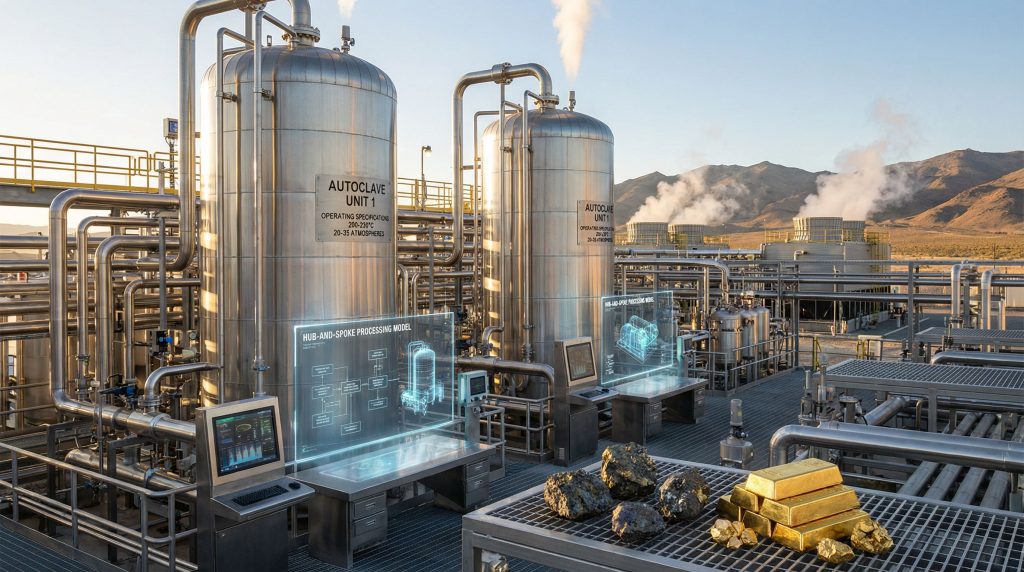
Pressure oxidation facilities operate under extreme conditions, maintaining temperatures between 200-230°C and pressures exceeding 20 atmospheres to break down sulphide bonds within pyrite, arsenopyrite, and chalcopyrite host minerals. This high-pressure oxidation process generates sulphuric acid as a byproduct, requiring specialised metallurgy including titanium-clad steel or 316L stainless steel equivalents to resist corrosive environments.
Nevada produced 5.9 million ounces of gold in 2023, representing approximately 80% of total U.S. gold production and positioning the state as the world's fourth-largest gold-producing region. Within this output, refractory deposits comprise an estimated 15-25% of remaining economically viable gold resources across mature mining districts, with proportions increasing as near-surface oxide deposits become depleted.
Infrastructure Concentration and Market Control
The technical complexity and capital intensity of autoclave ownership in Nevada gold processing has created a duopoly structure. Nevada Gold Mines operates multiple pressure oxidation facilities integrated into their Carlin Trend operations, while i-80 Gold controls the Lone Tree autoclave facility currently undergoing comprehensive refurbishment to restore operational capacity.
| Facility Controller | Processing Location | Operational Status | Strategic Focus |
|---|---|---|---|
| Nevada Gold Mines | Goldstrike/Twin Creeks | Active Operations | Internal Production Priority |
| i-80 Gold | Lone Tree Complex | Refurbishment Phase | Hub-and-Spoke Strategy |
This concentration reflects both the substantial capital barriers to entry and the specialised expertise required for successful autoclave operations, creating competitive advantages for companies with owned processing infrastructure.
When big ASX news breaks, our subscribers know first
Economic Framework: Owned Processing versus Third-Party Arrangements
The fundamental economics of refractory gold processing reveal dramatic differences between facility ownership and toll milling arrangements. These variations extend beyond simple cost structures to encompass operational control, margin capture, and strategic positioning within Nevada's gold processing ecosystem.
Recovery Performance Differentials
Toll milling arrangements typically achieve 55-60% payable gold recovery rates, reflecting the economic terms under which third-party processors operate. In contrast, owned autoclave facilities target recovery rates approaching 92% of theoretical potential, representing a substantial improvement in metallurgical performance and revenue capture.
The cost differential between these approaches ranges from $1,000-$1,500 per ounce, according to operator disclosures. This margin compression under toll arrangements stems from both reduced recovery rates and third-party processing fees that eliminate direct margin capture opportunities. However, with gold prices 2025 expected to reach new highs, the value of controlling processing infrastructure becomes even more compelling.
Operational Control and Flexibility Advantages
Autoclave ownership provides operational parameters unavailable through toll arrangements:
- Process Optimisation: Direct control over temperature, pressure, and residence time adjustments
- Blend Management: Ability to optimise ore characteristics through strategic feed blending
- By-Product Capture: Retention of silver, copper, and molybdenum recovery credits
- Scheduling Flexibility: Coordination between mining operations and processing campaigns
- Quality Control: Immediate response capability for metallurgical performance issues
These advantages compound over mine life cycles, providing operational resilience and margin protection during volatile commodity price environments.
Capital Allocation Efficiency
The hub-and-spoke processing model distributes fixed infrastructure costs across multiple ore sources, reducing per-ounce capital intensity compared to standalone facility development. This approach enables mid-tier operators to achieve economies of scale typically associated with larger integrated producers.
What Are the Financial Requirements for Autoclave Infrastructure Development?
Modern autoclave construction represents one of the mining industry's most capital-intensive undertakings, with costs reflecting both technical complexity and specialised material requirements. Recent engineering assessments indicate total capital expenditures ranging from $400-500 million for facilities processing 2,000-3,000 tonnes per day.
Capital Cost Structure Analysis
Engineering studies reveal predictable cost distribution patterns across autoclave development programs:
- Pressure Vessels and Reactors: 25-30% of total capital
- Infrastructure and Utilities: 20-25% of total capital
- Environmental Controls: 15-20% of total capital
- Engineering and Construction: 15-20% of total capital
- Contingency and Owner's Costs: 15-20% of total capital
The Lone Tree refurbishment program exemplifies brownfield capital efficiency, with total estimated expenditure of $430 million comprising a $412 million AACE Class 3 estimate plus $18 million in capital spares. This brownfield approach leverages existing permitted footprint and foundation infrastructure, reducing capital requirements relative to greenfield development.
Engineering Execution and Risk Management
Successful autoclave projects require specialised contractor expertise and proven track records in high-pressure oxidation technology. The Lone Tree refurbishment benefits from Hatch Ltd.'s legacy knowledge of the facility's original 1990s construction, providing institutional memory and reducing execution risk compared to greenfield developments.
Funding Timeline and Market Access
Capital deployment schedules reflect both technical requirements and market timing considerations. The Lone Tree program targets $350-400 million in additional financing beyond existing corporate resources, with funding completion expected by Q2 2026 to enable major construction commencement in the second half of 2026. Companies typically explore various capital raising methods to secure such substantial investments.
Capital cost estimates are subject to engineering refinement, commodity price inflation, and construction market conditions. Actual expenditures may vary materially from preliminary assessments.
Integrated Production Systems and Operational Synergies
The transition from standalone mine economics to integrated processing systems represents a fundamental shift in how Nevada gold operations create value. Hub-and-spoke configurations aggregate multiple ore sources through centralised processing infrastructure, optimising both capital efficiency and operational performance.
Production Integration Mechanics
Integrated systems consolidate underground deposits through strategic processing coordination:
- Multiple Mine Feeds: Granite Creek, Cove, and Archimedes deposits feed the Lone Tree processing hub
- Ore Blending Optimisation: Metallurgical performance enhancement through strategic feed mixing
- Infrastructure Sharing: Reduced total capital requirements versus individual facility development
- Operational Redundancy: Enhanced production reliability through diversified ore sources
Scaling Economics and Production Targets
The integrated approach enables dramatic production scaling from current constrained levels to substantial annual output targets:
- 2025 Production Guidance: 20,000-30,000 ounces under toll milling constraints
- 2028 Production Target: ~200,000 ounces annually through owned processing
- Long-term Production Goal: >600,000 ounces annually across integrated system
- 2028 EBITDA Projection: $200-300 million depending on gold price environment
Value Creation Through Processing Control
Net present value calculations demonstrate the leverage inherent in processing ownership. At a 5% discount rate, preliminary economic assessments indicate NPV expansion from approximately $1.6 billion at $2,175/oz gold to $4.9 billion at $3,000/oz gold, representing $3.3 billion in potential value enhancement across the portfolio.
This value creation stems from margin capture previously lost to toll processing arrangements, combined with operational flexibility unavailable through third-party processing contracts. Moreover, the gold price forecast suggests continued upward momentum, further enhancing these value propositions.
Regulatory Environment and Permitting Requirements
Nevada autoclave operations function within a comprehensive regulatory framework addressing environmental protection, worker safety, and community impact considerations. The permitting processes reflect both the technical complexity of pressure oxidation and the environmental sensitivity surrounding mercury and sulphur dioxide emissions.
Primary Permit Requirements
Autoclave facilities require multiple federal and state approvals:
- Title V Air Quality Permits: Clean Air Act compliance for mercury and SO₂ emissions
- NPDES Water Discharge Permits: National Pollutant Discharge Elimination System approvals
- Nevada Division of Environmental Protection: State-level mercury emissions control authorisation
- Waste Management Protocols: Specialised handling requirements for autoclave residues
Environmental Compliance Infrastructure
Modern autoclave facilities incorporate sophisticated environmental controls:
- Mercury emissions monitoring and abatement systems with real-time tracking capability
- Sulphur dioxide capture and treatment infrastructure preventing atmospheric release
- Comprehensive groundwater protection programmes with continuous monitoring networks
- Specialised waste management protocols for high-sulphur autoclave residues
Permitting Timeline Considerations
Regulatory approval processes typically require 12-18 months for comprehensive permitting, with environmental impact assessments and public comment periods extending timelines for greenfield developments. Brownfield refurbishments benefit from existing permitted footprints but require amendments for capacity modifications or process changes.
The Lone Tree refurbishment leverages existing environmental permits while updating specific operational parameters, reducing regulatory timeline risk compared to greenfield autoclave development.
Market Dynamics and Processing Capacity Constraints
Nevada's gold processing landscape reflects a structural imbalance between refractory ore generation and available autoclave capacity. As mature mining districts encounter increasing proportions of sulphide mineralisation, processing bottlenecks increasingly influence asset valuations and development economics.
Supply-Demand Dynamics
Several factors contribute to processing capacity constraints:
- Limited Facility Count: Only two operational autoclave facilities serving the entire state
- Internal Production Priority: Existing facilities prioritise owner ore processing
- High Toll Processing Costs: Capacity constraints drive premium pricing for available capacity
- Long-term Contract Scarcity: Limited availability of guaranteed processing capacity
Impact on Asset Valuation
Processing access increasingly influences Nevada gold asset valuations, with owned processing capacity commanding premium multiples compared to deposits dependent on toll arrangements. This dynamic reflects both the structural margin advantages and operational control that autoclave ownership provides.
Future Capacity Considerations
Nevada's autoclave processing landscape may evolve as refractory ore development accelerates, though high capital requirements and technical complexity maintain significant barriers to entry. Existing facility expansions and strategic partnerships may provide incremental capacity increases without requiring entirely new autoclave construction. The broader mining industry innovation trends are also influencing how companies approach processing infrastructure development.
Market Analysis Disclaimer: Processing capacity projections are subject to commodity price cycles, regulatory changes, and capital market conditions that may influence development timing and feasibility.
The next major ASX story will hit our subscribers first
How Do Companies Manage Technical Risk in Autoclave Operations?
Autoclave operations present unique technical challenges requiring specialised risk management approaches. High-pressure vessel integrity, corrosive environment management, and process control complexity demand comprehensive safety protocols and predictive maintenance strategies.
Primary Operational Risk Factors
Critical risk areas include:
- Equipment Corrosion: Accelerated degradation from sulphuric acid generation
- Process Control Complexity: Temperature and pressure parameter optimisation requirements
- Safety Management: High-pressure vessel operations with emergency response protocols
- Metallurgical Variability: Ore characteristic variations affecting processing performance
Risk Mitigation Framework
Successful autoclave operations implement comprehensive risk management:
- Redundant Safety Systems: Emergency shutdown protocols with multiple backup systems
- Predictive Maintenance: Advanced monitoring for critical equipment lifecycle management
- Specialised Training: Operator certification requirements for pressure vessel operations
- Comprehensive Insurance: Coverage for pressure vessel operations and business interruption
Metallurgical Performance Variables
Ore characteristics significantly impact autoclave performance and require continuous optimisation:
- Sulphide Mineralogy: Pyrite, arsenopyrite, and chalcopyrite content affecting oxidation requirements
- Carbon Content: Preg-robbing carbon requiring specialised treatment protocols
- Arsenic Levels: Environmental controls and reagent consumption considerations
- Feed Grade Variations: Residence time and temperature adjustments for optimal recovery
Understanding these variables enables operators to maximise recovery while maintaining environmental compliance and cost efficiency.
Strategic Investment Implications and Valuation Framework
Investment analysis for Nevada gold projects must incorporate processing pathway assumptions, with owned autoclave access providing superior economics compared to toll arrangements. The strategic value of processing control extends beyond direct cost savings to encompass operational flexibility and competitive positioning.
Valuation Assessment Criteria
Key evaluation factors for autoclave-dependent projects include:
- Processing Capacity Access: Availability and terms of autoclave processing arrangements
- Toll Milling Cost Assumptions: Long-term cost projections and escalation sensitivity
- Development Timeline Risk: Facility construction or refurbishment completion schedules
- Net Present Value Sensitivity: Processing cost impact on project economics
Enterprise Value Considerations
Valuation frameworks must account for processing infrastructure control:
- Margin Capture Differential: NPV sensitivity to processing cost assumptions
- Per-Ounce Valuation Premiums: Owned versus toll processing scenario comparisons
- Capital Allocation Efficiency: Integrated versus mining-only operation returns
- Strategic Optionality Value: Processing infrastructure control benefits
Investment Risk Assessment
Processing-dependent projects carry both execution and operational risks requiring careful evaluation. Capital deployment risk, permitting timeline uncertainty, and cost inflation exposure must be balanced against the strategic advantages of processing control.
Successful autoclave ownership provides sustainable competitive advantages through margin capture, operational flexibility, and strategic positioning as processing bottlenecks persist across Nevada's gold sector.
Nevada's Autoclave Infrastructure: Future Outlook
Technology advancement in pressure oxidation focuses on energy efficiency improvements, automated process control systems, and enhanced environmental performance. Next-generation facilities incorporate heat recovery systems, advanced metallurgy for extended equipment life, and integrated digital monitoring platforms that reduce operational risk while improving performance consistency.
The concentration of autoclave ownership in Nevada gold processing creates long-term strategic advantages for infrastructure-controlling companies, supporting premium valuations relative to toll-dependent operators as processing bottlenecks persist throughout the state's mature mining districts. Additionally, the Nevada Gold Mines operation continues to set industry standards for integrated autoclave processing efficiency.
Looking to Capitalise on Nevada's Gold Processing Infrastructure?
Discovery Alert's proprietary Discovery IQ model provides instant notifications when significant ASX mineral discoveries are announced, enabling investors to identify and act on opportunities in companies developing processing infrastructure and integrated mining systems. Explore historic examples of exceptional discovery returns and begin your 30-day free trial today to secure your market-leading advantage in identifying the next major breakthrough.