Qmines Ltd
- ASX Code: QML
- Market Cap: $43,231,522
QMines Delivers 32% Gold Resource Upgrade at Mount Mackenzie
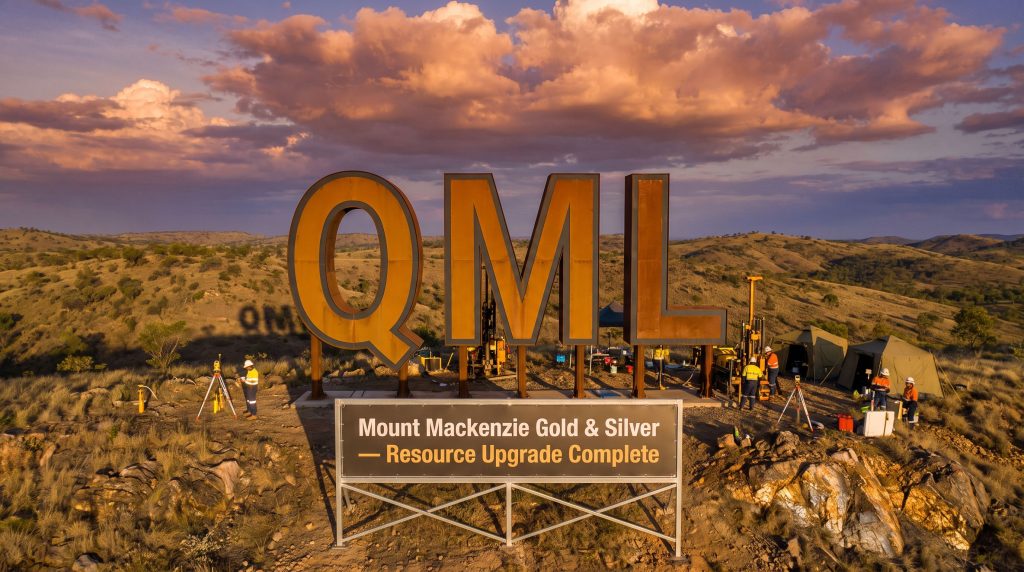
QMines (ASX: QML) has reported an updated Mineral Resource Estimate (MRE) for its 100%-owned Mount Mackenzie Gold and Silver Project in Central Queensland, lifting contained metal to 170,000 ounces of gold and 1.12 million ounces of silver. This QMines Mount Mackenzie gold resource upgrade to 170,000 ounces represents a 32% increase in contained gold and a 30% increase in contained silver since QMines acquired the project. Approximately 70% of contained gold is now classified in the higher-confidence Indicated category, a shift the company says strengthens the technical foundation for future development studies.
The update is the ninth resource revision QMines has published since listing in 2021, and the first at Mount Mackenzie to draw on drilling completed by the company itself. It follows a 73-hole, 9,798-metre reverse circulation (RC) and diamond drilling campaign concentrated on the project's North Knoll deposit.
When big ASX news breaks, our subscribers know first
The Numbers at a Glance
Table 1: Updated Mount Mackenzie Mineral Resource Estimate (July 2026, 0.4 g/t Au cut-off)
| Classification | Tonnes (Mt) | Au (g/t) | Ag (g/t) | Au (oz) | Ag (oz) |
|---|---|---|---|---|---|
| Indicated | 3.77 | 0.99 | 7.3 | 120,000 | 889,000 |
| Inferred | 1.45 | 1.07 | 4.9 | 50,000 | 230,000 |
| Total | 5.22 | 1.01 | 6.7 | 170,000 | 1,119,000 |
Reported at a 0.4 g/t Au lower cut-off grade in accordance with the JORC Code (2012), figures are rounded and may not sum exactly.
Since QMines acquired the project, the proportion of contained gold classified as Indicated has grown from approximately 51% to 70%, according to the company. That shift is described as directly strengthening the basis for mine planning and economic evaluation work ahead.
How Does This Compare to Previous Estimates?
Table 2: Comparison with the Acquisition Benchmark (REZ, May 2020)
| Resource Estimate | Date | Tonnes (Mt) | Au (g/t) | Ag (g/t) | Au (oz) | Ag (oz) |
|---|---|---|---|---|---|---|
| Resources & Energy Group | May 2020 | 3.42 | 1.18 | 9.0 | 129,000 | 862,000 |
| QMines Limited | July 2026 | 5.22 | 1.01 | 6.7 | 170,000 | 1,119,000 |
| Change | +53% | -14% | -26% | +32% | +30% |
The May 2020 REZ estimate was reported within an optimised pit shell using separate oxide and primary cut-offs of 0.35 g/t and 0.55 g/t Au respectively, while the July 2026 MRE applies a uniform 0.4 g/t Au cut-off. QMines has been clear that this is not a like-for-like comparison, and that the percentage changes reflect the respective published reporting bases.
The grade dilution visible in the table is attributed to the expanded mineralised envelope captured by QMines' drilling. The resource now encompasses more lower-grade tonnes within a broader geological domain, which the company describes as a more complete picture of the deposit system rather than any deterioration in the underlying mineralisation.
Table 3: Comparison with July 2025 QMines Estimate
| Resource Estimate | Date | Tonnes (Mt) | Au (g/t) | Ag (g/t) | Au (oz) | Ag (oz) |
|---|---|---|---|---|---|---|
| QMines Limited | July 2025 | 3.35 | 1.40 | 8.4 | 151,200 | 902,000 |
| QMines Limited | July 2026 | 5.22 | 1.01 | 6.7 | 170,000 | 1,119,000 |
| Approximate Change | +56% | -28% | -20% | +12% | +24% |
The July 2025 figures were reported at a 0.3 g/t Au cut-off, while the July 2026 figures use a 0.4 g/t Au cut-off. These estimates sit on different reporting bases and are not directly comparable.
The Confidence Upgrade: Why Indicated Classification Matters
Tom Bartschi, QMines Exploration Manager: "Contained gold classified as Indicated has increased from 66,000 oz to 120,000 oz, with approximately 70% of the updated gold Resource now classified as Indicated."
For investors less familiar with resource reporting mechanics, the distinction between Indicated and Inferred classification is one of the most important signals in this announcement.
What Is the Difference Between Indicated and Inferred Resources?
Under the JORC Code (2012), the reporting standard applied by ASX-listed mining companies, mineral resources are classified according to the level of geological confidence supporting them.
- Inferred Resources rely on limited drilling where geological continuity can reasonably be assumed but has not been sufficiently established. They carry higher uncertainty and generally cannot support mine planning or economic feasibility studies.
- Indicated Resources are supported by closer drill spacing, validated data and greater confidence in grade continuity. They can underpin Prefeasibility Studies (PFS) and more advanced economic modelling.
- Measured Resources, not yet applicable at Mount Mackenzie, represent the highest confidence level and typically require very tight drill spacing.
Why Does This Matter to Investors?
The conversion of tonnes from Inferred to Indicated directly advances a project's readiness for technical and economic evaluation. A higher Indicated proportion suggests the geological team has moved from a broad understanding of mineralisation to a more defined picture of its location and behaviour, which underpins the credibility of future pit optimisation, mine scheduling and economic assessments.
At Mount Mackenzie, furthermore, the announcement confirmed the following:
- Indicated tonnes increased by approximately 122% compared to the 2020 REZ estimate
- Indicated contained gold grew from approximately 66,000 oz to 120,000 oz
- Approximately 70% of total contained gold now sits in the Indicated category
What the Drilling Revealed Beyond the Numbers
One of the more significant outcomes of the 73-hole campaign, according to QMines, is an improved geological understanding of the deposit system. The company reports that gold distribution at Mount Mackenzie is governed by identifiable controls rather than occurring randomly.
Key findings cited in the announcement include:
- Advanced argillic alteration, a specific rock alteration pattern, has emerged as the strongest logged indicator of gold mineralisation
- Moderately broken silica-rich ground has been confirmed as a favourable structural setting for mineralisation
- The deposit displays a shallow-enriched gold position overlying deeper, structurally controlled mineralised zones
- The system is interpreted as a coherent magmatic-hydrothermal system, specifically a high-sulphidation epithermal deposit with potential porphyry affiliation, with predictable geological controls
QMines states this geological clarity provides clearer targeting criteria for future drilling, particularly at depth and to the west of North Knoll. Importantly, none of the three deposits at Mount Mackenzie have been fully drilled out, with the company confirming all remain open along strike and at depth.
Understanding the Deposit: A Primer on High-Sulphidation Epithermal Systems
What Is a High-Sulphidation Epithermal Deposit?
Mount Mackenzie is interpreted as a high-sulphidation (HS) epithermal gold-silver system, a deposit type that forms in volcanic environments where hot, acidic fluids rise through the earth's crust and interact with overlying rocks, depositing gold and silver within an altered volcanic sequence known as a lithocap.
| Term | Plain-English Meaning |
|---|---|
| Epithermal | Formed at relatively shallow crustal depths, typically 1-2 km, in volcanic settings |
| High-sulphidation | Describes the acidic nature of mineralising fluids, which create distinctive alteration patterns |
| Lithocap | The altered volcanic cap rock where gold-silver mineralisation preferentially occurs |
| Advanced argillic alteration | An alteration pattern including minerals such as alunite and kaolinite that indicates proximity to mineralisation |
| Porphyry affiliation | Possible connection to a deeper copper-gold system, which would be significant for potential scale |
According to QMines, HS epithermal deposits globally are known for hosting sizeable gold-silver inventories and are often suited to open-pit mining when mineralisation occurs at or near surface, both characteristics considered relevant at Mount Mackenzie.
Resource Sensitivity: What Grades Look Like at Different Cut-offs
Table 4: Resource Sensitivity at Various Cut-off Grades
| Cut-off (g/t Au) | Total Tonnes (Mt) | Au (g/t) | Ag (g/t) | Total Au (koz) |
|---|---|---|---|---|
| 0.20 | 7.76 | 0.78 | 5.5 | 195 |
| 0.30 | 6.54 | 0.88 | 6.0 | 185 |
| 0.40 (reported) | 5.22 | 1.01 | 6.7 | 170 |
| 0.50 | 4.20 | 1.15 | 7.3 | 155 |
| 0.60 | 3.44 | 1.28 | 7.9 | 141 |
| 0.70 | 2.76 | 1.44 | 8.7 | 128 |
| 1.00 | 1.56 | 1.91 | 10.6 | 96 |
This sensitivity table gives investors a picture of how the resource responds under differing economic assumptions. At a 0.5 g/t Au cut-off, still within the range typically applicable to shallow open-pit gold operations, the resource holds 155,000 oz of gold at 1.15 g/t Au. A more conservative 0.7 g/t cut-off still returns 128,000 oz at 1.44 g/t Au.
What This Unlocks: A Stronger Foundation for Development Studies
QMines has indicated this MRE update is a step toward, rather than an endpoint of, the project's technical development. The company states the improved resource now provides a stronger basis for:
- Open-pit optimisation, running pit shell scenarios to define the economically extractable portion of the resource
- Metallurgical testwork, noting historical (not QMines' own) testwork reported gold recoveries of approximately 94% for oxide and transitional material and approximately 59% for fresh or sulphide material using conventional processing methods
- Mine scheduling and geotechnical evaluation
- Infrastructure and processing route assessment
- Future economic studies, building toward a Prefeasibility or Feasibility Study
The shallow geometry of North Knoll mineralisation, commencing at or near surface and extending approximately 300 metres vertically, supports continued assessment of conventional open-pit mining methods, according to the announcement.
The South West Slopes deposit, one of three at the project, was not drilled during the recent campaign and remains available for future resource growth drilling, representing an additional avenue for organic growth within the existing project footprint.
The Broader QMines Portfolio Across Queensland
Mount Mackenzie is one of three wholly owned projects in QMines' Queensland-focused portfolio. Across all assets, the company reports combined resources of approximately 22 Mt, including an Ore Reserve of 9.6 Mt at the flagship Mt Chalmers copper-gold project.
QMines Portfolio Summary
| Project | Ownership | Primary Commodities | Status |
|---|---|---|---|
| Mt Chalmers | 100% | Copper, Gold, Silver | Ore Reserve of 9.6 Mt; PFS completed |
| Develin Creek | 100% | Copper, Zinc, Gold, Silver | Resource of 4.70 Mt |
| Mt Mackenzie | 100% | Gold, Silver | Resource of 5.22 Mt (updated July 2026) |
Mt Chalmers is a historic mine that produced 1.2 Mt at 2.0% Cu, 3.6 g/t Au and 19 g/t Ag between 1898 and 1982 and remains the most advanced asset in the portfolio. A Prefeasibility Study completed in April 2024 supported the potential viability of a copper and gold mine at that site.
Why This Matters to Investors
This resource upgrade builds on several elements of QMines' investment case. In addition, the QMines Mount Mackenzie gold resource upgrade to 170,000 ounces demonstrates the company's capacity to consistently deliver meaningful results from its own drilling programs.
Demonstrated Exploration Delivery
This marks QMines' ninth resource update since listing in 2021, and the first at Mount Mackenzie built on the company's own drilling data. That track record is, consequently, becoming an increasingly meaningful differentiator.
Quality Alongside Quantity
The conversion of approximately 82% more contained gold to Indicated status (relative to the 2020 REZ estimate) represents a change in resource confidence, not simply resource volume. Higher-confidence resources are positioned to enable more robust development studies.
Open-Ended Exploration Upside
All three deposits at Mount Mackenzie remain open along strike and at depth, and the South West Slopes deposit has yet to be drilled by QMines. This preserves meaningful potential for further resource growth within the existing project area.
Improved Geological Targeting
The identification of alteration and structural controls on gold distribution provides a targeting framework that was not available at acquisition, which may, furthermore, improve the efficiency of future drilling programs considerably.
A Defined Pathway to Development Evaluation
The updated MRE is positioned to support pit optimisation, metallurgical testwork and economic studies as logical next steps toward a development decision at Mount Mackenzie.
Key Takeaway: The QMines Mount Mackenzie gold resource upgrade to 170,000 ounces is described as substantive in both scale and confidence, with 32% more gold, 30% more silver, and 70% of contained gold now classified as Indicated. With all deposits remaining open and a clearer geological model in place, the project moves further along the pathway from an acquired asset toward a development study candidate. Investors may watch for the next phase of technical work as QMines seeks to build on this resource base.
The next major ASX story will hit our subscribers first
Glossary of Key Terms
| Term | Definition |
|---|---|
| JORC Code (2012) | The Australasian Code for Reporting of Exploration Results, Mineral Resources and Ore Reserves, the standard governing resource reporting for ASX-listed companies |
| Mineral Resource Estimate (MRE) | A volumetric estimate of mineralised material with reasonable prospects for economic extraction, classified by confidence level |
| Indicated Resource | A resource with sufficient geological confidence to support mine planning and Prefeasibility Studies |
| Inferred Resource | A resource where geological continuity can be inferred but has not been sufficiently established for Indicated classification |
| RC Drilling | A drilling method using compressed air to return rock chips to surface, commonly used for near-surface resource definition |
| Diamond Drilling | A drilling method that returns continuous cylindrical rock core, used for detailed geological and structural analysis |
| Cut-off Grade | The minimum grade at which mineralisation is included in a resource estimate, reflecting assumptions about economic viability |
| Ordinary Kriging | A geostatistical technique used to estimate grade values in unmeasured locations based on surrounding drill data |
| CIP/CIL | Carbon-in-Pulp and Carbon-in-Leach, conventional gold processing methods using activated carbon to recover gold from leached slurry |
| High-sulphidation epithermal | A deposit type formed by acidic hydrothermal fluids in volcanic settings, often characterised by advanced argillic alteration |
| Competent Person | A suitably qualified and experienced professional responsible for reported technical and geological data under the JORC Code |
Want to Learn More About QMines and Its Queensland Gold Projects?
QMines (ASX: QML) is building a compelling multi-asset portfolio across Queensland, with a 32% gold resource upgrade at Mount Mackenzie representing the latest milestone in its development journey. With all three deposits remaining open along strike and at depth, a clearer geological model in place, and a defined pathway toward development studies, there is considerably more to explore about this company's investment case. To find out more about QMines and its projects, visit qmines.com.au.