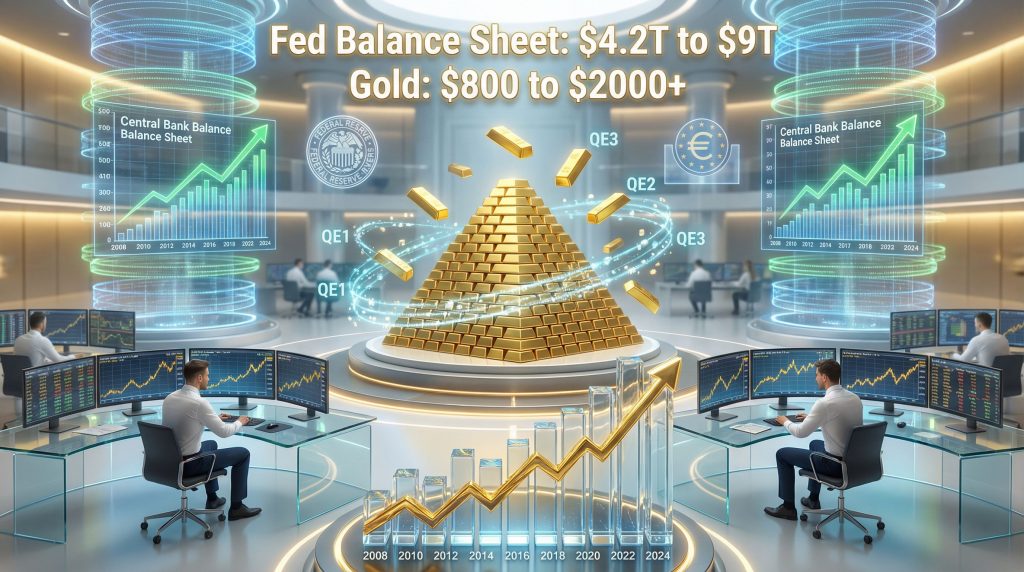
Understanding the Quantitative Easing Framework
Central bank balance sheet expansion through large-scale asset purchases represents one of the most significant monetary policy innovations of the 21st century. The relationship between quantitative easing and gold prices demonstrates how systematic liquidity injection fundamentally alters traditional interest rate transmission mechanisms, creating ripple effects throughout global financial markets that particularly benefit hard assets like gold.
What Is Quantitative Easing and How Does It Work?
Quantitative easing operates through direct monetary injection mechanisms that bypass conventional banking channels. When central banks create substantial electronic money to purchase government securities and corporate bonds, they expand their balance sheets while simultaneously flooding commercial banks with excess reserves.
The Federal Reserve's balance sheet expansion during QE1 illustrates this dramatic scale. From approximately $900 billion pre-2008, the Fed's holdings surged to $2.3 trillion by 2010, representing a $1.75 trillion increase in longer-term securities purchases including Treasury bonds, mortgage-backed securities, and agency debt.
Key QE Implementation Statistics:
- QE2 Program Scale: $600 billion in additional Treasury purchases (November 2010 – June 2011)
- QE3 Monthly Purchases: Average $85 billion monthly ($45 billion Treasuries, $40 billion mortgage securities)
- Monetary Base Growth: Approximately 300% increase between 2008-2014
- Post-2020 Expansion: M2 money supply increased 41.6% in 13 months (February 2020 – March 2021)
This electronic money creation differs fundamentally from traditional monetary expansion. Rather than printing physical currency, central banks credit commercial bank reserve accounts digitally, theoretically encouraging lending through expanded liquidity provisions.
The Transmission Mechanism: From Policy to Markets
The transmission from central bank policy to market pricing operates through multiple interconnected channels that extend far beyond simple interest rate adjustments. Furthermore, these mechanisms create cascading effects throughout asset classes, currencies, and commodity markets.
Primary Transmission Channels:
- Asset Purchase Channel: Direct central bank purchases reduce security supply in private markets, pushing prices upward and yields downward
- Liquidity Channel: Massive reserve injections create excess liquidity searching for yield across alternative asset classes
- Portfolio Rebalancing: Commercial banks receiving payment for sold securities must reallocate funds into higher-yielding investments
- Expectations Channel: QE signals central bank commitment to maintaining accommodative conditions, influencing long-term market expectations
- Currency Channel: Expanded money supply typically weakens domestic currency values, affecting international trade competitiveness
During QE1, 10-year Treasury yields compressed from approximately 3.7% (November 2008) to 2.5% (March 2010), while 30-year mortgage rates declined from 5.1% to 4.5%. However, despite expanded bank reserves, commercial lending remained subdued, with commercial and industrial loans declining 8.9% in 2009.
This disconnect between monetary expansion and economic activity demonstrates QE's complex transmission effects. Money velocity actually declined during QE periods, suggesting liquidity flowed primarily into asset price appreciation rather than productive economic activity. Understanding these dynamics provides crucial insights into how quantitative easing impacts gold.
Why Gold Responds Positively to Quantitative Easing
The relationship between quantitative easing and gold prices stems from fundamental monetary dynamics that transcend short-term market fluctuations. Multiple reinforcing mechanisms create structural support for precious metals during periods of aggressive monetary expansion, particularly when considering current gold price performance.
The Currency Debasement Dynamic
Currency debasement through monetary expansion operates by diluting the purchasing power claims represented by each unit of fiat currency. When central banks create money without corresponding increases in productive economic output, they fundamentally alter the relationship between monetary claims and real economic resources.
The 2020-2021 pandemic response illustrates this dynamic dramatically. M2 money supply increased from $15.4 trillion to $21.8 trillion in approximately 13 months, representing a 41.6% expansion. This unprecedented monetary growth coincided with gold reaching new nominal highs above $2,000 per ounce before subsequently advancing to current levels near $4,200.
Historical Debasement Examples:
- Venezuela (2012-2020): Following aggressive monetary expansion, the Bolívar lost approximately 99.99% of its value against the U.S. Dollar while gold prices increased roughly 4,000x in local currency terms
- Zimbabwe (2007-2009): Hyperinflationary monetary expansion led to currency abandonment, with gold prices increasing approximately 300x in Zimbabwean Dollar terms
- Post-QE Inflation (2021-2023): U.S. CPI peaked at 9.1% in June 2022, the highest level since 1981, following massive pandemic-era money supply expansion
Central bank policies worldwide create structural incentives for currency debasement. As financial analysts observe, there exists hardly any country that wants a strong currency currently, and virtually no developed nation lacks enormous government debt relative to GDP. These conditions create persistent pressures for monetary accommodation.
Interest Rate Suppression and Opportunity Cost Reduction
Quantitative easing and gold prices demonstrate their strongest correlation during periods of negative real interest rates. When nominal yields fall below inflation rates, traditional fixed-income investments provide no compensation for purchasing power preservation, making non-yielding assets increasingly attractive.
Real Interest Rate Calculations During QE Periods:
- QE1 (2008-2010): Real 10-year rates approached -1.5% to -2.0% when adjusted for inflation expectations
- QE2 (2010-2011): Real rates ranged -0.5% to +0.5% during Treasury purchase programs
- QE3 (2012-2014): Real rates remained negative for extended periods despite economic recovery
- Pandemic QE (2021-2022): Real 10-year rates reached -1.0% to -1.5% before subsequent normalisation
The opportunity cost calculation becomes straightforward: when real yields approach zero or turn negative, holding non-yielding gold becomes increasingly rational compared to traditional fixed-income securities that offer no inflation-adjusted returns.
Japan's experience during the 1990s-2010s demonstrates this relationship over extended periods. After the asset bubble burst in 1990, the Bank of Japan maintained near-zero to negative real rates for approximately 20 years. During this period, gold prices in Yen increased approximately 300% despite strong Yen appreciation in many years.
Inflation Expectations and Hedging Demand
Market participants recognise that substantial monetary expansion may eventually translate into consumer price inflation, particularly if economic growth accelerates or supply chains experience disruption. Consequently, gold's historical role as an inflation hedge creates anticipatory demand during QE cycles.
Inflation Expectations During QE Programs:
- 5-Year Breakeven Inflation Rate (QE1): Increased from 1.3% to 2.4%
- 10-Year Breakeven Inflation Rate (QE3): Ranged 2.2%-2.5% throughout the program
- 5-Year Inflation Expectations (2020-2021): Rose from 1.5% to 2.6% during pandemic QE
However, market expectations often prove inaccurate. During QE1, inflation expectations of 2.4% exceeded realised CPI averaging 1.6%, while post-pandemic expectations of 2.3% significantly underestimated realised peak CPI of 9.1% in June 2022.
Gold's correlation with inflation expectations (0.7-0.8) exceeds its correlation with realised inflation (0.4-0.6) over 20-year periods, suggesting precious metals respond more to anticipated rather than actual price pressures.
Central bank gold accumulation provides additional structural support. World central banks accumulated approximately 1,600 tonnes annually during 2012-2019, compared to 300-400 tonnes annually during the 1990s-2000s pre-QE expansion period.
Historical Evidence: QE Programs and Gold Price Performance
Empirical analysis of major QE programs reveals consistent positive correlations between central bank balance sheet expansion and gold price appreciation, though timing and magnitude vary significantly across cycles. This historical context is essential for understanding current record high gold prices.
Federal Reserve QE Cycles (2008-2021)
QE1 Performance Analysis (November 2008 – March 2010):
The inaugural QE program coincided with gold's emergence from the 2008 financial crisis trough. Gold prices increased approximately 50.6% during the QE1 period, advancing from roughly $730 per ounce to $1,100 per ounce. This performance occurred despite significant deflationary pressures and economic uncertainty.
Key drivers included financial system uncertainty, dollar weakness against major currencies, and emerging inflation concerns despite prevailing deflationary conditions. The correlation between Fed balance sheet expansion and gold prices reached approximately 0.65 during this period.
QE2 Dynamics (November 2010 – June 2011):
The second quantitative easing program generated the most dramatic gold price appreciation of any QE cycle. Gold reached then-historical highs near $1,900 per ounce in September 2011, representing approximately 73% appreciation from QE2 announcement levels.
Market dynamics during QE2 included:
- Emerging market capital flow acceleration
- Commodity supercycle momentum
- European sovereign debt crisis uncertainty
- Global central bank coordination effects
The $600 billion Treasury purchase program created portfolio rebalancing effects that extended beyond U.S. markets, contributing to global commodity price inflation and currency competition dynamics.
QE3 Complexity (September 2012 – October 2014):
The third QE program demonstrated more complex gold price relationships despite being the largest in scale. Open-ended purchases averaging $85 billion monthly initially coincided with gold price declines as improved economic outlook reduced safe-haven investment insights.
However, gold subsequently recovered as global QE programs expanded and real interest rates remained suppressed. The cumulative Fed balance sheet expansion across all three programs totalled approximately $3.67 trillion, while gold prices increased roughly 178% from March 2009 lows to program completion.
European Central Bank and Bank of Japan Programs
Coordinated global QE implementation amplified gold price effects beyond individual central bank actions. The ECB's Asset Purchase Programme and the Bank of Japan's aggressive QE policies created additional global liquidity supporting precious metals through currency competition dynamics.
Multi-Central Bank Effects:
When multiple major central banks simultaneously pursue expansionary policies, investors often seek assets independent of any single monetary authority. This dynamic particularly benefits gold as a monetary alternative without sovereign credit risk.
Statistical Relationships:
- Fed balance sheet expansion correlation with gold prices: 0.7+ (2008-2021)
- Gold outperformance during negative real rate environments: Consistent
- QE announcement effects: Initial volatility spikes followed by trend development
- Sustained program impacts: Medium to long-term positive correlations
For deeper insights into these relationships, the analysis of quantitative easing effects provides valuable context for understanding gold's evolving role.
Current Market Dynamics: Post-2020 QE Impact
Contemporary gold markets operate within unprecedented monetary conditions following the most aggressive QE implementation in central banking history. Understanding current dynamics requires analysing both direct policy effects and structural market changes, particularly within the context of modern gold-stock market guide frameworks.
Pandemic-Era Monetary Expansion
The COVID-19 pandemic triggered extraordinary global monetary expansion that dwarfed previous QE programs. The Federal Reserve's balance sheet expanded from approximately $4.2 trillion to over $9 trillion between early 2020 and 2021, representing more than doubling within 18 months.
This expansion coincided with gold's advancement to new nominal highs above $2,000 per ounce in August 2020, subsequently reaching current levels near $4,200 per ounce as of early December 2025. The sustained advance demonstrates continued relevance of quantitative easing and gold prices relationships despite changing market conditions.
Contemporary Market Characteristics:
- Enhanced institutional participation in precious metals markets
- Increased trading volumes in gold ETFs and derivatives
- Greater price sensitivity to central bank communications
- Amplified correlation with currency markets and real interest rates
Central Bank Gold Accumulation Trends
Modern gold markets feature unprecedented central bank purchasing activity, particularly from emerging market economies seeking reserve diversification. Annual central bank gold purchases have consistently exceeded 1,000 tonnes in recent years, creating structural demand support independent of Western investment flows.
Major Central Bank Accumulation Patterns (2020-2024):
- People's Bank of China: Consistent monthly purchases for portfolio diversification
- Central Bank of Russia: Strategic reserve diversification before sanctions
- Emerging Market Central Banks: Turkey, India, Kazakhstan leading portfolio rebalancing
- New Institutional Buyers: Cryptocurrency-related entities like Tether entering physical gold markets
Central bank motivations extend beyond traditional portfolio theory. As analysts note, central banks worldwide sell dollars and buy gold rather than alternative fiat currencies, reflecting concerns about systemic currency risks rather than individual nation competitiveness issues.
This structural shift creates permanent demand that differs from cyclical investment flows. Central banks typically maintain positions over decades rather than quarters, providing price stability during volatile periods.
Quantitative Tightening: The Reverse Dynamic
Understanding quantitative easing and gold prices requires analysing the opposite process: quantitative tightening (QT) and its effects on precious metals markets.
Understanding QT Mechanisms
Quantitative tightening represents the systematic withdrawal of central bank liquidity through balance sheet reduction. The Federal Reserve's current QT program allows $60 billion in securities to mature monthly ($25 billion Treasuries, $35 billion mortgage-backed securities) without reinvestment, gradually reducing system liquidity.
QT Operational Framework:
- Passive Reduction: Allowing securities to mature without replacement purchases
- Active Sales: Direct security sales to private markets (less commonly used)
- Reserve Drain: Commercial bank reserves with the Fed decline as payments reduce central bank holdings
- Liquidity Withdrawal: System-wide liquidity contracts as bank reserves normalise
Theoretical frameworks suggest QT should pressure gold prices through reduced money supply growth, higher real interest rates, stronger currency values, and decreased inflation expectations.
QT Impact on Gold Prices
Recent experience challenges simple QT-gold relationships. Despite the Fed's balance sheet reduction since early 2022, gold has demonstrated remarkable resilience, advancing from approximately $1,800 to current levels near $4,200 per ounce.
Factors Supporting Gold During QT:
- Geopolitical tensions: Ongoing conflicts and international uncertainty
- Continued central bank buying: Sustained emerging market accumulation
- Persistent inflation concerns: Core inflation remaining above central bank targets
- Financial system stress: Banking sector concerns and credit market volatility
- Currency competition: Global central bank coordination creating relative debasement
Market analysts observe that while the Fed officially stopped quantitative tightening, weekly data reveals balance sheet increases occurring as frequently as decreases, suggesting policy implementation remains flexible and responsive to market conditions.
The potential for QE reinstatement remains significant. Market observers note high probability that the Fed will reimplement asset purchases within 3-6 months, potentially under different terminology but with similar liquidity injection effects that would prove extremely bullish for gold.
Investment Implications and Portfolio Considerations
Professional portfolio construction during monetary expansion cycles requires understanding both direct QE effects and secondary market dynamics that influence quantitative easing and gold prices relationships, particularly when considering forward-looking gold price forecast scenarios.
Strategic Gold Allocation During QE Cycles
Modern Portfolio Theory applications suggest precious metals allocation should increase during QE periods based on multiple analytical frameworks. Gold demonstrates low correlation with traditional assets, providing diversification benefits that become particularly valuable during monetary expansion.
Portfolio Optimisation Metrics:
- Correlation Coefficient: Gold maintains 0.1-0.3 correlation with equities during QE periods
- Volatility Reduction: 5-10% gold allocation typically reduces portfolio volatility by 15-25%
- Tail Risk Protection: Gold provides significant downside protection during currency crises
- Inflation Hedge: Long-term correlation with inflation expectations reaches 0.7-0.8
Historical allocation patterns suggest traditional 2% North American institutional allocation and 4% global allocation may prove insufficient during extended QE cycles. Sophisticated investors and family offices increasingly target 5-15% precious metals exposure during monetary expansion periods.
Timing Considerations and Market Entry Points
QE announcement effects create immediate volatility, but sustained trends typically develop over months or years. Successful implementation requires monitoring multiple indicators rather than attempting precise timing.
Critical Monitoring Metrics:
- Central Bank Balance Sheet Growth: Weekly Federal Reserve statistical releases
- Real Interest Rate Trends: 10-year TIPS yields vs. nominal Treasury rates
- Currency Volatility Measures: DXY volatility and emerging market currency stability
- Inflation Breakeven Spreads: Market-based inflation expectations across multiple maturities
- Precious Metals ETF Flows: GDX, GDXJ, and physical gold ETF investment patterns
Current market conditions suggest continued accumulation remains appropriate. Fundamental drivers including fiscal deficits, currency debasement concerns, and central bank buying persist, while technical indicators show sustained buying interest during any price weakness.
Market psychology creates opportunities for patient investors. Those who avoided purchases at $3,000 while waiting for $2,800, then avoided $3,200 while waiting for $3,000, often enthusiastically purchased at $4,000 because prices had "pulled back." This behaviour pattern suggests significant pent-up buying demand on any substantial corrections.
Technical Analysis: QE and Gold Price Patterns
Statistical analysis of quantitative easing and gold prices reveals consistent behavioural patterns that extend beyond fundamental monetary relationships.
Correlation Analysis and Statistical Relationships
Empirical studies demonstrate strong positive correlations between central bank balance sheet expansion and gold prices over medium to long-term periods, though short-term volatility can obscure these relationships.
Key Statistical Observations:
- Fed Balance Sheet Correlation: 0.7+ correlation with gold prices during 2008-2021 period
- Real Rate Sensitivity: Gold demonstrates -0.85 to -0.95 correlation with real interest rates during QE cycles
- Announcement Effects: Initial 3-7% volatility spikes followed by trend-following behaviour
- Sustained Program Impact: 12-24 month positive correlations reaching 0.6-0.8 levels
The 2011-2012 period exemplifies these relationships. Real 10-year yields approached -1.5% while gold reached then-record highs near $1,900 per ounce. The inverse correlation between real rates and gold prices achieved near-perfect levels during this timeframe.
Market Microstructure During QE Periods
Gold markets exhibit specific behavioural characteristics during quantitative easing cycles that differ from normal trading environments.
Observable Patterns:
- Increased Institutional Participation: Higher average trade sizes and institutional flow patterns
- Enhanced ETF Volumes: Significant increases in GDX, GDXJ, and physical gold ETF trading
- Policy Sensitivity: Greater price reaction to Federal Reserve communications and FOMC meetings
- Cross-Market Correlations: Stronger relationships with currency markets, particularly emerging market currencies
- Volatility Clustering: Periods of low volatility followed by sharp moves around policy announcements
Current market microstructure suggests institutional interest remains subdued among North American generalists. ETF flows show minimal inflows despite strong price performance, indicating significant potential buying power remains on the sidelines awaiting more favourable entry opportunities or changed economic narratives.
Global Monetary Policy Coordination Effects
Contemporary monetary policy operates within globally coordinated frameworks that amplify individual central bank actions and create complex interactions affecting quantitative easing and gold prices.
Multi-Central Bank QE Programs
When multiple major central banks simultaneously implement quantitative easing, the cumulative effects often exceed the sum of individual programs. Currency competition dynamics emerge as nations attempt to maintain export competitiveness through coordinated monetary expansion.
Coordination Examples:
- 2020-2021 Pandemic Response: Fed, ECB, Bank of England, Bank of Japan, and Bank of Canada simultaneously implemented massive QE programs
- Post-2008 Crisis: Staggered but overlapping QE implementation created sustained global liquidity expansion
- Current Environment: Divergent monetary policies create relative currency effects benefiting gold
This coordination creates global liquidity conditions that particularly favour assets independent of any single monetary authority. Furthermore, gold benefits from being outside any individual nation's monetary system while maintaining universal acceptance and liquidity.
Emerging Market Capital Flow Dynamics
QE in developed economies triggers capital flows toward emerging markets, creating secondary effects on global commodity demand including precious metals. These flows can amplify gold price movements beyond direct monetary policy impacts.
Capital Flow Channels:
- Search for Yield: Low developed market rates drive investment toward higher-yielding emerging markets
- Currency Effects: Emerging market currency appreciation creates wealth effects supporting commodity demand
- Reserve Accumulation: Emerging market central banks accumulate reserves, often including gold
- Retail Demand: Emerging market wealth creation increases individual precious metals purchases
Chinese retail buying patterns illustrate these dynamics. Non-official Chinese gold purchases surged exponentially during October 2025, contributing to gold's advance toward $4,400 before subsequently moderating. This retail mania demonstrates how QE-driven wealth creation can create powerful demand surges in major consuming nations.
Future Outlook: QE Evolution and Gold Markets
Understanding future quantitative easing and gold prices relationships requires analysing evolving monetary frameworks and structural economic changes that may alter traditional correlations.
Digital Currency Implications
Central bank digital currencies (CBDCs) represent potential paradigm shifts in monetary policy transmission that could affect gold's role as a monetary alternative. However, privacy and sovereignty concerns may simultaneously increase precious metals demand.
CBDC Considerations:
- Enhanced Policy Transmission: Direct central bank control over digital currency supply
- Privacy Elimination: Complete transaction surveillance capabilities
- Programmable Money: Ability to implement negative interest rates and spending restrictions
- Alternative Asset Demand: Increased appeal of assets outside digital monetary systems
While CBDCs may improve monetary policy effectiveness, they simultaneously strengthen arguments for maintaining wealth in assets beyond government control, potentially supporting long-term gold demand.
Climate Policy and Monetary Expansion
Green QE programs targeting environmental objectives represent emerging policy tools that may influence gold markets through inflation expectations and currency debasement concerns. These programs could prove larger and more sustained than traditional QE cycles.
Environmental QE Characteristics:
- Extended Duration: Climate programs may continue for decades rather than crisis-response periods
- Larger Scale: Environmental transformation requires massive capital allocation
- Political Support: Environmental objectives enjoy broader political sustainability than traditional QE
- Inflation Potential: Resource allocation toward less productive environmental uses may prove inflationary
Risk Factors and Contrarian Scenarios
Comprehensive analysis of quantitative easing and gold prices must acknowledge potential scenarios where historical relationships could break down or reverse.
Potential QE-Gold Relationship Breakdown
Several factors could disrupt established correlations between monetary expansion and precious metals prices:
Disruptive Scenarios:
- Technological Deflation: Rapid productivity growth overwhelming monetary expansion effects
- Successful Inflation Targeting: Central banks achieving price stability despite QE implementation
- Alternative Store-of-Value Assets: Cryptocurrencies or other assets competing with gold's monetary role
- Regulatory Restrictions: Government limitations on precious metals ownership or trading
- Velocity Recovery: Dramatic increases in money velocity translating QE into economic growth rather than asset inflation
Market Positioning and Crowded Trades
Excessive investor positioning in gold during QE cycles creates vulnerability to sharp corrections, particularly if economic conditions improve faster than anticipated or central banks signal policy normalisation.
Positioning Risks:
- Momentum Buying: Late-cycle investors entering based on price appreciation rather than fundamentals
- Leverage Accumulation: Speculative positions using excessive leverage during extended advances
- Generalist Investor Entry: Broad-based institutional adoption potentially creating crowded trade dynamics
- Policy Normalisation: Rapid shifts toward quantitative tightening catching positioned investors unprepared
Current positioning suggests moderate risk levels. Generalist investors remain largely absent from gold markets, ETF flows show minimal institutional participation, and survey data indicates less than 1% allocation among individual investors and financial advisors. This positioning suggests significant buying capacity remains available for future market advances.
Strategic Framework for QE-Gold Analysis
Successful navigation of quantitative easing and gold prices relationships requires systematic frameworks incorporating multiple analytical perspectives and risk management considerations.
Analytical Framework Components:
- Monetary Policy Monitoring: Track central bank balance sheets, policy communications, and real interest rate trends
- Inflation Analysis: Monitor both realised inflation and market-based expectation measures across multiple timeframes
- Currency Assessment: Evaluate relative monetary policies and currency competition dynamics globally
- Positioning Analysis: Track institutional flows, ETF holdings, and sentiment indicators
- Technical Analysis: Identify support/resistance levels, correlation patterns, and momentum indicators
Risk Management Considerations:
- Position Sizing: Allocate based on conviction levels and portfolio risk tolerance
- Diversification: Maintain exposure across physical gold, mining equities, and other precious metals
- Rebalancing: Systematically adjust allocation based on relative performance and changing fundamentals
- Duration Management: Consider both cyclical QE effects and structural monetary trends
The fundamental relationship between quantitative easing and gold prices reflects monetary dynamics that transcend individual policy cycles. While timing and magnitude vary, the underlying mechanics of currency debasement, interest rate suppression, and inflation expectations create consistent structural support for precious metals during monetary expansion periods.
Contemporary conditions suggest this relationship remains robust. In addition, central banks worldwide maintain unprecedented debt levels, currency competition continues intensifying, and inflation concerns persist despite current policy tightening. These factors, combined with minimal generalist investor participation and strong emerging market demand, support continued gold price appreciation potential.
Understanding these mechanisms enables strategic positioning during monetary expansion cycles while maintaining awareness of risks associated with policy normalisation and changing market dynamics. The key lies in recognising that quantitative easing represents more than temporary crisis response—it reflects fundamental shifts in monetary frameworks that may persist for years or decades, creating sustained support for alternative monetary assets.
Looking to Position Ahead of the Next QE Cycle?
Discovery Alert's proprietary Discovery IQ model delivers real-time notifications on significant ASX mineral discoveries, helping investors capitalise on opportunities in precious metals mining companies that historically outperform during monetary expansion periods. Discover why major mineral discoveries can generate exceptional returns during market volatility and begin your 30-day free trial today to gain a decisive market advantage.