June 3, 2026
The Silent Race Beneath the Surface: Why Rare Earth Supply Chains Are Being Rebuilt From Scratch
The global energy transition is not simply a story about solar panels and wind farms. At its foundation lies a quieter, more geologically constrained challenge: securing the specific elements that make high-performance electric motors, permanent magnets, and advanced semiconductors physically possible. These are not commodities that can be substituted easily or manufactured synthetically. They must be found, extracted, and processed — and for decades, virtually the entire world has depended on a single nation to do all three.
China currently controls between 52% and 58% of global rare earth reserves and operates approximately 90% of the world's rare earth separation and processing capacity. That concentration, built over several decades of deliberate industrial policy, has created a structural vulnerability that Western governments are now racing to address. The result is a redirection of capital, diplomatic attention, and geological exploration toward a small number of allied nations.
Brazil sits at the centre of this redirection, and understanding why requires examining not just its geology, but the financial architecture, project pipeline, and policy environment that will determine whether the country fulfils its considerable potential in investimentos em terras raras no Brasil.
When big ASX news breaks, our subscribers know first
Brazil's Geological Position in Global Rare Earth Supply
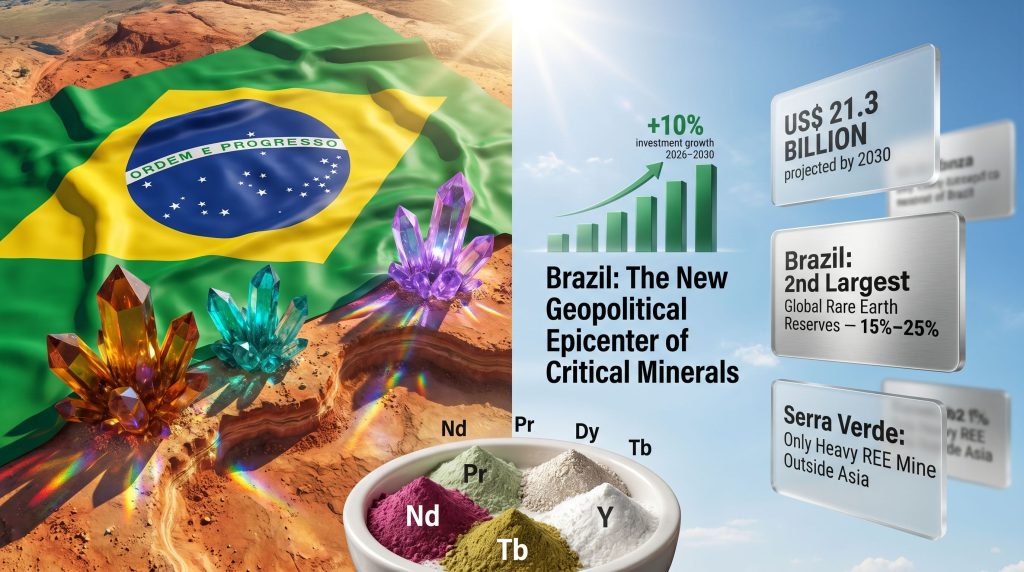
Reserve estimates for Brazil's rare earth endowment vary depending on the methodology applied. The Serviço Geológico do Brasil (SGB-CPRM) calculates Brazil's share of global rare earth reserves at approximately 15%, while the United States Geological Survey (USGS) places that figure closer to 25%. Both estimates confirm Brazil as the world's second-largest holder of rare earth reserves, trailing only China and ahead of Australia, which accounts for roughly 7% of global reserves.
What makes Brazil's positioning particularly significant is not just total reserve volume but deposit quality and composition. Brazilian deposits include material quantities of heavy rare earth elements (HREE), specifically dysprosium (Dy) and terbium (Tb), which command substantially higher market prices than light rare earth elements (LREE). Heavy rare earth elements are far less geographically distributed globally and are essential for the high-performance permanent magnets used in electric vehicle motors and wind turbine generators.
Two primary deposit typologies define Brazil's rare earth landscape:
-
Ionic clay deposits, where rare earth elements are adsorbed onto clay mineral surfaces and can be extracted through heap leaching without requiring hard-rock blasting. These offer simpler mining logistics and lower upfront capital requirements, though metallurgical processing remains technically demanding.
-
Hard rock deposits, which require conventional open-pit or underground mining followed by complex hydrometallurgical flowsheets. These typically offer higher grade concentrations but demand greater capital investment and longer development timelines.
This typological diversity within Brazil's reserve base creates a portfolio of project risk profiles that appeals to investors across different risk tolerance thresholds, from exploration-stage plays to near-production projects with defined feasibility study parameters. Furthermore, understanding these rare earth supply chains helps contextualise why global capital is increasingly flowing toward Brazilian deposits.
The US$ 21.3 Billion Investment Horizon: What the Numbers Actually Mean
Projected investment in Brazil's critical and strategic minerals sector through 2030 has reached US$ 21.3 billion, with rare earth elements serving as the principal capital attraction. According to the Instituto Brasileiro de Mineração (IBRAM), the 2026–2030 investment period is projected to grow approximately 10% relative to the prior five-year period, indicating structural acceleration rather than cyclical fluctuation. This scale of commitment reflects the critical minerals demand now being driven by the global energy transition.
To understand the full scale of this commitment, it helps to examine the distribution across minerals and development stages:
| Category | Estimated Figure |
|---|---|
| Total projected critical mineral investment to 2030 | US$ 21.3 billion |
| IBRAM-projected investment growth (2026-2030 vs. 2020-2025) | +10% |
| Brazil's share of global REE reserves (SGB-CPRM) | ~15% |
| Brazil's share of global REE reserves (USGS) | ~25% |
| Brazil's global reserve ranking | 2nd place |
| China's global reserve share | 52–58% |
| Australia's global reserve share | ~7% |
| Chinese processing capacity dominance | ~90% globally |
What makes this investment cycle structurally different from prior Brazilian mining booms is the explicit geopolitical motivation driving capital decisions. Previous commodity cycles were predominantly price-driven. This cycle is partly supply chain security-driven, meaning capital commitments are being made even in conditions of price uncertainty because the strategic imperative overrides conventional return-optimisation logic. For further context, Brazilian rare earth stocks surged as much as 390% during 2025, reflecting this investor conviction.
Beyond Rare Earths: Brazil's Full Critical Minerals Portfolio
Brazil's critical mineral credentials extend well beyond rare earth elements:
-
Niobium: Brazil, primarily through CBMM, supplies approximately 90% of global niobium demand. Niobium's role is expanding from steelmaking into battery technology, enhancing energy density in lithium-ion systems.
-
Lithium (spodumene): Brazil holds substantial hard-rock lithium reserves, with two operations currently in production. Additional operations are anticipated as battery manufacturing demand recovers.
-
Graphite: China dominates global graphite production. However, two Brazilian graphite projects have recently entered production, with additional projects expected to advance as supply chain diversification pressure intensifies.
-
Copper: Brazil's potential within the Carajás Mineral Province remains incompletely evaluated, with meaningful discoveries projected within the medium term.
-
Nickel: Brazilian nickel reserves are positioned within the battery supply chain and specialty steel manufacturing context, with demand tied closely to global electric vehicle production.
How Western Capital Is Flowing Into Brazilian Rare Earths
The capital architecture supporting Brazilian rare earth development reflects both the urgency of Western supply chain diversification and the complexity of financing projects with multi-year development timelines. Three primary capital channels have emerged.
United States Government-Linked Financing
The US International Development Finance Corporation (DFC) has publicly stated it holds US$ 205 billion available for investment in strategic projects aligned with American supply chain objectives. This funding capacity has been deployed through partnerships with private sector mining companies operating in Brazil. Americas rare earth supply chain dynamics are consequently shifting, with Brazil increasingly central to US strategic planning.
Corporate Acquisition as Strategic Entry
The acquisition of Serra Verde by USA Rare Earth (USAR) for approximately US$ 2.8 billion represents the most significant single transaction in Brazilian rare earth development history. The deal included an additional US$ 570 million financing commitment for operational expansion. Serra Verde is currently the only operating rare earth mine targeting heavy rare earth elements outside Asia, producing neodymium, praseodymium, dysprosium, and terbium from its Goiás operations.
European and Canadian Capital
European investment activity has proceeded primarily through company-to-company negotiations rather than government-intermediated structures. The Araxá project's valuation trajectory, with share appreciation of approximately 390% during 2025, illustrates the market's recognition of advanced-stage Brazilian projects. Indeed, the race for rare earths in Brazil has drawn significant private equity interest, further validating the sector's growth trajectory.
Domestic Capital Commitments
Vale has signalled R$ 70 billion for critical mineral development, subject to permitting and licensing progress. BNDES and Finep maintain financing programs directed toward mineral processing research and development, supporting the downstream capability building that project feasibility depends upon.
Technical Deep Dive: Project Carina's Feasibility Study
Aclara's Carina project in Goiás represents the most advanced rare earth development in Brazil behind existing Serra Verde operations. The recently completed feasibility study, conducted under Canadian NI 43-101 standards, delivers financial parameters that warrant detailed examination.
Production and Ore Quality
Carina's projected annual production of 4,378 tonnes of rare earth oxides (REO) is sourced from an ionic clay deposit with a concentrate composition weighted toward strategically critical heavy rare earth elements:
| Element | Concentrate Grade or Annual Volume |
|---|---|
| Dysprosium + Terbium (DyTb) | 4.2% of concentrate |
| Neodymium + Praseodymium (NdPr) | 27.2% of concentrate |
| Samarium (Sm) | 173 tonnes per year |
| Gadolinium (Gd) | 176 tonnes per year |
| Lutetium (Lu) | 10 tonnes per year |
| Yttrium (Y) | 1,160 tonnes per year |
The projected dysprosium and terbium output from Carina is equivalent to approximately 11.8% of China's estimated 2024 production of these elements. Given that dysprosium and terbium are among the scarcest and most strategically sensitive rare earth elements globally, this production volume carries significance well beyond its absolute tonnage.
Financial Architecture
| Financial Metric | Value |
|---|---|
| Base construction CAPEX | US$ 678.2 million |
| Contingency allowance | US$ 102.7 million |
| Total CAPEX | US$ 780.9 million |
| NPV (post-tax, 8% discount rate) | ~US$ 1.7 billion |
| IRR (post-tax) | 26.9% |
| Payback period | 2.9 years |
| Average annual net revenue | US$ 599 million |
| Average annual EBITDA | ~US$ 460 million |
| Project life | 18 years |
The CAPEX increase of US$ 100.4 million relative to the prior pre-feasibility study estimate reflects currency movements, inflation, and greater engineering precision. This increase is consistent with the engineering refinement expected between pre-feasibility and full feasibility study stages.
A post-tax IRR of 26.9% with a 2.9-year payback period represents exceptional financial performance for a mining project of this scale, particularly given that the 8% discount rate applied is conservative relative to many emerging market project evaluations.
Development Sequence
The Carina construction timeline follows a modularisation strategy designed to compress the development schedule:
- Q3 2026: Preliminary site works commence, including camp construction, road improvements, and supporting infrastructure preparation.
- 2027: Accelerated construction phase using modularisation to allow parallel fabrication and site preparation.
- H1 2028: Commissioning activities begin.
- H2 2028: Initial production commences.
- 2029: Gradual production ramp-up to full capacity.
The Mine-to-Magnet Supply Chain Ambition
One of Carina's most strategically differentiated characteristics is Aclara's plan to build a 100% wholly-owned separation facility in Louisiana, USA. This downstream integration positions Carina as part of a fully American-hemisphere supply chain, from ore extraction in Brazil through separation and refining in the United States to magnet manufacturing for North American industrial consumers.
Aclara is currently the only company globally reporting heavy rare earth mineral reserves from ionic clay deposits under NI 43-101 standards, a distinction that reflects both technical achievement and the metallurgical work completed through continuous pilot plant operation. However, as with all projects of this kind, rare earth processing challenges remain a central consideration for investors evaluating downstream integration ambitions.
Bambuí: Geological Scale Meeting Processing Complexity
Bemisa's Bambuí project in Minas Gerais occupies a different position on the development curve but commands attention through sheer geological scale. The deposit represents a case study in how straightforward geology can coexist with technically demanding metallurgy.
Resource Scale
- Measured and indicated resources: approximately 600 million tonnes at 0.28% TREO
- Additional resources under evaluation: 1.5 billion tonnes
- Deposit type: ionic clay, with NdPr as primary valuable component
- Average grade range: 0.3% to 0.4% TREO
- Average mineralisation depth: 45 to 55 metres below surface
The shallow horizontal layering of the mineralisation is geologically advantageous for open-pit mining. Continuous lateral extent and predictable stratigraphy reduce geological risk in the resource estimation process.
The Processing Challenge
Despite the geological simplicity, Bambuí's processing pathway has demanded extensive validation work. Bemisa has conducted over 600 metallurgical tests and approximately 1,500 leaching assays to validate the flowsheet from ore through to mixed rare earth carbonate production. A current drilling campaign of approximately 210 holes is designed to support formal resource certification, targeted for completion within the next year. Pre-feasibility study completion is projected for approximately 2029.
The next major ASX story will hit our subscribers first
Regulatory Risk: PL 2.780/2024 and the Sovereignty Debate
Brazil's rare earth investment environment cannot be evaluated without addressing the regulatory uncertainty introduced by proposed legislation. PL 2.780/2024, currently progressing through the Congresso Nacional, includes provisions that would prohibit the sale of Brazilian mining companies to foreign entities and mandate domestic processing of rare earth ore rather than export of raw mineral concentrates.
This legislation creates a genuine tension within the investment environment. Foreign capital — essential to the capital requirements of large-scale rare earth development — requires investment certainty that the proposed legislation could undermine. Simultaneously, Brazilian policymakers hold legitimate sovereignty interests in preventing the transfer of strategic mineral assets to foreign control without corresponding domestic value creation.
Industry associations have flagged that measures restricting foreign investment or imposing premature processing obligations could reduce Brazil's attractiveness relative to competitor jurisdictions. Furthermore, the broader dimensions of rare earth geopolitics suggest that how Brazil navigates this legislative tension will influence not only domestic investment but its standing within global supply chain alliances.
Evaluating Rare Earth Investment Opportunities: A Framework for Investors
Disclaimer: The following section is intended for educational purposes only and does not constitute financial advice. All rare earth investments carry significant risk, including total loss of capital. Investors should conduct independent due diligence and consult qualified financial advisers before making investment decisions.
For investors seeking exposure to investimentos em terras raras no Brasil, a structured evaluation framework helps distinguish between projects with genuine near-term potential and those carrying execution risks that timelines and capital structures may not support.
Key Evaluation Criteria
-
Development stage: The gap between exploration, feasibility, construction, and production is measured in years and hundreds of millions of dollars. Understanding where a project sits on this curve is foundational.
-
Deposit typology: Ionic clay deposits typically require less upfront capital for mining but carry metallurgical processing complexity. Hard rock deposits invert this risk profile.
-
Heavy vs. light rare earth composition: Projects with meaningful HREE content, particularly dysprosium and terbium, command higher product value. Projects weighted toward LREE face lower per-unit pricing.
-
Offtake agreements: Long-term purchase commitments from qualified buyers reduce revenue uncertainty and support project debt financing. Government-backed offtake, as seen in the Serra Verde model, provides additional credit quality.
-
Downstream integration: Projects with planned or secured refining and separation capability command valuation premiums over those dependent on third-party processing arrangements.
-
Regulatory alignment: Exposure to PL 2.780/2024 risk varies by project structure. Investors should assess whether projects are positioned to comply with potential processing mandates without material economic disruption.
Investment Vehicles
- ASX, TSX, or NYSE-listed mining equities with Brazilian project exposure, including companies already reporting NI 43-101 compliant resources.
- Thematic ETFs targeting critical minerals, energy transition supply chains, or electric vehicle infrastructure.
- Infrastructure bonds (debêntures incentivadas) linked to qualifying strategic mineral projects within Brazil's tax-advantaged fixed income framework.
- Private equity and venture capital funds targeting early-stage mineral exploration in Brazil, offering higher potential returns with commensurately higher risk profiles.
Frequently Asked Questions on Brazil's Rare Earth Sector
Is Brazil currently a major rare earth producer?
Not yet. Despite holding the world's second-largest rare earth reserve base, Brazil's current production remains minimal. The production transformation anticipated by the investimentos em terras raras no Brasil projection remains concentrated in the post-2028 period, with most projects still working through feasibility, licensing, and engineering phases.
Which rare earth elements carry the most economic value in Brazilian deposits?
Heavy rare earth elements, particularly dysprosium and terbium, carry the highest per-kilogram pricing and strategic premium. These elements are essential for the high-performance permanent magnets that electric vehicle motors and wind turbine generators depend upon. Yttrium, neodymium, and praseodymium also carry significant demand from the magnetics and electronics sectors.
How long does a typical Brazilian rare earth project take from resource definition to production?
Based on the project timelines documented for leading Brazilian projects, the development pathway from formal resource certification through to initial production typically spans five to eight years. Ionic clay projects may compress this slightly relative to hard rock operations, but metallurgical validation, environmental licensing, and construction sequencing collectively drive this timeline regardless of deposit type.
What differentiates ionic clay deposits from hard rock deposits in investment terms?
Ionic clay deposits generally require lower CAPEX for the mining component but demand extensive metallurgical testwork to validate leaching efficiency. Hard rock deposits carry higher total CAPEX but may offer greater certainty in established processing flowsheets. Neither deposit type is inherently superior; the investment case depends on the specific grade, scale, infrastructure access, and processing validation of the individual project.
Want to Track the Next Major Mineral Discovery Before the Market Moves?
Discovery Alert's proprietary Discovery IQ model delivers real-time alerts on significant ASX mineral discoveries — including critical minerals driving the global energy transition — instantly translating complex geological data into actionable investment insights for both new and experienced investors. Explore Discovery Alert's dedicated discoveries page to understand how historic mineral discoveries have generated exceptional returns, and begin your 14-day free trial today to secure your market-leading advantage.