Livium Ltd
- ASX Code: LIT
- Market Cap: $16,514,937
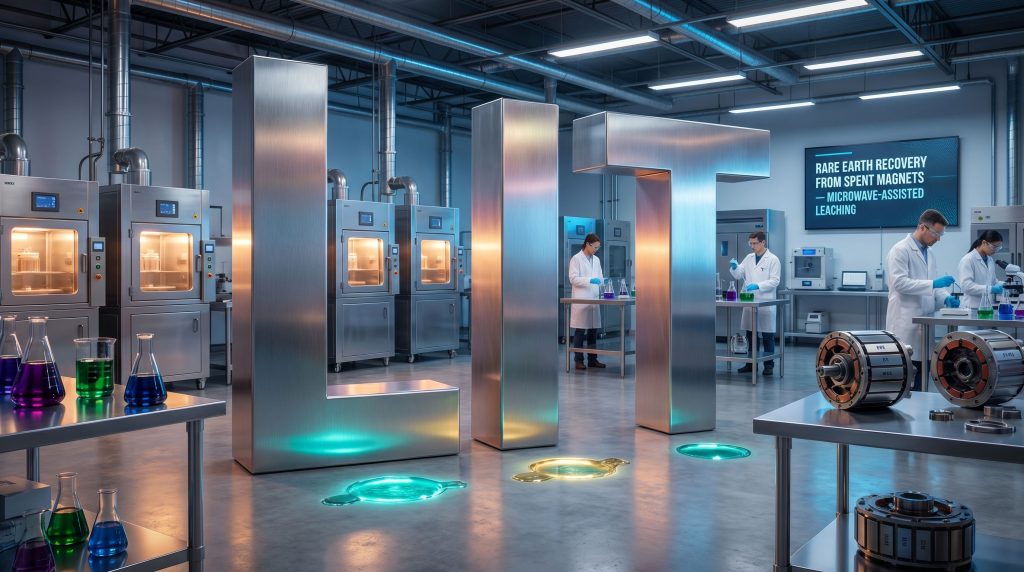
Livium Ltd validates high rare earth recovery and selective leaching in Stage 1 University of Melbourne trials
Livium rare earth recovery technology results from University of Melbourne trials have confirmed approximately 25 times scale up from initial laboratory conditions, while maintaining 96% Neodymium (Nd) recovery, greater than 96% Praseodymium (Pr) recovery, and iron leaching as low as 3% at 150°C. Livium Ltd (ASX: LIT) reported these final Stage 1 test results from its microwave assisted rare earth element extraction programme with the University of Melbourne.
According to the ASX announcement dated 1 July 2026, the Stage 1 results provide the initial operating window for further development of a potential commercial process to recover rare earth elements from end-of-life NdFeB permanent magnets.
Livium Ltd has framed these results as a technical foundation for assessing commercial pathways, including possible production of mixed or separated rare earth oxide products using microwave assisted processing.
When big ASX news breaks, our subscribers know first
Stage 1 Testwork Overview and Key Performance Metrics
Stage 1 testwork at the University of Melbourne was designed to answer two central questions:
- Can the microwave assisted leaching process be scaled up from small laboratory samples while maintaining high rare earth recovery?
- Can the process achieve better selectivity, meaning high Nd and Pr extraction with low iron dissolution?
According to the final report, both objectives were achieved within the Stage 1 programme.
Headline Stage 1 outcomes reported:
- Nd recovery: 96% at 150°C
- Pr recovery: greater than 96% (capped at 100% in calculations, with the company noting feedstock variability and analytical uncertainty)
- Fe leaching: as low as 3% at a solid to liquid (S/L) ratio of 0.1 (10%)
- Scale up: approximately 25x from initial laboratory conditions
- Temperature reduction: from 210°C down to 150°C while retaining strong rare earth recovery
- Reagent optimisation: best performance at 150°C achieved using a mixed chloric and nitric acid system
- Testing closer to industrial conditions: operation at higher S/L ratios regarded as more representative of potential commercial settings
The Stage 1 programme also identified that single acid systems at 150°C showed reduced selectivity, pointing to acid and oxidant selection as a continuing development variable for subsequent stages.
Feedstock Composition and Why It Matters
The testwork used spent NdFeB magnets sourced from discarded vehicle motors. Furthermore, the final University of Melbourne report recorded the following average composition for the magnet feedstock:
| Element | Composition (% of feedstock) |
|---|---|
| Iron (Fe) | 66.5% |
| Neodymium (Nd) | 23.9% |
| Praseodymium (Pr) | 7.6% |
| Combined Nd + Pr | ~31.5% |
This composition shows that:
- Iron accounts for roughly two thirds of the mass but is comparatively low in value.
- Nd and Pr together account for around 31.5% of the feedstock and are the commercially important rare earth components.
From an economic perspective, the objective is to recover as much of the rare earth content as possible while leaving most of the iron behind. The reported reduction of Fe leaching down to 3% while maintaining greater than 96% Nd and Pr recovery is the core performance outcome claimed by Livium Ltd.
Understanding Microwave Assisted Leaching and Selectivity
What Is Microwave Assisted Leaching?
Microwave assisted leaching is a form of hydrometallurgical processing where microwave energy is used to heat the mixture of solid material and leaching solution.
In this programme:
- The solid material is shredded NdFeB magnet feedstock.
- The leaching solution is an acid based system designed to dissolve specific metals.
- Microwave energy is used to heat the mixture quickly and uniformly, rather than relying solely on conventional heating.
Potential advantages that are often investigated in microwave assisted systems include:
- Faster heating and reaction times.
- Lower required operating temperatures compared with standard heating.
- More controlled interaction between the leaching solution and the solid particles.
The Stage 1 results indicate that the operating temperature could be reduced from 210°C to 150°C while still delivering high Nd and Pr recovery, which is presented as evidence of potential energy optimisation.
What Is Selectivity and Why Is Low Iron Leaching Important?
In hydrometallurgical processing, selectivity refers to how effectively a leaching solution targets desired metals while avoiding unwanted ones.
In this case:
- Desired metals: Nd and Pr.
- Unwanted metal: mainly Fe, which forms the bulk of the magnet body.
High iron dissolution creates several challenges:
- More complex separation steps later in the flowsheet to remove iron.
- Higher reagent consumption.
- Larger volumes of solution and residues to manage.
- Potential impacts on the purity and quality of the final rare earth products.
By contrast, low Fe leaching with high Nd and Pr recovery has several potential benefits:
- The pregnant leach solution that exits the leach step is richer in rare earths relative to iron.
- Downstream purification circuits can be simpler, as there is less iron to remove.
- Reagent use for iron removal and waste handling has scope to be reduced.
The Stage 1 programme reported Fe leaching as low as 3% while maintaining 96% Nd and greater than 96% Pr recovery. For investors assessing processing technologies, such selectivity figures are often used as inputs to later economic assessments.
Key Technical Terms Explained
Technical glossary
- NdFeB magnets: Permanent magnets made from neodymium, iron and boron. They are used in electric vehicles, wind turbines, industrial motors, data centres, medical devices, aerospace and defence applications.
- Rare earth elements (REE): A group of metals that are widely used in high technology and clean energy systems. Nd and Pr are important for magnet applications.
- Leaching: A process where a liquid solution, often an acid, dissolves metals from a solid material.
- Solid to liquid ratio (S/L): The ratio between the amount of solid material and the volume of liquid used in leaching. Higher ratios mean less liquid per unit of solid, which is closer to industrial practice.
- NdPr oxide: A mixed oxide product containing neodymium and praseodymium. It is a traded material used as an input for magnet manufacture.
Commercial Potential of NdPr Recovery from Magnet Waste
The announcement provides an indicative view of the contained and potentially recoverable value in NdFeB magnet waste processed under the Stage 1 conditions.
Based on the University of Melbourne feedstock assay:
- 1 tonne of NdFeB magnet material contains approximately 315.2 kg of combined Nd + Pr.
- Applying Stage 1 recovery results gives approximately 307.8 kg of recoverable Nd + Pr metal per tonne of NdFeB feedstock.
- Converting this metal content to oxide form results in around 362 kg of recoverable NdPr oxide equivalent per tonne.
Using recent published benchmark NdPr oxide prices of US$90 to US$95 per kilogram, the company calculates an indicative gross recoverable material value of approximately:
| NdPr oxide price scenario | NdPr price (US$/kg) | Indicative gross recoverable value per tonne of NdFeB feedstock |
|---|---|---|
| Low | US$90 | ~US$33,000 |
| High | US$95 | ~US$34,000 |
The announcement stresses that these figures:
- Represent gross contained/recoverable material value only.
- Do not account for:
- Recovery losses beyond the tested leaching step.
- Conversion, separation and refining costs.
- Payability and pricing terms.
- Product quality and specification.
- Transport, feedstock preparation and processing costs.
- Commercial arrangements and margins.
For investors, these values primarily illustrate the inherent value concentration in NdFeB magnet waste streams when high recovery and selectivity are achieved. They do not represent project level economics at this stage.
CEO Commentary
"The final Stage 1 test results represent an important milestone in validating this technology. Achieving high rare earth recovery rates while significantly reducing iron dissolution and lowering operating temperatures demonstrates the pathway towards a commercially viable process. With this strong technical foundation in place, we look forward to progressing grant funding pathways and moving to the next stages of development, firstly prototype scale testing and then commercialisation," said Simon Linge, CEO and Managing Director, Livium Ltd.
This comment summarises how Livium Ltd views the Stage 1 results: as a technical validation step preceding larger scale prototype and potential pilot trials.
Stage 2 Pathway and Planned Technical Workstreams
The final University of Melbourne report sets out several recommended areas of focus prior to and during Stage 2, which is planned around a Prototype Scale Microwave Reactor.
Key technical workstreams outlined include:
-
Ion speciation control
- Understanding the exact form in which metals exist in solution.
- Refining process conditions so that Nd and Pr are leached efficiently while Fe remains mostly in the solid phase.
-
Microwave solvent interaction studies
- Studying how microwave energy interacts with different solvent and acid systems.
- Optimising energy input and heating profiles to enhance selectivity and efficiency.
-
Sample homogenisation
- Improving how feedstock is mixed and prepared, to reduce variability in test results.
- Addressing the impact of differing magnet compositions and particle sizes.
-
Scaling beyond 1 g to multi gram or pilot scale
- Moving from gram scale laboratory tests to larger samples that are more representative of industrial conditions.
- Generating data for process control, equipment design and product specification.
Following completion of Stage 1, Livium Ltd and the University of Melbourne can commence planning of Stage 2 activities linked to the prototype reactor.
On funding, the announcement states:
- Grant funding pathways are being assessed to finalise Stage 1 related activities and support Stage 2 prototype scale work.
- A previously submitted application under the Australia's Economic Accelerator (AEA) Ignite programme is no longer available as a funding pathway following conclusion of that programme.
- Alternative government funding opportunities are, however, being considered.
Investors monitoring development timelines may wish to track grant outcomes, as these can influence the pace and scope of Stage 2 testwork.
Livium Ltd's Broader Recycling Platform and Rare Earth Strategy
The ASX release provides context on how the rare earth extraction project fits within the broader activities of Livium Ltd.
According to the announcement:
- Livium Ltd is described as Australia's leading battery recycler through its wholly owned subsidiary Envirostream.
- Envirostream is characterised as a profitable business focused on recovering valuable materials from end-of-life batteries.
- Building on this platform, the company is expanding into rare earth element recycling, solar panel recycling and black mass processing, referring to the intermediate material generated from battery recycling that contains valuable metals.
From an investment perspective, this positions the rare earth project as part of a multi-stream recycling and materials recovery portfolio rather than a standalone initiative. Existing operational experience in collection, sorting and processing of complex feedstocks through Envirostream may be relevant to securing and handling magnet waste feed, integrating new processing steps with current facilities over time, and managing environmental and regulatory requirements.
Why Rare Earth Recycling from NdFeB Magnets Is Gaining Attention
Nd and Pr are widely regarded as key magnet rare earths due to their role in high performance NdFeB magnets. According to the announcement, these magnets are used in:
- Electric vehicles (EVs)
- Wind turbines
- Industrial motors
- Data centres
- Medical equipment
- Aerospace and defence applications
As EV and renewable energy deployment grow, the volume of end-of-life motors, generators and electronic equipment containing NdFeB magnets is expected to increase over time.
Rare earth recycling from these magnets is, consequently, being investigated by several parties globally for reasons that include:
- Potential to diversify supply of Nd and Pr beyond primary mining.
- Ability to reduce waste and recover value from existing products.
- Opportunity to shorten material loops by sourcing rare earths closer to end use markets.
The Livium rare earth recovery technology results from University of Melbourne trials address a specific part of this broader picture, developing a microwave assisted leaching process that offers high rare earth recovery, low iron dissolution, and operation at reduced temperatures compared with earlier test conditions.
If subsequent stages confirm these results at larger scale, this type of process could be considered among the possible routes for magnet recycling, subject to economic and operational assessment.
The next major ASX story will hit our subscribers first
Investor Considerations and Near-Term Milestones
From an investor perspective, the Stage 1 update highlights several areas of potential focus.
Technical Validation
Independent laboratory testwork at the University of Melbourne has produced quantified metrics:
- 96% Nd and greater than 96% Pr recovery.
- 3% Fe leaching at S/L 0.1.
- Operation at 150°C with approximately 25x scale up from initial conditions.
These data points provide a technical basis for further evaluation but do not yet represent a feasibility level study.
Economic Relevance
NdFeB magnet waste appears to contain ~31.5% Nd + Pr by mass, resulting in around 362 kg NdPr oxide equivalent per tonne under the tested scenario. At reference prices of US$90–95/kg, this equates to ~US$33,000–34,000 gross recoverable material value per tonne of feedstock, before all costs and commercial factors.
Development Roadmap
Key milestones and status as outlined in the announcement are:
| Milestone | Description | Status |
|---|---|---|
| Stage 1 completion | Final University of Melbourne results and operating window defined | Complete |
| Grant funding assessment | Identification and pursuit of alternative funding after AEA Ignite conclusion | In progress |
| Stage 2 planning | Design and planning of Prototype Scale Microwave Reactor programme | Can commence |
| Pilot scale trials | Larger scale testing beyond prototype reactor | Future stage, dependent on Stage 2 outcomes |
Integration with Existing Operations
Envirostream's existing activities in battery recycling and black mass processing may provide operational synergies if rare earth recycling progresses to commercial implementation. The rare earth project sits within a broader clean energy and recycling theme that some investors prioritise when assessing ASX resource and technology exposures.
Overall, the Livium rare earth recovery technology results from University of Melbourne trials present Stage 1 as a completed testwork phase providing high recovery and low iron leaching data, a defined operating temperature range, and a set of technical and funding steps for Stage 2. Investors following Livium Ltd may consider how these technical results align with the company's existing recycling platform, rare earth market dynamics and their own risk and return expectations.
Want to Know More About Livium's Rare Earth Recycling Technology?
Livium Ltd (ASX: LIT) has completed a significant technical milestone, validating high rare earth recovery and selective leaching at University of Melbourne scale-up trials — all underpinned by an already profitable battery recycling business through Envirostream. To learn more about Livium's rare earth extraction programme, its broader recycling platform, and what Stage 2 development could mean for the company, visit the Livium investor hub for the latest updates and announcements.