
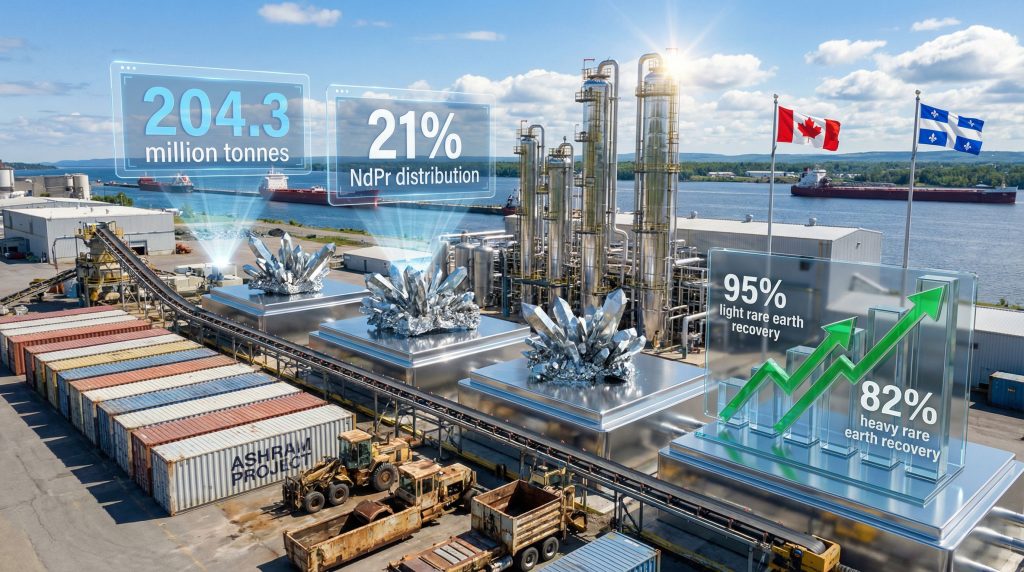
Global rare earth supply chains face unprecedented strain as traditional monopolistic structures encounter mounting geopolitical pressures and demand acceleration from critical minerals energy transition. While dominant producers maintain market control through vertical integration and processing expertise, strategic mineral security concerns drive allied nations toward supply diversification initiatives. This evolving landscape creates opportunities for Western hemisphere projects like the Mont Royal Ashram Rare Earths Project capable of establishing integrated production systems that combine resource extraction with downstream processing capabilities.
Strategic Infrastructure Development Framework
Critical minerals development increasingly relies on hub-and-spoke logistics models that optimise transportation costs while maintaining operational flexibility. The Port Saguenay partnership approach demonstrates how established industrial infrastructure can reduce capital expenditure requirements for mineral processing operations through shared utility access and transportation networks.
Strategic Infrastructure Components:
- Multi-modal transportation integration linking mine sites to global markets
- Industrial zone processing facilities leveraging established power and utility infrastructure
- Year-round operational capability through ice-free port access
- Skilled workforce availability within established industrial regions
The Canadian Northern Corridor framework positioning enables rare earth concentrate importation and processed product export through integrated logistics networks. This approach contrasts with remote site processing models that require extensive infrastructure development in challenging environments. Furthermore, these Canada energy transition initiatives align with federal strategic mineral policies.
According to industry analysis, infrastructure relocation strategies can significantly reduce operational complexity by accessing established service industries and technical expertise. The availability of natural gas, electrical power, and water resources at industrial ports creates processing advantages compared to remote mining locations.
Integrated Processing Economics
Hydrometallurgical facility placement decisions involve complex trade-offs between concentrate transportation costs and final product logistics. Port-based processing enables inventory management flexibility and customer specification adjustments that remote facilities cannot accommodate efficiently.
The non-binding memorandum structure provides strategic decision flexibility while advancing technical due diligence on processing facility requirements. December 2026 termination clauses create defined evaluation periods for both infrastructure providers and project developers.
When big ASX news breaks, our subscribers know first
Resource Scale and Strategic Positioning in Global Markets
Monazite-hosted mineralisation represents a technically proven pathway for rare earth extraction, with established flotation and hydrometallurgical processing methods achieving commercial recovery rates. Advanced metallurgical testing validates dual-stage processing approaches that separate light rare earth elements from heavy rare earth concentrates through sequential treatment.
Processing Performance Metrics:
- Flotation concentration efficiency: Achieving elevated grades through mineral separation
- Hydrometallurgical recovery rates: Light rare earth elements demonstrate higher recovery compared to heavy elements
- Co-product potential: Fluorspar recovery provides additional revenue streams
The neodymium-praseodymium content in rare earth deposits determines commercial viability for permanent magnet applications. Electric vehicle motor manufacturing and wind turbine generator production create sustained demand for NdPr-rich materials, supporting premium pricing for qualified suppliers.
Strategic mineral classification by government agencies reflects supply chain vulnerability assessments rather than geological scarcity. However, the global mining landscape shows that rare earth elements remain geologically abundant, but processing capacity concentration creates artificial supply constraints that geopolitical tensions can exploit.
Technical Processing Advantages
Dual-stage processing systems enable mineral grade optimisation through sequential concentration and purification steps. Initial flotation processing removes gangue minerals and concentrates rare earth-bearing phases, while subsequent hydrometallurgical treatment separates individual rare earth elements.
Processing facility location decisions impact capital expenditure requirements, operational costs, and market access capabilities throughout project lifecycles.
Metallurgical test work validation demonstrates technical feasibility for commercial-scale operations at the Mont Royal Ashram Rare Earths Project, though specific recovery rates and concentrate grades require verification through independent technical reports. Industry-standard processing approaches suggest achievable recovery rates for both light and heavy rare earth elements.
Port Infrastructure Integration and Supply Chain Optimisation
Year-round operational capacity through ice-free port access enables continuous rare earth concentrate importation and processed product export, eliminating seasonal transportation constraints that affect other regional projects. Deep-water port capabilities accommodate bulk shipping requirements for both raw materials and finished products.
The comprehensive logistics solution integrates marine, rail, and road transportation networks to optimise supply chain efficiency. This multi-modal approach reduces dependency on single transportation methods while providing redundancy during maintenance or operational disruptions.
Industrial zone advantages include established utility infrastructure, environmental permitting frameworks, and skilled workforce availability. In addition, these factors reduce project development timelines compared to greenfield industrial site development in remote locations.
Infrastructure Partnership Benefits
Conditional infrastructure access subject to availability and regulatory approvals creates structured evaluation frameworks for both port authorities and project developers. This approach enables detailed feasibility assessment while maintaining flexibility for alternative development scenarios.
Service industry proximity provides maintenance, technical support, and specialised equipment access that remote mining operations cannot achieve cost-effectively. Industrial cluster development creates economies of scale for specialised services and technical expertise.
The skilled workforce accessibility within established industrial regions reduces training costs and improves operational reliability compared to remote workforce development programs. Consequently, technical expertise in metallurgical processing and chemical operations already exists within regional labour markets.
Competitive Market Positioning and Supply Chain Security
North American rare earth production capacity remains limited compared to global demand projections, creating opportunities for new suppliers capable of achieving commercial-scale operations. Market share calculations depend on total addressable market definitions and geographic scope considerations.
Supply Chain Diversification Scenarios:
| Development Approach | Market Impact | Infrastructure Requirements | Timeline Considerations |
|---|---|---|---|
| Concentrate Production | Limited domestic supply | Mine-to-port logistics | Shorter development period |
| Integrated Processing | Higher value-added manufacturing | Processing facility investment | Extended development timeline |
| Hub Development Model | Regional processing centre | Multi-project infrastructure | Scalable capacity expansion |
Technology transfer opportunities through dual-listing structures enable access to international mining expertise and established rare earth processing knowledge. Australian rare earth sector experience provides technical benchmarks for Canadian project development through the Ashram project development framework.
Regional Cluster Development Potential
Quebec rare earth processing centre development could attract additional concentrate processing from other North American deposits, creating industrial synergies and economies of scale. Cluster development approaches reduce individual project infrastructure requirements through shared facilities and services.
Critical minerals policy alignment with federal investment incentives supports processing infrastructure development through tax credits, grants, and accelerated depreciation allowances. Government strategic partnership facilitation connects project developers with allied nation purchasing commitments.
The hub-based processing model enables capacity expansion through modular facility additions rather than complete new plant construction. Furthermore, this scalable approach accommodates market demand growth while minimising initial capital requirements for the Mont Royal Ashram Rare Earths Project.
Processing Facility Location Analysis and Risk Management
Site selection optimisation balances concentrate transportation costs against processed product logistics complexity. Remote mine site processing reduces raw material transportation but increases utility infrastructure requirements and workforce development challenges.
Decision Framework Components:
- Capital expenditure allocation between mine development and processing infrastructure
- Operating cost structures including utilities, labour, and maintenance
- Regulatory permitting pathways for industrial facility development
- Market access logistics for finished product distribution
Environmental assessment timelines for industrial zone facility placement typically proceed faster than greenfield site development due to existing baseline studies and established regulatory frameworks. For instance, permitting efficiency creates development timeline advantages.
Risk Mitigation Strategies
Non-binding agreement structures provide evaluation flexibility while advancing technical and commercial due diligence. Termination clauses create defined decision points without irreversible capital commitments during feasibility assessment periods.
Infrastructure partnership approaches reduce single-project risk through shared facility utilisation and operational redundancy. Port authority collaboration provides operational stability and technical support that independent facility development cannot achieve.
Workforce training partnerships with established industrial operations enable technical skill development while reducing recruitment and retention risks. However, regional labour market access improves operational reliability compared to remote location workforce development.
Investment Themes and Market Development Opportunities
Electric vehicle market expansion drives sustained neodymium and praseodymium demand growth, supporting long-term pricing stability for qualified suppliers. Permanent magnet manufacturing requirements create specification-driven purchasing rather than commodity-based procurement.
Critical minerals strategy implementation provides government support mechanisms including investment incentives, strategic partnership facilitation, and regulatory streamlining for qualified projects. Federal policy frameworks prioritise supply chain security over purely economic considerations.
Strategic partnership opportunities with allied nations create preferential purchasing arrangements that reduce market risk and provide pricing stability. Government-to-government agreements support project financing and offtake commitments for developments like Mont Royal Resources.
Market Demand Drivers
Renewable energy infrastructure growth requires permanent magnet materials for wind turbine generators and energy storage systems. Clean energy transitions create structural demand increases that exceed traditional electronics and automotive applications.
Defense and aerospace applications provide premium pricing opportunities for qualified suppliers meeting specification and supply chain security requirements. Government purchasing preferences support domestic and allied nation producers over potentially compromised supply sources.
Technology sector supply chains increasingly prioritise supply security over cost optimisation, creating opportunities for Western hemisphere producers capable of meeting quality and delivery requirements. This reflects broader mining industry trends toward strategic sourcing.
The next major ASX story will hit our subscribers first
Regional Economic Development and Scalable Development Models
Multiplier effects from critical minerals processing create broader economic development through high-skilled employment, service industry expansion, and research partnership opportunities. Industrial cluster development attracts additional investment and technology development initiatives.
Hub-based development frameworks provide replicable models for other critical mineral projects requiring processing infrastructure. Shared facility utilisation reduces individual project development costs while creating operational synergies.
Potential Applications:
- Lithium processing facilities for emerging Quebec lithium deposits
- Graphite purification operations for battery-grade material production
- Strategic metal refining for technology sector supply chains
- Research and development partnerships with universities and technology companies
The integrated processing approach creates opportunities for vertical integration and value-added manufacturing that raw material exports cannot achieve. Downstream processing capabilities provide pricing power and market differentiation compared to concentrate-only operations, similar to emerging European CRM facility developments.
What are the Economic Benefits of the Mont Royal Ashram Rare Earths Project?
Export revenue generation contributes to regional economic growth while reducing trade deficits in critical materials. Import substitution through domestic processing creates economic multiplier effects throughout industrial supply chains.
The Mont Royal Ashram Rare Earths Project represents a strategic opportunity to establish Western hemisphere rare earth processing capabilities. This integrated approach positions Canada as a reliable supplier within critical mineral supply chains whilst creating substantial regional economic development opportunities.
This analysis is based on publicly available information and industry knowledge. Investment decisions should consider additional factors including detailed technical reports, market analysis, and regulatory developments. Forward-looking statements involve uncertainties that may affect actual outcomes.
Ready to Capitalise on Emerging Critical Mineral Opportunities?
Discovery Alert's proprietary Discovery IQ model delivers real-time alerts on significant ASX mineral discoveries, instantly empowering subscribers to identify actionable opportunities ahead of the broader market. Understand why major mineral discoveries can lead to substantial returns by exploring Discovery Alert's dedicated discoveries page, showcasing historic examples of exceptional outcomes, and begin your 30-day free trial today to position yourself ahead of the market.
