July 22, 2026
Why the Race for Rare Earths Is Reshaping Global Mining Strategy
The periodic table has become a geopolitical battleground. Seventeen elements classified as rare earth elements (REEs) sit at the centre of the most consequential supply chain debate of the 21st century, underpinning everything from electric vehicle motors and offshore wind turbines to defence-grade guidance systems and consumer electronics. As Western nations scramble to reduce dependence on Chinese processing dominance, a new cohort of mining jurisdictions is drawing serious capital attention. Brazil, long overshadowed by Australia and Canada in critical minerals conversations, is rapidly emerging as one of the most compelling frontiers in global REE development, and the Harvest Minerals rare earths sector in Brazil pivot is one of the clearest signals yet that the country's moment has arrived.
When big ASX news breaks, our subscribers know first
Brazil's Geological Case: Why the Fundamentals Are Unusually Strong
Carbonatites, Ionic Clays, and a Continent-Scale Mineral Endowment
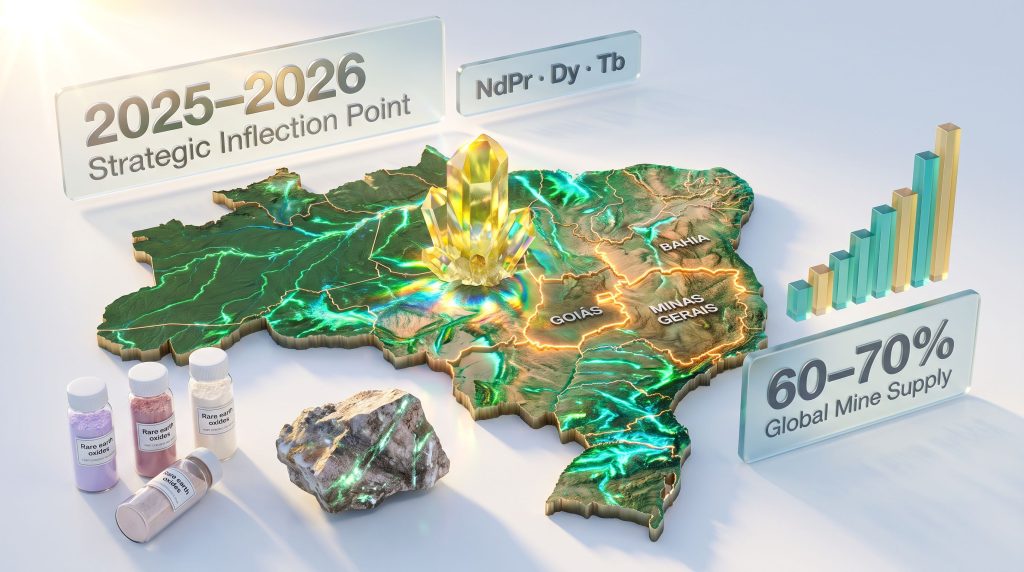
Brazil's rare earth prospectivity is rooted in two distinct geological settings that, taken together, represent a formidable mineral endowment. The first is carbonatite-hosted mineralisation, which accounts for some of the world's largest known REE accumulations. Carbonatite intrusions, which are igneous rocks with unusually high carbonate mineral content, act as natural concentrators of light rare earth elements including cerium, lanthanum, neodymium, and praseodymium. Brazil's Minas Gerais, Goiás, and Bahia states host some of the most significant carbonatite-associated REE occurrences outside of China and Greenland.
The second, and perhaps more strategically exciting, setting is the emergence of ionic clay-type REE deposits in Brazil's interior. These deposits form when tropical weathering over millions of years leaches REEs from parent rock and re-concentrates them in clay horizons. What makes this deposit type so commercially attractive is its amenability to simple heap-leach or in-situ recovery techniques using ammonium sulphate or magnesium sulphate solutions, bypassing the energy-intensive flotation and roasting circuits required for hard-rock carbonatite processing.
Ionic clay REE deposits in southern China built the foundation of China's dominance in heavy rare earth supply. The discovery and delineation of analogous deposits in Brazil could represent a structural shift in the global HREE supply equation over the coming decade.
A critical but underappreciated distinction is that Brazilian ionic clay zones are increasingly showing elevated concentrations of heavy rare earth elements (HREEs) such as dysprosium and terbium. These elements are far scarcer than their light counterparts, command substantially higher prices, and are the specific materials under greatest supply stress as EV and wind energy deployment accelerates globally.
How Does Brazil Stack Up Against Competing Jurisdictions?
| Jurisdiction | Key REE Deposit Type | Regulatory Stability | Infrastructure Maturity | Western Supply Chain Alignment |
|---|---|---|---|---|
| Brazil | Carbonatite + Ionic Clay | High | Moderate to High | Growing |
| Greenland | Carbonatite | Moderate | Low | High |
| Tanzania | Carbonatite | Moderate | Low to Moderate | Emerging |
| Canada | Carbonatite | High | High | Very High |
| Australia | Monazite + Ionic Clay | Very High | High | Very High |
Brazil's combination of geological diversity, political stability relative to many African and Arctic competitors, and existing mining infrastructure places it in a compelling mid-tier position. Furthermore, the ongoing Greenland minerals race illustrates just how intensely nations are competing to secure REE assets outside China's sphere of influence, with significant upside for Brazil as its regulatory frameworks mature.
The Supply Chain Imperative Driving Capital Into Brazil
China's Stranglehold on REE Processing and Why It Matters
China currently controls approximately 60 to 70% of global rare earth mine production and, more critically, over 85% of global REE separation and processing capacity, according to data tracked by the U.S. Geological Survey and the International Energy Agency. This processing bottleneck is the true leverage point. A country can mine REE ore concentrate, but without access to separation infrastructure, that concentrate must be shipped to China for conversion into separated oxides before it can be used in magnet manufacturing.
This dependency is precisely what Western critical minerals strategies are designed to address. China's rare earth strategy has long exploited this processing advantage, and the U.S. Inflation Reduction Act, the European Union's Critical Raw Materials Act, and equivalent frameworks in the United Kingdom and Japan are all structured around incentivising the development of non-Chinese REE supply chains from mine through to separated oxide and beyond. Brazil, as a politically aligned and geologically endowed jurisdiction, sits at an attractive intersection of these policy tailwinds.
Why Do 2025 and 2026 Represent a Defining Window?
Several converging forces make the current period unusually significant for Brazilian REE investment:
- Global demand for neodymium-praseodymium (NdPr) oxide, the primary input for permanent magnets in EV motors and direct-drive wind turbines, is forecast to grow substantially through 2030, with multiple structural supply deficit scenarios emerging in analyst modelling if new non-Chinese projects fail to reach production within the decade.
- Dysprosium and terbium, the HREE additions that enhance magnet performance at elevated temperatures, face even tighter supply trajectories given their near-total sourcing from Chinese ionic clay provinces.
- Brazil's federal government has been advancing a national critical minerals strategy that is expected to formalise clearer regulatory pathways and potential fiscal structures for REE developers, though no project-specific commitments have been confirmed at this stage.
- Infrastructure investment across Brazil's key mining corridors is gradually reducing the logistics risk premium that historically deterred junior and mid-tier operators from committing to Brazilian REE exploration programmes.
In addition, rare earth supply chains are increasingly viewed as a national security priority by governments across the Western world, further amplifying the capital flows directed toward emerging REE jurisdictions like Brazil.
Harvest Minerals' Strategic Pivot: Reading the In-Country Advantage
From Fertiliser Minerals to Rare Earths: A Logic-Driven Transition
Harvest Minerals' decision to acquire REE-prospective assets in Brazil is best understood not as a dramatic corporate reinvention, but as a calculated capitalisation on an existing competitive moat. The company's operational presence through its Arapua Fertiliser Project in Minas Gerais state provided a foundation of regulatory licences, landholder relationships, geological databases, and in-country staff that represent genuine barriers to entry for new market participants attempting the same strategic move from a standing start.
Companies with established operational infrastructure in a given jurisdiction can execute adjacent mineral acquisitions at a fraction of the cost and timeline required by new entrants. In-country operational depth is one of the most undervalued competitive advantages in junior mining M&A.
The fertiliser minerals sector, which encompasses potassium and phosphate-bearing rocks, shares meaningful geological overlap with carbonatite-hosted REE systems. Carbonatite complexes are known to host both phosphate mineralisation and REE enrichment, meaning Harvest Minerals' geological team would have encountered REE indicator minerals during routine Arapua project work. This geological adjacency makes the pivot intellectually coherent, not merely opportunistic. For further context, Brazilian Rare Earths provides a useful reference point for understanding the scale of REE prospectivity across the country.
Three Strategic Pathways: Scenario Modelling the Harvest Minerals REE Play
The range of realistic outcomes for the Harvest Minerals rare earths sector in Brazil strategy can be mapped across three distinct development scenarios:
Scenario 1: Exploration-to-Development (Base Case)
- Systematic drill-out of acquired REE tenements targeting a JORC-compliant resource estimate
- Indicative timeline of 18 to 36 months to maiden resource declaration
- Capital requirement typically in the A$5 to A$20 million range for early-stage Brazilian REE programmes
- Key risk: geological uncertainty and REE price trajectory dependency
Scenario 2: Offtake-Backed or Strategic Partnership Development
- Securing downstream interest from a magnet manufacturer, REE processor, or strategic investor to underwrite development capital
- Concurrent or post-resource timeline; partially de-risks the funding requirement
- Moderate risk profile contingent on partner alignment and market conditions at the time of negotiation
Scenario 3: Asset Monetisation via JV or Acquisition
- Positioning delineated REE assets for acquisition or joint venture by a larger operator seeking Brazilian REE exposure
- Realisation timeline of 24 to 48 months post-acquisition
- Lower execution risk but value dependent on M&A market conditions and REE price sentiment
Brazil's Regulatory Framework: What REE Developers Must Navigate
The ANM Licensing Pathway and Its Complexities
Brazil's National Mining Agency, the Agência Nacional de Mineração (ANM), governs the full spectrum of mineral rights from initial exploration authorisation through to mining concession grant. For REE projects, the regulatory pathway involves several distinct milestones:
- Exploration Authorisation (Alvará de Pesquisa): Grants the right to conduct geological surveys, sampling, and drilling over a defined area for a specified period, typically three years with extension provisions.
- Mineral Resource Report (Relatório Final de Pesquisa): A detailed geological report submitted to ANM following exploration, demonstrating the commercial potential of the deposit.
- Mining Concession Application (Requerimento de Lavra): The formal application to convert exploration rights into a production licence, triggering the environmental licensing process.
A particularly important consideration for REE projects in Brazil is the co-occurrence of thorium and uranium with certain REE minerals, particularly monazite. Brazil's nuclear regulatory body, the CNEN (Comissão Nacional de Energia Nuclear), maintains oversight of any mineral processing involving elevated thorium or uranium content, adding an additional regulatory layer that can extend project timelines and increase compliance costs if not proactively managed.
Indigenous Territory and Environmental Licensing Considerations
Exploration activity near indigenous territories requires consultation processes overseen by FUNAI (Brazil's National Indian Foundation). Projects that intersect or approach demarcated indigenous lands face significantly extended approval timelines. Environmental licensing through IBAMA adds a further layer of complexity, particularly for projects in ecologically sensitive biomes such as the Cerrado or Amazon.
Sophisticated REE developers operating in Brazil increasingly treat early community engagement not as a compliance checkbox but as a project de-risking tool. The social licence to operate, while not formalised in regulation, functions as a practical prerequisite for maintaining exploration momentum in Brazil's politically sensitive mining environment.
The Processing Gap: Brazil's Most Critical Structural Weakness
Brazil's REE sector faces a challenge that no amount of geological prospectivity can resolve on its own: the near-complete absence of domestic rare earth separation and processing infrastructure. The REE processing challenges confronting Brazil are, in many respects, a microcosm of the wider global supply chain problem.
Producing a saleable rare earth ore concentrate is only the first step in the value chain. Converting that concentrate into separated oxides of neodymium, praseodymium, dysprosium, or terbium requires specialised hydrometallurgical circuits that currently exist at commercial scale almost exclusively in China. Without domestic separation capacity, Brazilian REE producers face the same strategic dependency that Western governments are actively working to eliminate.
The economics of this gap are significant. Shipping REE concentrate to China for separation and then importing separated oxides for magnet manufacturing in Western facilities defeats much of the supply chain diversification objective that is driving REE investment in the first place. Several proposals for Brazilian REE processing facilities have been advanced by both private operators and government-aligned institutions, but none has yet reached final investment decision stage. The development of domestic hydrometallurgical processing capacity represents the single most important value-creation catalyst for Brazil's REE sector beyond resource delineation itself. Columbia University's Energy Policy research on Brazil's potential role in diversifying US critical mineral supply provides an authoritative assessment of this structural challenge.
The next major ASX story will hit our subscribers first
Risk Framework for Investors Evaluating Brazilian REE Exposure
| Risk Category | Specific Risk Factor | Mitigation Indicators |
|---|---|---|
| Geological | Low grade or unfavourable mineralogy | Independent geological review; comparable regional deposits |
| Regulatory | Licence delays or environmental objections | Experienced local legal counsel; community engagement programmes |
| Processing | No domestic separation pathway | Offtake discussions; processing partnership MoUs |
| Market | REE price volatility | Magnet-grade focus (NdPr, Dy, Tb) with stronger demand fundamentals |
| Execution | Management inexperience in REE | Prior REE project experience or specialist advisory board |
| Currency | BRL/AUD or BRL/USD exchange rate movements | Hedging policies; USD-denominated offtake structures |
Disclaimer: This analysis is provided for informational purposes only and does not constitute financial advice. Investments in early-stage mining companies carry significant risks including capital loss. Readers should conduct their own due diligence and consult a licensed financial adviser before making investment decisions.
Five Structural Trends Defining Brazil's REE Sector Through 2030
The medium-term trajectory of Brazil's rare earths industry will be shaped by forces that extend well beyond any single corporate transaction. Consequently, understanding the broader context of rare earth geopolitics is essential for investors seeking to evaluate the long-term significance of Brazilian REE development:
- Federal policy formalisation: Brazil's national critical minerals strategy framework is expected to create clearer regulatory pathways and potential fiscal structures for REE project developers, though the detail and timing of these measures remain subject to political processes.
- Processing infrastructure investment: The establishment of domestic REE separation capacity, whether through private initiative or public-private partnership, will be the most consequential value-creation event in Brazil's REE development timeline.
- Accelerating M&A activity: As global REE demand tightens through the late 2020s, larger operators and downstream manufacturers are likely to accelerate acquisition of delineated Brazilian REE assets to secure future supply optionality.
- ESG-driven capital allocation: International institutional investors are directing capital toward REE projects with demonstrable environmental management, community engagement, and governance credentials, raising the bar for project development standards across Brazil's mining sector.
- Technology-assisted exploration: Advances in airborne geophysical surveying, satellite-based geological mapping, and AI-assisted target generation are compressing exploration timelines and reducing the cost of identifying high-priority REE drill targets across Brazil's underexplored interior provinces.
Key Takeaways: The Brazilian REE Opportunity in Context
| Theme | Core Insight |
|---|---|
| Geological prospectivity | Brazil holds world-class REE deposits across carbonatite and ionic clay settings |
| Strategic timing | 2025 to 2026 represents a structural inflection point for Brazilian REE investment |
| Harvest Minerals positioning | Existing Brazilian operational footprint materially reduces entry risk and cost |
| Processing gap | Domestic separation infrastructure remains the critical missing link in Brazil's REE value chain |
| Investor signal | Early-stage M&A activity in Brazilian REE is a leading indicator of a potential sector re-rating cycle |
| Regulatory environment | Brazil's ANM framework is maturing but requires experienced and proactive navigation |
The Harvest Minerals rare earths sector in Brazil story is most accurately read as a leading indicator rather than an isolated corporate event. When an established in-country operator with existing regulatory relationships, geological data, and landholder access chooses to pivot into REE exploration, it signals a management-level conviction that the geological prospectivity, market timing, and regulatory environment have aligned sufficiently to justify capital commitment. Whether that conviction proves prescient will depend on drill results, REE price trajectories, and Brazil's ability to address its processing infrastructure deficit. What is not in question is that Brazil's rare earth potential is attracting the kind of strategic attention that precedes genuine sector maturation.
For ongoing coverage of mining investment activity across Latin America, BNamericas (bnamericas.com) provides project tracking and industry intelligence across the region's key mineral sectors.
Ready to Catch the Next Major Mineral Discovery Before the Market Does?
Discovery Alert's proprietary Discovery IQ model scans ASX announcements in real time, instantly identifying high-potential mineral discoveries across rare earths and more than 30 other commodities — turning complex data into clear, actionable opportunities for investors at every level. Explore how historic discoveries have generated extraordinary returns on Discovery Alert's discoveries page, and begin your 14-day free trial today to position yourself ahead of the broader market.