July 22, 2026
The Hidden Geography of Critical Minerals: Why One Brazilian City Changed Everything
For decades, the global conversation around rare earth elements has operated under a single, uncomfortable assumption: that meaningful production outside of Asia was either technically impossible or economically unviable. That assumption shaped corporate supply chains, defence procurement strategies, and clean energy roadmaps across the Western world. It created a structural dependency so deeply embedded in industrial planning that most policymakers treated it not as a risk to be managed, but as a permanent feature of the global economy.
That assumption is no longer valid. And the reason it collapsed can be traced to a small city in the Brazilian savanna.
When big ASX news breaks, our subscribers know first
Minaçu Terras Raras Serra Verde: Understanding the Deposit That Rewired Global Supply Chains
The municipality of Minaçu, located in the northern reaches of the state of Goiás with a population of roughly 27,000 people, sits atop one of the most geologically unusual and strategically consequential mineral deposits on the planet. The Projeto Pela Ema, operated by Serra Verde, is not simply another rare earth prospect. It is the only commercially active ionic clay rare earth operation outside of Asia, producing the four magnetic elements that sit at the absolute top of every critical minerals priority list maintained by Western governments and industrial planners.
Those four elements are neodymium (Nd), praseodymium (Pr), terbium (Tb), and dysprosium (Dy). Together, they form the chemical backbone of high-performance permanent magnets — components that are irreplaceable in electric vehicle motors, offshore and onshore wind turbines, military guidance systems, and consumer electronics. Their criticality is not theoretical. Without a reliable supply of these four elements, the clean energy transition stalls, and defence manufacturing faces serious bottlenecks.
Why Ionic Clay Deposits Are Fundamentally Different
Most Western audiences familiar with rare earths think of hard rock carbonatite deposits like Mountain Pass in California or Mount Weld in Australia. These are geologically complex, often radioactive due to associated thorium and uranium content, and require aggressive chemical processing to yield usable concentrates. The ionic clay deposits of southern China, and now Minaçu, work on an entirely different principle.
In ionic clay systems, rare earth elements are not locked inside hard mineral structures. Instead, they are adsorbed onto the surface of clay minerals through electrostatic bonds. This means they can be liberated using a relatively simple leaching process — typically involving ammonium sulphate or magnesium sulphate solutions — without the need for crushing, grinding, or high-temperature smelting. The environmental footprint is structurally lower than conventional hard rock mining, and the concentration of critical magnetic elements tends to be significantly higher relative to the lighter rare earths that dominate carbonatite deposits.
This is a distinction that matters enormously from a commercial standpoint. Mountain Pass and Mount Weld produce large volumes of rare earths, but their output is heavily weighted toward cerium and lanthanum — elements with limited market demand and depressed pricing. The ionic clay profile at Minaçu terras raras Serra Verde is biased toward the high-value magnetic elements, making each tonne of material extracted considerably more economically valuable.
The Four Critical Elements and Their Market Applications
| Element | Primary Application | Market Significance |
|---|---|---|
| Neodymium (Nd) | NdFeB permanent magnets | Core component in EV motors and wind turbines |
| Praseodymium (Pr) | NdPr alloy for magnets | Blended with Nd to enhance magnet coercivity |
| Terbium (Tb) | Heavy rare earth magnet additive | Increases magnet performance at high temperatures |
| Dysprosium (Dy) | Heavy rare earth magnet additive | Critical for magnets in high-heat environments |
Terbium and dysprosium deserve particular attention. These heavy rare earth elements are produced almost exclusively from ionic clay deposits in Jiangxi and surrounding provinces in southern China. Supply is tightly controlled, and prices have historically been subject to extreme volatility. Furthermore, China's export restrictions have amplified this volatility considerably, driving Western governments to urgently pursue alternative sources. The fact that Minaçu's deposit contains meaningful concentrations of both elements is what elevates the project from strategically interesting to genuinely irreplaceable.
From Asbestos to Rare Earths: Five Decades of Economic Reinvention
To understand what Minaçu terras raras Serra Verde means for the region, it is necessary to understand the city's history — a chronicle of resource cycles, each one transformative, each one carrying its own costs.
Minaçu's name derives from the Tupi-Guaraní language, meaning Mina Grande, or Great Mine — a name the indigenous peoples of the region assigned to the landscape of vast mountain ranges, rocky outcrops, and mineral-rich terrain. History eventually justified the name in ways its original inhabitants could not have anticipated.
The city's modern economic identity was built around the largest asbestos deposit in Brazil. For decades, asbestos extraction was the engine of local employment, municipal revenue, and social infrastructure. The deposit drew large corporations, created a local labour class, and funded hospitals, schools, and public works. It also, eventually, contributed to one of the most contested public health regulatory battles in Brazilian history, with the Supreme Court ultimately recognising the harmful effects of asbestos exposure on human health decades after the science had made the case.
The construction of two major hydroelectric plants introduced the next transformative cycle. The Usina Hidrelétrica de Serra da Mesa, operated by Furnas, was built between 1990 and 1996. The UHE Cana Brava, managed by Engie, followed from 1999 to 2001. Both construction phases triggered rapid, poorly planned population growth, straining municipal services while simultaneously inflating commercial activity. The companies behind both projects left lasting infrastructure in exchange, including the Hospital Municipal, cultural facilities, schools, and the Praia do Sol — an artificially created island beach that became the defining landmark of northern Goiás.
The Hydroelectric Advantage: An Often Overlooked Competitive Asset
The presence of two major hydroelectric installations within a relatively small municipal territory creates an energy infrastructure profile that is exceptionally rare in Brazilian mining contexts. Serra da Mesa functions as a large upstream regulatory reservoir along the Tocantins River corridor, while Cana Brava operates downstream, capturing the hydraulic sequence in a complementary chain.
For energy-intensive mineral processing operations, access to competitive and reliable electricity is a fundamental cost driver. The availability of substantial hydroelectric capacity in and around Minaçu creates a structural cost advantage for any future downstream processing facilities. This matters significantly when considering where Serra Verde's new American ownership might choose to locate separation and refining infrastructure, particularly given the broader challenges within rare earth processing.
The USA Rare Earth Acquisition: Strategic Logic Behind a US$2.8 Billion Transaction
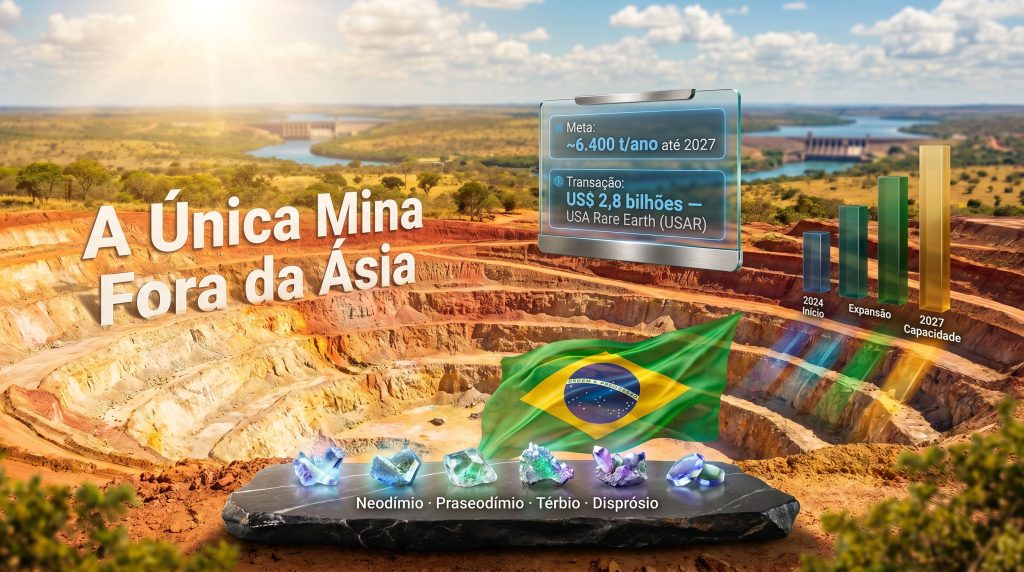
In April 2026, Serra Verde was acquired by USA Rare Earth (USAR) in a transaction valued at approximately US$2.8 billion. The scale of the deal reflects not simply the assessed value of the ore body, but the geopolitical premium attached to owning the only commercially producing ionic clay rare earth operation outside of Asia at a moment when Western industrial policy is aggressively pursuing supply chain diversification.
The critical question following the acquisition is not whether the deposit has value, but where that value will be captured. The decision about whether to conduct rare earth separation in Brazil or in the United States carries profound implications for the quantum of economic benefit that remains in Minaçu and in Brazil more broadly.
This distinction — between exporting a rare earth concentrate and exporting a separated, refined product — is the difference between extractive dependency and genuine industrial value creation. A rare earth concentrate is a partially processed material. Separated rare earth oxides are refined industrial inputs that command significantly higher prices and support skilled employment in chemistry, engineering, and materials science. Brazil has historically been a supplier of the former and an importer of the latter.
Comparative Positioning: Where Serra Verde Stands Globally
| Producer | Country | Deposit Type | Key Elements | Status |
|---|---|---|---|---|
| Serra Verde (Projeto Pela Ema) | Brazil | Ionic clay | Nd, Pr, Tb, Dy | Commercial production since 2024 |
| Bayan Obo | China | Carbonatite | Light rare earths dominant | World's largest producer |
| Mountain Pass (MP Materials) | USA | Carbonatite | Light rare earths dominant | Operational |
| Mount Weld (Lynas) | Australia | Carbonatite | Light rare earths dominant | Operational |
| Ionic clay deposits | Southern China | Ionic clay | Nd, Pr, Tb, Dy | Dominant global segment |
The table above reveals something that the broad rare earths narrative frequently obscures. The Western world already has carbonatite rare earth production at scale in the United States and Australia. What it does not have, outside of Minaçu, is ionic clay production weighted toward the heavy and magnetic rare earths. This is the genuine supply gap, and it is precisely the gap that Serra Verde fills. Consequently, understanding rare earth supply chains in this context requires looking well beyond conventional carbonatite producers.
Production Capacity and Expansion Timeline
| Operational Phase | Estimated Capacity (t/year) | Target Timeline |
|---|---|---|
| Initial Commercial Production | Operational scale | 2024 |
| Phase 1 Expansion | ~5,000 t/year | Underway |
| Full Expansion Target | ~6,400 t/year | By end of 2027 |
The Serra Verde operation currently employs approximately 350 direct workers, with the majority recruited from the local Minaçu workforce. The multiplier effect on the local economy extends across services, retail, hospitality, and municipal tax revenues — echoing the pattern established by previous economic cycles, though with a fundamentally different geopolitical dimension attached to it.
The Full Mineral Map: A Subsurface Profile Unlike Any Other in Brazil
The strategic importance of Minaçu extends well beyond the Serra Verde operation. The municipality sits atop a mineral endowment of exceptional breadth, and the 65 active mineral research permits currently registered in the region reflect the depth of international interest in what the subsurface might still yield.
| Mineral | Primary Industrial Application |
|---|---|
| Neodymium / Praseodymium / Terbium / Dysprosium | Permanent magnets, clean technology, defence systems |
| Nickel / Chromium / Platinum Group Metals | Metallurgy, catalysts, electronics |
| Graphite | Battery anodes, electrodes, industrial lubricants |
| Titanium / Rutile / Ilmenite | Aerospace, pigments, medical implants |
| Tantalum | Electronic capacitors, surgical equipment |
| Wolframite | Cutting tools, armour plating, electronics |
| Kyanite / Mica / Muscovite | Refractories, electrical insulators |
| Tin / Zinc | Soldering, galvanisation, metal alloys |
The Complexo Máfico-Ultramáfico de Canabrava, situated in the Serra de Cana Brava area, represents a particularly significant geological feature. This mafic-ultramafic complex carries recognised potential for nickel, chromium, and platinum group metal mineralisation. Globally, mafic-ultramafic complexes of this type have hosted world-class nickel sulphide and PGM deposits, and the Canabrava complex remains incompletely explored by modern geophysical and geochemical methods.
The graphite occurrences in the region also carry relevance that may have been underappreciated in earlier assessments. With battery-grade graphite now classified as a critical mineral in multiple Western jurisdictions, and with demand projections tied directly to lithium-ion battery manufacturing scale-up, graphite deposits in politically stable, low-risk jurisdictions are attracting renewed exploratory interest.
Royalties, Benefits Distribution, and the Structural Economics of Mining Towns
The mechanism through which mineral wealth translates into municipal benefit in Brazil is the Compensação Financeira pela Exploração de Recursos Minerais, or CFEM — a royalty system administered federally and partially distributed to producing municipalities. The rate and distribution formula have been revised over time, but the fundamental tension between the scale of resource extraction and the quantum of local compensation has persisted through every economic cycle Minaçu has experienced.
The asbestos era demonstrated this tension with particular clarity. Enormous economic value was extracted from the municipality over decades, but the long-term health and environmental costs ultimately fell disproportionately on the local population and the public health system rather than on the extracting corporations. This pattern serves as a cautionary reference point for current and future mineral development in the region.
Cities built around a single extractive cycle carry structural economic vulnerability that persists long after the resource is depleted or the market changes. Minaçu's extraordinary mineral diversity offers a genuinely rare opportunity to construct multi-cycle economic resilience, but geological abundance alone does not create institutional capacity. That requires deliberate policy architecture.
The next major ASX story will hit our subscribers first
Three Scenarios for Minaçu's Mineral Future
Scenario 1: Vertical Integration Within Brazil
Serra Verde expands beyond concentrate production into rare earth separation and refining on Brazilian soil. This pathway would generate skilled employment in chemical engineering and materials processing, expand the CFEM royalty base, and position Brazil as an exporter of refined rare earth oxides rather than raw concentrates. It would require significant capital investment and resolution of the technical and regulatory frameworks for hydrometallurgical processing at scale.
Scenario 2: Concentrate Export with Offshore Processing
Brazil remains a supplier of partially processed material, with separation and refining conducted in the United States under USA Rare Earth's operational framework. This scenario captures less domestic value per tonne extracted but may progress more rapidly given existing processing infrastructure in the US. However, America's rare earth supply chain strategy will ultimately determine how much of this value flows back to the Brazilian operation.
Scenario 3: Mineral Diversification Across Multiple Projects
The 65 active research permits in the Minaçu region convert into new development projects across nickel, graphite, titanium, or platinum group metals. This scenario would structurally reduce Minaçu's dependence on any single commodity price cycle, creating a diversified mineral economy with a broader employment and revenue base. In addition, the broader rare earth geopolitics of the current moment make this diversification strategy increasingly attractive to foreign investors seeking to reduce exposure to Chinese supply dominance.
Frequently Asked Questions
What rare earth elements are produced at Minaçu and why do they matter?
The Serra Verde operation produces neodymium, praseodymium, terbium, and dysprosium. These four elements are the critical inputs for high-performance permanent magnets used in electric vehicle motors, wind turbines, military guidance systems, and advanced electronics. Their combined importance to the clean energy transition is unmatched by any other group of rare earth elements.
Why is Minaçu's deposit considered unique outside of Asia?
Ionic clay deposits, which are the geological type hosting the Projeto Pela Ema, naturally concentrate the heavy and magnetic rare earth elements at grades and in forms amenable to low-impact extraction. Outside of southern China, commercially viable ionic clay rare earth operations do not exist at scale, making the Minaçu terras raras Serra Verde operation structurally singular in the global supply landscape.
When did Serra Verde begin commercial rare earth production?
Commercial production commenced in 2024. The operation is targeting an expansion to approximately 6,400 tonnes per year by the end of 2027.
Who acquired Serra Verde and at what valuation?
USA Rare Earth acquired Serra Verde in April 2026 in a transaction valued at approximately US$2.8 billion.
What is the current employment impact of the Serra Verde operation?
Approximately 350 direct employees, predominantly sourced from the local Minaçu community, are currently engaged in the operation.
Are there other minerals beyond rare earths in the Minaçu region?
Yes. The subsurface of Minaçu contains nickel, chromium, platinum group metals, graphite, titanium, rutile, ilmenite, tantalum, wolframite, kyanite, mica, muscovite, tin, and zinc. The Complexo Máfico-Ultramáfico de Canabrava adds further potential for nickel, chromium, and PGM mineralisation.
This article contains forward-looking statements, projected timelines, and scenario analysis that are inherently speculative. Readers should conduct independent due diligence before making any investment or strategic decisions based on the information presented. The production targets, transaction valuations, and expansion timelines referenced reflect publicly reported data and are subject to change.
Want to Track the Next Major Critical Minerals Discovery Before the Market Moves?
Discovery Alert's proprietary Discovery IQ model delivers real-time alerts on significant ASX mineral discoveries — instantly translating complex geological data into actionable investment insights for both short-term traders and long-term investors. Explore historic examples of major discovery returns and begin your 14-day free trial at Discovery Alert to position yourself ahead of the market.