
June 16, 2026
Central Banks at a Crossroads: Understanding the RBA's Difficult Balancing Act
Monetary policy is rarely straightforward, but the conditions facing central banks in mid-2026 represent one of the more genuinely complex environments in recent memory. Across developed economies, policymakers are navigating a collision between stubborn inflation and decelerating growth, a combination that defies the standard monetary policy playbook. For the Reserve Bank of Australia, this tension has crystallised into a holding pattern that is anything but passive.
The RBA holds rates steady at 4.35% and warns hikes are not off the table, a position that tells a more layered story than a simple pause in the rate cycle. It reflects a central bank caught between the discipline required to anchor inflation expectations and the caution demanded by an economy showing signs of fatigue. Furthermore, this stance arrives against a backdrop of significant global recession risks that continue to weigh on policymakers worldwide.
When big ASX news breaks, our subscribers know first
The Stagflationary Trap: Why the RBA's Position Is Unusually Constrained
Central banking operates on a fundamental principle: raise rates to cool inflation, cut rates to stimulate growth. The challenge arises when both pressures exist simultaneously, forcing policymakers to choose which risk to prioritise.
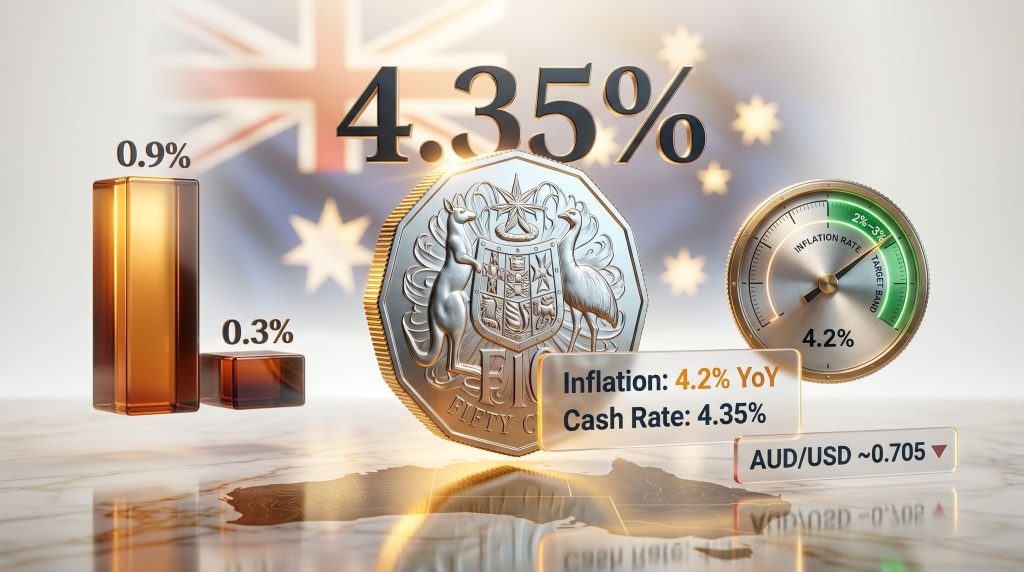
Australia is experiencing precisely this dilemma. Headline inflation registered 4.2% year-on-year in the April 2026 reading, sitting materially above the RBA's target corridor of 2% to 3%. At the same time, GDP growth came in at just 0.3% quarter-on-quarter in Q1 2026, a sharp retreat from the 0.9% recorded in the prior quarter and well below the 0.5% consensus forecast compiled by Reuters. On an annual basis, the economy expanded 2.5%, matching the prior period but missing expectations.
This combination of above-target inflation and below-expectation growth narrows the RBA's room to manoeuvre considerably. Cutting rates risks reigniting price pressures; hiking aggressively risks tipping an already softening economy into contraction.
The board's response to this environment was unanimous: hold the cash rate target at 4.35%, with the Exchange Settlement balances rate maintained at 4.25%. However, the language accompanying the decision was pointedly hawkish, signalling that the RBA is not yet satisfied that inflation is on a credible downward path.
The Iran War's Lasting Imprint on Australian Inflation
One of the more distinctive features of Australia's current inflationary episode is the role played by global energy market disruption. The conflict involving Iran created significant supply-side pressure in oil markets, and while a diplomatic agreement has since been reached to end hostilities, the RBA has been explicit that the resolution remains at an early stage. In addition, the oil price rally driven by geopolitical tensions has made global oil supply normalisation a slow and uncertain process.
This matters because energy price shocks do not operate in isolation. Higher fuel costs feed directly into the cost of transporting goods, manufacturing inputs, and a broad range of services. The RBA acknowledged this pass-through dynamic directly, noting that elevated fuel prices have contributed to inflation across goods and services categories, making price pressures harder to contain through demand-side monetary tools alone.
This is a critical distinction for understanding why the RBA is reluctant to declare victory on inflation despite some moderation in the headline figure. Supply-driven inflation is structurally different from demand-driven inflation in one important respect: interest rate increases are far less effective at addressing it. The RBA cannot drill for oil or resolve geopolitical disputes. What it can do is prevent second-round effects, where businesses and workers begin to price in persistently higher energy costs through wage demands and price-setting behaviour.
Table: Key Australian Economic Indicators at the June 2026 RBA Decision
| Indicator | Latest Reading | Prior Period | RBA Target / Benchmark |
|---|---|---|---|
| Cash Rate Target | 4.35% | 4.35% (unchanged) | N/A |
| Exchange Settlement Rate | 4.25% | 4.25% (unchanged) | N/A |
| Headline Inflation (YoY) | 4.2% | Above target | 2%–3% |
| GDP Growth (QoQ) | 0.3% | 0.9% | ~0.5% (consensus) |
| GDP Growth (YoY) | 2.5% | 2.5% | Above consensus |
| AUD/USD Post-Decision | ~0.705 | Pre-decision level | N/A |
How the RBA Communicates Uncertainty: The Art of Policy Language
One of the least appreciated aspects of central banking is the strategic use of language. When the RBA states that a further rate increase cannot be ruled out, this is not rhetorical imprecision. It is deliberate communication architecture designed to influence market expectations without committing to a specific action.
This approach, often described as data-dependent policy guidance, serves several functions simultaneously:
- It prevents markets from pricing in rate cuts prematurely, which would loosen financial conditions and potentially reignite inflation.
- It preserves the board's flexibility to respond to new data without being accused of reversing course.
- It signals credibility on the inflation mandate, reassuring businesses and workers that the RBA will not tolerate a sustained overshoot of its target band.
The board reinforced that policy must remain sufficiently restrictive until there is clear and sustained evidence that inflation is returning to the 2%–3% target range within a reasonable timeframe. This framing is consistent with the RBA's broader communication strategy under Governor Michele Bullock, which has emphasised evidence over signalling. Concerns around two-year yield uncertainty have further complicated the RBA's efforts to anchor market expectations in this environment.
Monetary Policy Transmission Lags: The Hidden Variable in Rate Decisions
A factor that receives insufficient attention in mainstream coverage of rate decisions is the transmission lag between a central bank's policy action and its full effect on the real economy. Academic research and historical central bank experience consistently point to lags of 12 to 18 months before the complete impact of a rate change flows through to consumer spending, business investment, and ultimately, inflation.
This creates a genuine complication for the RBA. The rate increases delivered over the prior tightening cycle are still working their way through the economy. Mortgage repayments, business refinancing costs, and household balance sheet adjustments all operate on time horizons that extend well beyond the date of any individual rate decision. The RBA's acknowledgement that it is evaluating the response to previous interest rate rises reflects this awareness.
In practical terms, this means the full disinflationary effect of the current restrictive stance may not yet be visible in the data. Consequently, this partially explains why the board is reluctant to add further tightening unless evidence clearly warrants it, while simultaneously refusing to pivot toward cuts.
Market Reactions and Investor Recalibration
Financial markets responded to the June 2026 decision with measured but meaningful adjustments. The S&P/ASX 200 edged marginally lower following the announcement, reflecting the equity market's sensitivity to the prospect of prolonged restrictive monetary conditions. Growth-oriented sectors, particularly real estate and consumer discretionary, are most exposed to a sustained high-rate environment. For broader context on how local equities have been faring, Australian share market performance data highlights the pressure these sectors have been under throughout 2025 and into 2026.
The Australian dollar weakened 0.3% against the US dollar, settling around 0.705. This reaction is instructive. Currency markets had apparently priced in some probability of a more dovish tone from the RBA. The board's explicit warning about potential further hikes prompted a reassessment, pushing the AUD lower as rate differentials between Australia and other economies were repriced.
A weaker Australian dollar carries its own inflationary consequences. Imported goods become more expensive in Australian dollar terms, adding to headline inflation through the import price channel, a dynamic the RBA will be monitoring carefully in coming months.
Market pricing for future rate cuts shifted further out along the yield curve following the decision. Investors reassessing the timeline for any easing cycle reflects a broader recalibration of expectations that had, in some corners of the market, anticipated rate relief arriving sooner than the RBA's guidance now supports.
The next major ASX story will hit our subscribers first
The RBA in Global Context: Where Australia Sits Among Peer Central Banks
Australia's monetary policy stance takes on additional meaning when viewed alongside the decisions of other major central banks navigating similar, if not identical, conditions. Moreover, tariffs and inflation risks emanating from the United States have added another layer of complexity for central banks attempting to chart a clear course through this period.
Table: Comparative Central Bank Policy Rates, Mid-2026
| Central Bank | Policy Rate | Recent Direction | Inflation Target |
|---|---|---|---|
| Reserve Bank of Australia | 4.35% | Hold with hawkish bias | 2%–3% |
| US Federal Reserve | ~4.25%–4.50% | Data-dependent | ~2% |
| Bank of England | ~5.00% | Hold / cautious easing | 2% |
| Reserve Bank of New Zealand | ~5.25% | Cutting cycle underway | 1%–3% |
What stands out in this comparison is the RBA's explicit retention of a hiking bias at a point when several peer institutions have either begun cutting or are clearly signalling an easing pivot. The Reserve Bank of New Zealand, operating in a broadly comparable economic environment, has already commenced a cutting cycle. This divergence reflects Australia's specific inflation dynamics, particularly the energy pass-through effect, and the RBA's assessment that its domestic conditions do not yet justify a pivot.
Three Scenarios for Australia's Rate Path Through Late 2026
The RBA's deliberately open-ended language creates a genuine range of possible policy outcomes over the next two to three quarters. Investors, borrowers, and businesses should be thinking in scenario terms rather than assuming a single trajectory.
Scenario 1: Inflation Remains Sticky, Triggering a Further Hike
If the May and June inflation readings fail to show meaningful progress toward the 3% upper bound, and if wages growth accelerates or services inflation proves resilient, the RBA may deliver one additional 25 basis point increase. This scenario would likely push the cash rate to 4.60% and extend mortgage stress for variable-rate borrowers.
Scenario 2: Gradual Disinflation Supports an Extended Hold
The base case for most economists remains a prolonged hold at 4.35% through the second half of 2026. Under this scenario, inflation trends downward but remains above target, and the RBA judges that existing policy settings are doing their work. Rate cuts do not enter the picture until 2027 at the earliest. Current interest rate data from Trading Economics provides a useful historical lens for understanding how long previous hold periods have lasted.
Scenario 3: Growth Deteriorates, Prompting an Early Pivot
If GDP growth falls materially below trend and unemployment rises sharply, particularly in the context of a slowdown among Australia's major trading partners, the RBA could be forced into a reluctant pivot toward easing. This scenario is currently considered the least likely by most market participants, but the RBA's own acknowledgement that prolonged uncertainty could weigh on growth in trading partners suggests the board is not dismissing it entirely.
Disclaimer: The scenarios outlined above are analytical frameworks based on current economic conditions and RBA communication. They do not constitute financial advice. Economic conditions can change rapidly, and actual policy outcomes may differ materially from any projection.
What This Means for Australian Borrowers and Businesses
For the approximately one-third of Australian households carrying variable-rate mortgages, the June 2026 decision brings limited immediate relief. With the cash rate anchored at 4.35%, mortgage serviceability remains near cycle highs, and the RBA's guidance removes any near-term expectation of rate reductions.
The practical implications are significant:
- Household consumption will remain constrained as mortgage repayments absorb a larger share of disposable income.
- Business investment decisions, particularly those reliant on debt financing, are likely to be deferred while the rate outlook remains uncertain.
- The property market faces continued affordability pressure, particularly in high-leverage segments.
- Small and medium enterprises with floating-rate credit facilities face sustained cost pressures on their working capital.
The broader concern is that cumulative tightening, even without further hikes, continues to bite through its effect on credit availability and consumer confidence. The transmission lag dynamic means the full weight of existing rate increases is still being felt.
Frequently Asked Questions: RBA Rate Decision June 2026
What is the current RBA cash rate?
The cash rate target sits at 4.35%, with the Exchange Settlement rate at 4.25%. Both were held unchanged at the June 2026 board meeting in a unanimous decision. The official RBA media release confirms the full details of this decision.
Why did the RBA not cut rates?
Headline inflation of 4.2% year-on-year remains above the 2%–3% target band. The board concluded that maintaining restrictive monetary conditions was necessary to return inflation sustainably to target within a reasonable timeframe.
Could there be another rate hike in 2026?
Yes. The RBA explicitly retained the possibility of a further increase if incoming data shows inflation is not moderating as expected. The board's stance is deliberately data-dependent rather than forward-committed.
How does the Iran war affect Australian interest rates?
The conflict elevated global oil prices, feeding directly into Australian headline inflation through fuel costs and broader goods and services pass-through effects. Even with a peace agreement reached, the RBA has indicated that oil supply normalisation will take time, keeping energy-related inflation elevated in the near term.
What happened to the Australian dollar after the June 2026 RBA decision?
The AUD fell 0.3% against the US dollar, trading at approximately 0.705, as markets adjusted expectations for the timing of any future rate cuts.
When might the RBA start cutting rates?
Based on current guidance, rate cuts are unlikely before 2027 under the base case scenario. The RBA holds rates steady at 4.35% and warns hikes are not off the table, and has given no indication of an imminent pivot while explicitly leaving the door open to further tightening.
Key Takeaways
- The RBA's unanimous decision to hold the cash rate at 4.35% reflects a central bank operating in a genuinely constrained environment where both inflation and growth concerns are simultaneously active.
- Headline inflation at 4.2% remains 120 basis points above the upper bound of the target range, and energy-driven pass-through effects are expected to persist.
- GDP growth of 0.3% quarter-on-quarter signals a slowing economy but does not yet constitute grounds for a policy pivot.
- The RBA holds rates steady at 4.35% and warns hikes are not off the table, distinguishing its posture from several peer central banks that have moved toward easing.
- Monetary policy transmission lags mean the full disinflationary effect of the current tightening cycle is still unfolding, a factor the board is actively weighing.
- The next two to three months of inflation, wages, and employment data will be decisive in determining whether Australia's rate trajectory tilts toward one more hike, a prolonged hold, or an earlier-than-expected pivot.
For official RBA communications, board statements, and monetary policy review documents, readers can access the Reserve Bank of Australia's publications at rba.gov.au. For ongoing coverage of Asia-Pacific central bank developments, CNBC's Asia Economy section provides regular reporting on regional monetary policy.
Want to Stay Ahead of Major ASX Mineral Discoveries While Navigating Rate Uncertainty?
While the RBA's restrictive monetary policy stance continues to reshape the investment landscape, Discovery Alert's proprietary Discovery IQ model delivers real-time alerts on significant ASX mineral discoveries, cutting through market complexity to provide actionable opportunities for both traders and long-term investors. Explore historic examples of exceptional discovery returns and begin your 14-day free trial today to position yourself ahead of the broader market.