June 3, 2026
When Legacy Meets Longevity: The Strategic Architecture of a Half-Century Mining Operation
Across the global mining landscape, the rarest achievement is not discovering a world-class deposit. It is sustaining one across five decades of shifting commodity cycles, evolving regulatory frameworks, community expectations, geopolitical pressures, and technological disruption. Fewer still manage this feat while simultaneously expanding reserves, transitioning energy systems, and attracting the attention of a sitting head of state. RBM hosts Ramaphosa during landmark visit as company marks 50 years, and understanding why this convergence matters requires looking beyond the headline event and into the structural forces that define how mineral sands operations compete, survive, and ultimately shape the economies that host them.
When big ASX news breaks, our subscribers know first
Why Mineral Sands Are More Strategically Important Than Most Investors Realise
The mineral sands sector rarely captures the same investor attention as gold, copper, or lithium. Yet the products extracted from heavy mineral concentrates, particularly titanium feedstocks and zircon, underpin industries ranging from aerospace components to paint pigmentation, from nuclear fuel pellets to advanced ceramics. This quiet ubiquity means that supply disruptions flow quickly and invisibly through downstream manufacturing chains, often before markets fully register the source.
Titanium dioxide, the primary derivative of ilmenite processing, is the world's most widely used white pigment. It appears in roughly 90% of all pigment applications globally, according to industry data, including paints, plastics, coatings, paper, and sunscreen formulations. Rutile, a naturally occurring high-grade titanium feedstock, commands a price premium over ilmenite precisely because it requires less processing to convert into titanium metal or welding electrode flux. Zircon, meanwhile, sits at the intersection of ceramics manufacturing, refractory linings for steel furnaces, and increasingly, advanced nuclear applications where its low neutron absorption characteristics make it uniquely suited.
South Africa holds one of the world's most significant heavy mineral sand endowments, and Richards Bay Minerals (RBM), a subsidiary of Rio Tinto operating in KwaZulu-Natal, has been the cornerstone of that position since its founding in 1976. As RBM marks its 50th year of continuous production in 2026, the company finds itself at a genuine inflection point: a major expansion approval secured, a renewable energy transition underway, and a presidential visit providing rare public validation of its strategic importance to the national economy. Notably, the titanium manufacturing supply chain that relies on feedstocks from operations like RBM underscores precisely why this milestone carries global weight.
What Is Richards Bay Minerals and Why Is It Globally Significant?
A Snapshot of Operational Scale and Product Mix
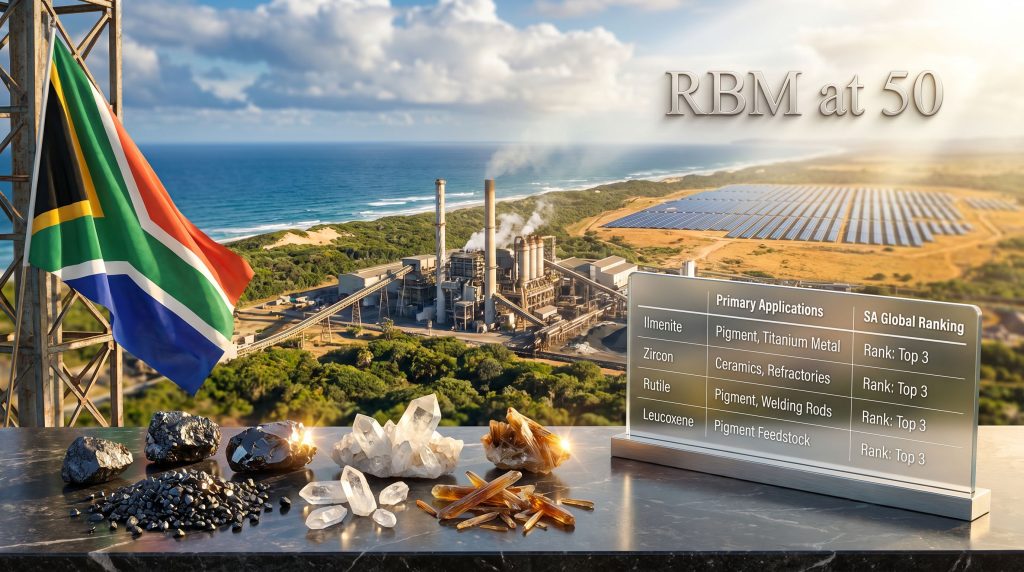
RBM operates one of the largest mineral sands complexes in the world, extracting and processing a suite of heavy minerals from the coastal dune systems of KwaZulu-Natal. The operation produces four primary products:
- Ilmenite: The dominant volume product, processed downstream into titanium dioxide pigment for paints, plastics, and paper industries.
- Rutile: A high-grade, naturally occurring titanium dioxide mineral used in titanium metal production, aerospace alloys, and as flux in welding electrode coatings.
- Zircon: A mineral with diverse applications in high-temperature ceramic production, refractory linings for steelmaking furnaces, nuclear fuel cladding research, and precision optics.
- Leucoxene: A partially altered ilmenite with elevated titanium dioxide content, used as a specialty feedstock where intermediate titanium grades are required.
What distinguishes RBM from many of its peers in the global mineral sands market is not simply the scale of its reserve base, but the presence of on-site smelting infrastructure. Unlike pure mining operations that export heavy mineral concentrate for offshore processing, RBM operates smelter facilities that convert ilmenite into titania slag and pig iron on location. This integrated processing capability reduces exposure to raw ore commodity pricing and creates a more defensible margin position across commodity cycles.
How RBM Compares Within the Global Competitive Landscape
The mineral sands sector is dominated by a relatively small number of large operators. Key competitors and peer operations include:
| Operator | Primary Geography | Key Products | Integration Level |
|---|---|---|---|
| RBM (Rio Tinto) | South Africa | Ilmenite, rutile, zircon, leucoxene | High (smelting on-site) |
| Tronox Holdings | Multiple regions | Titanium dioxide, zircon | Vertically integrated |
| Kenmare Resources | Mozambique | Ilmenite, zircon, rutile | Concentrate export model |
| Iluka Resources | Australia | Zircon, rutile, synthetic rutile | Variable by asset |
RBM's integrated model creates a structural advantage that is difficult to replicate quickly. The capital cost and technical complexity of smelter infrastructure represents a significant barrier to entry, and the decades of operational knowledge embedded in RBM's workforce adds further insulation against competitive pressure.
RBM Hosts Ramaphosa During Landmark Visit as Company Marks 50 Years
On 7 May 2026, President Cyril Ramaphosa made his first official visit to RBM's operations in Richards Bay, coinciding with the company's 50th anniversary milestone. The visit encompassed a tour of key operational infrastructure, including the mining pond complex and smelter control rooms, as well as direct engagement with employees and union representatives, according to Mining Weekly's reporting by Sabrina Jardim (May 8, 2026).
The significance of a sitting president touring active extraction and processing infrastructure should not be interpreted narrowly. In resource-dependent economies, operational site visits by heads of government typically serve multiple simultaneous functions:
- They signal policy alignment between the executive branch and the mining sector at a specific moment in time.
- They provide political cover for ongoing regulatory and permitting processes associated with project expansions.
- They create a public narrative linking resource extraction to employment and economic development, which is essential for maintaining the social licence framework that underpins operational continuity.
- They demonstrate to international capital allocators that the sovereign environment is stable enough to warrant continued investment in large-scale, long-horizon projects.
The company itself characterised the visit as a moment to reflect on its historical impact in the region and consider its future trajectory, with collaboration between government, industry, and communities identified as the cornerstone of driving economic growth and long-term development in South Africa. (Mining Weekly, May 8, 2026)
How Has RBM Shaped the Richards Bay Region Over 50 Years?
Economic Footprint and Community Architecture
Half a century of continuous operation in a single geographic region creates economic dependencies that extend far beyond direct employment numbers. The multiplier effects of a large-scale mining and processing operation on a regional economy operate through several channels simultaneously:
- Direct employment: Skilled and semi-skilled roles across mining, processing, maintenance, logistics, and administration create a formal wage base in the regional economy.
- Indirect employment: Local suppliers of goods and services, from catering and security to engineering components and transport, generate secondary employment that sustains broader household income levels.
- Induced employment: Wages earned by direct and indirect employees circulate through the local economy, supporting retail, housing, healthcare, and education sectors.
- Infrastructure development: Mining operations of RBM's scale typically catalyse infrastructure investment in road, port, power, and water systems that benefits the broader regional population.
The Richards Bay port and associated logistics corridor, for example, has developed alongside the industrial operations concentrated in the region, creating a logistics ecosystem that serves multiple industries.
The Evolution of Community and Labour Relations
One of the less-discussed dimensions of long-tenure mining operations is the transformation of their community relations model over time. Operations that began in a compliance-driven era, where community engagement was primarily a legal obligation rather than a strategic priority, have had to evolve substantially as host community expectations have shifted, regulatory requirements have intensified, and social licence has become a material operational risk.
RBM's direct engagement with union representatives during the presidential visit reflects an embedded culture of labour dialogue that took decades to develop. Operations that maintain active and transparent union engagement consistently demonstrate lower rates of work stoppages and higher operational continuity metrics compared to those where labour relations are managed reactively.
Transformation and B-BBEE Obligations
South Africa's Mining Charter framework imposes specific transformation requirements on mining operations, covering ownership, management representation, skills development, procurement, and beneficiation commitments. For a Rio Tinto subsidiary operating in South Africa, navigating the tension between global parent company capital allocation priorities and local transformation obligations represents an ongoing governance challenge.
Beneficiation — specifically the requirement to process minerals locally rather than exporting raw concentrate — is an area where RBM's integrated smelting capability aligns naturally with government industrial policy objectives. This alignment reduces regulatory friction and supports the narrative of mining as a driver of industrial development rather than simple resource extraction. Furthermore, understanding Rio Tinto taxes and royalties provides important context for appreciating the full scale of RBM's fiscal contribution to South Africa.
What Does the Zulti South Project Approval Mean for RBM's Long-Term Viability?
Understanding Mine Life Extension as a Strategic Imperative
For large-scale mineral sands operations, the single greatest existential threat is not commodity price cycles or regulatory change. It is deposit depletion. Unlike hard rock mining where vertical depth can extend mine life significantly, coastal dune mineral sands operations are geographically constrained by the extent of economically viable heavy mineral concentration along specific coastal corridors.
The approval of the Zulti South project therefore represents something more fundamental than a capacity expansion. It is a reserve life extension decision that determines whether RBM's integrated smelting infrastructure remains economically justified for the next generation of operation. Without feed material for the smelters, the on-site processing advantage disappears entirely. The completion of construction at the Zulti South pilot plant marked a critical preparatory milestone for this larger approval.
Mine life extension projects in mineral sands are structurally different from brownfield expansions in hard rock mining. The processing infrastructure already exists; the critical variable is securing the feed material pipeline to justify its continued operation and ongoing capital maintenance. This makes reserve replacement decisions disproportionately important to operational viability.
Strategic Implications of Approval During an Emerging Market Uncertainty Period
The timing of the Zulti South approval carries additional significance. Securing major project greenlight decisions during periods of broader emerging market uncertainty sends a credible signal to international capital markets that Rio Tinto views South Africa as a sufficiently stable jurisdiction to commit long-duration capital. This is a form of revealed preference that goes beyond corporate communications and investor relations positioning.
Key risk factors that will govern project execution include:
- Port capacity: Richards Bay harbour is a critical export gateway, and throughput constraints could bottleneck expanded production volumes.
- Coastal environmental conditions: KwaZulu-Natal's coastal environment involves sensitive dune ecosystems, and environmental approval conditions for construction and rehabilitation will shape both project timelines and operating cost structures.
- Community consultation outcomes: The consent framework governing Zulti South's construction phase will reflect the quality of community relationships developed over the preceding decades.
- Water access: Mineral sands processing operations require significant water volumes, and resource availability in coastal KwaZulu-Natal involves competing agricultural, municipal, and environmental claims.
The next major ASX story will hit our subscribers first
How Is RBM Integrating Renewable Energy Into Its Operations?
The Bolobedu Solar Project in Context
The recently commissioned Bolobedu solar power project represents RBM's most visible step toward reducing its reliance on South Africa's constrained electricity grid. Mineral sands smelting is among the most energy-intensive processes in the mining value chain. Smelting ilmenite into titania slag requires sustained high-temperature arc furnace operation, which consumes electricity at rates that make energy cost a material variable in determining processing economics.
South Africa's experience with grid instability over the preceding decade created measurable operational disruption for energy-intensive industries. Load-shedding events interrupted production scheduling, increased maintenance costs associated with equipment cycling, and added uncertainty to output planning. For an operation like RBM with continuous-process smelting requirements, grid independence is not simply an ESG preference; it is an operational resilience investment. Indeed, renewable energy in mining is increasingly reshaping the competitive dynamics across the entire sector.
Comparing Energy Models for Large-Scale Mineral Processing
The strategic rationale for hybrid and eventually off-grid energy systems in mineral sands processing can be evaluated across several dimensions:
| Energy Model | Grid Dependency | Cost Predictability | Emissions Exposure | Resilience to Outages |
|---|---|---|---|---|
| Fully Grid-Dependent | High | Low | Higher carbon intensity | Vulnerable |
| Hybrid Solar and Grid | Moderate | Improved | Reduced footprint | Medium-High |
| Full Off-Grid Renewable | Minimal | High | Lowest | Highest |
The transition from fully grid-dependent to hybrid operations typically yields meaningful improvements in cost predictability before the emissions reduction benefits become the primary driver. This sequencing matters for understanding why mining companies frame renewable energy investments in operational resilience terms alongside their decarbonisation narratives.
Alignment With Rio Tinto's Decarbonisation Architecture
The Bolobedu initiative fits within Rio Tinto's broader Scope 1 and Scope 2 emissions reduction commitments. Major diversified miners face intensifying pressure from institutional shareholders to demonstrate credible, asset-level decarbonisation progress rather than group-level target-setting without operational substance. In addition, the mining decarbonisation benefits extend well beyond emissions metrics, encompassing meaningful cost efficiencies and improved long-term competitiveness.
Subsidiary-level renewable projects serve multiple strategic functions within parent company ESG reporting:
- They provide verifiable, auditable emissions reduction data at the asset level.
- They reduce exposure to future carbon pricing mechanisms that could increase operating costs for energy-intensive processing.
- They demonstrate to host governments that foreign mining capital is aligned with domestic energy transition priorities.
- They build the operational knowledge base required to scale renewable integration across other assets in the portfolio.
What Does Government-Industry Collaboration Look Like in Practice?
The Tripartite Framework in South African Mining
Effective public-private partnership in resource-dependent regions requires navigating three distinct sets of interests that frequently diverge: government's fiscal and industrialisation objectives, industry's return-on-capital requirements, and communities' livelihood and environmental expectations. When these three sets of interests are aligned, large-scale mining operations function with minimal disruption and attract continued capital investment. When they are misaligned, the consequences range from regulatory delays to operational shutdowns.
RBM's 50-year operational record suggests a relatively durable version of this tripartite alignment, though this does not imply the absence of friction over specific issues. The company's characterisation of community and government partnership as the cornerstone of its success reflects an understanding that social licence is not granted once and held permanently; it must be continuously maintained through demonstrated performance across employment, environment, procurement, and community investment metrics.
South Africa's Mining Sector Conditions in 2026
The broader context in which RBM's milestone occurs includes meaningful improvements in South Africa's energy supply reliability compared to the severe load-shedding peaks of earlier years. For mining operations, reduced grid instability translates directly into improved production scheduling, lower maintenance costs from equipment cycling, and greater certainty in export volume planning.
The regulatory environment has also evolved. Amendments to South Africa's mineral resources development legislation have sought to streamline certain permitting processes while strengthening beneficiation and transformation requirements. The net effect on investor sentiment has been cautiously positive, though policy uncertainty remains a persistent feature of the investment risk calculus for long-horizon mining commitments. However, the South Africa mining decline narrative that has dominated recent discourse makes RBM's sustained operational success all the more noteworthy.
Benchmarking South Africa Against Competing Mineral Sands Jurisdictions
South Africa does not operate in isolation within global mineral sands supply. Alternative sourcing geographies include:
- Mozambique: Kenmare Resources' Moma operation has established itself as a significant ilmenite producer, with the logistical advantage of coastal location but without integrated smelting capability.
- Madagascar: QIT Madagascar Minerals (another Rio Tinto operation) produces ilmenite and zircon from the Fort Dauphin region, providing Rio Tinto with geographic diversification within its mineral sands portfolio.
- Australia: Iluka Resources and other operators benefit from a highly rated sovereign risk environment, advanced infrastructure, and a deep pool of technical mining expertise, though labour costs are significantly higher.
South Africa's competitive advantages centre on its established processing infrastructure, the depth of its skilled technical workforce, and the integrated logistics capability of the Richards Bay port corridor. Risks to maintaining this competitive position include infrastructure deterioration, policy instability, and labour relations complexity that could erode cost and reliability advantages over time.
Frequently Asked Questions About Richards Bay Minerals and the Presidential Visit
What minerals does Richards Bay Minerals produce?
RBM extracts and processes four primary heavy minerals from coastal dune deposits in KwaZulu-Natal: ilmenite, which is the primary feedstock for titanium dioxide pigment production; rutile, a high-grade titanium mineral used in aerospace alloys and welding electrodes; zircon, used in ceramics, refractories, and nuclear applications; and leucoxene, a specialty titanium feedstock with elevated titanium dioxide content.
Who owns Richards Bay Minerals?
RBM operates as a subsidiary of Rio Tinto, one of the world's largest diversified mining companies. This ownership structure means RBM operates within Rio Tinto's global governance, capital allocation, and ESG compliance frameworks, while also being subject to South Africa's domestic mining regulations and transformation requirements.
What is the Zulti South project?
Zulti South is an approved mine expansion project designed to extend RBM's mineral reserve base and ensure continued feed material supply to its existing smelting infrastructure. The project represents a major capital commitment to the long-term operational continuity of the Richards Bay operation.
How does RBM contribute to South Africa's economy?
RBM contributes through direct employment in mining and processing operations, indirect employment through local supplier networks, export revenue from mineral sands products, tax and royalty contributions to the national fiscus, and community investment programmes in the KwaZulu-Natal region that have developed over 50 years of continuous operation.
What is the Bolobedu solar project?
Bolobedu is a recently commissioned solar power facility that forms part of RBM's strategy to reduce dependence on South Africa's national electricity grid, lower operational carbon emissions, and improve energy supply resilience for its energy-intensive smelting and processing operations.
Why did President Ramaphosa visit Richards Bay Minerals?
President Ramaphosa's visit on 7 May 2026 marked RBM's 50th anniversary and represented his first official engagement with the company's operations. The visit included tours of key infrastructure, direct engagement with employees and union representatives, and served to reinforce the narrative of government-industry-community partnership as a driver of South Africa's mining-led economic development. Consequently, RBM hosts Ramaphosa during landmark visit as company marks 50 years stands as one of the most symbolically significant moments in the operation's half-century history.
Key Takeaways: What RBM's 50-Year Milestone Reveals About South Africa's Mining Trajectory
Five Strategic Lessons From Half a Century of Mineral Sands Production
- Integrated processing creates durable competitive advantage. Operations that invest in on-site beneficiation build structural barriers to competition and reduce exposure to raw commodity price volatility in ways that pure mining operations cannot replicate.
- Reserve replacement is the defining challenge for mature operations. Zulti South's approval demonstrates that the critical long-term question for large mineral sands operations is not production efficiency but securing the feed material pipeline to justify continued infrastructure investment.
- Renewable energy is transitioning from an ESG reporting metric to an operational necessity. In energy-constrained markets, hybrid and off-grid energy systems represent a competitive advantage, not merely a compliance cost.
- Community relationships require continuous investment, not periodic management. Fifty years of operating in the same geographic region has created both obligations and advantages, and the quality of those relationships directly affects the regulatory and social licence environment for new project approvals.
- Long-horizon capital commitments signal sovereign confidence more credibly than policy statements. The combination of Zulti South approval and Bolobedu commissioning within a single strategic moment represents revealed preference by Rio Tinto about South Africa's investability.
Forward-Looking Indicators to Watch
- Progress milestones along the Zulti South construction timeline and first production scheduling.
- Bolobedu solar capacity utilisation data and potential replication across other RBM facilities.
- South Africa's aggregate mineral sands export volumes as a proxy for sector-wide health.
- Global titanium feedstock demand trajectory, driven by aerospace production recovery and clean energy technology growth, which creates the fundamental demand backdrop against which RBM's expansion economics will be evaluated.
The convergence of a 50-year operational milestone, a major reserve extension approval, and an energy transition commissioning within a single strategic period positions RBM as a case study in how legacy mineral sands operations can reposition for the next generation of resource demand. The durability of that positioning will ultimately depend on the stability of the enabling environment that has underpinned five decades of continuous production.
Readers seeking further context on South Africa's mineral sands sector and broader mining industry developments may find value in exploring coverage from Mining Weekly, which regularly publishes industry analysis and operational updates across the South African resources sector.
Want to Stay Ahead of the Next Major Mineral Discovery on the ASX?
Discovery Alert's proprietary Discovery IQ model delivers real-time alerts the moment significant mineral discoveries are announced on the ASX, transforming complex data across more than 30 commodities into clear, actionable insights for both short-term traders and long-term investors. Explore Discovery Alert's discoveries page to see how historic finds have generated substantial returns, and begin your 14-day free trial today to position yourself ahead of the broader market.