Redcastle Resources Ltd
- ASX Code: RC1
- Market Cap: $14,071,454
Drilling Confirms Grade and Continuity as Redcastle Reef Mining Moves Forward
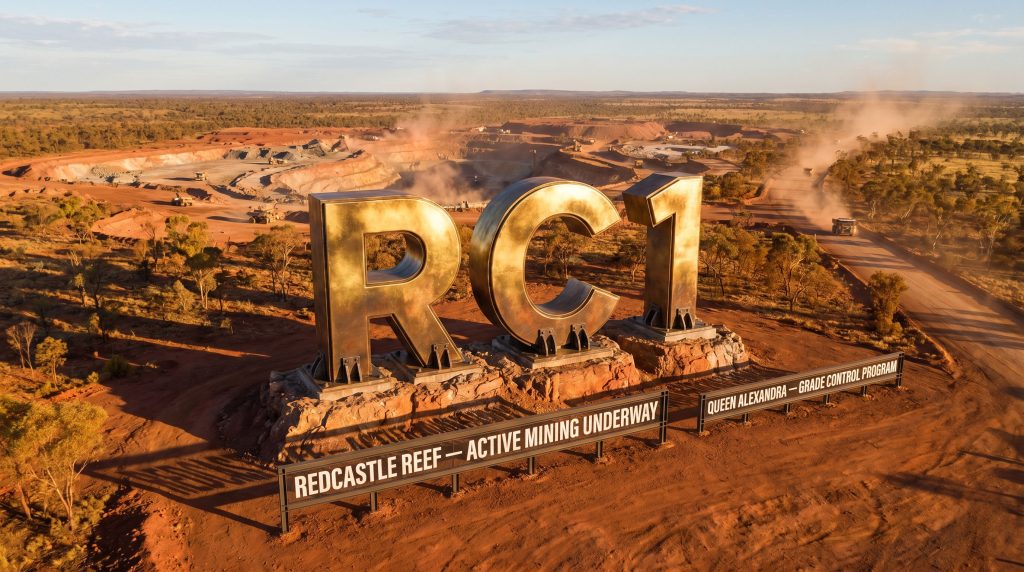
Redcastle Resources Limited (ASX: RC1) has released new assay results from grade-control and infill drilling across its two principal development deposits — Redcastle Reef (RR) and Queen Alexandra (QA) — at the Redcastle Gold Project in Western Australia's Eastern Goldfields. Redcastle Resources drilling confirms grade continuity at Redcastle Reef and Queen Alexandra at a pivotal moment: continuous mining operations are now underway at Redcastle Reef under the Redcastle-BML Ventures Joint Venture (RB JV), with BML Ventures as operator.
The latest programme comprised 28 RC drillholes for a combined 2,097 metres — 17 additional grade-control holes at RR (585m) and 11 infill holes at QA (1,512m). Together, they add meaningful technical data to both deposits as the Company pursues a coordinated, staged approach to developing RR and QA in tandem.
Key headline intercepts from the programme include:
- BMRC444: 7m @ 4.63 g/t Au from 9m, including 1m @ 25.5 g/t Au from 9m (RR)
- BMRC440: 2m @ 4.92 g/t Au from surface, including 1m @ 8.75 g/t Au from surface (RR)
- BMRC453: 5m @ 3.82 g/t Au from 13m, including 1m @ 6.44 g/t Au from 15m (RR)
- BMRC405: 3m @ 5.80 g/t Au from 58m, including 1m @ 14.0 g/t Au from 58m (QA — Kestrel Lode)
- BMRC438: 11m @ 1.13 g/t Au from 20m, including 1m @ 2.60 g/t Au from 28m (QA — Kestrel Lode)
Chairman's Comment
Dr Ray Shaw stated: "These results reinforce the Company's strategy of developing Redcastle Reef and Queen Alexandra in tandem. Together, the current Redcastle Reef mining activities and the potential development of Queen Alexandra could establish a more substantial revenue base capable of funding ongoing exploration, resource growth and project advancement across Redcastle, the TBone Belt and the Kilkenny Belt with reduced dependence on external capital."
When big ASX news breaks, our subscribers know first
What the Drilling Is Telling Investors
The results serve two distinct but complementary purposes — mine-scale grade refinement at Redcastle Reef and structural confidence-building at Queen Alexandra.
Redcastle Reef: Defining the Active Mining Area
The additional RR grade-control holes were drilled at shallow depths to refine grade distribution and ore-waste boundaries in the western end of the active development area. Results were consistent with the existing interpretation of a high-grade shoot and quartz vein-stockwork model.
| Hole ID | From (m) | Interval (m) | Au Grade (g/t) | Notable Sub-Interval |
|---|---|---|---|---|
| BMRC444 | 9 | 7 | 4.63 | 1m @ 25.5 g/t Au from 9m |
| BMRC440 | 0 (surface) | 2 | 4.92 | 1m @ 8.75 g/t Au from surface |
| BMRC453 | 13 | 5 | 3.82 | 1m @ 6.44 g/t Au from 15m |
| BMRC459 | 21 | 11 | 1.36 | 1m @ 4.49 g/t Au from 30m |
| BMRC448 | 18 | 3 | 2.39 | Broad mineralised position |
Multiple holes also returned additional mineralised intervals above and below the main intercepts, highlighting the complexity and multi-lode nature of the RR system. Furthermore, the Company noted that the latest results are consistent with its previously interpreted 300-metre western strike extension at RR (announced 18 March 2026), underscoring continued lateral potential at the deposit.
Queen Alexandra: Building Confidence in a Stacked Lode System
The QA infill RC drilling was targeted across interpreted lode positions within and around the 2025 Mineral Resource Estimate (MRE) conceptual pit area. Results confirmed mineralisation at both shallow and moderate depths across multiple named lodes.
| Hole ID | From (m) | Interval (m) | Au Grade (g/t) | Lode |
|---|---|---|---|---|
| BMRC405 | 58 | 3 | 5.80 | Kestrel Lode |
| BMRC405 | 100 | 3 | 1.38 | Second interval |
| BMRC438 | 20 | 11 | 1.13 | Kestrel Lode |
| BMRC409 | 36 | 5 | 1.45 | Kestrel Lode |
| BMRC408 | 104 | 2 | 1.94 | Hawk Lode |
The Kestrel Lode results in particular contribute to the picture of a stacked, structurally controlled system with multiple mineralised horizons. The Hawk Lode intercept at 104m depth suggests the system extends to moderate depths, adding to the geological case for the pending QA grade-control assays.
Critically, the recently completed 8,810-metre QA grade-control programme — the results of which are still pending — is expected to provide substantially more data across the QA area. These results are not included in this announcement and will be reported separately once received, validated and QA/QC reviewed.
Understanding Grade-Control Drilling: A Key Concept for Investors
What Is Grade-Control Drilling?
Grade-control drilling is a dense, short-spaced programme of holes drilled within or immediately adjacent to an active or planned mining area. Unlike broader exploration or resource-definition drilling, grade-control holes are designed to answer very specific mine-planning questions: Where exactly is the ore? Where does it transition to waste? How does the grade vary metre by metre across the ore body?
Why Does It Matter to Investors?
Grade-control data directly feeds into the practical decisions that determine how profitably a mine operates — where blast holes are positioned, how ore is selectively extracted, and how dilution (the mixing of waste rock with ore) is minimised.
For Redcastle Resources, the grade-control programme at both RR and QA is foundational to translating the geological model into an operationally executable mine plan. In short, better grade-control data supports better mining outcomes.
Glossary of Key Terms
| Term | Definition |
|---|---|
| RC Drilling | Reverse Circulation drilling — a technique where rock chips are brought to surface through the drill pipe, enabling 1-metre sampling intervals |
| g/t Au | Grams per tonne of gold — the standard measure of gold grade in a rock sample |
| MRE | Mineral Resource Estimate — a formal quantification of mineralisation that meets the criteria of the JORC Code |
| Lode | A vein or zone of mineralisation within the rock |
| Ore-Waste Boundary | The geological contact separating economic mineralisation from non-economic rock |
| QA/QC | Quality Assurance/Quality Control — procedures used to verify the integrity and accuracy of assay data |
| Stacked Lode System | Multiple parallel or sub-parallel mineralised lodes occurring at different depths within the same geological zone |
| Nuggety Gold | Gold that occurs as discrete, irregularly distributed coarse particles rather than finely disseminated grains |
| Downhole Length | The length of an intercept as measured along the drill hole — not necessarily the true width of the mineralised zone |
| JORC Code | The Australasian Code for Reporting of Exploration Results, Mineral Resources and Ore Reserves — the industry standard for transparent and credible reporting |
The RR–QA Corridor: More Than Two Deposits
One of the more strategically significant aspects of this announcement is the broader context it reinforces. Redcastle Resources is not simply developing two individual deposits — it is advancing what the Company describes as a west-east mineralised corridor that also encompasses Redcastle Reef West and Morgan's Castle East (MCE).
The potential for shared infrastructure, progressive pit execution and ongoing exploration along this corridor underpins the Company's medium-term growth thesis. If RR and QA can be developed in concert — as the current strategy envisages — there is a pathway to a more substantial combined production profile and the exploration runway to expand the resource base across the broader corridor.
The Company's current JORC-compliant Mineral Resources are housed across QA and RR, with a total Mineral Resource lifted to 42,000 ounces as reported in the August 2025 announcement. Additional targets including Sligo, Coronation, South Queen and Battery Lode provide further upside within the Redcastle Project Area.
What Comes Next: Near-Term Catalysts
Several important milestones are either underway or approaching, making the next reporting period a potentially significant one for RC1 investors.
| Catalyst | Status / Expected Timing |
|---|---|
| QA grade-control assay results (8,810m programme) | Completed — assays pending, to be reported when material |
| Assess western 300m RR strike extension opportunity | Under evaluation using latest drilling data and mining observations |
| Integration of RR grade-control and QA infill data into geological model | Ongoing |
| Broader QA–RR–MCE corridor evaluation | Continuing — additional drilling possible where warranted |
| Kilkenny Belt farm-in completion | Pending — adds further Eastern Goldfields tenement coverage |
The pending QA grade-control assay results represent the most immediate near-term catalyst. With 8,810 metres completed across the QA area — a substantial programme — these results will either confirm or refine the Company's geological interpretation of the stacked lode system and directly inform the QA mine plan and development timeline.
Also of note is the potential appraisal of the western 300-metre strike extension at Redcastle Reef, a target that has emerged from the latest drilling data combined with geological observations from active mining. Confirmation and delineation of this extension could, consequently, add meaningfully to the defined RR ore envelope.
The Investment Case: Active Mining, Dual-Deposit Development, and Exploration Upside
Redcastle Resources sits at a stage that relatively few ASX-listed junior gold companies reach: it has moved from exploration into actual mining operations, with the RB JV now operating at Redcastle Reef. At the same time, it is actively building the technical dataset required to bring its second deposit, Queen Alexandra, into development — with a strategy explicitly designed to create a combined, more substantial revenue base.
The investment thesis rests on several compounding factors:
-
Active mining at Redcastle Reef — the operation is running, generating operational data and learnings that directly improve the geological model and mine plan.
-
Dual-deposit development strategy — RR and QA are being advanced in tandem, with the stated goal of establishing a combined revenue base capable of funding ongoing exploration with reduced reliance on external capital.
-
Substantial pending dataset — the 8,810-metre QA grade-control programme is complete and awaiting assays. This represents a significant volume of data that could materially upgrade confidence in the QA mine plan.
-
Shallow, high-grade mineralisation — multiple drill holes in this announcement intersected high-grade gold at or near surface, including 1m @ 25.5 g/t Au from 9m and 2m @ 4.92 g/t Au from surface. Shallow, high-grade resources are typically among the most economically attractive mining targets.
-
Exploration corridor upside — the west-east corridor encompassing RR, QA, Redcastle Reef West and MCE offers staged exploration optionality beyond the current resource base, with results to date already demonstrating the prospectivity of the broader system.
-
Growing tenement portfolio — following completion of the Kilkenny Belt farm-in, RC1's Eastern Goldfields portfolio will comprise interests across approximately 15,072 hectares, providing significant ground for future discovery.
The next major ASX story will hit our subscribers first
Why Investors Should Keep Watching RC1
The transition from explorer to active mining operator is a defining inflection point in the lifecycle of a junior gold company. Redcastle Resources is navigating that transition while simultaneously building toward a second production source at Queen Alexandra — a dual-track execution that, if successful, has the potential to deliver operating leverage and a self-funding exploration profile.
The near-term pipeline is particularly well-stocked with catalysts. The pending QA grade-control assay results alone represent a substantial data release that could validate the geological model underpinning one of the Company's two core assets. Meanwhile, continued grade-control work at the active RR mine is refining the ore body in real time, and the western strike extension at RR remains a live exploration opportunity.
For investors tracking early-stage gold producers with near-term development catalysts, Redcastle Resources drilling confirms grade continuity at Redcastle Reef and Queen Alexandra in a manner that presents a compelling combination of active operational momentum and a clearly articulated growth pathway that warrants close attention.
Key Takeaway:
Redcastle Resources (ASX: RC1) has moved into active gold mining operations while simultaneously advancing the development of a second deposit, Queen Alexandra. With high-grade, shallow drilling results continuing to confirm the geological model, and a substantial 8,810-metre QA grade-control assay dataset pending, the Company is approaching a series of near-term catalysts that could materially advance both deposits and the broader west-east exploration corridor. Investors focused on emerging gold producers with operational activity and multiple near-term data releases should keep RC1 firmly on their watchlist.
Ready to Go Deeper on Redcastle Resources' Dual-Deposit Strategy?
With active mining underway at Redcastle Reef and a substantial 8,810-metre Queen Alexandra grade-control assay dataset pending, Redcastle Resources (ASX: RC1) is approaching a series of near-term catalysts that could materially advance both deposits and the broader west-east corridor. Investors seeking early exposure to an emerging ASX-listed gold producer with operational momentum, high-grade shallow mineralisation, and a clearly defined dual-deposit development strategy should explore the full details of the Redcastle Gold Project — visit redcastle.net.au to find out more.