August 24, 2026
When Scale Becomes a Survival Strategy in Gold Mining
The economics of gold mining have always rewarded size, but the relationship between production volume and shareholder value has rarely been as stark as it is today. Across the global gold sector, a structural bifurcation is accelerating: producers capable of generating 500,000 ounces or more annually are increasingly capturing institutional attention, index weighting, and analyst coverage, while smaller operators face growing pressure to either grow or consolidate. This dynamic is not unique to Australia, but it is playing out with particular intensity on the ASX, where a relatively concentrated group of mid-tier producers has spent years orbiting the threshold of major-producer status without quite reaching it.
Against this backdrop, the proposed Regis Resources Vault Minerals merger announced on 5 May 2026 represents one of the most consequential restructuring events in the Australian gold sector in several years. The transaction is not simply a deal between two companies. It is a strategic response to an industry-wide imperative, one that has been building quietly through years of elevated gold prices, balance sheet repair, and shifting institutional capital flows.
When big ASX news breaks, our subscribers know first
Why Australian Gold M&A Is Accelerating Now
Several forces have converged to make the current period unusually fertile for gold sector consolidation on the ASX. Understanding them is essential context for evaluating whether the Regis Resources Vault Minerals merger is a well-timed strategic move or a deal struck at the peak of favourable conditions. Furthermore, the broader gold M&A activity trends shaping the Australian market provide critical backdrop for this deal.
The gold price backdrop: Sustained elevation in record gold prices has expanded balance sheets across the mid-tier producer universe. Companies that were managing debt and capital constraints just three years ago now carry significant cash positions, reducing the financial barriers to deal-making and enabling equity-funded mergers without dilutive capital raises.
The institutional investor threshold problem: Large asset managers and passive index funds allocate capital according to rules that disadvantage small producers. A company producing 350,000 ounces annually may generate strong free cash flow, but it often falls below the market capitalisation and liquidity thresholds required for meaningful index weighting. Crossing the 700,000 oz/yr barrier fundamentally changes that calculus, attracting a broader, more stable institutional shareholder base.
The organic growth dilemma: Building production organically is slow, capital-intensive, and increasingly fraught with permitting complexity. Acquiring scale through consolidation compresses the timeline dramatically, pooling reserve bases, processing infrastructure, and technical expertise in a single transaction.
Western Australia's enduring appeal: The Leonora and Kalgoorlie corridors in Western Australia continue to attract merger activity due to their established processing infrastructure, deep labour pools, and well-understood geological endowment. The concentration of high-quality assets in a stable, low-sovereign-risk jurisdiction lowers the friction associated with combining operations.
The Architecture of the Regis Resources Vault Minerals Deal
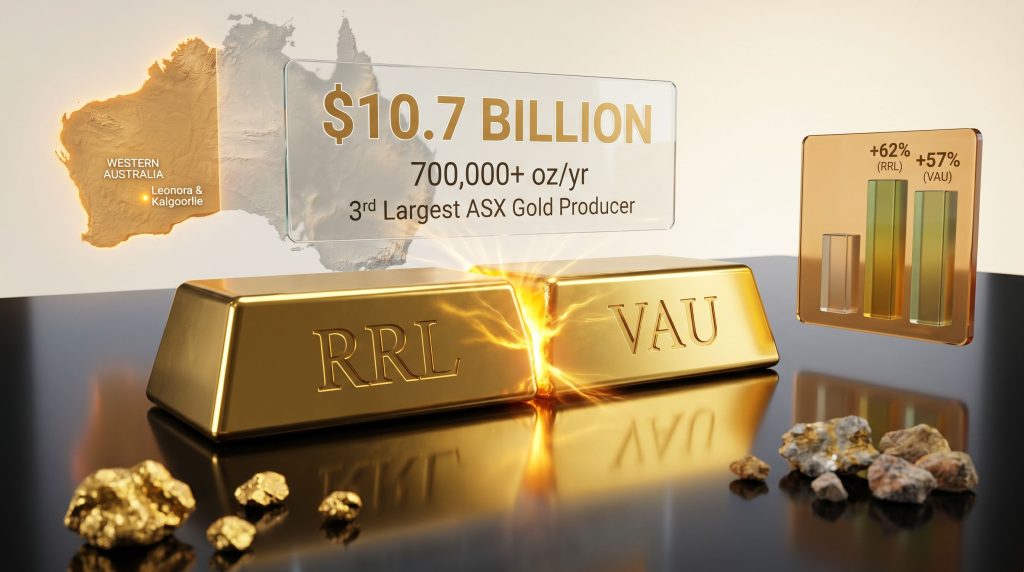
The proposed Regis Resources Vault Minerals merger is structured as a scheme of arrangement under which Regis Resources (ASX: RRL) would acquire 100% of Vault Minerals (ASX: VAU). The exchange ratio is set at 0.6947 Regis shares for each Vault share held, translating into a post-completion ownership split of approximately 51% Regis shareholders and 49% Vault shareholders. This near-equal division is a deliberate signal: despite the technical acquisition structure, both boards have framed this as a merger of equals rather than a straightforward takeover.
The financial profile of the proposed combined entity is substantial:
| Metric | Combined Entity (Pro Forma) |
|---|---|
| Pro Forma Market Capitalisation | ~$10.7 billion |
| Annual Gold Production Target | 700,000+ ounces |
| Cash and Bullion (as at 31 March 2026) | $1.9 billion |
| Ore Reserves | 6.0 million ounces |
| Mineral Resources | 20.5 million ounces |
| Expected Annualised Free Cash Flow | ~$1.7 billion |
| Anticipated Corporate Tax Benefits | $500 million+ |
| Net Drawn Debt | Nil |
Both the Regis and Vault boards have provided unanimous support for the transaction. Reciprocal break fees of approximately $50.7 million apply to both parties under specified termination scenarios, providing a degree of deal protection while remaining modest relative to the overall transaction size.
Regis Managing Director and CEO Jim Beyer framed the rationale in terms of global competitive positioning, noting that the transaction would create Australia's third-largest primary ASX-listed gold producer. He highlighted the combined entity's A$1.9 billion cash and bullion position, its multi-asset production base spanning five Western Australian and Canadian operations, and an organic growth pipeline anchored by the McPhillamys development project in New South Wales and the Sugar Zone asset in Canada. (Source: Motley Fool Australia, 5 May 2026)
Leadership and Governance
Jim Beyer will serve as Managing Director and CEO of the merged group, with Russell Clark as Non-Executive Chairman. Board composition will reflect equal representation from both legacy companies, reinforcing the merger-of-equals framing. Both companies retain the capacity to pay dividends prior to scheme completion, with the exchange ratio subject to adjustment if dividends are declared before implementation.
Vault Minerals: The Consolidator Being Consolidated
One of the more analytically interesting dimensions of the Regis Resources Vault Minerals merger is that Vault itself is a relatively young entity born from a prior wave of consolidation. Vault Minerals was created in June 2024 through the combination of Red 5 Limited and Silver Lake Resources, two mid-tier producers that joined forces to build greater scale in the Leonora district of Western Australia.
This layered consolidation history adds a dimension of complexity that investors should weigh carefully. At the time of the proposed Regis transaction, Vault's own internal integration from the Red 5 and Silver Lake combination was still maturing, meaning the merged entity would be absorbing a business that was itself still embedding operational and cultural change.
Vault's primary asset is the King of the Hills mine, situated in the Leonora goldfield, one of Western Australia's most enduringly productive gold districts. The geological setting is characterised by Archaean greenstone belts, the same ancient rock sequences that host many of the world's premier gold deposits, including those in the broader Kalgoorlie region. These terranes are prized for their capacity to host large, structurally controlled gold systems with strong continuity at depth, which supports long mine lives and sustained reserve replenishment through ongoing exploration.
The Leonora hub's mill expansion programme targets throughput capacity of 7.5 million tonnes per annum (Mtpa), a significant uplift that would directly support the combined group's 700,000+ oz/yr production ambition. With mineral resources exceeding 6 million ounces in the Leonora region and ore reserves of approximately 2.24 million ounces, Vault contributes meaningful geological endowment to the combined entity.
Vault reported an FY25 operating profit of approximately $319.7 million, reflecting the operational leverage that its consolidated asset base delivered in its first full post-merger financial year. This earnings trajectory provided both the financial credibility and strategic confidence necessary to engage in a further combination with Regis.
What Regis Resources Brings to the Table
Regis Resources enters this transaction from a position of strength. In the 12 months preceding the merger announcement, Regis shares appreciated by approximately 62%, materially outperforming the S&P/ASX 200 Index (ASX: XJO), which returned approximately 7% over the same period. This performance reflects both the gold price tailwind and Regis's demonstrated operational execution across its Western Australian asset base. The relationship between gold price and mining equities has been a key driver of this outperformance. (Source: Motley Fool Australia, 5 May 2026)
| Entity | 12-Month Share Price Performance | vs. ASX 200 |
|---|---|---|
| Regis Resources (ASX: RRL) | +62% | +55 percentage points outperformance |
| Vault Minerals (ASX: VAU) | +57% | +50 percentage points outperformance |
| S&P/ASX 200 Index (ASX: XJO) | +7% | Benchmark |
Beyond its operating hubs in Western Australia, Regis contributes two strategically significant growth assets to the merged entity:
McPhillamys (New South Wales): This represents one of Australia's most significant undeveloped gold deposits. Its inclusion in the combined group's organic growth pipeline provides a potential pathway to push production materially beyond the initial 700,000 oz/yr baseline, subject to permitting and development timelines. McPhillamys has faced a complex regulatory path historically, and investors should treat its contribution to production forecasts as subject to permitting risk.
Sugar Zone (Canada): The Canadian asset adds geographic diversification and optionality beyond the Australian jurisdictional base, though it also introduces cross-border operational complexity into a group that is otherwise concentrated in Western Australia.
The combination of Regis's established WA operations, its development pipeline, and its debt-free balance sheet makes it a credible acquiring vehicle, though the 51%/49% ownership split reinforces that this is not a straightforward acquisition premium scenario. Vault shareholders are receiving Regis equity rather than a cash premium, meaning their ongoing returns depend on the execution quality of the merged group.
Mapping the Path to Completion
The Regis Resources Vault Minerals merger follows a structured approval pathway typical of Australian scheme of arrangement transactions:
- Scheme Booklet preparation: Detailed transaction documentation compiled, incorporating an independent expert's opinion on whether the scheme is fair and reasonable for Vault shareholders.
- Independent expert review: A formal fairness assessment must conclude in favour of the scheme before Vault's board can maintain its recommendation.
- Scheme Booklet dispatch: Documentation delivered to Vault shareholders within the coming months of announcement.
- Shareholder vote: Vault shareholders vote on scheme approval, requiring both a majority in number and 75% by value of votes cast.
- Federal Court approval: The Federal Court of Australia must sanction the scheme following shareholder approval.
- Regulatory consents: Foreign Investment Review Board (FIRB) notification and any applicable competition clearances must be obtained.
- Implementation: Targeted for August or September 2026 subject to all preceding steps completing successfully. (Source: Motley Fool Australia, 5 May 2026)
A critical consideration for investors: if a competing bidder emerges before scheme implementation and tables a superior proposal, the Vault board is obligated to assess it against its fiduciary duties. The $50.7 million break fee payable to Regis under specified scenarios provides some deal protection, but remains modest at approximately 0.5% of the combined transaction value.
The next major ASX story will hit our subscribers first
How This Deal Stacks Up Against Recent ASX Gold Consolidations
The proposed merger sits within a broader wave of gold sector consolidation that has reshaped the ASX producer landscape over the past five years. The gold market outlook for 2025 and beyond has been a significant catalyst for this wave of deal-making.
| Transaction | Year | Combined Production Scale | Structure | Outcome |
|---|---|---|---|---|
| Northern Star + Saracen Mineral Harvest | 2021 | ~1.6 million oz/yr | Merger of equals | ASX's largest gold producer |
| Evolution Mining + Ernest Henry | 2021 | Bolt-on addition | Asset acquisition | Copper-gold diversification |
| Red 5 + Silver Lake (forming Vault Minerals) | 2024 | ~300,000+ oz/yr | Merger of equals | Vault Minerals created |
| Regis + Vault (proposed) | 2026 | 700,000+ oz/yr | Scheme of arrangement | Pending approval |
The Northern Star and Saracen combination in 2021 is the most instructive precedent. That deal created Australia's largest gold producer through a merger-of-equals structure and demonstrated that combining two credible mid-tier operators could generate significant re-rating once the merged entity achieved major-producer scale. The Regis Resources Vault Minerals merger follows the same conceptual logic, though at a smaller absolute scale and with the additional complexity of Vault's own recent formation.
Notably, Vault Minerals was itself the product of consolidation just two years prior. The speed at which the sector is cycling through consolidation rounds signals that competitive pressure from institutional investors and gold market dynamics is intensifying, not moderating. Consequently, undervalued gold stocks across the mid-tier cohort are increasingly coming into focus as potential consolidation targets.
Key Risks Investors Should Assess Before the August Vote
The headline metrics of the proposed merger are compelling, however several risk factors warrant careful consideration:
- Integration complexity: Combining five operating assets across two countries, with two distinct corporate cultures and contractor relationships, introduces meaningful execution risk. Vault itself is still embedding changes from its June 2024 formation, creating a layered integration challenge.
- Gold price sensitivity: The projected $1.7 billion in annualised free cash flow is highly sensitive to gold price assumptions. A sustained pullback from current elevated price levels would materially compress this figure and alter the merger's financial attractiveness.
- McPhillamys permitting risk: The New South Wales project has a complex regulatory history. Delays or adverse permitting outcomes could undermine the organic growth narrative that underpins part of the deal's strategic rationale.
- Exchange ratio fairness: At 0.6947 Regis shares per Vault share, Vault shareholders should assess whether the implied value adequately reflects Vault's standalone growth trajectory, particularly given its Leonora mill expansion pipeline and the 57% share price appreciation delivered in the preceding 12 months.
- Counter-bid window: The August-September 2026 implementation target creates a multi-month period during which either party could attract alternative interest from larger domestic producers or international gold majors.
- Ownership split dynamics: The near-equal 51%/49% split may generate near-term selling pressure as legacy Vault shareholders reassess their desired exposure to a combined entity with a broader operational footprint and different risk profile.
- Canadian operational complexity: The Sugar Zone asset introduces cross-border regulatory, labour, and logistics considerations that add operational overhead to an already complex integration.
This article contains general information only and does not constitute financial advice. Past share price performance is not indicative of future returns. Investors should conduct their own due diligence and consider seeking advice from a licensed financial adviser before making investment decisions. Forward-looking projections including free cash flow estimates and production targets are subject to material assumptions and risks.
What This Means for the Broader ASX Gold Landscape
The Regis Resources Vault Minerals merger, if completed, will not simply create a larger gold company. It will recalibrate competitive dynamics across the entire mid-tier ASX gold producer cohort. Producers sitting below the 300,000–400,000 oz/yr threshold face intensifying pressure from investors demanding either a credible path to scale or a willingness to explore their own combination opportunities.
The deal also reinforces Western Australia's Leonora and Kalgoorlie districts as the most active zones of Australian gold consolidation. The geological richness of these Archaean greenstone corridors, combined with established processing infrastructure and skilled labour availability, makes them natural candidates for continued rationalisation as the industry seeks to optimise capital deployment across contiguous asset bases.
From a market psychology perspective, the strong pre-announcement share price performance of both Regis (+62%) and Vault (+57%) over the preceding 12 months illustrates an important dynamic in gold M&A: deals struck from equity strength, rather than financial distress, tend to produce more balanced negotiating outcomes. The 51%/49% ownership structure reflects this equilibrium, suggesting both parties approached the table with comparable leverage.
Furthermore, the broader implication is straightforward. Australia's gold sector is consolidating with urgency, driven by institutional capital thresholds, organic growth constraints, and the strategic imperative of achieving major-producer status. The Regis Resources Vault Minerals merger is the most significant expression of this trend to date in 2026, but it is unlikely to be the last. Mid-tier operators that have not yet addressed their scale gap may find the competitive environment considerably less forgiving by the time this deal reaches implementation in August or September 2026.
Want to Identify the Next Major ASX Gold Discovery Before the Market Does?
Discovery Alert's proprietary Discovery IQ model delivers real-time alerts on significant ASX mineral discoveries, instantly cutting through complex geological and market data to surface actionable opportunities — explore the historic returns major discoveries have generated and begin your 14-day free trial today to position yourself ahead of the next wave of ASX gold consolidation.