How Regulatory Evolution Shapes Mining Industry Water Management
Water governance frameworks across the globe are undergoing fundamental restructuring, driven by mounting environmental pressures and evolving regulatory philosophies. The water law changes mining impact extends far beyond traditional resource management, creating new operational paradigms that mining companies must navigate while maintaining economic viability. Furthermore, the convergence of climate adaptation strategies, water scarcity concerns, and evolving international trade requirements has established water stewardship as a critical determinant of mining project success.
Traditional approaches to mining regulation focused primarily on extraction rights and basic environmental compliance. Today's regulatory environment demands comprehensive water cycle integration, real-time monitoring capabilities, and long-term sustainability commitments that fundamentally alter project economics and operational planning.
Understanding the Regulatory Landscape Shift
Government agencies worldwide are implementing sophisticated water governance frameworks that extend regulatory oversight into previously autonomous operational areas. These changes reflect growing recognition that water resources represent strategic national assets requiring careful stewardship rather than mere inputs for industrial processes.
The evolution from resource extraction paradigms to integrated water stewardship represents one of the most significant regulatory shifts affecting mining operations in decades. Jurisdictional variations in implementation approaches create complex compliance landscapes where mining companies must adapt operational strategies to multiple regulatory frameworks simultaneously.
For instance, companies seeking guidance on navigating these complex regulatory requirements can benefit from comprehensive mining permitting guidance that addresses the evolving landscape of water-related compliance.
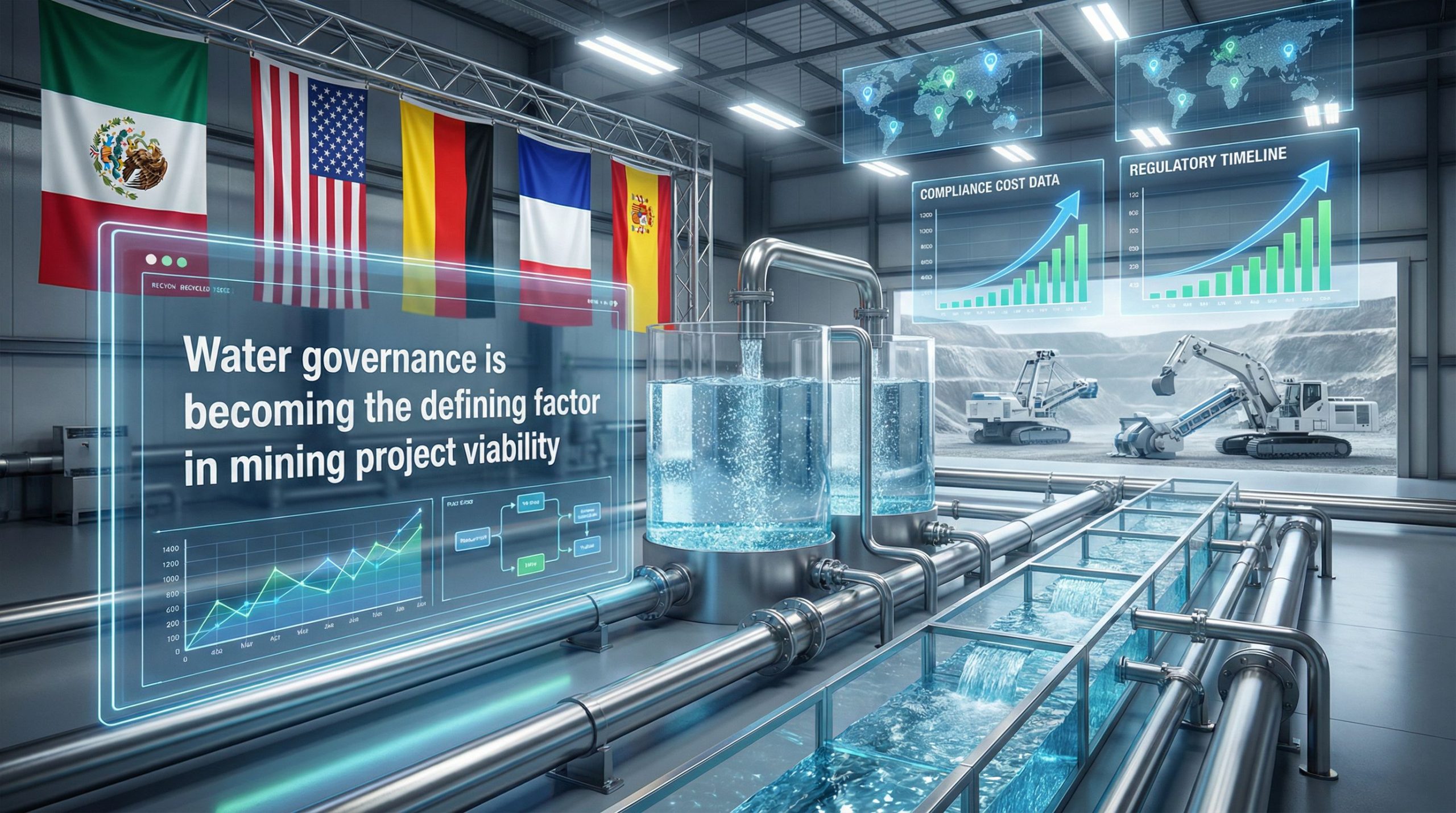
"Water governance is becoming the defining factor in mining project viability, with regulatory frameworks evolving faster than industry adaptation strategies."
Mexico exemplifies this regulatory transformation through its comprehensive National Water Law amendments currently under legislative review. The proposed Article 118 modification prohibits water concessions for mining waste disposal while establishing enhanced oversight mechanisms through CONAGUA's expanded authority. These changes affect approximately 3 million people who depend directly or indirectly on mining operations, according to industry assessments.
The implementation timeline for major water law reforms spans 2020-2025, with Mexico's legislative process including at least 50 key modifications to original presidential proposals following agricultural sector input. CONAGUA now handles reassignments within 20 business days for succession or property transfers, representing significant acceleration compared to previous administrative timelines.
Jurisdictional Implementation Approaches
Regulatory enforcement mechanisms vary substantially across jurisdictions, creating operational complexity for multinational mining operations. Mexico's approach emphasises federal oversight through centralised agencies, whilst other jurisdictions implement basin-specific management structures or state-level coordination frameworks.
The National Water Registry (REPNA) replacement of traditional public registries demonstrates technological integration in regulatory systems. This transformation provides enhanced legal certainty while imposing new data management requirements on mining operations.
Penalties for water law violations reflect this regulatory intensification. Mexico's proposed reforms reduce imprisonment terms from 10 to 5 years and fines from 4,000 to 2,000 UMAs for water diversion violations, suggesting more nuanced enforcement approaches whilst maintaining deterrent effectiveness.
What Drives Government Water Policy Reform in Mining Jurisdictions?
Climate Adaptation and Resource Security
Increasing drought frequency and intensity across mining-intensive regions compels legislative action to protect water resources for essential uses. Government agencies prioritise water allocation frameworks that balance industrial needs against agricultural, municipal, and ecological requirements.
Population growth in water-stressed regions intensifies competing demands for limited water resources. Mining operations must demonstrate water use efficiency and recycling capabilities to maintain social licence whilst meeting production targets.
Agricultural sectors wield significant political influence in water law development, as evidenced by Mexico's incorporation of family agricultural use provisions and inheritance protections for farming water rights. These agricultural considerations directly impact mining water allocation priorities and availability.
International Trade Compliance Requirements
Trade agreement environmental provisions increasingly affect mining water regulations. USMCA environmental standards create harmonisation pressures across North American jurisdictions, whilst EU Critical Raw Materials Act requirements establish water use assessment criteria for mineral imports.
WTO dispute resolution mechanisms provide enforcement pathways for trade-restrictive environmental measures, creating international legal frameworks that influence domestic mining water regulations. These international dimensions add complexity to national regulatory development processes.
Additionally, recent developments in the United States, including the executive order on mining permits, illustrate how government policy changes can significantly affect water-related mining regulations.
Which Countries Are Leading Water Law Reform in Mining?
Mexico's Comprehensive Regulatory Overhaul
Mexico's water law reforms demonstrate comprehensive integration of environmental protection with industrial policy considerations. The legislative process reveals sophisticated stakeholder consultation mechanisms that produced substantial modifications to original government proposals.
| Regulatory Component | Current Framework | Proposed Changes | Implementation Timeline |
|---|---|---|---|
| Extension Request Deadline | 1 year | 2.5 years | Legislative approval pending |
| CONAGUA Reassignment Processing | Unspecified timeline | 20 business days | Upon law enactment |
| Water Rights Registry System | Public registry | REPNA digital system | Phased implementation |
| Mining Waste Water Concessions | Case-by-case review | Prohibited under Article 118 | Immediate upon enactment |
CAMIMEX, Mexico's mining chamber, emphasises that mining operations do not discharge toxic waste into federal water bodies and that mineral processing waste management utilises specialised infrastructure complying with national and international standards. The organisation warns that Article 118 amendments threaten operational continuity for critical metal production and affect over 3 million people dependent on mining activities.
Mining operations in mountainous regions face particular challenges under new regulatory frameworks, as tailings facilities and wastewater management systems require federal authorisation processes that may become more restrictive under proposed amendments.
Basin Agency authority preservation maintains regional water management coordination whilst enhancing federal oversight through CONAGUA's expanded responsibilities. This dual-level governance structure reflects sophisticated approaches to managing water resources across diverse geographic and economic conditions.
North American Integration Trends
United States federal and state-level water law evolution affects cross-border mining operations through Clean Water Act enforcement variations and critical minerals permitting procedures. Western states implement water rights modernisation affecting mining operations in arid regions where water scarcity creates operational constraints.
The critical minerals executive order creates tension between environmental protection goals and supply chain security objectives, particularly regarding water usage requirements. These competing priorities influence regulatory development timelines and enforcement approaches.
European Union Coordination Mechanisms
EU Water Framework Directive implementation across member states establishes harmonised environmental standards whilst accommodating national regulatory variations. Cross-border water management requirements affect mining operations spanning multiple jurisdictions within the EU economic area.
Environmental impact assessment standardisation creates predictable regulatory processes for multinational mining companies whilst ensuring consistent environmental protection across diverse European mining regions.
How Do Water Law Changes Impact Mining Project Economics?
Capital Investment Requirements
Water law compliance necessitates substantial capital expenditure increases across mining operations. Water treatment infrastructure investments require sophisticated technology integration and ongoing maintenance capabilities that affect project return calculations.
Legal and consulting expenses for regulatory navigation increase significantly during transition periods when regulatory frameworks undergo substantial modification. These professional service costs compound during permitting processes that involve multiple jurisdictional requirements.
Insurance premiums for environmental liability coverage adjust to reflect enhanced regulatory oversight and potential violation penalties. These risk management costs become integral components of project financing structures rather than optional coverage elements.
Operational Cost Restructuring
Water recycling system implementation creates ongoing operational expenses whilst reducing water consumption costs and regulatory compliance risks. The net cost impact depends on local water pricing, technology efficiency, and regulatory penalty structures.
Monitoring and reporting compliance overhead requires dedicated personnel and technology systems that represent permanent operational cost increases. Real-time monitoring capabilities demand continuous investment in data management and analytical capabilities.
Workforce training for environmental protocols ensures operational compliance whilst creating recurring education expenses. These human resource investments become essential for maintaining regulatory standing and operational licences.
Revenue Risk Considerations
Production capacity limitations in water-scarce regions directly affect revenue generation capabilities. Mining operations must balance water consumption against production targets within regulatory constraints that may change over operational lifespans.
Market access restrictions for non-compliant operations create binary risk scenarios where regulatory violations result in complete market exclusion rather than graduated penalties. These compliance-dependent market access requirements elevate regulatory risk in project valuations.
"Mining companies now factor water regulatory risk as heavily as geological and commodity price risks in project valuations."
Sustainability-focused commodity price premiums create revenue opportunities for compliant operations whilst penalising non-compliant production. These market-driven compliance incentives complement regulatory enforcement mechanisms.
What Are the Key Compliance Challenges for Mining Companies?
Technical Implementation Complexity
Retrofitting existing mining operations for enhanced water management standards requires substantial engineering modifications to established infrastructure. Legacy systems often lack integration capabilities necessary for modern monitoring and reporting requirements.
Technology gaps in water treatment and recycling create implementation challenges where available solutions may not align with specific operational requirements or geographic constraints. Custom engineering solutions increase compliance costs and implementation timelines.
Monitoring system integration with regulatory reporting platforms demands sophisticated data management capabilities that extend beyond traditional mining operational systems. These technological requirements often necessitate comprehensive IT infrastructure upgrades.
Geographic constraints in mountainous and remote mining locations complicate infrastructure construction and maintenance for water management systems. Transportation costs and construction complexity increase substantially in challenging terrain.
Administrative and Legal Navigation
Multi-jurisdictional permit coordination requirements create administrative complexity where mining operations span multiple regulatory authorities. Coordination timelines and conflicting requirements may delay project implementation or operational modifications.
Indigenous rights consultation processes for water use agreements add substantial complexity and timeline requirements to permitting procedures. These consultation requirements often involve cultural considerations extending beyond technical water management issues.
Environmental bond and financial assurance calculations require sophisticated actuarial analysis to determine appropriate coverage levels for potential environmental remediation costs. These financial instruments represent substantial capital commitments that affect project financing structures.
In some jurisdictions, new mining claims framework developments add additional layers of complexity to water rights and consultation requirements.
Planning and Timeline Disruption
Mining companies implement structured compliance planning frameworks to manage regulatory transition periods:
- Regulatory monitoring systems for tracking legislative and administrative changes across operational jurisdictions
- Stakeholder engagement protocols for maintaining relationships with regulatory agencies and community groups
- Technical assessment procedures for evaluating compliance requirements against operational capabilities
- Financial planning integration incorporating compliance costs into capital allocation and operational budgeting
- Timeline coordination mechanisms for managing permit applications across multiple jurisdictions and regulatory agencies
Project development timeline extensions result from enhanced regulatory review processes and expanded consultation requirements. These delays affect investor relations and financing arrangements that depend on predictable development schedules.
How Are Mining Companies Adapting Their Water Management Strategies?
Technology Investment and Innovation
Advanced water treatment and recycling system deployment represents the primary technological response to evolving water law requirements. Mining companies invest in closed-loop water systems that minimise freshwater consumption whilst meeting production requirements.
Real-time monitoring and data analytics implementation enables proactive compliance management and optimisation of water use efficiency. These systems provide regulatory agencies with continuous operational transparency whilst supporting operational decision-making.
Technology partnerships with specialised water management providers offer access to cutting-edge solutions without requiring internal research and development investment. These collaborative approaches accelerate implementation timelines whilst reducing technical risk.
Corporate Governance Evolution
Board-level oversight of water stewardship programmes elevates water management from operational to strategic governance levels. Directors with environmental expertise increasingly join mining company boards to provide specialised oversight capabilities.
ESG reporting integration with water use metrics creates transparency mechanisms that satisfy investor requirements whilst supporting regulatory compliance documentation. These reporting frameworks often exceed regulatory minimums to meet stakeholder expectations.
| Water Risk Assessment Component | Implementation Approach | Monitoring Frequency | Stakeholder Reporting |
|---|---|---|---|
| Basin-level water availability | Hydrological modelling | Quarterly updates | Annual sustainability reports |
| Operational water efficiency | Real-time monitoring systems | Continuous measurement | Monthly operational reports |
| Regulatory compliance status | Legal compliance audits | Semi-annual reviews | Board governance reports |
| Community water impacts | Stakeholder consultation | Ongoing engagement | Community liaison reports |
Strategic Portfolio Adjustments
Geographic diversification strategies reduce regulatory concentration risk by distributing operations across multiple jurisdictions with varying regulatory frameworks. This approach provides operational flexibility whilst maintaining production capacity.
Asset divestiture in high-risk regulatory jurisdictions enables capital reallocation toward more stable regulatory environments. These strategic decisions reflect long-term regulatory risk assessments rather than short-term operational considerations.
Joint venture structures facilitate shared compliance costs and technical expertise among partners with complementary capabilities. These collaborative approaches particularly benefit smaller operators facing substantial compliance cost burdens.
Consequently, companies are increasingly embracing sustainable mining transformation initiatives that integrate water management with broader environmental stewardship goals.
What Are the Long-Term Industry Implications?
Market Structure Transformation
Consolidation pressures intensify as smaller mining operators struggle with compliance costs that create disproportionate financial burdens relative to operational scale. Larger operators with advanced water management capabilities gain competitive advantages through economies of scale in compliance infrastructure.
Supply chain concentration occurs in jurisdictions with stable and predictable regulatory frameworks where operators can make long-term investment commitments. This geographic concentration creates supply security risks whilst providing regulatory certainty benefits.
"Water law compliance is becoming a barrier to entry that may fundamentally reshape mining industry structure."
Competitive advantages accrue to companies demonstrating superior water stewardship capabilities through operational efficiency and stakeholder relationship management. These advantages translate into preferred contractor status and enhanced market access opportunities.
Investment Flow Redirection
Capital allocation shifts toward water-efficient mining technologies create market opportunities for specialised equipment and service providers. These investment flows accelerate technological development whilst reducing compliance costs across the industry.
ESG-focused investment criteria emphasising water stewardship influence capital availability for mining projects. Investors increasingly evaluate water management capabilities as fundamental project viability factors rather than secondary considerations.
Development finance institutions evolve lending criteria to incorporate water risk assessments and sustainability performance metrics. These changes affect project financing availability and terms for mining operations in water-stressed regions.
Supply Chain Resilience Considerations
Critical mineral supply security concerns arise from regulatory restrictions that may limit production capacity in key mining regions. Government agencies balance environmental protection objectives against strategic mineral supply requirements.
Alternative sourcing strategies develop for minerals produced in water-constrained regions where regulatory restrictions may affect long-term supply availability. These strategies involve geographic diversification and strategic stockpiling considerations.
Trade policy implications emerge when environmental mining restrictions create supply disruptions that affect international commodity markets. These disruptions may trigger diplomatic discussions about balancing environmental protection with supply security objectives.
How Can Stakeholders Navigate the Changing Regulatory Environment?
Mining Company Strategic Approaches
Comprehensive regulatory compliance frameworks enable proactive management of evolving water law requirements:
- Legislative monitoring systems tracking proposed and enacted water law changes across operational jurisdictions
- Stakeholder engagement strategies maintaining productive relationships with regulatory agencies and community groups
- Technical capacity building developing internal expertise for water management system design and operation
- Financial planning integration incorporating compliance costs into capital allocation and operational budgeting processes
- Risk management protocols identifying and mitigating water-related operational and regulatory risks
- Performance measurement systems tracking water use efficiency and regulatory compliance metrics
- Continuous improvement mechanisms updating procedures based on regulatory changes and operational experience
Proactive engagement with regulatory agencies during rule-making processes provides opportunities to influence regulatory development whilst demonstrating industry commitment to environmental stewardship. These engagement efforts require sustained investment in regulatory relationship management.
Investment in water management infrastructure ahead of mandate deadlines provides competitive advantages whilst reducing implementation risk during regulatory transition periods. Early adoption strategies often result in more favourable regulatory treatment and reduced compliance costs.
Investment Community Frameworks
Due diligence frameworks incorporating water regulatory risk assessment enable more accurate project valuation and investment decision-making. These assessments consider regulatory stability, compliance costs, and operational constraints in financial modelling.
Portfolio diversification strategies across regulatory jurisdictions reduce concentration risk whilst maintaining exposure to mining sector opportunities. Geographic and regulatory diversification provides protection against jurisdiction-specific regulatory changes.
| Water Risk Indicator | Assessment Criteria | Weight in Decision Matrix | Data Sources |
|---|---|---|---|
| Regulatory stability | Historical law changes, political trends | 25% | Government publications, legal analysis |
| Water availability | Basin hydrology, competing uses | 30% | Hydrological studies, water authority data |
| Compliance costs | Infrastructure requirements, penalties | 20% | Engineering estimates, regulatory filings |
| Stakeholder relations | Community acceptance, permit history | 25% | Social impact assessments, media analysis |
ESG integration with water stewardship performance metrics provides standardised evaluation criteria for comparing mining investment opportunities. These metrics enable portfolio-level water risk management and performance tracking.
Government and Regulatory Considerations
Stakeholder consultation processes ensure balanced policy development that considers environmental protection objectives alongside economic and social impacts. Comprehensive consultation reduces regulatory uncertainty whilst building stakeholder support for policy implementation.
Recent developments in Australia highlight the importance of comprehensive stakeholder engagement, particularly regarding EPBC Act reforms that significantly impact mining water management requirements.
Economic impact assessment integration with environmental protection goals enables evidence-based policy development that optimises outcomes across multiple policy objectives. These integrated assessments support more effective regulatory frameworks.
International coordination mechanisms facilitate regulatory harmonisation for cross-border mining operations whilst maintaining national sovereignty over water resources. These coordination efforts reduce regulatory compliance complexity for multinational operators.
What Does the Future Hold for Water Law and Mining?
Emerging Regulatory Technologies
Artificial intelligence integration in water use monitoring and compliance creates opportunities for more sophisticated regulatory oversight whilst reducing administrative burdens on mining operators. AI-powered systems enable real-time compliance verification and predictive risk assessment.
Carbon pricing mechanisms linked to water consumption in mining operations reflect growing integration between climate and water policy frameworks. These integrated approaches create economic incentives for resource efficiency whilst supporting multiple environmental objectives.
Community benefit-sharing requirements for water-intensive operations represent evolving approaches to social licence management that extend beyond traditional environmental compliance. These requirements create new stakeholder relationship management challenges and opportunities.
Industry Transformation Scenarios
| Regulatory Evolution Pathway | Key Characteristics | Industry Implications | Timeline |
|---|---|---|---|
| Technology-Enabled Compliance | AI monitoring, automated reporting | Reduced compliance costs, enhanced transparency | 5-10 years |
| Consolidated Regulatory Frameworks | Harmonised international standards | Simplified multi-jurisdiction compliance | 10-15 years |
| Market-Based Water Allocation | Trading mechanisms, efficiency incentives | Optimised resource allocation, innovation incentives | 15-20 years |
Technology-driven compliance cost reductions become feasible as monitoring and reporting systems achieve economies of scale and technological sophistication. These cost reductions may offset initial implementation expenses whilst improving environmental outcomes.
Market consolidation acceleration under stricter regulatory regimes concentrates mining operations among companies with superior compliance capabilities and financial resources. This consolidation affects competition dynamics and supply chain structures.
Policy Development Recommendations
Graduated compliance timelines for existing versus new operations provide reasonable transition periods whilst ensuring environmental protection objectives. These tiered approaches recognise infrastructure investment requirements and operational complexity differences.
Technical assistance programmes for smaller mining companies support industry-wide compliance whilst maintaining competitive market structures. Government or industry association programmes can provide expertise and financial support for compliance implementation.
Water trading mechanism development enables efficient allocation between mining and agricultural uses whilst supporting both sectors' economic viability. These market-based approaches optimise resource allocation through price signals and voluntary exchanges.
Innovation incentives for water-efficient mining technology development accelerate technological advancement whilst reducing long-term compliance costs. Public-private partnerships can support research and development investments that benefit both environmental and economic objectives.
Moreover, recent legal developments regarding environmental law reforms demonstrate the evolving nature of water law changes mining impact across different jurisdictions.
Disclaimer: This analysis contains forward-looking assessments of regulatory trends and industry implications that involve inherent uncertainty. Regulatory changes may differ substantially from projections described herein. Readers should consult current regulatory authorities and legal professionals for specific compliance guidance. Water law changes mining impact varies significantly across jurisdictions and operational contexts, requiring individualised assessment for specific circumstances.
Ready to Capitalise on Mining's Regulatory Transformation?
Discovery Alert's proprietary Discovery IQ model delivers real-time alerts on significant ASX mineral discoveries, empowering subscribers to identify actionable opportunities as regulatory changes reshape the mining landscape. Begin your 30-day free trial today to position yourself ahead of market developments and secure your competitive advantage in this evolving sector.