June 2, 2026
How Does Resource Expansion Economics Drive Junior Mining Valuations?
Resource expansion economics in junior mining operate through systematic value creation mechanisms that institutional investors actively monitor. GR Silver Mining resource expansion strategy demonstrates how proper capital allocation during favorable market conditions can generate substantial enterprise value growth through systematic drilling programs and resource base expansion.
The fundamental driver centers on per-ounce valuation metrics, where development-stage silver companies typically trade based on their in-ground resource endowment multiplied by market-determined valuations per ounce of contained metal. GR Silver Mining's current valuation of $1.09 per silver equivalent ounce represents approximately half the $2.00+ per ounce valuations observed across comparable development-stage silver projects, creating substantial rerating potential as resource expansion validates exploration thesis.
Capital Allocation Framework for Precious Metals Development
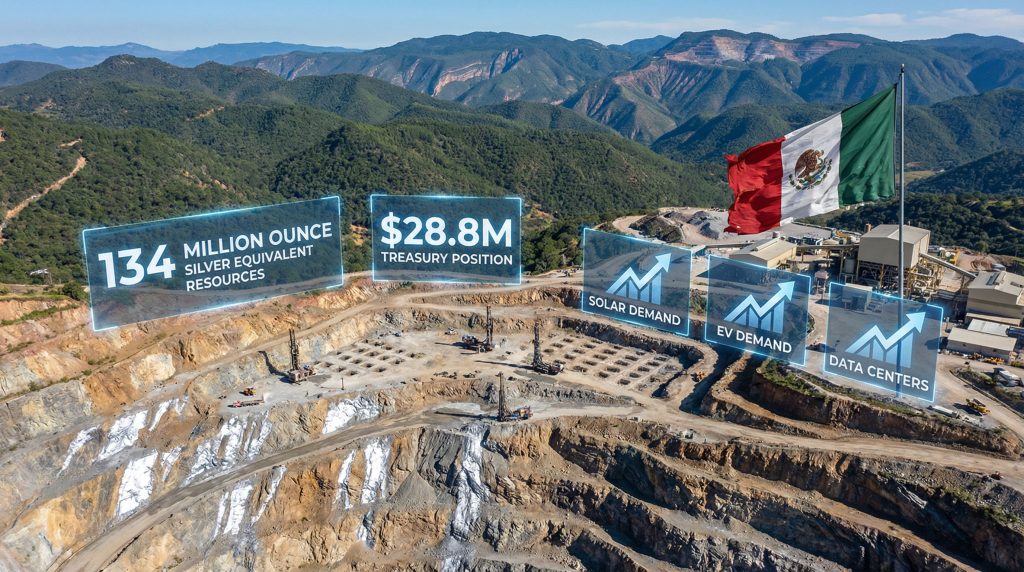
Effective capital deployment in resource expansion requires strategic balance between exploration upside and technical de-risking activities. Furthermore, the current market environment presents opportunities for companies implementing effective junior mining exploration strategies to capitalise on elevated silver prices. GR Silver's $28.8 million treasury position enables parallel execution of both strategies simultaneously, with 15,000 meters of planned drilling at San Marcial discovery area while advancing bulk sampling engineering at the permitted Plomosas Mine facility.
This dual-track approach optimises risk-adjusted returns by maintaining discovery exposure through step-out drilling while generating near-term cash flow validation through bulk sampling operations. The financial structure provides operational flexibility unavailable to companies facing immediate funding pressures, enabling management to follow up on high-grade intersections without capital constraints limiting drilling decisions.
Key financial metrics supporting this framework include:
- Treasury runway extending through 2026 catalyst delivery
- Warrant structure providing $22+ million additional capital access at $0.42 exercise price
- Zero debt position eliminating interest expense during development phases
- Fully-funded exploration programmes reducing dilution risk during drilling campaigns
Market Timing Advantages in Current Silver Supply Environment
Silver prices exceeding $60 per ounce as of December 2025 create favourable economic conditions for advancing development-stage projects, particularly those with substantial resource bases and established metallurgical characteristics. However, investors must also consider potential silver tariff impacts that could affect pricing dynamics. This pricing environment improves project economics calculations while providing junior developers access to equity financing at premium valuations relative to historical trading ranges.
The structural supply deficit driving current silver pricing stems from declining mine production coinciding with accelerating industrial demand from technology sectors. Annual silver consumption for solar panel manufacturing now exceeds 150 million ounces, while electric vehicle and data centre applications contribute additional demand growth rates exceeding 15% annually.
Market timing becomes critical as resource expansion drilling during elevated price cycles generates maximum investor attention and valuation multiples expansion. Companies executing successful drilling programmes when silver prices remain elevated historically achieve higher enterprise valuations as institutional investors apply higher net present value assumptions to project economic assessments.
When big ASX news breaks, our subscribers know first
What Makes Mexican Silver Districts Attractive for Resource Growth?
Mexico's position as the world's leading silver producer reflects geological advantages concentrated within specific mining districts that demonstrate consistent mineralisation patterns and economic viability. The Sierra Madre Occidental belt represents one of Earth's most prolific epithermal silver systems, hosting multiple world-class deposits that have supported centuries of mining operations.
GR Silver's Plomosas Project benefits from strategic positioning within this established mining district, located approximately 100 kilometres from Vizsla Silver's Panuco operations and surrounded by historic silver production areas that validate the region's geological prospectivity and operational feasibility for large-scale mining development.
Geological Advantages of Sierra Madre Occidental Belt
Epithermal silver systems within the Sierra Madre Occidental demonstrate predictable geological characteristics that enable systematic exploration success rates substantially higher than global averages. These volcanic-hosted precious metal systems typically exhibit vertical zoning patterns with silver-rich mineralisation concentrated at shallow depths, reducing stripping ratios and capital requirements compared to deeper mining scenarios.
San Marcial discovery exemplifies these geological advantages through several key characteristics:
- High-grade silver mineralisation averaging 162 g/t silver equivalent across 52 million ounce indicated resource
- Hydrothermal breccia hosting enabling bulk mining methods rather than narrow vein extraction
- Geological continuity confirmed through 75-metre intersection grading 293 g/t silver equivalent
- Systematic geophysical anomalies indicating larger mineralised system with 80% remaining untested
The geological model positions San Marcial as the upper portion of a regional porphyry intrusive system, suggesting substantial mineralisation potential at depth and along structural extensions. This interpretation, supported by recent drilling intersections 100 metres beyond existing resource boundaries, indicates the discovery represents early-stage delineation of a district-scale silver system.
Infrastructure Synergies Between Historic and Discovery Areas
Plomosas Mine's 14-year operating history between 1986-2000 established crucial infrastructure including underground development, power systems, water access, and milling facilities that remain accessible for rehabilitation and expansion. This infrastructure legacy provides substantial capital savings compared to greenfield development scenarios where complete infrastructure development can require $50-100+ million investments depending on project scale.
The 5-kilometre separation between Plomosas Mine and San Marcial discovery area enables infrastructure sharing strategies where expanded operations could utilise upgraded Plomosas facilities for processing San Marcial ore, reducing overall capital requirements while maximising utilisation of existing assets.
Infrastructure advantages include:
- 21 accessible underground areas at Plomosas Mine for immediate bulk sampling operations
- Established power transmission access eliminating grid connection costs
- Water rights and access points reducing permitting complexity for expanded operations
- Historic tailings facilities providing engineered storage capacity with proven environmental compliance
Regulatory Framework Supporting Exploration Activities
Mexico's established mining jurisdiction provides regulatory certainty through proven permitting frameworks that enable large-scale mining operations while maintaining environmental compliance standards. GR Silver's five-year drilling permit granted September 2025 demonstrates regulatory efficiency in approving systematic exploration programmes across district-scale land packages.
The company's fully permitted status at Plomosas Mine eliminates 2-4 years of regulatory approval timelines typically required for new mining projects, providing significant competitive advantages in advancing toward production scenarios. This permitted status reduces development risk while enabling immediate commencement of bulk sampling operations that generate technical data supporting economic assessments.
Regulatory advantages supporting expansion include:
- Established precedent for large-scale silver mining operations in the district
- Proven environmental compliance frameworks from historic Plomosas operations
- Streamlined permitting for exploration expansion within existing land packages
- Access to skilled mining workforce with experience in similar geological settings
Why Do Institutional Investors Target Step-Out Drilling Programmes?
Step-out drilling represents the optimal risk-reward intersection for institutional capital allocation in junior mining, offering asymmetric upside potential while maintaining lower technical risk compared to grassroots exploration programmes. Institutional investors recognise that step-out drilling from established discoveries provides transparent catalysts with quantifiable impact on enterprise valuations.
The appeal centres on probability-weighted return scenarios where successful drilling expansion generates substantial share price appreciation through resource estimate upgrades, while unsuccessful drilling typically results in limited downside as existing resources remain intact. This asymmetric risk profile aligns with institutional investment mandates requiring positive expected returns with manageable downside scenarios.
Risk-Adjusted Returns from Brownfield Exploration
Brownfield exploration within established mining districts demonstrates superior success rates compared to greenfield programmes, with epithermal silver systems showing particularly favourable drilling outcomes when systematic geological models guide target selection. The broader context of a silver market squeeze amplifies the importance of systematic approaches to resource development. GR Silver's systematic approach targets multiple zones simultaneously, reducing single-hole risk while building geological understanding.
Statistical analysis of brownfield drilling programmes indicates:
| Success Metrics | Brownfield Programmes | Greenfield Programmes |
|---|---|---|
| Mineralisation Intersection Rate | 65-80% | 25-40% |
| Economic Grade Achievement | 45-60% | 15-25% |
| Resource Expansion Probability | 70-85% | 30-45% |
| Timeline to Resource Update | 12-18 months | 24-36 months |
Recent drilling results supporting this thesis include SMS25-09 intersection of 75 metres at 293 g/t silver equivalent, with mineralisation continuity confirmed 100 metres beyond existing resource boundaries. This intersection validates geological model predictions while demonstrating the systematic approach effectiveness in targeting high-probability expansion zones.
Catalyst Timeline Analysis for Development-Stage Companies
Institutional investors value catalyst transparency enabling portfolio management through defined timeline milestones. GR Silver's 2026 catalyst sequence provides clear inflection points where drilling results translate to quantifiable enterprise value changes through resource estimate updates and preliminary economic assessment delivery.
The catalyst timeline creates multiple rerating opportunities:
- Q1 2026: Completion of 15,000-metre step-out drilling programme
- Q2 2026: Updated mineral resource estimate incorporating 2025-2026 drilling results
- Q3 2026: Bulk sampling results from Plomosas Mine validation programme
- Q4 2026: Preliminary Economic Assessment delivery with initial project economics
Each catalyst represents independent value creation opportunities while contributing to cumulative understanding of district-scale development potential. This structured approach enables institutional investors to adjust position sizing through the catalyst sequence as technical risk decreases and economic visibility increases.
Key Insight: Step-out drilling programmes at established discoveries typically generate 2-4x enterprise value appreciation when successful resource expansion exceeds 25% of existing resource base, providing institutional investors favourable risk-adjusted returns compared to production-stage mining equity alternatives.
How Do Polymetallic Resource Estimates Impact Project Economics?
Polymetallic mineralisation provides revenue diversification benefits that significantly improve project economics compared to single-commodity deposits, particularly during volatile commodity price cycles. GR Silver's resources contain silver, lead, zinc, and gold assemblages that generated multiple revenue streams during Plomosas Mine's historic production period between 1986-2000.
The economic advantage stems from base metals providing steady cash flows that support precious metals upside exposure, while processing synergies enable extraction of multiple commodities through integrated metallurgical circuits. This diversification typically generates 15-25% higher net present values compared to single-commodity projects with equivalent precious metals content.
Silver-Lead-Zinc Revenue Diversification Benefits
Base metals provide cash flow stability during precious metals price volatility, with zinc and lead markets demonstrating different supply-demand fundamentals compared to silver and gold. This diversification enables mining operations to maintain positive cash flows even when individual commodity prices experience temporary declines.
Revenue diversification analysis for polymetallic silver deposits:
| Metal Contribution | Typical % of Revenue | Price Volatility (Annual) | Demand Growth Rate |
|---|---|---|---|
| Silver | 45-60% | 25-35% | 8-12% |
| Lead | 15-25% | 15-20% | 3-5% |
| Zinc | 10-20% | 20-25% | 4-6% |
| Gold | 5-15% | 10-15% | 2-4% |
Plomosas Mine's historic production demonstrates this diversification advantage, where lead-silver concentrate sales provided consistent revenues while precious metals contributed higher-margin production during favourable price cycles. The 200 g/t silver equivalent grades at Plomosas Mine Area reflect these polymetallic assemblages that supported 14 years of economic mining operations.
Metallurgical Recovery Optimisation Strategies
Polymetallic processing requires optimised metallurgical circuits designed to maximise recovery of multiple commodities while managing concentrate specifications for different end markets. Furthermore, investors analysing such projects benefit from understanding the complexities involved in interpreting drill results to assess resource potential accurately. GR Silver's 2024 bulk sampling at San Juan facility processed 20,430 tonnes producing 420 tonnes of lead-silver-gold concentrate, validating processing feasibility and recovery parameters.
Metallurgical optimisation typically achieves:
- Silver recoveries exceeding 70% through flotation concentration
- Lead concentrate grades meeting smelter specifications for premium terms
- Zinc recovery as secondary concentrate stream generating additional revenue
- Gold recovery as doré or concentrate depending on processing configuration
The bulk sampling programme planned for Plomosas Mine in 2026 will generate additional metallurgical data specific to Plomosas mineralisation, enabling optimisation of processing parameters and concentrate specifications that directly impact project economics through recovery rates and smelter treatment charges.
What Strategic Value Do Permitted Mining Assets Provide?
Permitted mining assets eliminate regulatory timeline risk while providing operational flexibility unavailable to development projects requiring complete permitting approval processes. GR Silver's fully permitted status at Plomosas Mine represents substantial competitive advantages in advancing toward production scenarios compared to peer companies facing multi-year approval timelines.
The strategic value encompasses both cost savings through existing infrastructure utilisation and timeline acceleration through proven operational feasibility. Permitted assets typically trade at 20-40% valuation premiums compared to similar resources requiring complete permitting approval, reflecting reduced development risk and accelerated cash flow generation potential.
De-Risking Through Historic Production Data
Plomosas Mine's 8 million ounces of historic production between 1986-2000 provides validated mining and processing data that reduces technical risk compared to unproven deposits. This production history demonstrates that mineralisation grades, widths, and continuity supported economically viable mining operations under historic cost structures and commodity prices.
Historic production validation includes:
- Proven ore reserve conversion rates from resource estimates to mineable reserves
- Established mining methods appropriate for mineralisation geometry and geotechnical conditions
- Validated metallurgical recoveries and concentrate specifications meeting market requirements
- Environmental compliance demonstrated through successful closure and rehabilitation programmes
The 21 accessible underground areas remaining at Plomosas Mine enable immediate bulk sampling operations that generate current mining and processing data while validating historic production parameters under contemporary operational standards and regulatory requirements.
Bulk Sampling as Validation Methodology
Bulk sampling provides comprehensive technical validation through actual mining and processing operations rather than laboratory-scale testing, generating data supporting feasibility studies and economic assessments. GR Silver's planned bulk sampling programme at Plomosas Mine targets validation of mining methods, metallurgical recoveries, and operational costs under current regulatory and economic conditions.
Bulk sampling advantages include:
- Large sample sizes providing statistical confidence in grade estimates and metallurgical characteristics
- Actual mining conditions validating geotechnical parameters and extraction methods
- Commercial-scale processing demonstrating recovery rates and concentrate quality under operational conditions
- Revenue generation partially offsetting programme costs while advancing technical studies
The bulk sampling methodology bridges the gap between resource estimates and feasibility study confidence levels, providing institutional investors with comprehensive technical data supporting project advancement decisions and economic modelling parameters.
Which Market Forces Support Silver Development Timing?
Silver markets demonstrate structural supply deficits that create favourable development timing for companies advancing significant resources toward production. The current environment represents part of a broader silver squeeze transformation affecting global markets. Industrial demand growth accelerates beyond traditional investment patterns, with technology sector consumption now representing substantial portions of annual silver supply that historically supported primarily investment and jewellery demand.
The convergence of supply constraints with accelerating demand creates persistent upward pressure on silver prices that improves project economics for development-stage companies while providing favourable financing conditions for capital-intensive mining projects.
Industrial Demand Growth from Technology Sectors
Technology sector silver consumption demonstrates sustained growth rates exceeding overall economic growth, driven by expanding applications in renewable energy, electric vehicles, and data infrastructure that require silver's unique electrical and thermal conductivity properties.
Silver demand growth drivers and projections:
| Application Sector | Current Annual Consumption | Growth Rate | 2026 Projected Demand |
|---|---|---|---|
| Solar Panel Manufacturing | 130-150 million oz | 8-12% | 155-170 million oz |
| Electric Vehicle Components | 45-50 million oz | 15-20% | 60-70 million oz |
| Data Centre Infrastructure | 25-30 million oz | 25-30% | 40-50 million oz |
| 5G Network Equipment | 15-20 million oz | 20-25% | 22-28 million oz |
Solar panel manufacturing represents the largest industrial demand driver, with photovoltaic cell production requiring approximately 20 grams of silver per kilowatt of installed capacity. Global renewable energy installation targets through 2030 indicate sustained demand growth that exceeds current mine production expansion rates.
Investment Demand Dynamics in Precious Metals
Investment demand for silver intensifies during periods of monetary policy uncertainty and inflation concerns, with ETF accumulation and physical metal purchases contributing additional pressure on available supply beyond industrial consumption requirements.
Silver's unique market characteristics create amplified investment demand impact:
- Smaller market size compared to gold enables modest investment flows to generate significant price movements
- Industrial demand floor provides fundamental support during investment demand cycles
- Supply inelasticity limits short-term production response to price increases
- Inventory constraints at major exchanges reflect physical delivery limitations
The combination of industrial and investment demand exceeding mine production creates persistent supply deficits that support elevated pricing through development timelines for projects like GR Silver's Plomosas district development.
The next major ASX story will hit our subscribers first
How Do Geophysical Anomalies Translate to Resource Potential?
Systematic geophysical surveying identifies subsurface mineralisation signatures that guide drilling programmes toward highest-probability targets, significantly improving exploration efficiency and success rates. GR Silver's identification of extensive geophysical anomalies with 80% remaining untested indicates substantial additional drilling targets beyond current resource boundaries at San Marcial.
Geophysical interpretation becomes critical in epithermal systems where mineralisation typically occurs within discrete structural zones that can be identified through resistivity, magnetic, and induced polarisation survey techniques. The systematic approach enables prioritisation of drilling targets based on anomaly strength and geological model integration.
Systematic Target Generation Methodology
Target generation methodology integrates multiple geophysical datasets with geological mapping and structural analysis to identify highest-confidence drilling locations. This systematic approach reduces exploration risk while maximising the probability of intersecting economic mineralisation grades and widths.
GR Silver's target generation incorporates:
- Induced polarisation surveys identifying sulphide mineralisation signatures consistent with silver-bearing systems
- Magnetic surveying mapping structural controls and intrusive contacts that focus hydrothermal fluid flow
- Resistivity mapping delineating altered zones associated with epithermal mineralisation processes
- Geological mapping confirming surface expression of mineralised structures and lithological contacts
The recent SMS25-09 intersection of 75 metres at 293 g/t silver equivalent validates this systematic approach by demonstrating that geophysical anomaly targeting successfully identified high-grade mineralisation extensions beyond existing resource boundaries.
Statistical Success Rates in Epithermal Systems
Epithermal precious metal systems demonstrate higher exploration success rates compared to other deposit types when systematic geological and geophysical models guide drilling programmes. Industry data indicates drilling success rates of 60-80% for intersecting mineralisation within established epithermal systems, compared to 25-40% success rates for grassroots exploration programmes.
Success rate factors in epithermal exploration:
- Geological continuity enables prediction of mineralisation extensions along structural controls
- Alteration signatures provide surface expression of hydrothermal systems identifiable through systematic mapping
- Geophysical response consistently identifies sulphide mineralisation assemblages characteristic of economic grades
- Structural controls demonstrate predictable patterns enabling systematic target generation
The 100-metre mineralisation extension beyond existing resource boundaries confirmed through recent drilling indicates that systematic target generation methodology successfully identifies expansion potential within the broader epithermal system hosting San Marcial discovery.
What Financial Engineering Supports Exploration Expansion?
Strategic financial engineering enables junior mining companies to optimise capital access while minimising dilution during critical exploration phases. GR Silver's warrant structure provides $22+ million additional capital access through 3-year exercise window at $0.42 per share, creating conditions where warrant exercise becomes accretive only when share price appreciation validates exploration success.
This financial structure incentivises long-term value creation while providing future funding flexibility without immediate dilution pressure affecting current shareholders. The engineering approach enables aggressive exploration execution during favourable market conditions while maintaining balance sheet strength through multiple development phases.
Warrant Structure Analysis for Future Capital Access
The 3-year warrant exercise window extending to December 2028 provides substantial flexibility for accessing additional capital during the exploration and development timeline, with exercise terms structured to align investor interests with long-term value creation rather than short-term trading dynamics.
Warrant structure advantages:
- $0.42 exercise price represents approximately 40% premium to $0.30 financing price, requiring substantial appreciation for warrant exercise
- 66.7 million warrants providing maximum $28+ million additional proceeds upon full exercise
- Three-year timeline spanning anticipated resource update and preliminary economic assessment delivery
- No acceleration provisions preventing forced exercise during unfavourable market conditions
This structure creates optimal conditions where warrant exercise occurs only when exploration success drives share price appreciation above exercise levels, ensuring additional capital access coincides with value creation validation rather than market pressures or funding requirements.
Treasury Management Through Development Phases
Treasury management becomes critical during multi-phase exploration and development programmes where capital requirements vary significantly based on drilling results and study advancement timelines. GR Silver's $28.8 million post-financing treasury position provides operational flexibility through 2026 catalyst delivery without requiring additional equity financing.
Treasury optimisation strategies include:
- Phase-gate capital allocation enabling programme expansion based on drilling success rather than predetermined budgets
- Contingency planning maintaining adequate reserves for opportunistic drilling if exceptional results warrant programme acceleration
- Working capital management optimising operational cash flow through bulk sampling revenue generation at Plomosas Mine
- Strategic reserves maintaining financial strength for potential acquisition opportunities within the district
The fully funded exploration programme through 2026 eliminates funding pressure that could force premature financing at unfavourable terms, enabling management to optimise drilling strategies based on geological results rather than capital constraints.
Why Does Valuation Arbitrage Exist in Silver Development?
Valuation arbitrage in junior silver development stems from market inefficiencies where institutional recognition lags behind resource expansion and technical advancement progress. GR Silver's $1.09 per ounce valuation represents approximately 50% discount to development-stage peers trading above $2.00 per ounce, despite comparable resource quality and superior treasury position.
These valuation discrepancies create opportunities for investors capable of analysing technical progression ahead of broader market recognition, particularly when companies execute systematic value creation strategies through transparent catalyst delivery and resource base expansion.
Market Inefficiencies in Junior Mining Sector
Junior mining markets demonstrate persistent inefficiencies where technical advancement and resource expansion often precede valuation adjustments by 3-6 months, creating opportunities for informed investors to position ahead of institutional recognition and analyst coverage initiation.
Market inefficiency drivers include:
- Limited analyst coverage for sub-$200 million market capitalisation companies reducing institutional awareness
- Technical complexity requiring specialised geological and engineering expertise for proper evaluation
- Catalyst timing uncertainty creating valuation discounts until milestone delivery validates execution capability
- Liquidity constraints limiting institutional position sizing despite compelling technical fundamentals
GR Silver's 71% year-to-date appreciation through December 2025 demonstrates emerging market recognition, yet current valuation metrics suggest substantial additional rerating potential as 2026 catalysts validate resource expansion thesis and economic feasibility through preliminary assessment delivery.
Institutional Recognition Lag for Resource Growth
Institutional recognition typically follows rather than anticipates resource expansion, with valuation adjustments occurring after drilling results translate to updated resource estimates rather than during exploration phases when drilling success becomes apparent through systematic intersection results.
This recognition lag creates valuation arbitrage opportunities where companies executing successful exploration programmes trade at discounts to ultimate resource-based valuations until formal resource updates incorporate drilling results into NI 43-101 compliant estimates that institutional investors utilise for valuation modelling.
Recognition catalyst sequence typically includes:
- Systematic drilling success validating exploration thesis through consistent high-grade intersections
- Resource estimate updates incorporating drilling results into increased tonnage and grade calculations
- Preliminary economic assessments providing initial project economics and development timeline guidance
- Feasibility study advancement demonstrating technical and economic viability for production scenarios
GR Silver's position within this sequence suggests substantial valuation rerating potential as 2026 catalyst delivery transitions the company from exploration-stage valuation multiples toward development-stage recognition with corresponding enterprise value adjustments.
Key Investment Considerations:
GR Silver Mining resource expansion represents a compelling opportunity for investors seeking leveraged exposure to silver market fundamentals through systematic value creation catalysts. According to recent corporate presentations, the company's $28.8 million treasury position funds aggressive drilling programmes targeting expansion of 134 million ounce silver equivalent resources currently valued at significant discounts to development-stage peers.
Investment thesis highlights include:
- Systematic exploration upside through 15,000-metre drilling programme targeting 80% untested geophysical anomalies
- Technical de-risking via bulk sampling operations at fully permitted Plomosas Mine with historic production validation
- Clear catalyst timeline providing transparent milestones for monitoring execution through 2026 resource update and preliminary economic assessment delivery
- Experienced management team with demonstrated track record at SilverCrest, Coeur Mining, and major investment banking roles
- Favourable market timing with silver prices above $60/oz amid persistent supply deficits supporting elevated pricing through development timeline
Furthermore, recent drill results continue to validate the expansion potential at San Marcial, with multiple high-grade intersections extending mineralisation beyond existing resource boundaries.
Risk considerations require evaluation of exploration-stage geological uncertainty, Mexican jurisdictional factors, and silver price volatility impacts on project economics. However, the combination of proven geological systems, adequate funding, and systematic exploration approach provides favourable risk-adjusted return potential for investors capable of underwriting exploration success ahead of broader institutional recognition.
Disclaimer: This analysis is for informational purposes only and should not be considered investment advice. Mining investments carry inherent risks including geological uncertainty, commodity price volatility, and regulatory changes. Investors should conduct independent research and consult qualified professionals before making investment decisions. Forward-looking statements regarding drilling results, resource estimates, and development timelines are subject to change based on actual results and market conditions.
Ready to Capitalise on the Next Major Silver Discovery?
Discovery Alert's proprietary Discovery IQ model delivers real-time alerts on significant ASX mineral discoveries, instantly empowering subscribers to identify actionable opportunities ahead of the broader market. Understand why historic discoveries can generate substantial returns by exploring Discovery Alert's dedicated discoveries page and begin your 30-day free trial today to position yourself ahead of the market.