July 21, 2026
When Fuel Becomes a Geopolitical Variable: Understanding Energy Risk in Bulk Mining
Every major mining operation on earth runs on diesel. It powers the haul trucks, the processing plants, the rail loading systems, and the marine vessels that carry finished product to market. For most of the past decade, the price of that diesel has been relatively predictable, varying within manageable ranges and rarely threatening to reshape cost structures in a meaningful way. That stability is now under serious pressure.
The convergence of armed conflict in the Middle East and tightening global energy markets has fundamentally altered the cost calculus for large-scale commodity producers in 2026. When regional tensions translate directly into fuel price surges, mining companies with enormous diesel appetites absorb those shocks in ways that smaller, less exposed industries simply do not. Mideast tensions push up Rio Tinto costs is not merely a headline outcome. It reflects a deeper structural vulnerability embedded in the economics of bulk mining that deserves careful analysis.
When big ASX news breaks, our subscribers know first
What Is Driving Rio Tinto's Rising Costs in 2026?
The mechanism linking geopolitical instability to mining cost inflation is more direct than many investors appreciate. It does not require physical disruption to supply routes. It requires only the credible threat of disruption to shift oil futures, lift spot diesel prices, and embed elevated fuel costs across an entire production quarter.
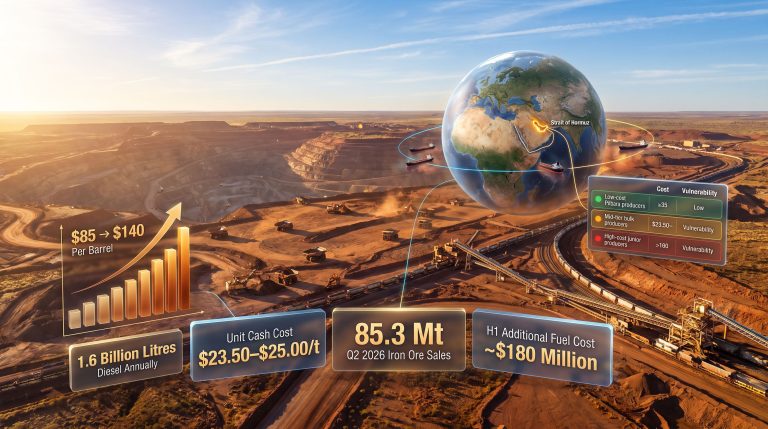
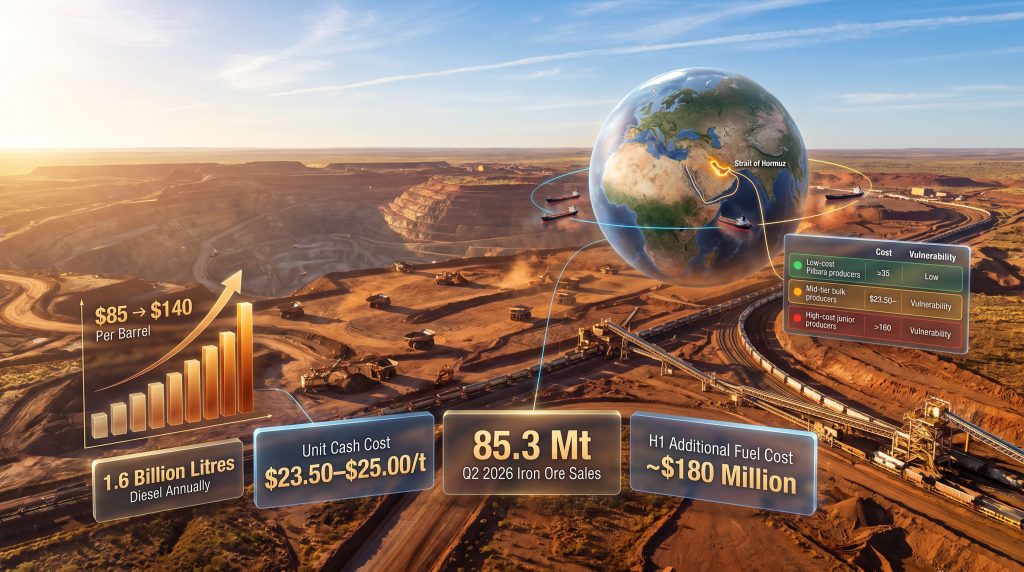
Since late 2025, conflict involving US and Israeli military engagement with Iran has introduced persistent uncertainty into Middle Eastern energy markets. Monitoring crude oil price trends reveals that diesel prices escalated from approximately $85 per barrel to around $140 per barrel within a six-month window. For most industries, this represents an inconvenience. For Rio Tinto's Pilbara iron ore operations, it represents a material cost event.
Rio Tinto consumes approximately 1.6 billion litres of diesel annually, with the substantial majority of that volume concentrated across its Western Australian iron ore infrastructure. Haul trucks operating in open-pit mining environments are among the most fuel-intensive pieces of machinery in industrial use. A fully loaded 400-tonne class haul truck can consume more than 130 litres per hour under full operating conditions, and Pilbara operations run these fleets continuously across multiple pits and shifts.
The financial consequence of the 2026 diesel price surge has been quantified by the company itself. Elevated fuel costs added approximately $180 million to production expenses during the first half of 2026, lifting Pilbara unit cash costs by roughly 80 cents per tonne. At production volumes exceeding 300 million tonnes annually, even fractional per-tonne cost movements carry significant aggregate weight.
A useful sensitivity benchmark: for every $10 per barrel move in diesel prices, Pilbara unit cash costs shift by approximately 15 cents per tonne. At Rio's scale, that seemingly modest figure translates to tens of millions of dollars across a full production year.
How Significant Is the Strait of Hormuz Risk to Global Mining Supply Chains?
The Strait of Hormuz is one of the most strategically consequential maritime passages on earth. At its narrowest point, the strait is approximately 33 kilometres wide, yet it carries an estimated 20% of global oil trade and a substantial proportion of liquefied natural gas from Gulf producers. Any credible threat to shipping through this corridor sends energy markets into risk-premium mode almost immediately.
For bulk commodity producers like Rio Tinto, a Hormuz disruption scenario creates multiple simultaneous cost pressures:
- Diesel prices spike as global oil supply tightens.
- War-risk insurance premiums for vessels transiting adjacent waters rise sharply.
- Shipping companies reroute around the Cape of Good Hope, adding approximately 9,000 kilometres and up to 10 additional days of transit time per voyage.
- Freight rates across all bulk cargo categories rise in sympathy with increased utilisation of alternative route capacity.
Rio Tinto has confirmed it is actively monitoring the Hormuz situation and maintaining contingency plans for further disruption. The company reported no material production interruptions or supply chain failures during the first half of 2026, but its public acknowledgment of limited second-half visibility is significant. It signals that planning assumptions for H2 cannot be anchored to historical baselines.
One underappreciated aspect of this risk is the way war-risk insurance premiums cascade through supply chain costs. When insurers increase premiums for vessels operating in or near conflict zones, those costs are typically passed through to cargo owners via freight rate adjustments. Commodity producers shipping large volumes absorb these adjustments at scale.
Rio Tinto's Q2 2026 Operational Performance: A Statistical Breakdown
Against this challenging backdrop, Rio Tinto's iron ore operational numbers were broadly encouraging. The company's ability to deliver strong volume outcomes while managing cost headwinds illustrates the competitive advantage that genuine scale provides.
| Metric | Q2 2026 Result | Consensus Estimate | Year-on-Year Change |
|---|---|---|---|
| Pilbara Iron Ore Sales (Q2) | 85.3 Mt | 83.6 Mt | +6.8% vs Q2 2025 (79.9 Mt) |
| First-Half Iron Ore Sales | 157.7 Mt | Not available | +5% vs H1 2025 |
| Full-Year Guidance Range | 323-338 Mt | Not available | Unchanged |
| Pilbara Unit Cash Cost Guidance | $23.50-$25.00/t | Not available | Maintained |
| H1 Additional Fuel Cost Burden | ~$180 million | Not available | New pressure in 2026 |
| Per-Tonne Diesel Cost Lift | 80c/t | Not available | Driven by diesel surge |
The Q2 iron ore sales figure of 85.3 million tonnes exceeded consensus expectations by approximately 1.7 million tonnes and represented a year-on-year increase of nearly 7% from the 79.9 million tonnes recorded in Q2 2025. Furthermore, first-half total sales of 157.7 million tonnes placed the company approximately 5% ahead of the same period the previous year.
However, the arithmetic for the second half reveals the challenge ahead. With a full-year guidance range of 323 to 338 million tonnes, Rio needs to deliver between 165 and 180 million tonnes across H2 2026. That requirement sits at the upper end of historical production rates and will demand operational consistency at a time when cost headwinds remain elevated. Share markets responded positively to the Q2 update, with the stock gaining as much as 2.8% to reach a one-week high, outperforming a broader mining index that itself rose close to 2% on the day.
Copper Operations Under Pressure: A Separate Set of Challenges
While iron ore delivered a volume beat, Rio Tinto's copper division presented a more complicated picture. Quarterly copper output fell approximately 7% to 213,000 tonnes, missing analyst forecasts and creating a distinct narrative for the base metals segment.
The production shortfall was driven by weaker performance at two flagship copper assets:
- Kennecott in Utah, where operational factors constrained output during the quarter.
- Escondida in Chile, where Rio holds a minority interest alongside BHP as operator, and where grade and throughput variability introduced production volatility.
Escondida is worth examining in more detail from a geological perspective. The deposit contains some of the most structurally complex ore zones of any porphyry copper system in the world, with significant grade variability between mining phases. As operations progress deeper into transitional and primary sulphide zones, recovery rates and processing costs can shift materially quarter to quarter. This geological reality means production forecasting at Escondida carries inherent uncertainty that no operational adjustment can fully eliminate.
Partially offsetting the copper volume miss, Rio revised its 2026 copper unit cost forecast downward, citing higher gold prices and productivity improvements. This is a meaningful counterbalance. Many large copper porphyry deposits contain gold as a significant byproduct, and elevated gold prices effectively reduce the net cost of copper production by increasing byproduct credit revenues. With gold prices remaining strong in 2026, this byproduct dynamic has become increasingly material to copper cost calculations.
The Aluminum Dimension: How Gulf Smelter Disruptions Are Reshaping Supply Dynamics
The conflict's impact on Rio Tinto extends beyond fuel costs into its aluminum business, though through a different mechanism. Gulf-region aluminum smelting capacity has faced curtailment pressures arising from conflict-related infrastructure stress and energy supply disruptions. Aluminum smelting is extraordinarily energy-intensive, requiring approximately 15 megawatt-hours of electricity per tonne of primary aluminum produced, and Gulf smelters rely heavily on domestic gas supplies that have been affected by regional instability.
The knock-on effect has been a meaningful tightening of global aluminum supply. Prices have risen more than 10% since late February 2026, and analyst consensus has shifted toward projecting a global aluminum deficit for the full year. This creates a dual dynamic for Rio Tinto as both a producer benefiting from higher prices and a participant in a market where contractual pricing has become deeply uncertain.
That uncertainty became visible when Rio suspended pricing negotiations with Japanese customers over Q2 aluminum supply premiums, withdrawing a $250 per tonne offer rather than locking in terms under conditions it regarded as too volatile to price accurately. This decision, while commercially prudent, signals the degree to which downstream buyers and producers alike are struggling to establish stable reference points in a disrupted supply environment.
When a major producer withdraws a premium offer rather than risk locking in below-market terms, it typically signals that the producer believes prices have further upside. That behaviour, in isolation, is a constructive signal for the aluminum market outlook.
The next major ASX story will hit our subscribers first
How Does Rio Tinto's Cost Position Compare Against the Broader Iron Ore Cost Curve?
One of the most important analytical frames for evaluating Rio Tinto's situation is where it sits on the global iron ore cost curve relative to other producers. Understanding iron ore price trends is essential context here, as cost curves in commodities are not static documents — they shift as input costs, exchange rates, and infrastructure conditions change.
| Cost Curve Position | Diesel Exposure Profile | Relative Vulnerability |
|---|---|---|
| Low-cost Pilbara producers (Rio Tinto, BHP) | High volume, scale leverage, infrastructure advantages | Moderate. Partially offset by efficiency and supply chain scale |
| Mid-tier bulk producers | Moderate volume, limited hedging capacity | High. Direct margin compression at current diesel levels |
| High-cost junior producers | Low volume, no scale buffer | Severe. Potential for operations to become uneconomic |
Rio Tinto's position at the lower end of the global iron ore cost curve provides a meaningful buffer. Even with the 80 cents per tonne fuel cost addition, the company's unit cash cost guidance of $23.50 to $25.00 per tonne remains significantly below the marginal cost of production for a large share of the global iron ore supply base. This cost advantage is reinforced by the company's proprietary rail infrastructure across the Pilbara, its multiple port facilities at Dampier and Cape Lambert, and its long-term contractual relationships with Chinese steel mills. The broader China steel and iron ore market dynamics consequently play a significant role in underpinning demand stability for Rio's output.
Mid-tier and high-cost producers face a structurally different challenge. With thinner margins and less ability to absorb sustained fuel cost increases, some of these operators may face genuine viability questions if diesel prices remain elevated through the second half of 2026.
What Are the Scenarios That Could Worsen or Improve Rio Tinto's Cost Outlook?
Forward visibility remains limited. Rio Tinto's own assessment acknowledges this openly, and it is appropriate for investors to model a range of outcomes rather than anchoring to a single base case.
Scenario A: De-escalation and Diesel Price Normalisation
- Diesel retreats toward the $95-$100 per barrel range as geopolitical risk premiums ease.
- Per-tonne cost pressure reduces by approximately 60-70 cents relative to current H1 levels.
- Full-year unit cost guidance is maintained comfortably within the $23.50-$25.00 per tonne range.
- Aluminum premium negotiations with Japanese clients resume on more predictable terms.
Scenario B: Sustained Conflict With Stable Hormuz Access
- Diesel remains elevated in the $130-$145 per barrel range through year-end.
- Full-year additional fuel cost burden approaches $350-$400 million.
- Guidance maintained but lower-end margin compression increasingly likely.
- Copper unit cost reductions via gold byproduct credits provide partial mitigation.
Scenario C: Hormuz Disruption or Closure Event
- Diesel prices spike beyond $160 per barrel, triggering emergency logistics rerouting.
- Potential for guidance revision, force majeure considerations across shipping contracts.
- Cascading effects across global freight, insurance, and energy-intensive manufacturing.
- Secondary aluminum supply shock amplifies already-tight global market conditions.
Scenario C is not Rio Tinto's base case, but the company's explicit acknowledgment that it cannot be excluded from planning frameworks is notable. Risk managers at major mining companies rarely highlight tail scenarios in public communications without purpose.
How Do Geopolitical Energy Shocks Historically Affect Major Mining Company Margins?
Historical precedent offers useful context. The 1973 Arab oil embargo caused a quadrupling of global oil prices within months, forcing mining operations across multiple continents to absorb cost increases that had not been factored into any planning model. The 1990 Gulf War triggered another sharp spike, though shorter in duration due to swift military resolution. The 2022 Russian invasion of Ukraine sent European energy markets into crisis and lifted diesel prices for mining operations across Africa, Australia, and the Americas, materially compressing H1 2022 margins for many operators.
Each of these episodes carried a consistent lesson: modern large-scale mining is significantly more energy-intensive than its historical counterparts. Ore grades at major operations have declined structurally over decades, meaning more rock must be moved per tonne of recoverable metal. Lower grades require more drilling, more blasting, more haulage, and more processing energy. This grade dilution effect means the energy cost per unit of production has been rising steadily even before geopolitical shocks are layered on top.
This structural trend has accelerated interest in alternative energy infrastructure for mining sites. Indeed, renewable energy in mining has gained significant traction, encompassing hydrogen fuel cell trials for haul trucks and battery-electric vehicle programmes for underground operations. Rio Tinto has active programmes in several of these areas, including trials of autonomous battery-electric haul trucks in its Pilbara operations. However, these technologies remain in early-stage deployment and will not meaningfully reduce diesel dependency within the current planning horizon.
The broader push toward mining electrification and decarbonisation is consequently being accelerated by precisely the kind of geopolitical fuel shock currently unfolding. Every quarter that diesel costs run above historical averages strengthens the internal rate of return calculation for alternative energy infrastructure at mine sites.
Frequently Asked Questions: Middle East Tensions and Rio Tinto's Cost Structure
How much have Middle East tensions added to Rio Tinto's costs in 2026?
Elevated diesel prices linked to the US-Israeli conflict with Iran added approximately $180 million to Rio Tinto's production costs in the first half of 2026, lifting Pilbara iron ore unit costs by approximately 80 cents per tonne. Mideast tensions push up Rio Tinto costs in ways that compound across the full scale of annual production.
Has Rio Tinto changed its full-year production guidance?
As of its Q2 2026 operational update, Rio Tinto maintained its full-year Pilbara iron ore guidance of 323 to 338 million tonnes and kept its unit cash cost outlook at $23.50 to $25.00 per tonne unchanged, despite the fuel cost headwinds.
What is the Strait of Hormuz and why does it matter to Rio Tinto?
The Strait of Hormuz is a critical maritime chokepoint through which approximately 20% of global oil trade transits. Any disruption to passage through this strait would tighten global energy supply, potentially driving diesel prices significantly higher and compounding Rio Tinto's already elevated fuel cost burden.
How sensitive is Rio Tinto's cost structure to diesel price movements?
Based on Rio Tinto's annual diesel consumption of approximately 1.6 billion litres, a $10 per barrel change in diesel prices equates to roughly 15 cents per tonne in Pilbara unit cash costs. This sensitivity becomes highly material at production volumes exceeding 300 million tonnes annually.
Why did Rio Tinto's copper production fall in Q2 2026?
Quarterly copper output declined approximately 7% to 213,000 tonnes, primarily due to weaker production performance at the Kennecott and Escondida operations. Rio partially offset this through a revised copper unit cost forecast supported by higher gold prices and productivity improvements.
What is happening with Rio Tinto's aluminum business?
Rio Tinto suspended pricing negotiations with Japanese clients over Q2 aluminum supply premiums, withdrawing a $250 per tonne offer amid market uncertainty. Conflict-related damage to Gulf smelting capacity has contributed to aluminum prices rising over 10% since late February 2026, with analysts now projecting a potential global aluminum deficit for the year.
Key Takeaways: What the Rio Tinto Cost Story Signals for the Broader Mining Sector
The situation in 2026 is not an isolated corporate story. It is an early-stage case study in how geopolitical energy shocks translate into first-order cost events for bulk commodity producers operating at massive scale. The fact that mideast tensions push up Rio Tinto costs so directly underscores a structural vulnerability that affects the broader industry. The specific numbers may be unique to Rio Tinto, but the underlying mechanism is universal.
Several structural conclusions emerge from this analysis:
- Diesel dependency is a growing liability. As ore grades decline globally and more material must be moved per unit of production, energy costs per tonne of output will rise even in stable price environments. Any geopolitical shock amplifies this trend sharply.
- Scale provides a buffer, not immunity. Rio Tinto's cost curve position protects margins more effectively than any mid-tier producer could achieve, but $180 million in additional costs across half a year is not immaterial at any scale.
- Byproduct economics are becoming strategic. The copper division's ability to reduce unit cost guidance through gold byproduct credits illustrates how multi-metal operations carry structural advantages that single-commodity producers do not.
- The energy transition investment case is being made in real time. Every quarter that diesel costs run above historical averages, the internal rate of return calculation for renewable energy and hydrogen infrastructure at mine sites improves. Geopolitical disruption is accelerating decarbonisation decisions that economics alone might have delayed.
For investors evaluating mining sector exposure, the Rio Tinto cost narrative reinforces the importance of understanding energy input intensity as a fundamental screening criterion. Companies with lower diesel consumption per tonne of production, stronger scale economics, and more diversified commodity portfolios will consistently demonstrate greater resilience when geopolitical fuel shocks arrive. Based on the current trajectory of Middle Eastern tensions, the probability that such shocks will remain a recurring feature of the investment landscape appears higher today than at any point in the past decade.
This article contains forward-looking analysis and scenario modelling based on publicly available information. It does not constitute financial advice. Investors should conduct their own due diligence before making any investment decisions.
Want to Identify the Next Major ASX Mineral Discovery Before the Broader Market?
Discovery Alert's proprietary Discovery IQ model delivers real-time alerts on significant ASX mineral discoveries, transforming complex commodity data across more than 30 resources into clear, actionable insights for both short-term traders and long-term investors — start your 14-day free trial today and explore how historic discoveries have generated extraordinary returns for those who moved early.