
August 8, 2026
Sovereign Gold in Crisis: What Russia's Reserve Liquidation Reveals About War, Sanctions, and Monetary Survival
For much of the past two decades, the relationship between sovereign wealth and physical gold followed a clear directional logic: accumulate, protect, and diversify away from dollar dependency. Central banks across the emerging world treated gold not as a relic but as a geopolitical shield. Russia was perhaps the most disciplined practitioner of this philosophy, systematically building its reserves through commodity windfalls and institutional conviction. That era is now in visible retreat.
The Russian central bank sells gold at scale in 2026, and this is not a routine portfolio adjustment. It is a structural signal, one that reveals the degree to which sustained military expenditure, sanctions-induced revenue compression, and domestic monetary pressure have converged into a fiscal emergency requiring the monetisation of the nation's most prized non-energy asset.
When big ASX news breaks, our subscribers know first
From Accumulator to Seller: Russia's Two-Decade Gold Strategy in Reverse
Between roughly 2000 and 2022, Russia's central bank pursued one of the most aggressive sovereign gold accumulation programmes ever recorded. Over this period, the Bank of Russia increased its gold holdings from under 400 metric tonnes to a peak exceeding 2,300 metric tonnes, at one point ranking among the top five sovereign gold holders globally. The strategy was deliberate: reduce exposure to US dollar-denominated assets, particularly after the 2014 Crimea-related sanctions previewed the financial weaponisation risk that would fully materialise in 2022.
What distinguished Russia's approach from other central banks was the degree to which domestic gold production fed directly into sovereign reserves. Russia is one of the world's largest gold-producing nations, and for years the central bank absorbed a significant share of domestically mined output, bypassing international markets entirely. This created a largely self-contained accumulation loop that insulated the programme from external price volatility.
The full-scale invasion of Ukraine in February 2022 broke that model irreversibly. Western sanctions froze a substantial portion of Russia's foreign exchange reserves held abroad and severed its access to international financial infrastructure. Gold, paradoxically, became both more valuable as an asset class and more difficult to deploy as a liquid instrument.
Russia's Gold Reserve Position: The Numbers Behind the Shift
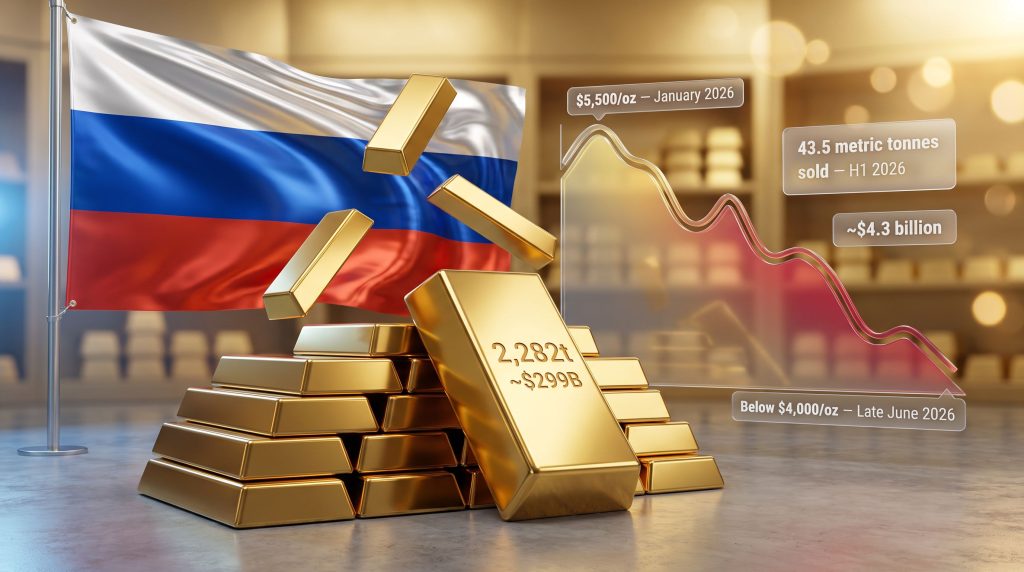
As of July 1, 2026, Russia's gold reserves stood at approximately 73.4 million troy ounces, equivalent to 2,282 metric tonnes. The total estimated market value of these holdings stood at roughly $299 billion. While substantial in absolute terms, these figures reflect a meaningful drawdown from prior peak levels.
| Metric | Value |
|---|---|
| Total Gold Reserves (July 1, 2026) | 73.4 million troy ounces / 2,282 metric tonnes |
| Estimated Market Value | ~$299 billion |
| Gold Sold in H1 2026 | ~1.4 million troy ounces / 43.5 metric tonnes |
| Gold Sold in First 4 Months of 2026 | ~900,000 oz / 27.9 metric tonnes |
| Sharpest Single-Month Drop | ~200,000 oz / 5.7 metric tonnes (April 2026) |
| Estimated Revenue Generated (Early 2026 Sales) | ~$4.3 billion |
The pace of sales accelerated through the first half of 2026. Approximately 900,000 troy ounces were sold across the first four months alone, with April recording the steepest single-month reduction of around 200,000 troy ounces. The total first-half liquidation of 43.5 metric tonnes generated an estimated $4.3 billion in proceeds, though the revenue per ounce varied significantly depending on when individual transactions were executed.
It is worth noting that this central bank programme did not emerge in isolation. Prior to the Bank of Russia's direct market sales, which began in November 2025, Russia's National Wealth Fund had already divested approximately 232.6 metric tonnes of gold, representing close to 57% of its gold allocation, to address earlier fiscal shortfalls. The central bank's current programme represents a deepening of this same liquidation impulse, now reaching into the core monetary reserve stack.
Three Structural Forces Driving the Russian Central Bank to Sell Gold
Understanding why the Russian central bank sells gold at this scale requires examining the confluence of pressures bearing on the country's fiscal architecture simultaneously.
1. Chronic Budget Deficits Driven by Military Spending
Russia's federal budget deficit reached 4.6 trillion rubles by the end of March 2026, a shortfall reflecting years of sustained defence expenditure operating well above peacetime norms. Military spending as a proportion of GDP has climbed sharply since 2022, consuming fiscal space that would otherwise support social programmes, infrastructure investment, and reserve accumulation. With no near-term political pathway to reducing this expenditure, gold has become a pressure valve.
2. Declining Hydrocarbon Export Revenues
Russia's economy historically ran on a straightforward equation: oil and gas revenues funded the state. However, Western sanctions, energy market realignment, and the OPEC+ dynamics of the mid-2020s have materially disrupted this equation. Price caps on Russian crude, restrictions on shipping insurance, and the gradual displacement of Russian energy from European markets have collectively compressed the foreign currency inflows Moscow previously relied upon to finance its deficit.
3. Ruble Stability and the Yuan Conversion Mechanism
Perhaps the least-discussed driver is the domestic monetary dimension. Gold-to-currency conversion, particularly into Chinese yuan, has become a primary tool for managing ruble stability. As Russia's trade architecture has reoriented toward China and other non-Western partners, the yuan has become functionally important to domestic liquidity management. Exchanging sovereign gold for yuan-denominated assets serves a dual purpose: it generates spendable reserves and reinforces the bilateral financial relationship with Beijing.
The Sanctions Constraint: Why Russia Cannot Simply Sell Gold Internationally
One of the most structurally significant aspects of this situation is that Western sanctions have effectively blocked the Bank of Russia from accessing international bullion markets. Under normal conditions, a sovereign holder of this scale could execute gold sales through London's over-the-counter market, Swiss refining intermediaries, or major commodity exchanges. These channels remain closed.
Instead, the gold being liquidated flows primarily through domestic Russian banking channels, both via formal exchange mechanisms and bilateral over-the-counter transactions between the central bank and domestic financial institutions. Market commentary from Freedom Global has indicated that Russian banks, operating within the domestic financial system, are the primary absorbers of this metal.
This structural constraint creates a fundamentally different liquidation dynamic than a typical central bank gold sale. Rather than dispersing metal into the global supply chain, Russia's sales are largely contained within a domestic market that has limited capacity to re-export or arbitrage the metal internationally given existing restrictions.
The question of whether Russia could route gold through third-party markets, such as the UAE, Turkey, or certain Southeast Asian intermediaries, remains open. Historical precedent suggests that sanctioned commodity flows do find alternative channels over time. Furthermore, the scale involved, potentially 115 to 230 metric tonnes annually based on analyst projections, would be difficult to obscure at the levels suggested by forecast models.
The Price Window: Does Gold's Historic Volatility Create a Monetisation Dilemma?
The timing of Russia's gold sales intersected with one of the most volatile periods in the metal's modern history.
| Period | Gold Price Level | Strategic Significance |
|---|---|---|
| January 2026 | Exceeded $5,500/oz (record high) | Maximum per-ounce monetisation value |
| Late June 2026 | Below $4,000/oz | Materially reduced revenue per ounce |
| July 2026 (spot) | Holding above $4,000/oz | Continued but diminished sale value |
January 2026 sales, estimated to represent a single tranche of approximately $1.41 billion to $1.68 billion, captured maximum value from the record price environment. However, as gold retreated from its historic highs, the per-ounce revenue generated by ongoing sales declined substantially. A $1,500 per ounce decline from peak to mid-year levels represents a significant reduction in the fiscal benefit of each tonne sold.
This creates a strategic tension that sovereign wealth managers rarely face in such compressed timeframes. Selling too slowly risks missing peak price windows; selling too aggressively depletes a finite strategic asset at depressed values. With Russia's fiscal pressures showing no signs of abating, the calculus has clearly favoured liquidity over price optimisation.
The next major ASX story will hit our subscribers first
How Russia's Position Compares to Global Central Bank Behaviour
For more than a decade following the 2008 financial crisis, central bank gold reserves shifted from net selling to net buying globally. Emerging market central banks in particular, including China, India, Turkey, and several Central Asian nations, drove this accumulation wave as a hedge against dollar system dependency and geopolitical risk. According to recent data, central bank gold holdings are at a 50-year high, underscoring just how dramatic Russia's reversal appears in context.
Russia's pivot to net selling represents one of the most significant reversals of this broader trend among major reserve holders. It also serves as an empirical stress test for the de-dollarisation thesis that Russia itself championed. Furthermore, while gold remains a meaningful store of value, its utility as a strategic reserve asset is constrained when the holder faces both sanctions-imposed market access restrictions and acute domestic liquidity needs simultaneously.
Sovereign wealth managers and commodity analysts are monitoring Russia's reserve trajectory closely. The trajectory of depletion, the channels through which gold is being monetised, and the pace at which sales are accelerating or decelerating all function as real-time indicators of Russia's underlying fiscal health and the sustainability of its current strategic posture. In addition, central bank gold buying trends among other nations provide a useful counterpoint to Russia's current behaviour.
Projected Scale and the Strategic Depletion Threshold
Forward estimates from market analysts suggest the following liquidation trajectory:
| Projection Period | Estimated Volume | Estimated Value |
|---|---|---|
| Full Year 2025 (analyst estimate) | Up to 230 metric tonnes | ~$30 billion |
| Full Year 2026 (analyst estimate) | Up to 115 metric tonnes | ~$15 billion |
| H1 2026 (confirmed) | 43.5 metric tonnes | Within ~$299B total reserve |
Note: Analyst projections involve significant uncertainty and should not be treated as confirmed forecasts. Actual volumes will depend on gold price movements, fiscal conditions, and geopolitical developments.
A critical but under-examined question is at what reserve level continued gold sales begin to carry their own strategic cost. Sovereign gold reserves serve multiple functions beyond their market value: they underpin currency credibility, provide collateral for bilateral financing arrangements, and signal financial sovereignty.
Depleting reserves past a certain threshold, whether measured in absolute tonnes or as a percentage of total foreign reserves, risks triggering confidence effects in domestic currency markets. Consequently, this complicates Russia's ability to use gold as collateral in future non-Western financial arrangements. The role of gold in the monetary system more broadly suggests that reserve depletion of this kind carries consequences well beyond immediate fiscal relief.
Analysts have also noted that central banks influencing gold prices through large-scale buying or selling can ripple through global markets, even when transactions are conducted domestically. Reports from sources tracking Russia's gold sales confirm that April 2026 alone saw one of the sharpest single-month drops in reserves on record, reinforcing the urgency of the country's fiscal position.
Frequently Asked Questions: Russia's Central Bank Gold Sales
Why is the Russian central bank selling gold?
The primary drivers are a widening federal budget deficit, reduced hydrocarbon export revenues due to sanctions and market shifts, and the need to support ruble stability through conversion into usable currency, particularly Chinese yuan.
How much gold has Russia sold in 2026?
Approximately 43.5 metric tonnes (1.4 million troy ounces) were sold across the first half of 2026, generating an estimated $4.3 billion in revenue.
Can Russia sell its gold on international markets?
Western sanctions have blocked access to major international bullion markets, including London and key Western exchange platforms. Sales are being conducted domestically through Russian banks.
What happens to the gold Russia sells domestically?
The metal flows to Russian commercial banks through exchange and over-the-counter mechanisms. Its ultimate destination, whether held domestically, processed, or eventually re-exported through non-sanctioned channels, remains a subject of ongoing market analysis.
How does Russia's gold selling affect global gold prices?
Because sales are confined to the domestic Russian market rather than entering the global supply chain, the direct price impact is limited. However, the market monitors Russia's reserve trajectory as a broader sentiment indicator.
When did Russia first start selling central bank gold reserves?
The Bank of Russia's direct domestic gold sales programme began in November 2025, marking the first such central bank-level liquidation in approximately 25 years.
How much is Russia's remaining gold reserve worth?
As of July 1, 2026, Russia's gold holdings were valued at approximately $299 billion, though this figure fluctuates with the gold spot price.
Key Takeaways
-
Russia has transitioned from one of the world's most aggressive sovereign gold accumulators to an active seller, driven by war-related fiscal pressure rather than monetary policy preference
-
Sanctions have confined gold monetisation to domestic banking channels, creating a structurally constrained liquidation pathway that limits both price discovery and global supply impact
-
Record gold prices in early 2026 provided a temporary revenue windfall, but the price decline to sub-$4,000 levels by mid-year materially reduced the per-ounce value of ongoing sales
-
Projected annual sales of 115 to 230 metric tonnes represent a meaningful shift in Russia's reserve composition, even if the metal remains within the domestic financial system
-
The depletion trajectory carries its own strategic risk: beyond a certain threshold, reserve drawdowns can undermine currency credibility and constrain Russia's future use of gold as collateral in non-Western financial arrangements
-
Russia's situation functions as a live case study in the limits of gold as a geopolitical shield when combined sanctions exposure and acute fiscal pressure converge simultaneously
Want to Track the Next Major Mineral Discovery Before the Market Does?
While sovereign gold reserves make headlines, the real wealth-building opportunities often lie in the ground floor of significant new mineral discoveries — and Discovery Alert's proprietary Discovery IQ model scans ASX announcements in real time to deliver those opportunities directly to subscribers. Explore historic discoveries and their exceptional returns on Discovery Alert's dedicated discoveries page, then begin your 14-day free trial to position yourself ahead of the broader market.